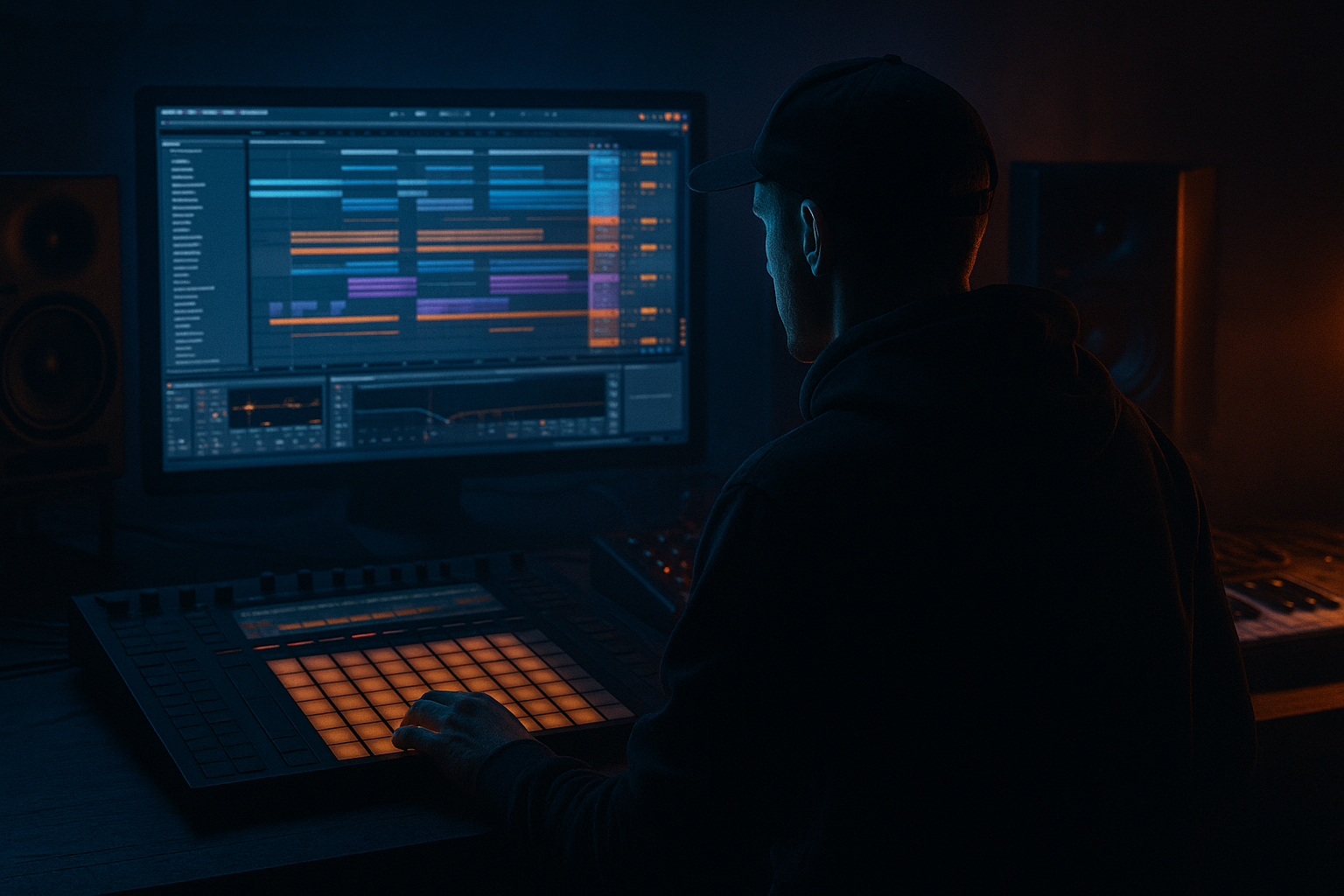
Main tutorial
Dub Chamber Sends From Scratch for DJ‑Friendly Sets (Ableton Live, Advanced DnB FX) 🔊🌫️
1) Lesson overview
“Dub chambers” are send/return FX that behave like a physical space and an instrument: you feed them with hits, automate the send, and the chamber spits back spacious, rhythmic, characterful tails. In drum & bass, this is gold for transitions, DJ-friendly outros/ins, drop impact, and dubby call‑and‑response without washing out your mix.
In this lesson you’ll build a modular dub chamber return using mostly Ableton stock devices, tuned specifically for rolling DnB/jungle tempos (170–176 BPM) and DJ-friendly arrangement control.
---
2) What you will build
You’ll create two returns and a simple control workflow:
Return A — “Dub Chamber (Clean → Dark)” 🌑
- Tempo‑aware delay feeding a tight reverb “room”
- Filters + saturation for dub tone
- Sidechain ducking so the chamber breathes with the drums
- A “DJ macro” approach: one knob (or automation lane) can push a sound into space without wrecking the drop
- More aggressive, distorted chamber for stabs, fills, snare throws
- Built to cut through a heavy mix and sound intentional
- Pre/Post send strategy for DJ sections
- Arrangement ideas (8/16 bar DJ intros/outros, throw moments, transition fog)
- Gain staging rules so returns don’t clip or blur your low end
- Utility
- EQ Eight
- Echo
- Saturator
- Hybrid Reverb
- Compressor
- Auto Filter
- HP @ 220–300 Hz (24 dB/oct)
- Optional: small boost 1–2 dB @ 1.5–3 kHz to help throws read on big rigs.
- Time: 1/16 or 1/8
- Feedback: 50–70%
- Character: Noise low, Wobble subtle (if you like movement)
- Filter: darker than Return A (HC ~ 3–6 kHz)
- Roar (stock in newer Live versions)
- If no Roar: use Saturator + Pedal (Overdrive) lightly.
- Decay: 0.6–1.2 s
- Pre-delay: 0–10 ms
- Damp: darker
- Goal: a “thwack” of space, not a long tail.
- Limiter
- Automate Send A or Send B on specific hits:
- Automate Echo Feedback on the return for that moment:
- Automate Return A Auto Filter cutoff down during breakdown for smoky dub.
- Start with hats/percs + a stab.
- Use Return A subtly on stabs (send around -18 to -12 dB).
- Every 4 bars, do a snare throw to Return B.
- Keep bass dry/controlled (little to no sends).
- In the 8 bars before drop:
- Make a 16–32 bar outro:
- Midrange discipline: Add an extra EQ Eight after reverb and notch 2–4 kHz if the chamber competes with your snare crack.
- Make space move with the groove: Use sidechain release times that match your drum swing (often 100–140 ms feels right at 174).
- Distort the return, not the source: Heavy neuro/rollers stay clean if the dirt lives in the FX return.
- Mono the lows of the return: Add Utility at end, set Bass Mono (if available) or reduce Width to 80–100% and keep lows filtered anyway.
- Breakbeat flavor: Try sending a tiny bit of amen/top loop to Return A; it creates that jungle halo without drowning the break.
- You built two DnB-focused dub chamber returns: a clean/dark chamber and a crunchy smash chamber.
- You kept the mix solid by HP filtering, gain staging, and sidechain ducking.
- You made it DJ-friendly by using pre-fader throws, controlled automation, and macro-style performance controls.
- You grounded everything in tempo-locked Echo timings (1/8D, 1/16) that sit perfectly in rolling/jungle patterns.
Return B — “Dub Smash (Crunchy Tape)” 🔥
You’ll also set up:
---
3) Step‑by‑step walkthrough
Step 0 — Session setup (DnB-friendly routing)
1. Tempo: 174 BPM (typical rolling sweet spot).
2. Groups:
- Group your drums as DRUM BUS (kicks, snares, hats, breaks).
- Bass channels grouped as BASS BUS.
- Musical elements grouped as MUSIC BUS (stabs, pads, vocals).
3. Returns: Create Return A and Return B.
4. Important: In Live’s Return tracks, keep meters visible and leave 6 dB headroom on the return faders (start them at -6 dB).
---
Step 1 — Build Return A: “Dub Chamber (Clean → Dark)”
On Return A, add devices in this order:
#### 1) Utility (Gain staging)
- Gain: -6 dB (starting point)
- Why: prevents your send FX from becoming the loudest thing in the track.
#### 2) EQ Eight (low cut + mud control)
- Filter 1: HP 24 dB/oct @ 180 Hz
- Optional bell dip: -2 to -4 dB @ 300–450 Hz, Q ~1.2
- Why: keeps sub + kick fundamentals out of the chamber. Your low end stays punchy.
#### 3) Echo (dub delay as the “engine”)
- Sync: On
- Time: 1/8 Dotted (classic DnB space)
Alternative: 1/4 for bigger throws
- Feedback: 35–55% (automate later)
- Filter:
- Low Cut: 250–400 Hz
- High Cut: 4.5–8 kHz
- Modulation: 10–20% (subtle movement)
- Stereo: 110–140% (wider but not phasey)
- Dry/Wet: 100% (because it’s a return)
DnB tip: 1/8D throws on snare fills feel fast but still readable at 174.
#### 4) Saturator (soft grime)
- Mode: Soft Sine or Analog Clip
- Drive: 2–6 dB
- Soft Clip: On
- Output: reduce to match input (aim for similar loudness)
- Why: makes the repeats “talk” and stay audible in dense mixes.
#### 5) Hybrid Reverb (the “chamber” part)
- Algorithm: Room or Chamber
- Decay: 1.0–1.8 s (DnB-friendly; not ambient wash)
- Pre-Delay: 10–25 ms
- Size: 30–50%
- Damp: increase until the top end isn’t fizzy
- Dry/Wet: 100%
Workflow idea: Delay first, reverb second = repeats smear into a cohesive space. Very dub.
#### 6) Compressor (sidechain ducking from kick/snare)
- Sidechain: On
- Audio From: DRUM BUS (or just kick + snare bus if you have it)
- Ratio: 4:1
- Attack: 2–10 ms
- Release: 80–160 ms (tune to groove)
- Threshold: set for 3–6 dB gain reduction on drum hits
- Why: the chamber dips when drums hit → clean drop, big atmosphere between hits.
#### 7) Auto Filter (performable “darken” control)
- Type: LP 12 dB
- Frequency: mapped later (start ~8–12 kHz)
- Resonance: 5–15%
- Why: a single filter sweep can shift from bright chamber to smoky dub.
✅ Return A is now your “space that behaves” return.
---
Step 2 — Build Return B: “Dub Smash (Crunchy Tape)”
Return B is for stabs, vocal chops, snare bombs, and transition chaos.
Device chain:
#### 1) EQ Eight (aggressive cut)
#### 2) Echo (shorter + more feedback)
#### 3) Roar (or Saturator if you want simpler)
- Choose a tape/drive style
- Drive: tasteful but obvious (aim for “edge,” not total crush)
- Tone: tilt darker if cymbals get spicy
#### 4) Hybrid Reverb (short but dense)
#### 5) Limiter (safety)
- Ceiling: -1 dB
- Just catching peaks so the return doesn’t blast when you crank a send.
✅ Return B is your “impact throw” return.
---
Step 3 — Set DJ-friendly send behavior (Pre/Post strategy)
This part is huge for sets.
1. On channels you’ll throw (snare, percussion, stabs, vox), decide send mode:
- Post-fader (default): when you mute or fade the source, the send follows. Good for normal mixing.
- Pre-fader: the send continues even if you pull the channel down—perfect for DJ-style “ghost throws” into breakdowns/outros.
2. In Ableton, enable Pre/Post switches (in the Return section).
- Use Pre-fader on at least one key throw source (often a snare fill channel or stab channel).
Example: Pre-fader snare → crank send at the end of 16 bars → pull snare fader down → the chamber tail continues into your transition. Clean and intentional 🎚️
---
Step 4 — Create “throw” workflows (the DnB way)
You don’t want constant reverb. You want moments.
#### Workflow A: Clip/automation throws (Arrangement View)
- Snare on bar 16 → send spike to -3 to 0 dB briefly
- Immediately back to -inf after the hit
- Normally 40% → bump to 60–70% for 1 bar → back down
#### Workflow B: “Dub button” macro (Rack on the Return)
1. Group Return A devices into an Audio Effect Rack.
2. Map macros:
- Macro 1: Throw Amount (map Return A’s output Utility gain or Echo Feedback carefully)
- Macro 2: Darkness (Auto Filter cutoff)
- Macro 3: Tail Length (Hybrid Reverb decay 1.0–2.2s range)
- Macro 4: Width (Echo stereo or Utility width)
3. Now you can perform transitions with 1–2 macros, and it stays controlled.
---
Step 5 — Arrangement ideas for DJ-friendly DnB sets 🧱
Here are proven structures where dub chambers shine:
#### A) 16-bar DJ intro (minimal drums + space)
#### B) Pre-drop tension (fog without mud)
- Slowly darken Return A (filter down)
- Increase send on vocal chops slightly
- Keep sidechain ducking active so it doesn’t mask the snare.
#### C) DJ outro (space carries the energy while elements drop out)
- Pull bass out first
- Keep drums rolling
- Use pre-fader throws so echoes/reverb carry the vibe as you strip elements
- Last 4 bars: one big snare throw to Return B, then cut source → tail remains for the blend.
---
4) Common mistakes
1. Sending sub/bass to the chamber
Fix: HP filters on the return (180–300 Hz) and keep bass sends minimal.
2. Return is too loud compared to the dry mix
Fix: start Return faders at -6 dB, then raise slowly. Use Utility to trim.
3. Reverb tail fights the snare transient
Fix: sidechain the return from drums; shorten decay; increase pre-delay slightly.
4. Echo feedback runaway
Fix: automate feedback carefully; add a Limiter; keep a “panic” macro (Utility mute or gain down).
5. Everything uses the same space
Fix: choose one main chamber return and one special smash return; keep the rest dry.
---
5) Pro tips for darker/heavier DnB 🖤
---
6) Mini practice exercise (15–20 minutes) ⏱️
1. Load a basic rolling groove:
- Kick on 1
- Snare on 2 and 4 (DnB halftime feel within 174 grid)
- Hats/ghost snares for movement
- Add a stab (one-shot) every 2 bars
2. Build Return A exactly as above.
3. Do three throws:
- Bar 8 snare → Send B spike (impact)
- Bar 16 snare → Send A spike (space)
- Bar 15 stab → Send A with feedback bump for 1 bar
4. Export 32 bars and listen:
- Does the drop still punch?
- Do the throws sound intentional and tempo-locked?
- If it’s messy: shorten reverb decay and/or increase ducking.
---
7) Recap
If you tell me your sub genre (rollers, jungle, neuro, minimal, dancefloor) and your typical drum pattern (2-step vs break-led), I can suggest exact delay times, decay ranges, and a “signature” throw rhythm that matches it.

