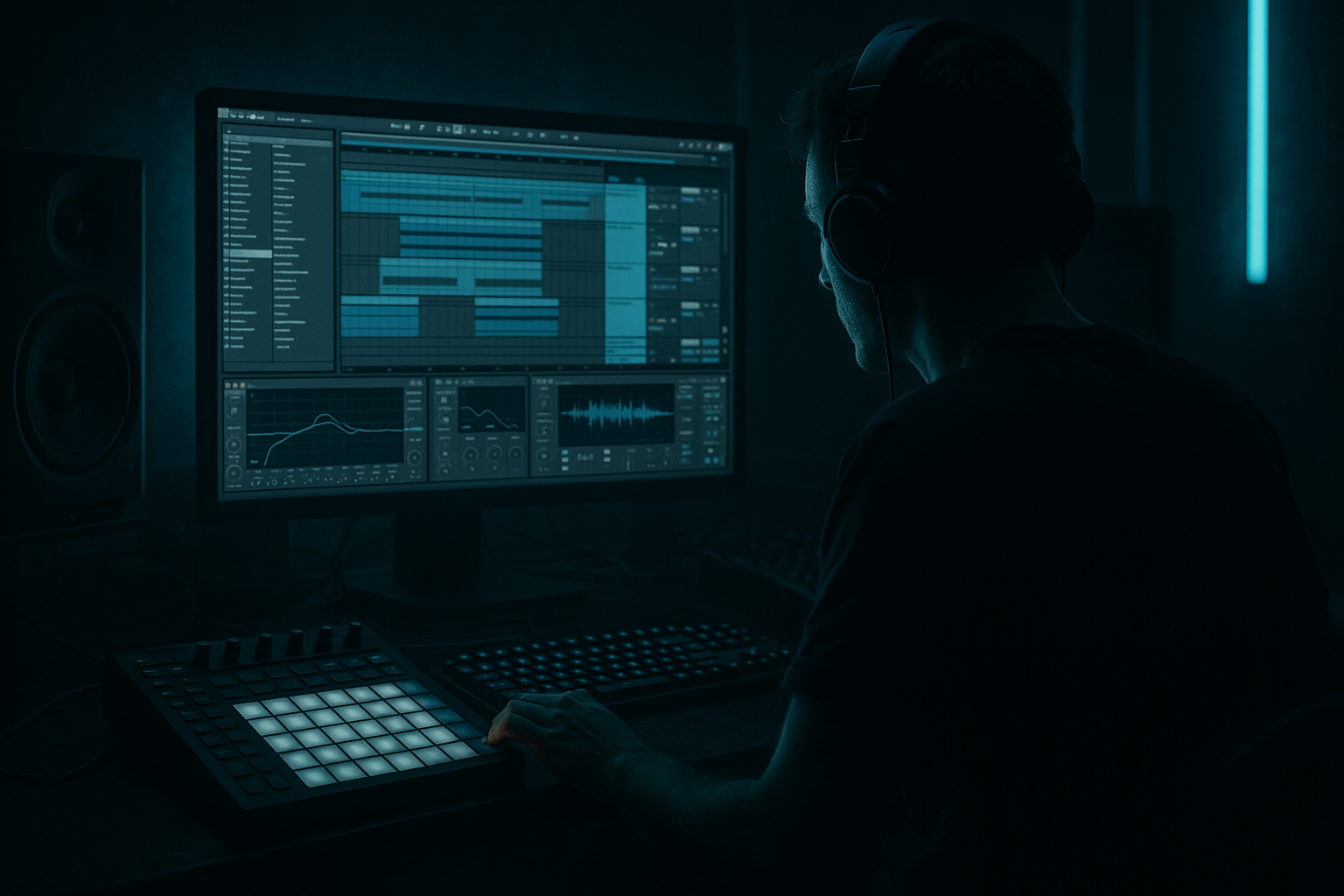
Main tutorial
Dub Chamber Sends From Scratch (Resampling Only) — Ableton Live (DnB)
1. Lesson overview
In drum & bass, “dub chambers” are those spacey, resonant, slightly dirty echo/reverb environments that make snares crack wider, fills feel psychedelic, and bass stabs speak like they’re in a concrete tunnel.
In this lesson you’ll build a send/return dub chamber in Ableton Live, but with a strict twist: you’ll only print (resample) the effect—no leaving it running live. This gives you control, CPU savings, and that classic “commit and sculpt” workflow used in heavier DnB/jungle production. 🔥
Goal: Create a dub chamber return, feed it from drums/bass stabs, resample to audio, then edit and process the printed FX as part of the arrangement.
---
2. What you will build
You’ll end up with:
- A Return Track “DUB CHAMBER” using stock devices:
- A dedicated Audio Track “PRINT DUB” that records the return via Resampling
- A workflow for:
- Arrangement tricks that feel very rolling DnB/jungle: snare throws, hat splashes, vocal chops, bass-stab echoes, and “ghost chamber” moments.
- Mode: LP24 (or BP if you want more “telephone dub”)
- Frequency: 6–10 kHz (start at ~8 kHz)
- Resonance: 10–20%
- Add a HP via Auto Filter? (Optional if you prefer one filter)
- EQ Eight
- Time: 1/8 D or 1/4
- Feedback: 35–60% (higher for more “space wash”)
- Filter:
- Modulation: 2–6% (subtle wobble)
- Stereo: 100–140% (careful—DnB needs solid mono compatibility)
- Dry/Wet: 100% (because it’s a return)
- Mode: Start with Convolution (more “real chamber”), then blend algorithmic if needed.
- Decay: 1.2–2.8s (DnB tends to prefer shorter than dub reggae—unless it’s a transition)
- Pre-delay: 10–25 ms (keeps the transient clear)
- Size/Character: choose a Chamber / Small Hall / Room IR (small-ish = tighter roll)
- EQ inside Hybrid Reverb:
- Dry/Wet: 100% (return track)
- Mode: Soft Sine or Analog Clip
- Drive: 2–6 dB (start at 3 dB)
- Output: compensate to avoid clipping
- Optional: turn on Soft Clip
- Attack: 3 ms
- Release: Auto or 0.3 s
- Ratio: 2:1
- Aim for: 1–3 dB gain reduction on peaks
- Make-up: minimal; don’t over-lift
- If your mix is getting messy:
- Optional: Bass Mono (if available) or just keep lows out earlier via EQ.
- Snare send up for the last snare before a drop
- Short hat “splash” send on the end of 4/8 bars
- Bass stab send during call-and-response gaps
- Temporarily solo:
- Record into PRINT DUB using Resampling
- Now your print is mostly chamber signal + its input
- Bar -2: increase snare send on the last hit
- Print it
- Place the printed tail in the gap before the drop
- High-pass it more as it approaches the drop (automation on EQ)
- Print a 1-bar chamber from a stab
- Place it in the empty spaces between bass notes
- Sidechain the printed audio slightly to the kick (Glue or Compressor sidechain)
- Send a break fill hard into the chamber for 1 bar
- Slice the print into 1/8 or 1/16 chunks and rearrange (glitchy, but musical)
- Sending full-range drums into the chamber → low-mid soup. High-pass your return (and often your send sources).
- Too much feedback in Echo → builds uncontrollably and masks groove. Keep feedback musical and print in short bursts.
- Over-wide returns → your snare loses punch in mono. Use Utility to rein it in.
- Never committing → you tweak endlessly. Printing forces decisions (and it’s the point of this lesson).
- Printing without headroom → saturated reverb tails can clip fast. Aim for peaks around -6 dBFS when printing.
- Make the chamber “cold”:
- Metallic tunnel vibe:
- Aggressive gating for neuro/tech rollers:
- Sidechain the printed FX to the kick and/or snare:
- Resample again:
- You built a dub chamber send/return tailored for DnB using Echo + Hybrid Reverb + tone + saturation.
- You used a resampling-only workflow: print the FX to audio, then edit and arrange it like a core musical element.
- You learned how to keep it tight, heavy, and mix-safe: filtering lows, controlling width, compressing the bloom, and using automation for throws.
- Echo (dub delay)
- Hybrid Reverb (room/chamber body)
- Filter/Auto Filter (tone shaping)
- Saturator + Glue Compressor (weight + control)
- Optional: Utility (mono/width management)
- One-shot prints (snare hit throws)
- Bar-length prints (fills + drops)
- Long tails (transition atmosphere)
---
3. Step-by-step walkthrough
A) Session prep (DnB-ready routing)
1. Set project tempo to something DnB-friendly: 172–176 BPM.
2. Group your drums if you haven’t:
- DRUMS group (Kick, Snare, Hats, Break, Perc)
3. Make sure your Return tracks are visible: `View → Returns`.
---
B) Build the Dub Chamber Return (Return A)
1. Create a return track (or use Return A) and rename it: A - DUB CHAMBER.
2. On A - DUB CHAMBER, add this device chain (top to bottom):
#### 1) Auto Filter (pre-tone control)
Purpose: Stop the chamber from eating your low-end and tame harshness before it blooms.
- If you need a hard low cut: use EQ Eight instead (see below).
Alternative (often better): EQ Eight first
- HP filter: 150–300 Hz, 24/48 dB slope
- Small dip: 2–4 kHz if the snare gets spiky
- Gentle shelf down: 10–14 kHz if the chamber hisses
#### 2) Echo (the dub engine)
Purpose: Musical repeats feeding the chamber.
- HP: 200–500 Hz
- LP: 4–8 kHz
DnB tip: 1/8D is money on snares in rollers—fast enough to groove, spacious enough to breathe.
#### 3) Hybrid Reverb (chamber body)
Purpose: Turn delay taps into a physical space.
- Low cut: 200–400 Hz
- High cut: 6–10 kHz
#### 4) Saturator (glue + grit)
Purpose: Make the chamber “speak” and sit forward without just getting louder.
#### 5) Glue Compressor (control the bloom)
Purpose: Stop the chamber tail from jumping out unpredictably.
#### 6) Utility (width discipline)
- Width: 70–100%
---
C) Send from key DnB elements (but keep it intentional)
Now feed the chamber like a dub engineer—selectively.
1. On your Snare track:
- Start Send A at -18 to -12 dB (taste)
2. On Break/Top loop:
- Send A at -24 to -15 dB (subtle vibe)
3. On a vocal chop / stab / FX hit:
- Send A can go hotter: -12 to -6 dB for big throws
4. Avoid sending sub bass (or filter it hard first). You want space, not mud.
Workflow suggestion: Automate sends for moments, not constantly:
---
D) Resampling-only printing (the “commit” workflow) 🎛️➡️🎚️
Now the key requirement: print the chamber to audio.
#### Option 1: Resampling the master (fast + universal)
1. Create a new Audio Track: rename PRINT DUB.
2. Set Audio From: Resampling
3. Arm PRINT DUB
4. Solo-safe approach:
- You can either:
- Play the full mix and record (most natural), or
- Temporarily solo the sources + return (see Option 2)
5. Hit record and capture:
- A single hit throw (1–2 bars)
- A fill section (4–8 bars)
- A long tail for transitions (8–16 bars)
Important: If you record the full mix, you’ll capture everything. That’s fine if you plan to slice the printed audio and keep only the dub bits.
#### Option 2: Record only the return (cleaner prints)
Ableton doesn’t let you “Resampling only Return A” directly without routing tricks, but you can do a clean approach:
- The A - DUB CHAMBER return
- And the track(s) feeding it (snare/stab etc.)
Pro move: Before printing, reduce the dry element in the mix momentarily (or mute it) so you print mostly wet signal. This gives you clean FX tails to place anywhere.
---
E) Edit the printed dub chamber like a jungle producer
Once you have audio on PRINT DUB, do the fun part: arrangement + sound design.
1. Consolidate a good tail: select region → `Cmd/Ctrl + J`
2. Warp mode:
- For natural tails: Complex or Complex Pro
- For crunchy artifacts (jungle-tech vibe): try Beats mode (sometimes magic)
3. Add Gate (tight “chamber chops”)
- Threshold: set so the tail is chopped rhythmically
- Return: lower for more “hard cut”
4. Add EQ Eight post-print
- HP at 200–350 Hz
- Notch any ringing tones (often 300–700 Hz or 2–4 kHz)
5. Add Utility to manage stereo
- If it’s too wide and washy, reduce Width to 70–90%
6. Create throw moments:
- Place a printed tail right after a snare on beat 2 or 4
- Reverse a tail into the downbeat (classic tension trick)
- Reverse audio → fade in → maybe add a short reverb again (optional)
---
F) Arrangement ideas that scream rolling DnB
Use these as “recipes”:
#### 1) Snare throw into drop (2-bar setup)
#### 2) “Ghost chamber” call-and-response (roller vibe)
#### 3) Jungle fill wash (break moment)
---
4. Common mistakes
---
5. Pro tips for darker/heavier DnB 🖤
- Low-pass the return at 5–7 kHz
- Add slight overdrive/saturation before reverb for grain
- In Echo, increase modulation slightly (but not chorus-y)
- Use Hybrid Reverb IRs that feel like small concrete rooms
- Print a long tail, then Gate it so it pumps rhythmically
- Keeps the mix punching while still huge
- Print → distort/EQ → print again
This “generation loss” can sound wicked on dark minimal rollers.
---
6. Mini practice exercise (15–25 minutes)
1. Build the A - DUB CHAMBER return as described.
2. Choose:
- One snare sample
- One 2-step hat loop
- One bass stab or vocal chop
3. Automate the Send A:
- Snare: send up only on the last snare every 4 bars
- Stab: send up once at the end of an 8-bar phrase
4. Record three prints into PRINT DUB:
- 1 bar
- 4 bars
- 8+ bar tail
5. Edit:
- Reverse one tail
- Gate one tail rhythmically
- High-pass all prints at 250 Hz
6. Arrange:
- Use the prints to create a 16-bar intro leading into your drop.
---
7. Recap
If you want, tell me what subgenre you’re aiming for (jungle, liquid roller, neuro, minimal techstep) and what your main drum source is (breaks vs one-shots), and I’ll suggest a chamber chain tuned to that vibe.

