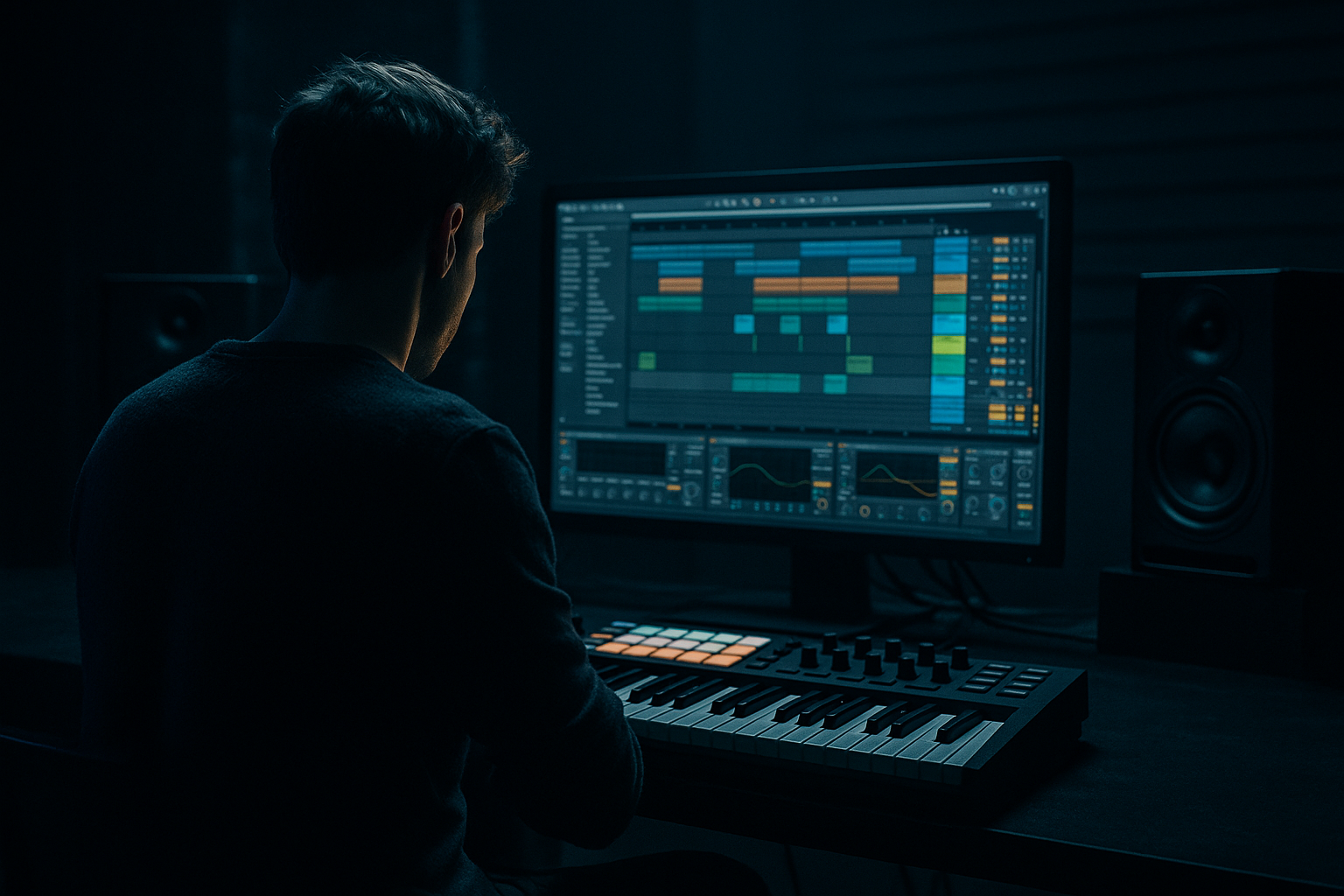
Main tutorial
Dub Echo Basics for DnB in Ableton Live
Teacher tone: energetic, clear, professional — let’s get those atmospheres rolling! 🎛️🥁
This beginner-friendly tutorial shows you how to create classic dub echo effects for drum & bass (jungle/rolling bass) productions in Ableton Live using practical device chains, clear settings, and arrangement tips. Everything is oriented toward 170–175 BPM DnB workflow.
---
1. Lesson overview
- Goal: Learn a repeatable dub-echo setup and performance workflow in Ableton Live that works on snares, percussion, vocal chops, synth stabs and bass fills.
- Outcome: A Return-track-based dub echo system (wet-only) you can automate in arrangement for rhythmic depth, break transitions, and dub-style space.
- Time to complete: ~25–40 minutes for the main setup + practice.
- Produces tempo-synced ping-pong/dotted echoes ideal for DnB groove.
- Has tone control (HP/LP) to keep the low end clean.
- Includes saturation/distortion and ducking so echoes stay heavy but don’t muddy the kick/bass.
- Is easy to automate in arrangement for transitions and breakdowns.
- Sync: ON (tempo-synced)
- Time: 1/8T (eighth-note triplet) or 1/4. For rolling DnB try 1/8T → it gives rhythmic space between breakbeat hits.
- Feedback: 60% (start here — tune later)
- Dry/Wet: 100% (return tracks should be wet-only)
- Filter / Hi-Cut / Lo-Cut (if device has them): roll off below 200 Hz and above ~6–8 kHz
- Set to Sync → 3/16 (dotted 1/8) or 1/8T, Feedback 60–70%, Dry/Wet 100%.
- Try Time = 1/8T, Feedback = 60–70%, Color / Diffusion to taste, High Cut around 6k, Low Cut around 200 Hz.
- EQ Eight → Band 1 (Low cut) set to 18–30 dB/Oct @ 120–200 Hz (removes sub from repeats).
- Band 8 (High cut) set as low-pass at 6–8 kHz to avoid harsh repeat highs.
- Saturator Drive: +2 to +5 dB (taste). Choose “Analog Clip” or “Soft Sine” for warmth.
- Dry/Wet: 30–50% (adds character to repeats without turning into distortion towers).
- Compressor with Sidechain input keyed to Kick (or Kick + Bass group). Use sidechain to duck echoes under the kick so the groove stays punchy.
- Settings: Threshold -18 to -12 dB, Ratio 2:1–4:1, Attack 5–15 ms, Release 100–250 ms. Tweak so the delay ducks on kick hits.
- Stereo Width: increase to 110–150% for wider echoes, or reduce to mono for subs-only control.
- Make sure output gain is not clipping.
- Feedback: 60% → 78% during a 4-bar fill.
- EQ Eight high-cut: 6 kHz → 1.2 kHz during the same 4 bars.
- Send knob: 0.15 → 0.6 on the snare for a 2-bar echoled fill.
- Swap Delay times mid-bar: duplicate the return or create Return B with a different timing (e.g., 1/4 dotted). Automate track activations or sends to switch rhythmic feel.
- Use Ping Pong for wide stereo echoes and Simple Delay (mono) or return with 100% dry/wet for narrow, focused echoes (good on mid-bass stabs).
- For pre-roll or ghost repeats before a drop: automate Send up a bar before transition and raise Feedback + Lower LP to create a wash that resolves when the drop hits.
- Too much low-end in the echoes → muddy mix. Fix: high-pass the return at 120–250 Hz.
- Leaving Feedback too high permanently → runaway oscillation. Fix: automate feedback or set a limiter (or keep it below 80%).
- Using Dry/Wet on track delay instead of return → phase issues and duplicated dryness. Use wet-only returns with sends for flexible control.
- Not ducking the echoes → echoes mask transient kick and weight. Use sidechain compressor on return.
- Over-wide low-frequency echoes → mono low-end first; widen only mids/highs with Utility or Multiband tricks.
- Use higher Feedback (70–85%) briefly in pre-drops and automate a long LP sweep down to 600–1000 Hz for a cavernous dub tail that still avoids the sub.
- Distort the repeats, not the dry: Place Saturator after the delay on the return. Crank Drive during a breakdown (automate it).
- Pitch-shift repeats for unease: Duplicate your delay return → put a Pitch plugin (Frequency Shifter/Pitch) or use Simple Delay with small detune on the duplicate; pan differently to create creepy stereo movement.
- Layer a short slapback (30–70 ms unsynced or 1/16) on top of the ping-pong for a gritty jungle feel.
- Use reverb after the delay on a secondary return for cavernous tails (Reverb → EQ to carve low end). Keep reverb mostly on delayed signal (i.e., chain Reverb after Ping Pong).
- Use bandpass filtering on echoes (Auto Filter in band-pass mode) and automate resonance to emphasize mid-range ghost tones.
- For maximum impact, sidechain the dub return to a transient shaper/gate that ducks less on offbeat snares — produces surfacing echoes on off-beats.
- Use a wet-only return track for dub echo (Ping Pong Delay or Echo), EQ out the lows, add saturation for grit, and duck with sidechain compression to keep the groove intact.
- Automate Feedback, Filter, and Send levels for classic dub movement in DnB — bump/send more for breakdowns, reduce for tight sections.
- Experiment with delay timings (1/8T, dotted 1/4, 1/16) and parallel returns for layered rhythmic echoes.
- Keep the low end safe (HP on returns) and use distortion/saturation on repeats for heavier, darker vibes.
---
2. What you will build
A standardized dub echo return chain using Ableton stock devices that:
Devices used (stock): Ping Pong Delay (primary), Simple Delay / Echo (optional), EQ Eight, Auto Filter, Saturator, Compressor (or Glue Compressor), Utility. If you have Echo (Suite), you can swap Ping Pong for Echo for more character.
---
3. Step-by-step walkthrough
A. Quick project prep
1. Set tempo to 174 BPM (typical DnB).
2. Create a drum group: Kick on Drum Rack, snare, hi-hats, break loop or chopped break. Make sure you have a snare/clap and a vocal stab or synth stab to test on.
3. Create a bass track with a rolling sub + mid-bass (separate tracks or layered).
B. Create a Return track for dub echo
1. Right-click in the return area → Insert Return Track (or Cmd/Ctrl+Alt+T). Name it “A – Dub Echo”.
2. On the return, load Ping Pong Delay (or Echo if you prefer its character).
Recommended Ping Pong Delay initial settings:
If using Simple Delay:
If you have Echo:
3. Insert EQ Eight after the delay on the return:
This keeps the bass solid and the tail smooth and “dubby.”
4. Add Saturator (after EQ) for grit:
5. Add Compressor or Glue Compressor for mild control and optional sidechain:
6. Add Utility at chain end:
Summary chain on Return A:
Ping Pong Delay (100% wet, sync) → EQ Eight (HP @ ~150–200 Hz, LP @ ~6–8 kHz) → Saturator (mild) → Compressor (sidechained to Kick) → Utility (width)
C. Route audio to the Dub Echo return
1. On your snare track (or vocal/synth stab), turn Send A up to around 10–30% (or 0.1–0.3). Watch the return level.
2. For percussive echo hits, you can automate the send knob: keep it low in the verse, bump to 50–80% for fills/breakdowns.
D. Automated feedback and tonal movement (the dub magic)
1. Map (or show automation lanes) for:
- Return Ping Pong Delay Feedback
- EQ Eight Low/High cut frequency
- Saturator Drive or Utility Width
2. Create moves:
- For a breakdown: automate Feedback up from 60% → 75% over 1–4 bars; automate Low-pass (EQ Eight) down to 1–2 kHz for a sinking dub tail.
- When coming back to drums: quickly reduce Feedback and sweep LP up to restore clarity.
3. Use Send automation on the source:
- Snare sends: quick spike on the 2nd and 4th bar of a fill.
- Vocal chop sends: long send for one bar to let repeat bleed.
Example automation nodes:
E. Performance & beat-sync tricks
---
4. Common mistakes
---
5. Pro tips for darker/heavier DnB
---
6. Mini practice exercise (10–15 minutes)
Follow these steps and checkboxes:
1. Project setup (1 min)
- Tempo: 174 BPM. Load a 2-bar drum loop with a solid snare.
2. Create Return A (3–5 min)
- Insert Ping Pong Delay on Return A.
- Set Sync → 1/8T, Feedback 60%, Dry/Wet 100%.
- Add EQ Eight: HP @ 150 Hz, LP @ 6 kHz.
- Add Saturator (Drive +3 dB), Compressor (sidechain to Kick), Utility width 120%.
3. Route + quick test (2 min)
- On snare track, raise Send A to 0.2. Play. Do you hear clean, stereo repeats without low rumble?
4. Automate a 2-bar echo fill (4–7 min)
- At bar 9, automate Snare Send A 0.2 → 0.6 for 2 bars.
- Automate Return A Feedback 60% → 75% over the same 2 bars.
- Automate EQ Eight LP from 6 kHz → 1.5 kHz to make the tail darker.
- Play from bar 8–12. Does the fill swell and sink? Tweak feedback and HP cutoff if it muddies.
Goal: By the end you should have a snare that, when sent, produces controlled dub repeats that you can shape and automate for transitions.
---
7. Recap
Have fun building your own dub echo signature — automate wildly, but always listen for the kick and sub! If you want, send me a short clip of your drum loop and I’ll give exact automation curves and tweaks for maximum impact. 🎚️🔥

