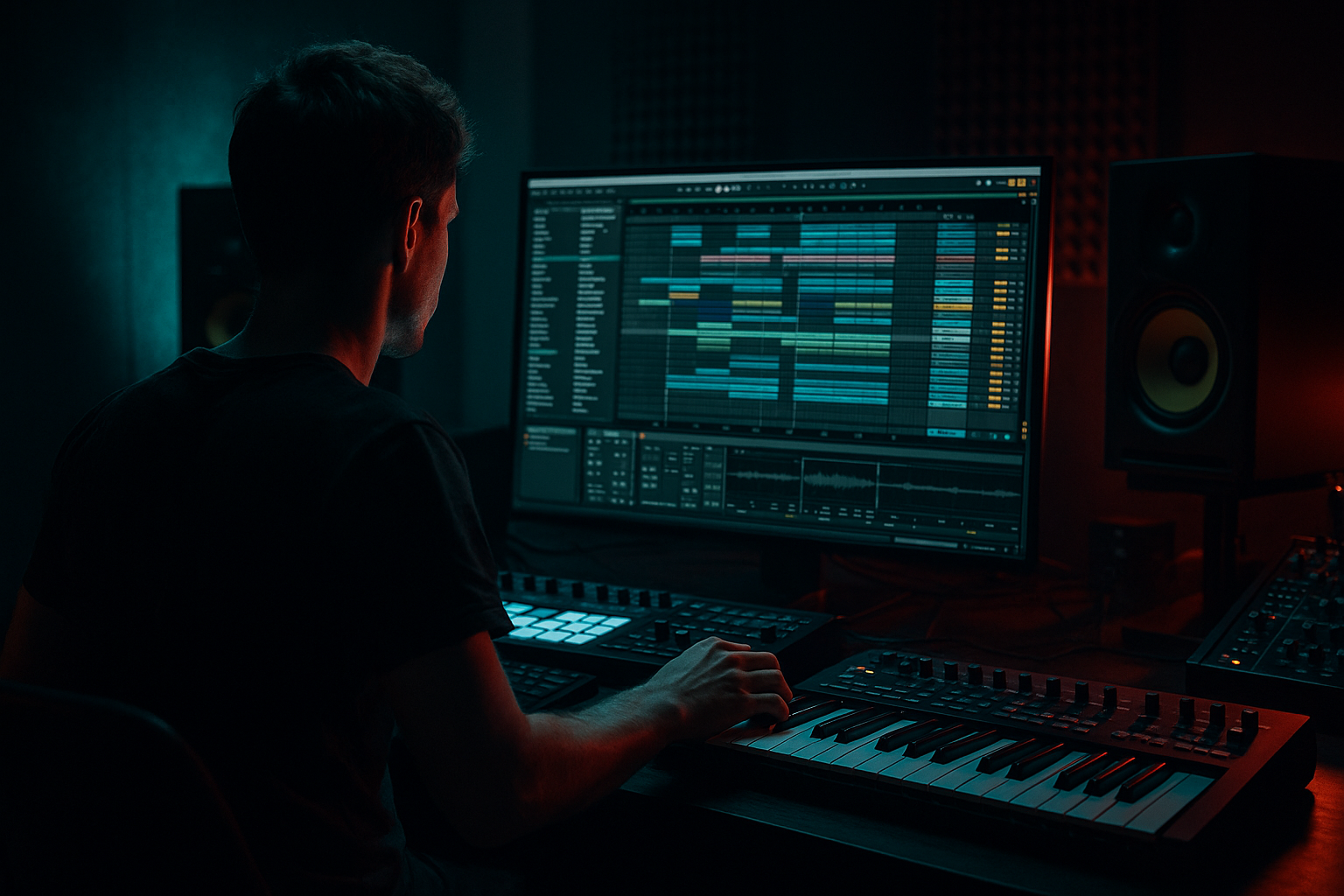
Main tutorial
Dub Siren Balance Blueprint: Warm Tape-Style Grit in Ableton Live 12 (Jungle / Oldskool DnB Atmospheres) 🚨🎛️
1. Lesson overview
This lesson is about making dub sirens sit perfectly in a jungle/oldskool DnB mix—present, exciting, and tape-gritty, without murdering your drums, bass, or headroom.
You’ll build a repeatable “balance blueprint”: gain staging → tone shaping → movement → tape-ish saturation → spatial placement → sidechain + automation.
We’re staying 100% Ableton Live 12 stock (with optional tweaks), and we’ll aim for that warm, slightly smashed, pirate-radio siren energy that feels glued into the breakbeat.
---
2. What you will build
A Dub Siren Atmosphere Rack on a return or group that delivers:
- Controlled loudness (no random peaks)
- Tape-style grit (warm harmonic density, soft clipping)
- Classic dub movement (echo throws, filter sweeps, pitch wobble)
- DnB-safe spatial (wide but not phasey; doesn’t mask snares/hats)
- Breaks-friendly ducking (siren dips under snares/kicks)
- Tempo: 165–172 BPM (classic jungle sits great around 168)
- You should already have:
- Use a dub siren one-shot or long note.
- Warp mode: Complex Pro (if melodic) or Tones (if more synthetic).
- Turn on Loop if you want sustained siren beds.
- Enable HPF at 24 dB/oct: 120–250 Hz
- If it’s honky:
- If it’s piercing:
- Mode: Soft Sine or Analog Clip
- Drive: 3–8 dB (don’t jump straight to 12 😅)
- Soft Clip: On
- Output: compensate so level matches bypass (critical for honest decisions)
- Drive: 5–15%
- Crunch: 0–10% (optional)
- Boom: Off (usually) OR 10–20% if the siren is thin and you want chest
- Damp: adjust to tame harshness (5–20%)
- Mode: Tape (or something tape-adjacent if available)
- Drive: low to medium
- Tone: tilt slightly dark
- Mix: 10–35% (keep parallel-ish)
- Mode: LP12 (smoother than LP24 in many cases)
- Cutoff: automate between 600 Hz → 4 kHz
- Resonance: 10–25%
- Envelope: small amount if you want it to “quack” with level
- Open filter on bar 4 of an 8-bar phrase leading into a drop, then snap slightly closed at the downbeat.
- Time: 1/4 or 3/16 (golden for jungle swagger)
- Feedback: 25–55%
- Modulation: 2–6 (subtle warble)
- Noise: 1–6% (tasteful tape dirt)
- Filter inside Echo:
- Ducking (inside Echo): 20–40%
- Pre-delay: 10–25 ms
- Decay: 0.8–1.8 s
- Low Cut: 250–500 Hz
- High Cut: 4–7 kHz
- Dry/Wet: 8–18% inline
- Bass Mono: On, set around 200–350 Hz
- Width: 110–140% if needed
- 2-bar call every 8 or 16 bars
- Strong throws into transitions
- Drop them out during the densest drum fills
- Fade tails precisely
- Reverse tiny bits
- Place micro-sirens right before snares for that rave punctuation
- Too bright going into saturation → turns into brittle fizz. Fix with pre-EQ + lower drive.
- No HPF → siren steals low-mid space, your bass feels smaller.
- Wide + reverb + delay all at once → phase soup in mono. Choose one main “space” and keep it controlled.
- Constant siren → listener fatigue and reduced drop impact. Use it like seasoning, not the meal.
- No sidechain / ducking → your snare loses authority (deadly in jungle).
- Pitch it down 3–7 semitones and filter lower for a more sinister siren.
- Add Redux very subtly (post-sat, pre-reverb):
- Use Roar as a parallel return instead of inline:
- Create a mid/side EQ approach:
- For neuro-leaning darkness: add Corpus very quietly (yes, on sirens):
- Start warm, not bright—tape grit exaggerates whatever you feed it.
- Your blueprint is: Gain stage → EQ → Saturate/Glue → Movement (filter/echo) → Space → Width control → Sidechain → Automation
- Use sirens like arrangement punctuation in jungle: call, response, throws, and restraint.
- Commit to audio (resample) for true oldskool energy and tight placement. 📼
End result: siren feels like it’s in the rave, not pasted on top. 🔥
---
3. Step-by-step walkthrough
Step 0 — Session context (quick setup)
- Breakbeat bus (Amen/Think/etc.)
- Sub/bassline
- A few atmos layers
Goal: siren becomes a call-and-response element, not a constant lead.
---
Step 1 — Source: pick or build a siren that reacts well to “tape”
Option A: Sample
Option B: Synthesize quickly (stock)
On a MIDI track:
1. Add Wavetable
2. Osc 1: Sine or Triangle (warm fundamentals)
3. Osc 2: Square (very low level for bite)
4. Add LFO to pitch for siren wobble:
- LFO Rate: 1/8 to 1/4 (sync)
- Amount: ±2 to ±7 semitones depending on how “siren-y” you want it
5. Add a Filter (LP24):
- Cutoff: start around 1.2–3 kHz
- Drive: 2–6 dB (subtle push)
Key tip: sirens that are too bright pre-processing get harsh when saturated. Start slightly warm.
---
Step 2 — Gain staging & peak control (your “don’t regret later” step) ✅
On the siren track, before any vibe processing:
1. Utility
- Gain: set so the siren peaks around -18 to -12 dBFS
- If it’s stereo-heavy, set Width 80–100% for now (we’ll widen later properly)
2. Limiter (temporary safety)
- Ceiling: -1.0 dB
- Only catching occasional peaks (1–2 dB GR max)
This keeps saturation behaving predictably (tape-style effects love consistent input).
---
Step 3 — The core “Tape Grit” chain (stock devices)
Order matters. Use this on the siren track (or inside a rack).
#### 3A) EQ Eight (pre-saturation cleanup)
- (DnB rule: don’t let sirens fight sub/bass)
- Bell cut 400–800 Hz: -2 to -5 dB (Q ~1.2)
- Dip 2.5–5 kHz: -1 to -4 dB (Q ~2)
#### 3B) Saturator (tape-ish warmth)
Sweet spot: You should hear thicker mids + slightly rounded transients, not fizz.
#### 3C) Drum Buss (glue + thump control)
Yes—on sirens. Used subtly, it gives “printed-to-tape” density.
#### 3D) Roar (modern grit, used like a “tape abuse” stage) 🧨
Ableton Live 12’s Roar can be too much; treat it like a “character send” inline.
If Roar gets spitty: reduce high input (EQ before) or lower drive and raise mix carefully.
---
Step 4 — Dub movement: echo + filter choreography
Classic siren vibe is movement + throws, not just distortion.
#### 4A) Auto Filter (post-grit, pre-delays)
Automation move (DnB-friendly):
#### 4B) Echo (dub throw engine) 🌀
Put Echo after filter so the repeats darken naturally.
- HP around 250–400 Hz
- LP around 2.5–6 kHz
- This helps repeats get out of the way of the dry siren.
Throw workflow: automate Echo Dry/Wet from 0% to ~25–40% on the last 1/8 or 1/4 of a phrase.
---
Step 5 — Spatial placement that doesn’t wreck mono
DnB is played on big systems—mono matters.
#### 5A) Reverb (short, dark space)
Use Reverb or Hybrid Reverb.
Or better: put it on a Return for consistent control.
#### 5B) Width management (do it safely)
Use Utility at the end:
If the siren feels phasey, reduce width or keep it closer to mono and let delays create width instead.
---
Step 6 — The “Balance Blueprint”: duck the siren like a pro (key to rolling mixes) 🎚️
This is the difference between “cool siren” and “why did my snare disappear?”
#### 6A) Sidechain compression keyed from your DRUM BUS
1. Add Compressor on the siren track (late in chain, after time FX if possible)
2. Enable Sidechain
3. Input: Drum Group (or breakbeat bus)
4. Settings (starting point):
- Ratio: 3:1 to 5:1
- Attack: 3–10 ms (let a bit of siren transient through)
- Release: 80–180 ms (tempo-dependent; set so it recovers musically)
- Threshold: aim for 2–5 dB gain reduction on snare hits
Advanced trick: if the kick is triggering too much, sidechain from a Snare-only trigger track (a ghost snare) so the siren “bows” to the snare like classic jungle.
#### 6B) Clip automation: let it breathe
Arrange sirens like an MC hype element:
Oldskool vibe comes from restraint.
---
Step 7 — Make it feel “printed”: resampling workflow (optional but very authentic) 📼
To get “tape committed” behavior:
1. Create a new audio track: RESAMPLE SIREN
2. Set input: Resampling
3. Solo the siren track + its returns (or route siren to a dedicated bus)
4. Record a few passes with your filter/echo automation live
5. Flatten and chop the best moments into fills/throws
Now you can:
---
4. Common mistakes
---
5. Pro tips for darker/heavier DnB 🌑
- Downsample: 2–6
- Dry/Wet: 5–15%
This gives crunchy “hardware pain” without destroying it.
- Return A: “ROAR GRIT”
- Roar Mix 100% on the return, then blend with send amount
Cleaner control in dense drops.
- EQ Eight in M/S mode
- Sides: roll off lows more aggressively (HP around 300–600 Hz)
- Mid: keep body, but notch harshness around 3–4 kHz
- Tune to the key note
- Dry/Wet 3–8%
Adds metallic presence that cuts through reeses without pure brightness.
---
6. Mini practice exercise (15–20 minutes) ⏱️
1. Make an 8-bar jungle loop: breaks + sub + hats.
2. Add a siren (sample or synth) that plays only in bars 7–8 as a lead-in.
3. Build this chain (in order):
- Utility (gain)
- EQ Eight (HP @ ~180 Hz)
- Saturator (Soft Sine, Drive ~5 dB, Soft Clip ON)
- Drum Buss (Drive ~10%)
- Auto Filter (automate cutoff opening into bar 9)
- Echo (3/16, feedback ~40%, dark filters)
- Compressor sidechained from drum bus (aim 3 dB GR)
4. Resample 2 takes of you performing the filter + echo throws live.
5. Place the best throw right before the drop and mute the siren for the first 4 bars of the drop.
Deliverable: one 16-bar clip where the siren hypes the transition but the drop stays clean.
---
7. Recap
If you want, tell me your typical drum bus level and whether you’re using an Amen-heavy break or cleaner two-step—I'll tailor exact sidechain timings and filter automation curves to your groove.

