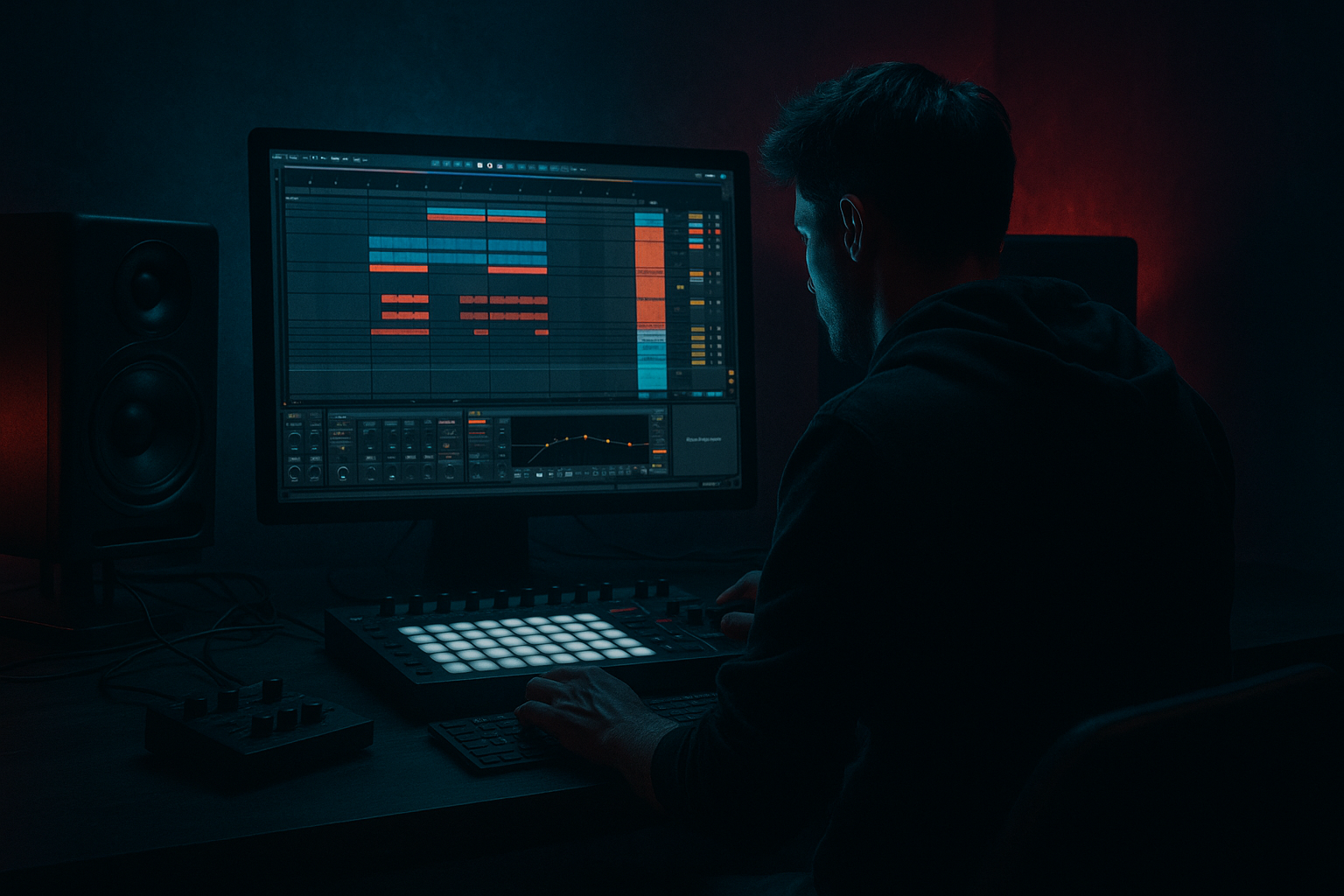
Main tutorial
Dub Siren Design Masterclass (Smoky Late‑Night Moods) — Ableton Live (Advanced) 🌫️🔊
1) Lesson overview
Dub sirens are more than “that reggae sound”—in drum & bass they’re tension devices: a call‑and‑response element that cuts through dense breaks, fills space between bass phrases, and signals drops, reloads, and transitions. In this masterclass you’ll design a modern, moody dub siren that sits perfectly in rolling/techy DnB and jungle, using mostly Ableton stock devices with an advanced workflow: macro control, resampling, and mix discipline.
You’ll build:
- A playable siren instrument (Wavetable-based)
- A “smoke” FX chain (saturation, dub echo, spring-ish reverb, movement)
- Performance macros for live automation and arrangement control
- Resampled versions to treat like audio (classic DnB workflow)
- 4 performance modes: Rise, Wail, Stab, Alarm
- Macros for: Pitch Sweep, Rate, Grit, Space, Feedback, Filter, Width, Duck
- A post-chain that makes it smoky and tucked behind the drums (not fighting hats/snare)
- A method to print/resample and then re-chop into fills and one-shots
- Tempo: 172–176 BPM
- Put a reference loop running:
- Osc 1: choose a simple, harmonically stable wavetable (e.g. Basic Shapes or a smooth digital table).
- Osc 2: optional, for edge
- If you want width later, keep unison subtle:
- Attack: 5–20 ms (avoid click)
- Decay: 300–900 ms
- Sustain: -6 to -12 dB (or lower)
- Release: 200–600 ms
- Mode: Soft Sine or Analog Clip
- Drive: 2–8 dB
- Output: compensate to unity
- Turn on Soft Clip (often yes)
- Type: LP12 (gentler) or LP24 (more control)
- Cutoff: 800 Hz – 4 kHz depending on how “behind” you want it
- Drive: 2–6 dB (if using filter drive)
- Envelope Amount: small 5–15% with short decay to give “push” on hits
- Sync: On
- Time: 1/8 dotted or 1/4 (both are DnB-friendly)
- Feedback: 35–65% (careful—this can run away fast)
- Filter:
- Modulation: 2–8% for drift
- Character: add a touch (10–30%) if it’s too clean
- Dry/Wet: 15–35% (you’ll macro this)
- Algorithm: Spring or Plate (spring for dub heritage, plate for classy haze)
- Decay: 1.2–3.5 s
- Predelay: 10–25 ms (keeps it from washing the transient)
- EQ inside Hybrid Reverb:
- Dry/Wet: 8–22% (keep it controlled—DnB needs headroom)
- Chorus-Ensemble:
- Width: 80–120%
- Bass Mono: On (if you’re letting low mids through)
- Sidechain: your Drum Group or Snare track
- Ratio: 2:1 to 4:1
- Attack: 5–20 ms
- Release: 80–180 ms
- Gain reduction: aim 2–6 dB on hits
- Amount: 20–45%
- Rate: 1/4 or 1/8 (sync)
- Phase: 0° (so it’s volume, not panning)
- Automate Macro 1 (Pitch Sweep) increasing
- Increase Macro 5 (Echo) in the last bar
- Hard cut the siren right before the drop (or leave a tiny tail)
- One long wail note, then stop time + tape/echo tail (Echo feedback up)
- Works great in jungle—combine with break edit.
- Short stabs on the “and” of beats (offbeats)
- Keep Macro 3 (Filter Mood) lower so it’s midrangey but not harsh.
- Bars 1–8: subtle (low echo/reverb)
- Bars 9–16: automate more feedback + slightly faster rate (Macro 2), then pull it back.
- Redux lightly (downsample) for grit
- EQ Eight surgical cleanup
- Gate keyed from drums for rhythmic slicing
- Too much top end (6–12 kHz): makes it sound like a cheap EDM lead instead of dub haze. Use High Cut in Echo/Reverb and EQ Eight.
- Runaway feedback: mapping Echo Feedback without safe ranges = instant clip city. Limit the macro range and add a Limiter.
- Stereo low mids: wide 150–400 Hz mud collapses in mono and fights bass. Use Utility Bass Mono + EQ.
- No ducking: siren will mask the snare crack and hats. Sidechain it—always.
- Overusing it: constant siren kills tension. Use it as punctuation.
- Tune it to the key: even if it’s noisy, set the root note and keep your pitch modulation musically intentional (e.g., sweep ±7 semitones for a “fifth” vibe).
- Midrange pockets: if your bass owns 150–300 Hz and 1–2 kHz, push the siren toward 500–1.2 kHz with a narrow EQ boost and roll off lows.
- Parallel dirt: create an Audio Effect Rack with a dry chain + a “Filth” chain (Saturator + Overdrive + EQ) and blend 10–30%.
- Rhythmic gating: use Gate sidechained from a ghost hat pattern to make the siren chatter in sync with rollers.
- Post-drop contrast: after a heavy 16 bars, a filtered, echo-heavy siren in a half-time break instantly signals a new chapter.
- Print + reverse tails: reverse a resampled siren tail into a snare hit for wicked late-night tension.
- You designed a Wavetable-based dub siren with controlled pitch/filter motion.
- You built a smoky FX chain (Saturator → Filter → Echo → Hybrid Reverb → stereo control).
- You added ducking so it sits behind breaks and bass like a pro.
- You created performance macros for fast, musical automation.
- You used the real DnB workflow: perform → resample → chop → arrange.
---
2) What you will build
By the end you’ll have an Instrument Rack called “Late Night Dub Siren” with:
---
3) Step-by-step walkthrough
Step 0 — Session prep (DnB context)
- Kick + snare on 2 & 4
- A rolling hat loop
- A sub/bassline (even a placeholder)
This matters because the siren must be tuned and mixed against real DnB density.
---
Step 1 — Build the core siren oscillator (Wavetable)
1. Create a new MIDI Track → load Wavetable.
2. Set Voices: `1` (mono vibe, classic siren behavior)
3. Enable Glide/Portamento: `On`
- Time: 80–160 ms (adjust to taste)
Oscillator settings (smoky but present):
- Position near sine/triangle-ish for a round body
- Detune: +7 to +14 cents
- Level low: -18 to -24 dB (just a halo)
Unison:
- Unison: 2–4 voices, Amount 10–25%
- (You’ll control width in FX so it doesn’t wreck mono compatibility)
---
Step 2 — The siren movement: LFO pitch + filter (the “wail”)
A dub siren lives and dies by pitch modulation. Do it musically and controllably.
1. In Wavetable, use LFO 1 → assign to Osc 1 Pitch.
2. Set LFO 1:
- Shape: Sine (smooth), or Triangle (more urgent)
- Rate: 1/4 to 1/2 (sync) for classic wail
- For faster “alarm”: 1/8 or 1/16
- Amount: start around ±2 to ±7 semitones (big moves are okay—DnB likes drama)
3. Add Filter in Wavetable:
- Type: LP24 (or MS2/PRD if you want character)
- Cutoff: start around 1.2–3 kHz
- Resonance: 15–35% (careful: too much gets whistly)
4. Use LFO 2 → map to Filter Cutoff:
- Rate: slower than pitch LFO, e.g. 1 bar or 1/2 bar
- Amount: subtle 10–25% movement
This creates that smoky “breathing” tone instead of a static synth.
Pro workflow tip: Put both LFO rates on sync for arrangement-tight motion. Then later automate rate switching for fills.
---
Step 3 — Amp/envelope: make it playable and “phrase-like”
In Wavetable’s Amp Envelope:
This makes it feel like a siren gesture rather than a held pad.
---
Step 4 — Add grit without turning it into a lead
DnB sirens should cut, but late-night ones sit in haze.
After Wavetable, add Saturator:
Then add Auto Filter (post-saturation for tone shaping):
---
Step 5 — The dub space: echo that feels like a room full of smoke 🌫️
This is where you get the late-night mood.
Add Echo:
- Low Cut: 200–500 Hz
- High Cut: 2.5–6 kHz
Then add Hybrid Reverb (after Echo):
- Low cut: 250–600 Hz
- High cut: 4–9 kHz
Key mixing idea: The echo is the “rhythm,” the reverb is the “smoke.” Don’t max both.
---
Step 6 — Make it move: subtle stereo + chorus without wrecking mono
Add Chorus-Ensemble (or Phaser-Flanger lightly):
- Mode: Chorus
- Amount: 10–25%
- Rate: 0.2–0.8 Hz
- Width: 70–120%
- Mix: 10–20%
Then add Utility:
DnB playback systems punish sloppy stereo—Utility is your safety belt.
---
Step 7 — Sidechain/ducking: keep it tucked behind drums 🥁
Late-night sirens should float behind the snare and not mask the break.
Option A (clean): Compressor sidechained from snare or drum bus
Option B (vibey): Auto Pan as tremolo duck
This gives rhythmic breathing that suits rolling DnB.
---
Step 8 — Performance Macros (Instrument Rack) 🎛️
Group your chain into an Instrument Rack (Cmd/Ctrl+G) and map macros like this:
1. MACRO 1 — Pitch Sweep
- Map to Wavetable LFO 1 Amount (pitch)
- Range: ±1 semitone → ±12 semitones
2. MACRO 2 — Rate
- Map to LFO 1 Rate (sync steps)
- Range: 1/2 → 1/16
3. MACRO 3 — Filter Mood
- Map Auto Filter cutoff
- Range: 700 Hz → 6 kHz
4. MACRO 4 — Grit
- Map Saturator Drive
- Range: 1 dB → 10 dB
5. MACRO 5 — Dub Echo
- Map Echo Dry/Wet + Feedback (careful ranges!)
- Dry/Wet: 10–40%
- Feedback: 25–70%
6. MACRO 6 — Smoke (Reverb)
- Map Hybrid Reverb Dry/Wet
- Range: 6–26%
7. MACRO 7 — Width
- Map Chorus Mix + Utility Width
- Mix: 0–25%, Width: 80–130%
8. MACRO 8 — Duck
- Map Compressor Threshold
- Range: set for 1–8 dB GR
Advanced safety: Put a Limiter at the end of the rack (Ceiling -1 dB) to catch feedback spikes when performing.
---
Step 9 — Arrangement ideas (very DnB-specific)
Use sirens like spice, not the meal:
A) “Pre-drop call” (2 or 4 bars)
B) “Reload marker”
C) “Between-snare answers”
D) “16-bar evolution”
---
Step 10 — Resample like a proper DnB producer (print to audio) 🎚️
1. Create an Audio Track called “Siren Resample”.
2. Set input: Resampling.
3. Record 2–5 minutes of you performing macros.
4. Chop the best bits into:
- One-shots (stabs)
- 2-beat fills
- Long risers
5. Warp mode for chops:
- Try Complex Pro for long tails
- Try Beats for rhythmic stabs (preserve transients)
Then process audio further with:
---
4) Common mistakes
---
5) Pro tips for darker/heavier DnB 🖤
---
6) Mini practice exercise (15–20 minutes) 🎯
1. Build the rack as above (or your own version).
2. Write a 16-bar rolling DnB loop.
3. Perform and automate:
- Bars 1–8: Macro 5 (Echo) at 15–20%, Macro 6 (Reverb) 10–12%
- Bars 9–12: increase Macro 1 (Pitch Sweep) and slightly open Macro 3 (Filter)
- Bars 13–16: push Macro 5 feedback higher, then hard cut at bar 16
4. Resample 2 minutes of performance and extract:
- 3 stabs
- 1 two-beat fill
- 1 long wail for a breakdown
5. Place them into a simple arrangement: intro → pre-drop → drop → breakdown.
Deliverable: a 32-bar sketch where the siren appears only in transition moments and between phrases, not constantly.
---
7) Recap
If you want, tell me your sub/bass style (minimal roller, foghorn, neuro-ish, jungle) and I’ll suggest exact macro ranges + EQ pockets tailored to your mix.

