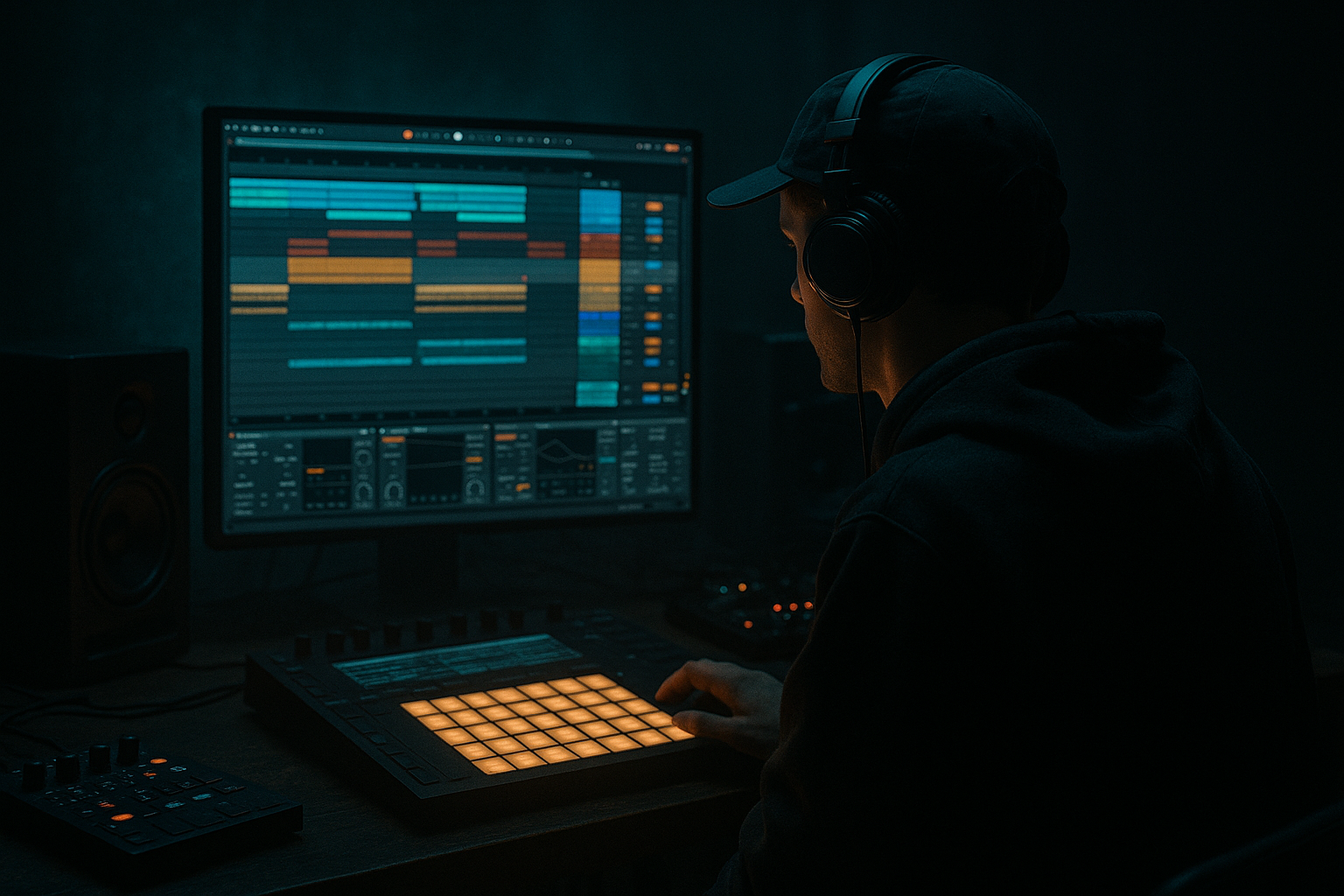
Main tutorial
Dubwise Ableton Live 12 Chop Guide (DJ‑Friendly Structure)
Jungle / oldskool DnB vibes — Intermediate — Atmospheres 🌫️🔊
---
1. Lesson overview
This lesson is all about building dubwise atmospheres in Ableton Live 12 using chops (micro-edits, tape-style drops, re-triggers, delays, and reverbs) that feel authentic to jungle / early DnB / sound system aesthetics—and arranging them into a DJ-friendly structure that’s easy to mix.
You’ll learn a repeatable workflow for:
- Creating atmo beds + stabs + FX hits
- Turning long audio into playable chops
- Doing dub-style throws (delay/reverb) cleanly
- Arranging with 16/32-bar phrasing, clean intros/outros, and “DJ markers”
- Dubwise atmo bed (textured, moving, sidechained)
- Chopped atmos / vox / horn hits triggered like an instrument
- Send-based tape delays and spring-ish reverb throws
- DJ-friendly sections with filtered drums and clean bass management
- A structure that works at 165–174 BPM (we’ll use 170 BPM)
- A field recording (rain, room tone, subway, vinyl noise)
- A long pad from a synth / sample
- A resampled chord stab stretched into a drone
- Add Compressor on ATM BED
- Sidechain from KICK or DRUM BUS
- Ratio: `2:1`
- Attack: `5–15 ms` (keep the transient)
- Release: `80–140 ms` (tempo-feel)
- Gain reduction: 1–3 dB (don’t overdo; it’s atmosphere)
- Reggae/dancehall vocal line
- Horn stab phrase
- Old documentary/dialogue
- Ambient FX (sirens, crowd, radio)
- Open a few Simpler instances and:
- A – Dub Delay
- B – Space Verb
- C – Dirty Throw (optional)
- Time: try 1/8 Dotted or 1/4
- Feedback: `35–65%` (automate for throws)
- Noise: `2–8%`
- Wobble: `0.2–1.0`
- Filter: HP around 200 Hz, LP around 6–9 kHz
- Output: keep it safe; dub delays can explode
- Saturator
- Decay: `3–8 s`
- Predelay: `20–45 ms`
- Low Cut: 250–450 Hz
- High Cut: 6–10 kHz
- Early Reflections: a bit (adds “room” realism)
- Delay (simple)
- Redux (subtle bit crush)
- Auto Filter (LP, automated)
- Reverb (small/medium)
- Place a vocal chop right after the snare (classic call/response):
- Use one horn stab every 2 bars and vary it with throws.
- Add a “pickup” chop at the end of bar 4 to lead into bar 1.
- In Groove Pool, try subtle swing (or extract groove from a break).
- Or manually nudge a few notes:
- Vary velocities between 60–110
- Lower velocity = less send = cleaner. Higher velocity = more send = dub chaos (if you map it, see next step).
- Macro 1: HP Cut → Auto Filter cutoff (HP12) from `80 Hz → 500 Hz`
- Macro 2: LP Sweep → Auto Filter cutoff (LP24) from `12 kHz → 800 Hz`
- Macro 3: Dirt → Saturator Drive `0 → 8 dB` (Soft Clip ON)
- Macro 4: Width → Utility Width `80% → 160%`
- Macro 5: Kill (DJ mute) → Utility Gain `0 → -inf` (for quick dropouts)
- Macro 6: Send A → your track’s Send A amount (dub delay)
- Macro 7: Send B → Send B amount (reverb)
- Macro 8: “Freeze vibe” (optional): map Echo Feedback `35 → 80%` (use carefully!)
- Ratio: `3:1`
- Attack: `2–10 ms`
- Release: `60–120 ms`
- Aim: 2–5 dB reduction on hits
- Bars 1–9: ATM BED + light vinyl/noise + filtered tops
- Bars 9–17: introduce chopped atmos quietly (call/response)
- Bars 17–25: bring in full drums but keep bass minimal
- Bars 25–33: tension: add dub throws, short dropouts, reverse FX
- Bars 33–49 (first 16): main beat + bass + light chops
- Bars 49–65: add more dub delay throws on selected chops
- Bars 65–81: variation: different chop bank or different timing
- Bars 81–97: “mini-break”: 2–4 bars of filtered drums + atmo push
- Strip to ATM BED + a few chops
- Automate LP filter down (darker)
- Add big reverb throw on a vocal fragment
- Optional: half-time kick or sparse rim hits
- Same foundations, but:
- Remove bass early (first 8–16 bars of outro)
- Keep drums + tops rolling, then gradually strip:
- Make your space darker, not louder:
- Use gated reverb for classic oldskool snaps:
- Mid/Side control for atmosphere clarity:
- Resample your throws:
- Add “system weight” without ruining sub:
- You built a dubwise atmosphere bed that moves and ducks around drums 🌫️
- You turned long audio into playable chops with Drum Rack slicing 🎚️
- You created proper dub sends (Echo + Hybrid Reverb) for clean throws 🎛️
- You arranged with DJ-friendly 16/32-bar phrasing so your track is easy to mix 🔄
- You kept the vibe rooted in jungle/oldskool by focusing on call/response chops, tasteful swing, and controlled chaos 🔊
---
2. What you will build
A 32-bar intro → 64-bar main → 32-bar breakdown → 64-bar second drop → 32-bar outro DnB arrangement, featuring:
---
3. Step-by-step walkthrough
Step 0 — Session setup (DJ-friendly from the start)
1. Set tempo: `170 BPM`
2. Time signature: `4/4`
3. Arrangement grid: right-click the ruler → Fixed Grid: `1 Bar` (switch to `1/16` when editing chops)
4. Markers/locators (important for DJ structure):
- `1` Intro (32 bars)
- `33` Drop 1 (64 bars)
- `97` Breakdown (32 bars)
- `129` Drop 2 (64 bars)
- `193` Outro (32 bars)
DJ-friendly rule: Make changes on 16-bar boundaries, big changes on 32-bar boundaries.
---
Step 1 — Build a dubwise atmosphere “bed” (the glue)
Create a track named ATM BED.
Source options (pick one):
Processing chain (stock devices):
1. EQ Eight
- HP filter: `24 dB/oct` at 120–200 Hz (keep subs clean)
- Gentle dip around 2–4 kHz if harsh: `-2 to -4 dB`
2. Auto Filter (movement)
- Mode: LP24
- Cutoff: 600 Hz – 4 kHz (map to a macro if using racks)
- Envelope: subtle, or automate cutoff slowly
- Add Drive: `2–6 dB` for thickness
3. Chorus-Ensemble (width)
- Amount: `15–35%`
- Rate: slow (`0.1–0.4 Hz`)
4. Hybrid Reverb (space)
- Algorithmic or Convolution “Room/Plate”
- Decay: `2.0–5.0 s`
- Predelay: `15–35 ms`
- Low Cut: `200–400 Hz`
- High Cut: `6–10 kHz`
5. Utility
- Width: `120–160%` (careful if your mix gets unstable)
- Mono below: you’ll do this later on the master or bass bus, but you can keep the bed airy.
Sidechain (classic DnB pump, subtle):
---
Step 2 — Create a “Chop Bank” from a long sample (Live 12 slicing workflow)
Pick a sample that screams jungle/dub:
Create a track named CHOPS and drop your audio in.
#### Option A (fast): Slice to a Drum Rack
1. Right-click the audio clip → Slice to New MIDI Track
2. Slicing preset:
- By Transients (or “Warp Markers” if you set your own)
- Create one slice per: Transient
- Slicing preset: Built-in → Slice (then you’ll add your own FX)
3. You now have a Drum Rack with each chop on a pad.
Tighten the chops:
- Set Fade In: `2–8 ms` (removes clicks)
- Set Fade Out: `5–25 ms`
- Use One-Shot mode for stabs; Classic for tonal bits.
#### Option B (clean + musical): Warp and manually place warp markers
Great for vocals or horn phrases you want tight to groove.
1. Enable Warp
2. Choose warp mode:
- Complex Pro for vocals (formants intact)
- Texture for noisy atmos (grainy dub character)
3. Set warp markers on key syllables/hits
4. Then Slice to New MIDI Track → By Warp Markers
Jungle feel tip: Don’t quantize everything dead-on. Let a few chops hit 5–15 ms late for swagger.
---
Step 3 — Build the “Dub Throw” FX system (clean, pro routing)
Instead of slapping delay/reverb on every chop, use Return tracks like a proper dub desk. 🎛️
Create Returns:
#### Return A: Dub Delay (stock)
Echo (great for tape-ish dub)
Add after Echo:
- Soft Clip: ON
- Drive: `2–6 dB`
#### Return B: Space Verb
Hybrid Reverb
#### Return C: Dirty Throw (optional spice)
Chain:
This is your “sound system damage” return—use sparingly.
---
Step 4 — Make chops feel like performance (MIDI pattern + velocity + timing)
On the CHOPS MIDI track, program a 2- or 4-bar loop that interacts with drums.
Practical patterns (very DnB):
Snare on 2 & 4 → chop on the “and” after 2 or 4.
Groove:
- Push occasional chops early by 5 ms for urgency
- Pull some late by 10–20 ms for laid-back dub
Velocity matters:
---
Step 5 — Add DJ-style “hands-on” control with an Audio Effect Rack (macros)
On the CHOPS track, build a rack for quick dub moves.
Add these devices (in order):
1. EQ Eight (cleanup)
2. Auto Filter (sweep)
3. Saturator (thicken)
4. Utility (mono/width & gain)
Group them into an Audio Effect Rack and map macros:
Suggested Macros (super practical):
Now you can automate these macros in Arrangement for clean, intentional dub moves.
---
Step 6 — Atmos chops that “duck” around the drums (clean mix, heavy groove)
If your chops smear the drums, do this:
On CHOPS track add Compressor (sidechain from Snare or Drum Bus):
This keeps chops energetic but not stepping on the snare crack.
---
Step 7 — Arrange with a DJ-friendly jungle/DnB structure 🧱
Here’s a practical template you can copy directly:
#### Intro (Bars 1–32)
Goal: easy to mix in, minimal sub/bass.
- Use Auto Filter on drum loop: LP around 8–12 kHz
- If you have bass, keep it HP’d above 80–120 Hz
Classic jungle move: last 1 bar before drop, kill the drums and let a reverb tail + vocal chop ring.
#### Drop 1 (Bars 33–96)
Goal: stable groove for DJs, evolving atmos so it doesn’t loop-bore.
Keep the core drums + bass consistent for mixability.
#### Breakdown (Bars 97–128)
Goal: reset energy + show atmos.
#### Drop 2 (Bars 129–192)
Goal: heavier version of Drop 1.
- More aggressive chop rhythm
- More distortion on the dirty return
- Extra ride/shaker energy
- Slightly different bass movement (even 1 note change works)
#### Outro (Bars 193–224)
Goal: easy to mix out.
- Chops out
- Percussion out
- ATM BED fades with reverb tail
---
4. Common mistakes
1. Too much low end in atmos
If your bed/chops have energy below ~150 Hz, your sub will feel weak. HP filter aggressively.
2. Over-wet reverb everywhere
Dub space is about contrast. Use throws (moments), not constant wash.
3. Delays running wild and masking the snare
Filter your delays (HP 200 Hz, LP 6–9 kHz) and automate feedback back down.
4. Chops not glued to the groove
Jungle loves looseness, but random timing feels amateur. Nudge intentionally.
5. No DJ phrasing
If you add new elements every 3 or 7 bars, DJs will hate you. Think 16/32 bars.
---
5. Pro tips for darker/heavier DnB 🌑
On reverb/delay returns, low-pass to 6–8 kHz and add Saturator for thickness.
Put Gate after Hybrid Reverb on Return B.
- Threshold: set so tails cut after ~`250–600 ms`
- Gives that tight, punchy dub space.
On ATM BED, use EQ Eight in M/S mode:
- Sides: cut a bit at 200–400 Hz (reduce mud)
- Mid: keep more focused for mono compatibility
Record 8 bars of your chop performance with wild sends → flatten → re-chop.
This creates printed dub moments that feel intentional (and mix better).
Saturate upper bass harmonics (150–400 Hz) on atmos returns, but keep <100 Hz clean/mono.
---
6. Mini practice exercise (15–25 minutes) 🧪
1. Pick a 10–20 second vocal phrase (reggae/dialogue).
2. Warp it, then Slice to Drum Rack (transients).
3. Program a 4-bar chop pattern:
- 2 chops per bar, one right after snare hits
4. Set up:
- Return A Echo (1/8 dotted)
- Return B Hybrid Reverb (5 s)
5. Automate over 16 bars:
- Bars 1–8: light Send A/B
- Bar 8: big delay throw on the last chop
- Bar 9: kill chops for 1 bar (Macro “Kill”)
- Bar 16: reverb throw into a drop
Export a quick bounce and listen: does the groove stay steady while the space moves?
---
7. Recap
If you want, tell me your target vibe (e.g., 1994 metalheadz dark, Congo Natty steppers, Ram Trilogy roll, Ragga jungle party) and I’ll give you a specific chop palette + 8-bar arrangement script to match.

