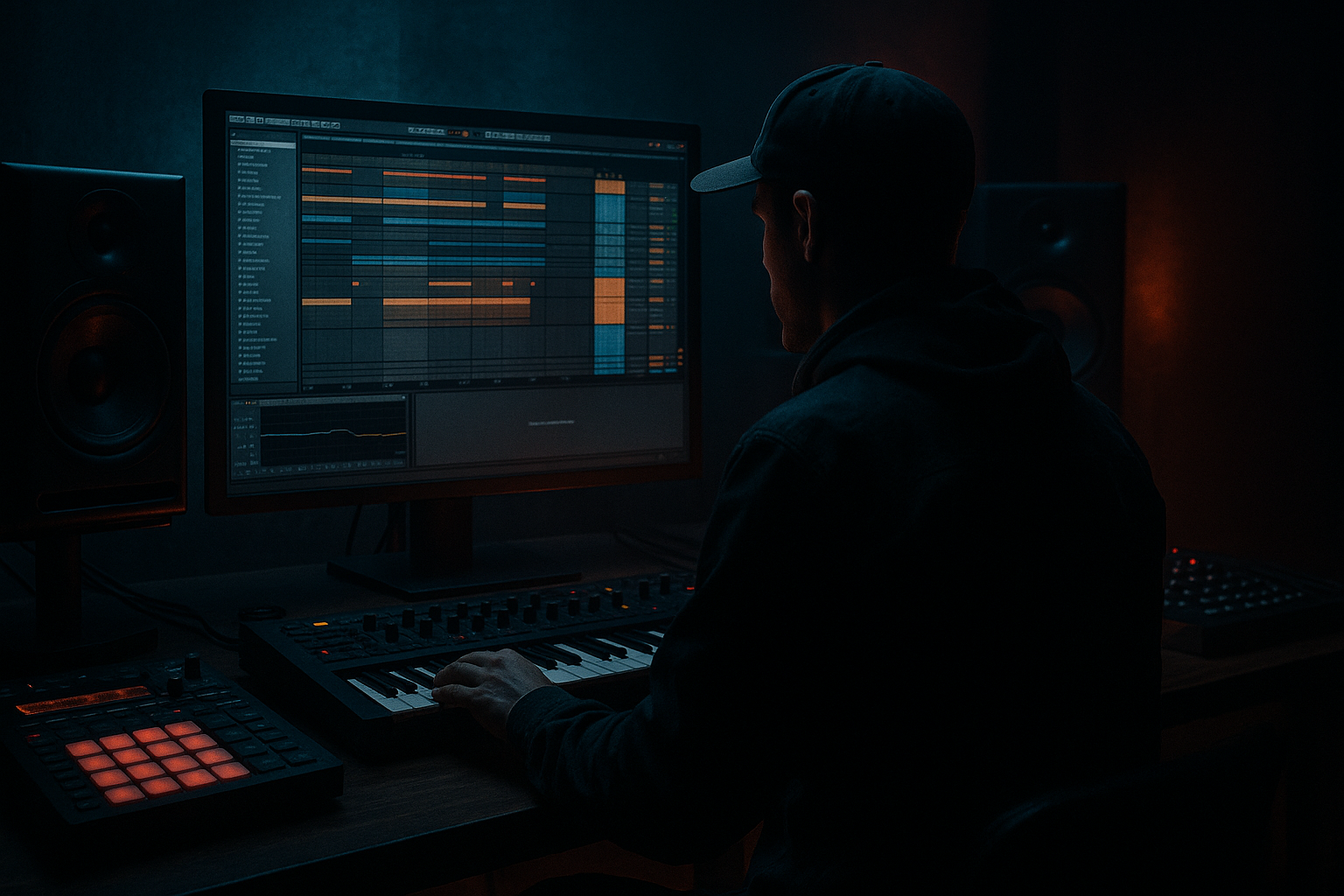
Main tutorial
Dubwise Deep Dive: Atmosphere Distort in Ableton Live 12 for Jungle / Oldskool DnB Vibes 🔥
1. Lesson overview
In this lesson, you’ll learn how to build a dubwise, atmospherically distorted bassline in Ableton Live 12 that feels at home in jungle, oldskool DnB, and dark rolling drum and bass.
We’re not just making a “bass sound.” We’re building a bass system:
- a solid sub for weight
- a mid-bass layer for grit and character
- dub-style distortion and movement
- space and atmosphere that sit around the drums without washing them out
- a rooted sub bass
- a wobbly, dirty dub layer
- delay and reverb textures that feel oldskool
- a simple arrangement approach that works in DnB
- Operator or Wavetable
- Saturator
- EQ Eight
- Utility
- Wavetable or Analog
- Amp or Pedal
- Overdrive or Saturator
- Echo
- Reverb
- Auto Filter
- optional Redux for oldskool grit
- punches the low end
- has grimey midrange movement
- leaves room for the kick and snare
- can be automated for drops, fills, and transitions
- 170–174 BPM for modern jungle / DnB
- 160–166 BPM if you want a heavier, half-step older feel
- 174 BPM
- 1 drum rack or audio track for breaks
- 1 MIDI track for sub
- 1 MIDI track for distorted atmosphere bass
- 1 return track for dub delay
- 1 return track for reverb
- F minor
- G minor
- A minor
- C minor
- a note on the 1
- a syncopated hit on the “&” of 2
- a short note before the snare
- a tail note leading into bar 2
- 1: root note
- 1e: rest
- 2&: root or fifth
- 3: short note
- 3a: rest
- 4&: root note pickup
- Oscillator A: Sine
- Octave: -1 or -2 depending on register
- Filter: off, or very subtle if needed
- Voices: 1
- Glide/Portamento: optional, very small amount if you want a little slide
- Oscillator 1: Saw
- Oscillator 2: Square or Saw
- Detune slightly
- Filter: Low-pass 24 dB
- Drive: moderate
- Envelope amount: medium
- Amp envelope
- Filter envelope
- Unison
- Model: Bass, Clean, or Plexi
- Gain: low to medium
- Bass: slightly boosted if needed
- Mid: boosted for character
- Treble: roll off if too harsh
- Drive: 3–8 dB
- Soft Clip: On
- Color: taste
- Dry/Wet: 30–70%
- Type: Low-pass
- Frequency: automate between 200 Hz and 2 kHz
- Resonance: 10–30%
- Drive: slight amount if desired
- Sync: On
- Time: 1/8 or 1/8 dotted
- Feedback: 20–45%
- Filter: cut lows, tame highs
- Modulation: low to moderate
- Stereo: moderate width, but don’t overdo it
- Use Echo mostly on the atmosphere layer, not the sub.
- If needed, place Echo on a return track instead of directly on the bass.
- Size: small to medium
- Decay: 1.2–2.8 s
- Pre-delay: 10–25 ms
- Low cut: high enough to protect the sub
- Dry/Wet: low if used on insert, or send via return
- High-pass around 120–200 Hz so it doesn’t fight the sub
- Cut harshness around 2–5 kHz if needed
- If it sounds boxy, dip around 300–600 Hz
- Sub should be the foundation
- Atmosphere layer should sit lower in level than you think
- The bass should still sound strong when the atmosphere layer is muted
- If the bass disappears, your sub is too weak
- If the bass still feels huge and wide, your atmosphere layer is probably too loud or too low in frequency
- Echo
- EQ Eight
- Time: 1/8 dotted or 1/4
- Feedback: 30–55%
- Filter out lows below 200–300 Hz
- Slight tape-style modulation if desired
- Reverb
- EQ Eight
- Decay: 2–4 seconds
- Low cut: fairly high
- High cut: slightly lowered for vintage tone
- filter cutoff
- distortion amount
- delay send
- reverb send
- During the build, increase filter cutoff gradually
- On the drop, snap it back down and hit harder with distortion
- On the last bar before the break repeat, send one bass note into delay
- filter cutoff
- distortion drive
- pan on the atmosphere layer
- echo dry/wet
- breakbeat
- filtered atmosphere
- very little bass
- bring in bass notes with low-pass filtering
- add delay throws on the last notes
- full sub + distorted atmosphere layer
- automate filter opening
- keep drum groove clear
- remove the sub for 1 bar
- add a delay hit or reverb tail
- bring bass back with a slightly different rhythm
- filter
- rhythm
- FX send
- note length
- bass articulation
- Wavetable
- detuned saws
- low-pass filter
- subtle chorus
- Downsample lightly
- Bit reduction very subtle
- Mix low
- Attack: fast
- Release: medium
- Gain reduction: subtle to moderate
- echo pops
- wash tails
- call-and-response moments
- clean sub
- dirty atmosphere layer
- one automated filter movement
- one dub delay throw
- Build bass in layers
- Keep the sub clean and mono
- Add character with saturation, amp, and distortion
- Use Echo and Reverb sparingly and musically
- Automate filters and sends for dub movement
- Arrange bass so it supports the drums, not fights them
- tight low end
- dirty mids
- controlled space
- rhythmic movement
This is a beginner-friendly workflow, but the end result will sound like something you’d hear tucked under chopped breaks and tape-worn ambience. 🌫️🥁
By the end, you’ll know how to create:
---
2. What you will build
You’ll make a 2-layer bass rack in Ableton Live:
Layer 1: Sub
A clean, mono low end using:
Layer 2: Dub atmosphere / distortion layer
A character layer using:
Result
A bassline that:
---
3. Step-by-step walkthrough
Step 1: Set up your project
Start with a fresh Ableton Live 12 project.
Suggested starting tempo
For this tutorial, use:
Create:
> Tip: Keep bass and atmosphere separate from the start. That makes mixing way easier.
---
Step 2: Write a simple DnB bass MIDI pattern
Use a short 1-bar or 2-bar loop.
Good beginner note choice
Stay mostly in one key center, like:
Example rhythm idea
Try a pattern with:
Example in 1 bar:
In DnB, the rhythm matters as much as the note choice. Keep the bass tight and intentional.
---
Step 3: Build the sub bass
Create a MIDI track and load Operator.
Operator settings
Add these stock devices after Operator:
1. EQ Eight
- High-pass only if needed, but be careful
- Usually leave the sub mostly untouched
- If there’s mud, cut a little around 200–350 Hz
2. Saturator
- Drive: 1–4 dB
- Turn on Soft Clip
- This helps the bass translate on smaller speakers
3. Utility
- Width: 0% or mono
- Keep the sub centered
Sub-bass rule
Your sub should sound clean and boring by itself. That’s good.
The excitement comes from the layer above it.
---
Step 4: Create the dub atmosphere layer
Duplicate the MIDI from the sub track onto a second MIDI track.
Now load Wavetable or Analog.
Good starting patch for Wavetable
Suggested sound design settings
- Attack: 0–10 ms
- Decay: 200–500 ms
- Sustain: 30–60%
- Release: 100–300 ms
- Small to medium amount
- Short decay for a pluckier dub hit
- Keep it subtle
- Too much unison can make the low end blurry
This layer should feel like a dubby mid-bass texture, not a giant EDM lead.
---
Step 5: Distort the atmosphere layer
Now we turn the sound into something gritty and alive.
Recommended device chain
Wavetable → Amp → Saturator → Auto Filter → Echo → Reverb → EQ Eight
Let’s break it down.
---
1. Amp
Use Amp to add character and drive.
Try:
This helps the bass feel more “speaker-like” and oldskool.
---
2. Saturator
Set:
If the sound gets too thin, back off the drive.
If it gets too clean, push it harder.
---
3. Auto Filter
This is where the dub vibe starts moving.
Try:
Use automation to make the bass sound like it’s opening and closing in the mix. That movement is very jungle/dubwise.
---
4. Echo
For dub flavor, Echo is your best friend. 🎛️
Suggested settings:
Important:
---
5. Reverb
Use Reverb for space, but keep it controlled.
Suggested settings:
For jungle and oldskool DnB, the reverb should feel like mist around the sound, not a huge wash.
---
6. EQ Eight
Clean up the layer after distortion and FX.
Typical moves:
This layer should add energy and tone, not low-end weight.
---
Step 6: Blend the sub and atmosphere
Now play both layers together.
Balance guide
Quick test
Mute the atmosphere layer:
Mute the sub:
Aim for support, not competition.
---
Step 7: Add dub-style space with returns
Create two return tracks:
Return A: Dub Delay
Load:
Settings:
Send short bass hits or selected chops into this return.
---
Return B: Atmospheric Reverb
Load:
Settings:
This is for sprinkles of space, not constant wash.
---
Step 8: Make the bass movement feel like jungle
Jungle and oldskool DnB bass often feels alive because it interacts with the break.
Try these techniques:
Option 1: Short notes with gaps
Use clipped, punchy MIDI notes so the drums can breathe.
Option 2: Call-and-response
Let the bass answer the snare or fill between drum hits.
Option 3: Automation phrases
Automate:
For example:
This is a classic dubwise trick: energy comes from automation, not constant volume.
---
Step 9: Add movement with Ableton stock modulation tools
Use these Ableton tools to make the bass feel less static:
Auto Filter
Great for sweeps and rhythmic movement.
LFO (Max for Live, if available)
If you have it, map a slow LFO to:
Envelope Follower
If you’re feeling more advanced later, use the drums to shape bass movement.
Chorus-Ensemble
Use very lightly on the atmosphere layer only.
Too much will smear the low mids.
---
Step 10: Arrange it like DnB
A bass sound only works if the arrangement supports it.
Simple arrangement approach
Intro
Build
Drop
Variation
Good beginner arrangement rule
Every 8 bars, change one thing:
That keeps the track moving without overwhelming the listener.
---
4. Common mistakes
1. Making the distortion layer too low
If your distorted layer has too much sub, it will clash with the clean sub and make the mix muddy.
Fix: high-pass the atmosphere layer.
---
2. Using too much reverb on the bass
Big reverb can destroy clarity in DnB.
Fix: keep reverb short, filtered, or on a send.
---
3. Making the sub stereo
A wide sub sounds weak and unstable.
Fix: keep the sub mono with Utility.
---
4. Not leaving space for the snare
In jungle and DnB, the snare needs to hit hard.
Fix: avoid long bass notes right on the snare unless it’s a deliberate arrangement choice.
---
5. Overusing distortion
More distortion is not always better.
Fix: use saturation for harmonics, then test the mix at lower volumes.
---
6. Forgetting automation
A static bass sound gets boring fast.
Fix: automate filter, send levels, and distortion in key sections.
---
5. Pro tips for darker/heavier DnB
Tip 1: Layer a reese under the dub atmosphere
Add a second mid layer with:
Keep it tucked under the main tone for extra weight.
---
Tip 2: Use Redux carefully
For oldskool grit, try Redux on the atmosphere layer:
This can give a worn, tape-like edge.
---
Tip 3: Saturate before reverb
If you want the reverb tail to feel dirty and vintage, saturate the source first.
That way the reverb “inherits” the grime.
---
Tip 4: Sidechain the bass to the kick
Use Compressor or Glue Compressor with sidechain from the kick.
Typical start point:
In DnB, the kick and bass relationship has to be tight, or the groove collapses.
---
Tip 5: Use automation lanes for dub throws
Automate send amounts only on selected bass notes.
That creates those classic:
Very effective in jungle and dubwise DnB.
---
6. Mini practice exercise
Goal
Build a 4-bar bass loop with:
Steps
1. Create a 4-bar MIDI clip in F minor or G minor
2. Program a simple root-note rhythm with 4–6 hits
3. Split the sound into:
- Sub: Operator + Utility + EQ Eight
- Atmosphere: Wavetable + Saturator + Auto Filter + Echo
4. Automate the atmosphere filter cutoff to open slightly over bars 3–4
5. Send the last note of bar 4 into Echo for a throw
6. Export or loop it over a breakbeat and listen at full track volume
Challenge
Make the bass feel heavier without making it louder.
That is the real skill here.
---
7. Recap
You now have a practical workflow for creating dubwise distorted atmosphere bass in Ableton Live 12 for jungle and oldskool DnB.
Key ideas to remember:
If you want the sound to feel authentic, think like a DnB engineer:
Keep it raw, keep it focused, and let the breaks breathe. 🥁🔥

