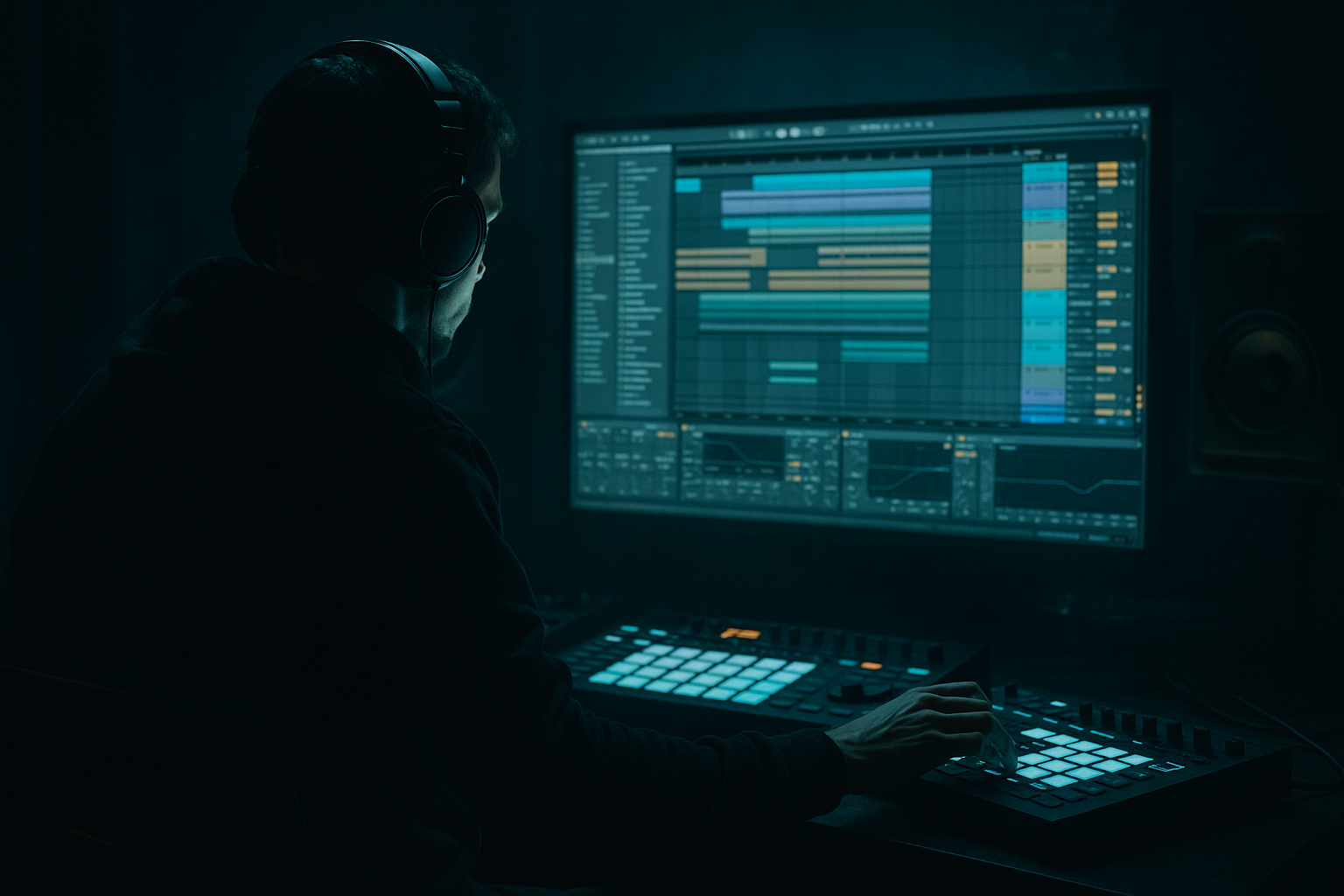
Main tutorial
Dubwise Sub Blend System (Crisp Transients + Dusty Mids) in Ableton Live 12
Beginner-friendly jungle / oldskool DnB composition lesson 🥁🔊
---
1. Lesson overview
In jungle and oldskool DnB, the bass often feels like two basses working as one:
- A clean, stable sub that hits the chest and stays consistent on big systems
- A dubwise mid layer that brings character: dusty, filtered, slightly saturated, and rhythmically alive
- Both glued together so the drums stay punchy, especially the kick + snare transients
- 8-bar drum loop (break + kick reinforcement)
- 8-bar bass phrase (sub holds foundation, mid dances around it)
- A quick dubwise “call and response” method
- Sub: holds long notes (foundation)
- Mid: answers with rhythmic stabs, slides, or filter moves
- Put Echo on the Mid (send/return is ideal)
- Automate the send on just the last note of a phrase
- Sub not mono: wide sub = weak sub. Keep it centered with Utility Width 0%.
- Mid layer still contains low bass: if you don’t high-pass the Mid at 120–160 Hz, it will smear your low end.
- Too much saturation on the sub: distortion can wreck headroom and make the bass “farty.” Keep sub harmonics subtle.
- Over-ducking: if sidechain is crushing 8–12 dB, your bass will feel like it’s disappearing.
- No space for snare: jungle relies on snare snap. If your mid layer is loud around 200–800 Hz, it can mask snare body.
- Split the mid into two bands (advanced but worth it):
- Use Roar with darker voicing:
- Add sub movement without losing stability:
- For heavier impact, tune your kick to complement the sub:
- Use Drum Buss Transient on the break and keep bass ducked lightly—this combo screams “rolling.”
- Sub = clean, mono, low-passed, lightly saturated
- Mid = high-passed, filtered, dusty saturation, movement via LFO/automation
- Bass Bus = glue + safety, plus sidechain to preserve crisp drum transients
- You arranged it in a simple 8–16 bar structure with dub-style filter/echo moments 🎛️
In this lesson you’ll build a repeatable “sub blend system” inside Ableton Live 12 using mostly stock devices, with a workflow that’s reliable for rolling 160–175 BPM jungle vibes.
---
2. What you will build
A 3-layer bass system with a control bus:
1. SUB Track (mono, clean, sine/triangle-focused, consistent)
2. MID Track (dubby, dusty, filtered, saturation + movement)
3. TRANSIENT CONTROL / DUCKING (sidechain or envelope shaping to keep drums crisp)
4. BASS BUS (glue, final EQ, and safety limiting)
You’ll also create a simple oldskool arrangement loop:
---
3. Step-by-step walkthrough
A) Set up the project (tempo + vibe)
1. Tempo: set 168 BPM (classic jungle range; works for oldskool DnB too)
2. Key: pick something bass-friendly like F minor or G minor
3. Create 4 tracks:
- Drums
- Sub
- Mid
- Bass Bus (Group): group Sub + Mid into this
> Tip: Color code. Drums = orange, Sub = blue, Mid = purple, Bus = green. It speeds up decision-making.
---
B) Build the DRUM foundation (so transients have a target)
You don’t need perfect drums, but you do need a clear kick + snare transient to mix the bass against.
1. On Drums, drop a breakbeat loop (Amen, Think, etc.)
2. Add Drum Buss (stock) after it:
- Drive: 5–15%
- Boom: 0 (for now; we’ll let bass own subs)
- Transient: +10 to +25 (bring snap)
- Crunch: 0–10 (optional, for grit)
3. Add EQ Eight:
- High-pass around 25–35 Hz (stop useless rumble)
- If the break is too boxy, dip 250–450 Hz by 2–4 dB
Optional but very “oldskool”: layer a one-shot snare on 2+4 quietly for extra crack.
---
C) Create the SUB track (clean + mono + stable)
This is the part that should still sound good on a phone and a club system.
1. On Sub, add Operator (stock)
2. Operator settings (simple and effective):
- Oscillator A: Sine (or Triangle if you want a touch more harmonics)
- Voices: 1 (mono)
- Glide/Portamento: Off at first (add later if you want slides)
3. Add MIDI clip (start simple):
- Notes follow the root: e.g. F1 (or F0 depending on your monitoring)
- Use a classic jungle rhythm: long notes with short “pickup” notes
- Example (1 bar):
- Beat 1: long F
- Beat 3&: short F (or an octave jump for energy)
4. Processing chain (keep it clean):
- EQ Eight
- Low-pass around 80–120 Hz (yes, low—this is sub only)
- If it’s too heavy, tiny dip around 50–60 Hz (1–2 dB)
- Saturator (very gentle)
- Drive: 1–3 dB
- Soft Clip: On
- Goal: make sub slightly more audible without turning it into mid-bass
- Utility
- Width: 0% (mono)
- Bass Mono: On (if you use it), set around 120 Hz
✅ Result: a sub that’s solid, centered, and doesn’t fight the mix.
---
D) Create the MID track (dusty dubwise layer)
This is your “speaker flex” layer—movement, texture, and vibe.
1. On Mid, add Wavetable (stock) or Analog
- Wavetable is great because it stays stable while you add harmonics.
2. Basic sound source (Wavetable suggestion):
- Osc 1: Basic Shapes → start on saw/square-ish
- Unison: 2 (keep subtle)
- Voices/Poly: Mono (or 1 voice), enable Glide if you want dub slides:
- Glide/Portamento: 30–80 ms
3. Make it “dubwise”: filter + saturation + movement
Device chain (in this order):
1) Auto Filter
- Mode: LP24 (steep low-pass)
- Freq: start around 200–600 Hz
- Resonance: 10–25%
- Envelope: small amount if you want pluck (optional)
- Add LFO for movement:
- Rate: 1/4 or 1/8 (tempo-synced)
- Amount: small (just enough to breathe)
2) Roar (Ableton Live 12 stock) for dusty mids 😤
- Style: try Tape or Tube
- Drive: 5–15% (don’t destroy it yet)
- Tone/EQ inside Roar: roll a bit of top end if it gets fizzy
3) EQ Eight (make space for sub + keep it “mid”)
- High-pass: 120–160 Hz (important!)
- Gentle boost (optional): 700 Hz – 1.5 kHz if you want “woody” presence
- If it’s harsh: dip 2–4 kHz
4) Chorus-Ensemble (optional, for width—but keep bass safe)
- Mix: 10–25%
- Then add Utility after:
- Width: 60–120% (but keep an ear on phase)
- Use Bass Mono up to 150 Hz if needed
✅ Result: the mid layer has character and movement, but no sub content.
---
E) Glue the layers: the BASS BUS
Group Sub + Mid into a group called BASS BUS.
On BASS BUS, add:
1. EQ Eight (safety and clarity)
- High-pass: 20–30 Hz
- Tiny dip where kick fundamentals live if needed (often 50–70 Hz)
2. Glue Compressor (very gentle)
- Attack: 10 ms
- Release: Auto
- Ratio: 2:1
- Aim for 1–2 dB gain reduction on peaks
3. Limiter (safety only)
- Ceiling: -0.8 dB
- Don’t slam it—this is just protection while you learn.
---
F) Keep transients crisp: sidechain the bass (simple + effective)
To keep the jungle drums punching, you’ll duck the bass slightly when the kick/snare hit.
Option 1 (Beginner-friendly): Compressor Sidechain
1. On BASS BUS, add Compressor
2. Enable Sidechain
3. Input: Drums
4. Settings:
- Ratio: 3:1
- Attack: 2–10 ms (fast enough to get out of the way)
- Release: 80–160 ms (tempo-dependent; adjust by feel)
- Threshold: lower until you see 2–4 dB reduction on hits
Option 2 (Cleaner groove control): Shaper (if available) / Volume automation
If you have Shaper in Live 12 Suite, you can do a rhythmic duck curve. If not, just automate Utility Gain dips on the Bass Bus at kick/snare moments.
✅ Result: kicks and snares stay front and snappy, bass stays big but controlled.
---
G) Write a jungle-style bass phrase (call & response)
Oldskool DnB bass often does this:
Practical workflow:
1. Copy the Sub MIDI to Mid
2. On Mid, delete some notes so it “speaks” in gaps:
- Leave space on the snare hits (beats 2 and 4)
- Add a short note before beat 3 or beat 4 for forward motion
3. Automate Auto Filter cutoff on Mid:
- Bar 1–2: darker (200–350 Hz)
- Bar 3–4: open slightly (400–700 Hz)
- Bar 7–8: open the most for mini “lift” into the loop
---
H) Arrangement idea (8 or 16 bars that feels like a tune)
Try this classic structure:
Bars 1–4: Drums + Sub only (tease)
Bars 5–8: Add Mid (main groove arrives)
Bars 9–12: Drop Mid out for 1 bar, do a little filter sweep (dub style)
Bars 13–16: Bring Mid back with more movement + a fill
Add a quick dub trick:
- Time: 1/8 or 1/4 dotted
- Feedback: 15–30%
- Filter inside Echo: roll off lows below 200 Hz
---
4. Common mistakes
---
5. Pro tips for darker/heavier DnB
- Mid Low (150–500 Hz): woody weight
- Mid High (500 Hz–3 kHz): growl/edge
Use two EQ’d duplicates and distort them differently.
- Drive moderate, then roll off top end after with EQ Eight low-pass around 6–10 kHz
- Tiny pitch envelope in Operator (very subtle) or a gentle velocity-to-filter on the Mid only.
- If your sub is F, try kick fundamental around 45–55 Hz depending on the sample.
---
6. Mini practice exercise (15–20 minutes)
1. Load a break and get it punching with Drum Buss (+15 Transient).
2. Write an 8-bar Sub line using only 2 notes (root + fifth).
3. Duplicate MIDI to Mid, then:
- High-pass at 150 Hz
- Add Auto Filter LFO at 1/8
- Add Roar with Tape style
4. Sidechain BASS BUS to Drums for ~3 dB ducking.
5. Export a quick loop and listen on:
- Headphones
- Small speaker / phone
Check: can you still feel the bass rhythm when quiet?
---
7. Recap
You built a classic jungle/DnB dubwise bass blend system:
If you want, tell me what BPM and key you’re working in and whether you’re using a specific break (Amen/Think/etc.), and I’ll suggest a ready-to-drag MIDI pattern and a tighter filter automation curve for that vibe.

