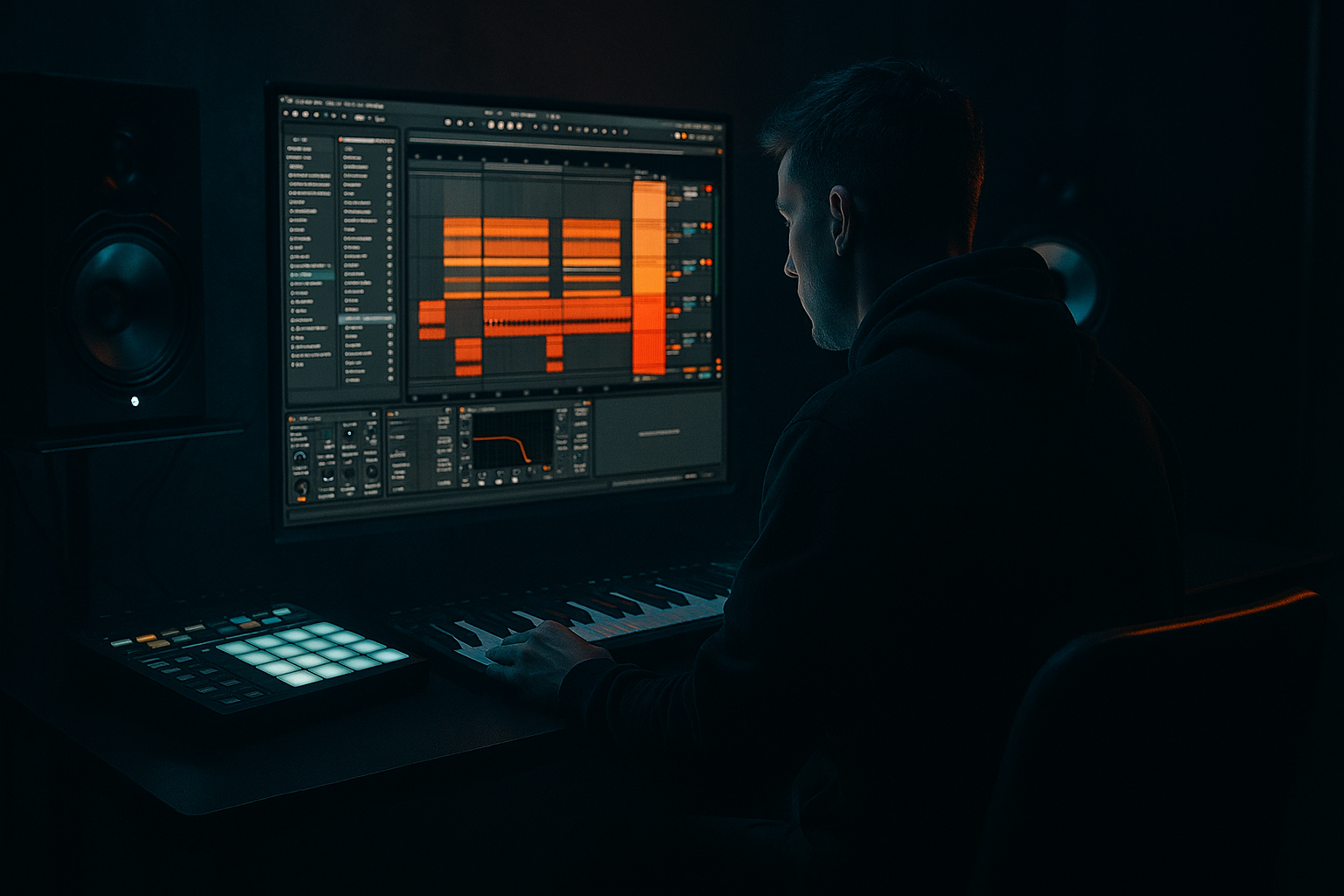
Main tutorial
Lesson Overview
This lesson is about building an echo-chamber filtered breakdown for jungle / oldskool DnB vibes inside Ableton Live 12: a short section where a vocal stab, drum hit, or chopped sample gets swallowed by delay, then narrowed, filtered, and reintroduced with tension before the drop lands.
In a real DnB track, this lives in the 8-bar or 16-bar breakdown, usually just before a drop or a switch-up. It is not just “a cool effect.” It is a functional arrangement tool: it clears space for the ear, creates contrast after a busy drum section, and makes the drop feel bigger because the listener has been stripped back into atmosphere and anticipation.
Musically, this technique suits:
- jungle and oldskool DnB
- dark rollers
- break-heavy intro/outro sections
- vocal sample-based breakdowns
- 90s-informed club music with modern low-end control
- dubby, haunted, and rhythmic
- slightly lo-fi but still intentional
- wide enough to feel atmospheric, but not wide in the low end
- polished enough to sit in a track without sounding like a random FX experiment
- ready to lead from a busy drum section into a drop
- sits in the breakdown or pre-drop
- gives the listener a breathing point
- can also work as a mid-track switch-up
- supports drums and bass by leaving them out, then preparing their return
- Filter the repeat, not just the source. If the sample is dark but the delay stays bright, the chamber feels fake. Tame the delay top end so each repeat gets a little more distant.
- Use saturation before echo for grime, after echo for glue.
- Let one element stay dry.
- Keep the chamber off-center, not the low end.
- Resample the best 2 bars.
- Use negative space before the drop.
- Use only one sample source.
- Use only Ableton stock devices.
- No more than three FX devices in the main chain.
- The effect must still make sense when drums return.
- One breakdown section with automation for filter and delay
- One final bar that clearly sets up the drop
- One bounce or resampled version of the best 2 bars
- Can you hear the sample’s identity through the effects?
- Does the chamber get more tense over time?
- Is the low end still clean when the drums come back?
- high-pass the chamber
- shape the delay rhythm
- automate the transition
- check it with drums and bass
- leave room for the drop to hit
Technically, it matters because you are shaping three things at once:
1. space — less full-spectrum energy than the main groove
2. motion — delay repeats and filter movement keep it alive
3. transition — the breakdown becomes a clear runway into the next section
By the end, you should be able to hear a short sample get pushed into a controlled, murky echo chamber, with the low end removed, the mids moving, and the whole phrase feeling like it is pulling the track toward the drop without muddying the mix.
What You Will Build
You will build a filtered breakdown passage made from a chopped sample or vocal phrase, with echo repeats, band-limited tone, and arrangement movement that feels authentic to jungle and oldskool DnB.
The finished result should sound:
Role in the track:
Success should feel like this: when the breakdown hits, the track seems to fall into a tunnel of echo and filter movement; the sample becomes a memorable hook, the groove remains implied, and the return of the drums feels justified and powerful.
Step-by-Step Walkthrough
1. Choose a sample with attitude, not too much low end
Start with a short vocal phrase, a stab, a chopped amen fragment, or a dusty one-shot with character. In jungle and oldskool DnB, the sample does not need to be pristine; it needs a recognisable personality. Put it on an Audio Track in Ableton and trim it to something between 1/2 bar and 2 bars long.
Good starting material:
- a vocal chop with a sharp consonant
- a ghostly stab
- a break hit with some room tone
- a reggae-ish phrase or texture
Why this works: the echo chamber effect becomes much more musical when the source has a clear contour. A flat sound just becomes mush. A sample with a strong transient or spoken rhythm gives the delay something to “grab.”
What to listen for:
- does the sample have a phrase shape?
- can you recognise it after one repeat?
- does it already hint at mood, even dry?
If the sample is too full, high-pass it later. If it is too thin, layer a second texture underneath rather than forcing more bass into the echo.
2. Build the core echo chain with stock Ableton devices
Put these devices after the sample in this order:
Option A: cleaner, more readable chamber
- Auto Filter
- Echo
- Reverb
- EQ Eight
Option B: dirtier, more vintage tunnel
- Saturator
- Auto Filter
- Echo
- Redux
- EQ Eight
For a beginner, Option A is easier to control. Option B is better if you want more grime and oldskool character.
A strong starter setup:
- Auto Filter: high-pass around 180–300 Hz
- Echo: delay time synced to 1/4, 3/16, or 1/8D depending on groove
- Echo Feedback: around 25–45%
- Echo Filter: cut some top so the repeats feel distant, often around 4–8 kHz
- Reverb: decay around 1.5–3.5 s, low cut engaged, dry/wet modest
- EQ Eight: remove any leftover sub and harshness
Why this works in DnB: delays in jungle and oldskool styles are often part of the arrangement language. They create the “echo chamber” feeling that bridges rhythmic tension and atmosphere, especially when the drums drop away.
3. Shape the sample into the breakdown, not the whole song
Now automate the filtering so the sample feels like it is being pulled into a tunnel.
In Ableton, automate:
- Auto Filter cutoff
- Echo feedback
- Echo dry/wet
- Reverb dry/wet
- optionally Saturator drive if you used it
A useful breakdown move:
- start the section with the sample fairly audible
- over 2 to 4 bars, narrow it into a more filtered, more echoed state
- on the final bar before the drop, reduce the dry signal and let the repeats do the talking
Realistic ranges:
- Auto Filter cutoff moving from roughly 3–6 kHz down to 300–800 Hz
- Echo feedback rising from 25% to 50% for tension
- Reverb dry/wet moving from 10–20% up to 30–45%
- If distortion is used, keep it subtle: 1–3 dB of added drive is often enough
What to listen for:
- does the breakdown feel like it is “closing in” rather than just getting quieter?
- do the repeats keep emotional momentum?
- does the automation create anticipation without masking the incoming drum impact?
4. Make the rhythm speak in DnB phrasing
Don’t place the sample randomly. Think in 2-bar and 4-bar phrases. Jungle and DnB arrangements feel much stronger when the breakdown has a sense of question and answer.
A simple arrangement idea:
- Bars 1–2: sample mostly clear, lightly echoed
- Bars 3–4: filter narrows, delay becomes more obvious
- Bars 5–6: leave more space between phrases, let tails breathe
- Bars 7–8: the chamber becomes more abstract; prep the drop
- Bar 8 end: cut the dry sample or reverse into the drop
If your sample is a vocal phrase, use the first half of the breakdown as the “call” and the second half as the “response,” but the response can be mostly echo and filter movement rather than a new line.
This is where the technique becomes useful in a track, not just interesting in isolation. The listener feels the arrangement shifting even if the actual source material is simple.
5. Add movement with a second stock-device layer
To give the chamber more life, duplicate the track or use a second Audio Track with a related layer.
Two good approaches:
A. Atmospheric layer
- duplicate the sample
- push it lower in level
- use Auto Filter with a more aggressive high-pass, around 300–600 Hz
- add Reverb with longer decay
- pan it slightly left or right, but keep it subtle
B. Dirty layer
- duplicate the sample
- put Saturator before Echo
- set Drive modestly, then reduce output to keep level stable
- optionally add Redux lightly for grain
Decision point:
- Choose A if you want a more haunted, spacious jungle breakdown.
- Choose B if you want a rawer, grimier oldskool / rave feel.
Important: do not create stereo chaos in the low mids. If the effect layer starts smearing the groove, high-pass it harder and keep the main sample more centered.
6. Check the idea against your drums and bass context
This step is essential. A breakdown is not successful just because it sounds cool in solo. Put your drums and bass back in around the transition and check whether the chamber has enough contrast.
Use this context check:
- mute the bass and let the breakdown breathe
- bring in only hats or a reduced break loop if needed
- then return the kick/snare or the full drop
Listen for:
- does the breakdown leave a clear pocket for the drop?
- is the bass return going to feel massive after this filtered space?
- does anything in the echo chamber fight the snare entrance?
If the sample overlaps with the snare entry too much, shorten the delay feedback or cut the wet signal earlier. If the breakdown feels empty, add a small rhythmic element: a ghost break slice, a low-level rim, or a filtered percussion tick.
This is a good moment to commit this to audio if the automation and delay movement already feel right. Printing the result can help you stop overworking it and make the arrangement decisions faster.
7. Control the low end and mono compatibility
This kind of effect can get messy very quickly if the delay or reverb carries too much low-mid energy. That is especially risky in DnB, where the bass and kick need a clean lane.
Use EQ Eight after your FX chain:
- high-pass the effect return or sample chain around 180–300 Hz
- if the chamber feels boxy, gently reduce around 250–500 Hz
- if the echoes poke harshly, check 2–5 kHz
- if the top gets fizzy, tame 7–10 kHz
Mix-clarity note: if you make the chamber too wide, it can sound huge in headphones and weak on systems. Keep the low end mono by design: the effect should live mostly above the low bass region, while the true bass stays elsewhere in the track.
What to listen for:
- does the kick still hit clearly when the breakdown returns to the drop?
- do the repeats disappear when collapsed toward mono, or do they still read as a clear texture?
- does the effect sound like atmosphere, or like it is clouding the whole mix?
8. Use automation for tension, then simplify at the end
The best echo chamber breakdowns usually get busier in the middle and simpler right before the drop.
Automate one or two key moves:
- increase feedback for the middle of the breakdown
- reduce dry signal near the end
- slowly close the filter
- cut the reverb tail just before the drop so the drop lands cleanly
A reliable phrasing example:
- bars 1–4: moderate echo, some definition
- bars 5–6: more filtering, more space between hits
- bar 7: the chamber gets hazier and more emotional
- bar 8: remove the dry sample and let one last delay tail spill into the drop
The goal is not endless effect. The goal is controlled anticipation. If the listener can predict the drop because the breakdown is clearly narrowing, the arrangement is doing its job.
9. Tighten the timing if the repeats blur the groove
If the delay feels too washed out, change the rhythmic value rather than stacking more effects. In DnB, the rhythm of the delay matters as much as the tone.
Try these delay choices:
- 1/4 for a slower, deeper echo chamber
- 3/16 for a more skipping, restless jungle feel
- 1/8D for a more urgent rolling tension
If the echoes land awkwardly against the drum phrasing, nudge the sample slightly earlier or later by a few milliseconds. Small moves matter here. A tiny timing change can make the chamber feel locked to the groove instead of floating randomly.
Workflow efficiency tip: once you find a good echo timing, duplicate the track or save the chain as a starting point for future breakdowns. One good chamber can become a repeatable track-building tool.
10. Finish with a drop-aware exit
The breakdown should not end like it was simply faded out. Give it a deliberate exit that sets up the next section.
Good exits:
- a single filtered tail that lands into the drop
- a reverse sample swell
- a final echo-only hit that disappears before the first kick/snare
- a drum pickup that reintroduces the rhythm before full impact
The exit should feel like the chamber opens back out into the room. That contrast is what makes the drop feel bigger.
Successful result check: if the breakdown makes you anticipate the drums returning, if the sample still has identity through the filtering, and if the low end stays clear when the drop arrives, you have nailed it.
Common Mistakes
1. Leaving too much low end in the sample or effects
- Why it hurts: the breakdown muddies the bass space and makes the drop less powerful.
- Fix in Ableton: use Auto Filter or EQ Eight to high-pass the sample/effect chain around 180–300 Hz, and check the return in context with bass.
2. Using too much feedback so the echoes become fog
- Why it hurts: the chamber loses rhythm and turns into a wash that hides the phrase.
- Fix in Ableton: lower Echo feedback into a more controlled range, often 25–45%, and automate it only where tension is needed.
3. Making the effect huge in solo but weak in the track
- Why it hurts: soloed sounds can trick you into overprocessing; in context the breakdown may fight the drums.
- Fix in Ableton: always check the chamber with at least kick/snare or a reduced drum loop before committing.
4. Stereo widening the whole effect, including the low mids
- Why it hurts: the breakdown sounds exciting on headphones but loses focus and mono compatibility.
- Fix in Ableton: keep the chamber’s low end filtered out, and if necessary narrow the effect by reducing width through your arrangement choices rather than forcing more stereo.
5. Not automating the transition
- Why it hurts: a static echo chamber sounds like a loop, not a breakdown.
- Fix in Ableton: automate filter cutoff, feedback, and dry/wet over 2 to 8 bars so the section evolves.
6. Choosing a source with no character
- Why it hurts: delays and reverb magnify bland material; the result feels generic.
- Fix in Ableton: use a sample with strong transient shape, vocal identity, or break texture so the chamber has something memorable to work with.
7. Letting the breakdown run too long without a payoff
- Why it hurts: the listener loses tension and the drop feels less earned.
- Fix in Ableton: keep the phrasing tight, usually 4, 8, or 16 bars, and design a clear final bar leading into the drop.
Pro Tips for Darker / Heavier DnB
Pre-echo saturation gives the repeats more attitude. Post-echo saturation makes the whole chamber feel more pinned together. For darker DnB, a small amount before the delay often sounds nastier and more oldskool.
If everything is swimming, nothing feels heavy. Keep one anchor element—often the snare, a ghost break, or the sub bass—clean while the sample sinks into the chamber.
You can pan the echoed texture slightly for width, but the actual weight of the track should stay centered and mono-safe. That contrast is what gives dark DnB its punch.
If the delay movement sounds perfect, record it to audio and chop the best tail. This lets you place the chamber precisely in the arrangement and avoid endless parameter chasing.
A final half-bar where the dry sample disappears and only a tail remains will often hit harder than adding one more effect. In heavier DnB, restraint is part of the pressure.
Mini Practice Exercise
Goal: Build a 4- to 8-bar filtered echo chamber breakdown that leads cleanly into a drop.
Time box: 15 minutes
Constraints:
Deliverable:
Quick self-check:
Recap
The core idea is simple: take a characterful sample, push it through a controlled delay-and-filter chain, and automate it so the breakdown feels like a dark tunnel of tension rather than a random wash of effects.
Remember:
If the result feels haunted, rhythmic, and clearly connected to the next section, you have built a proper jungle / oldskool DnB echo chamber breakdown.

