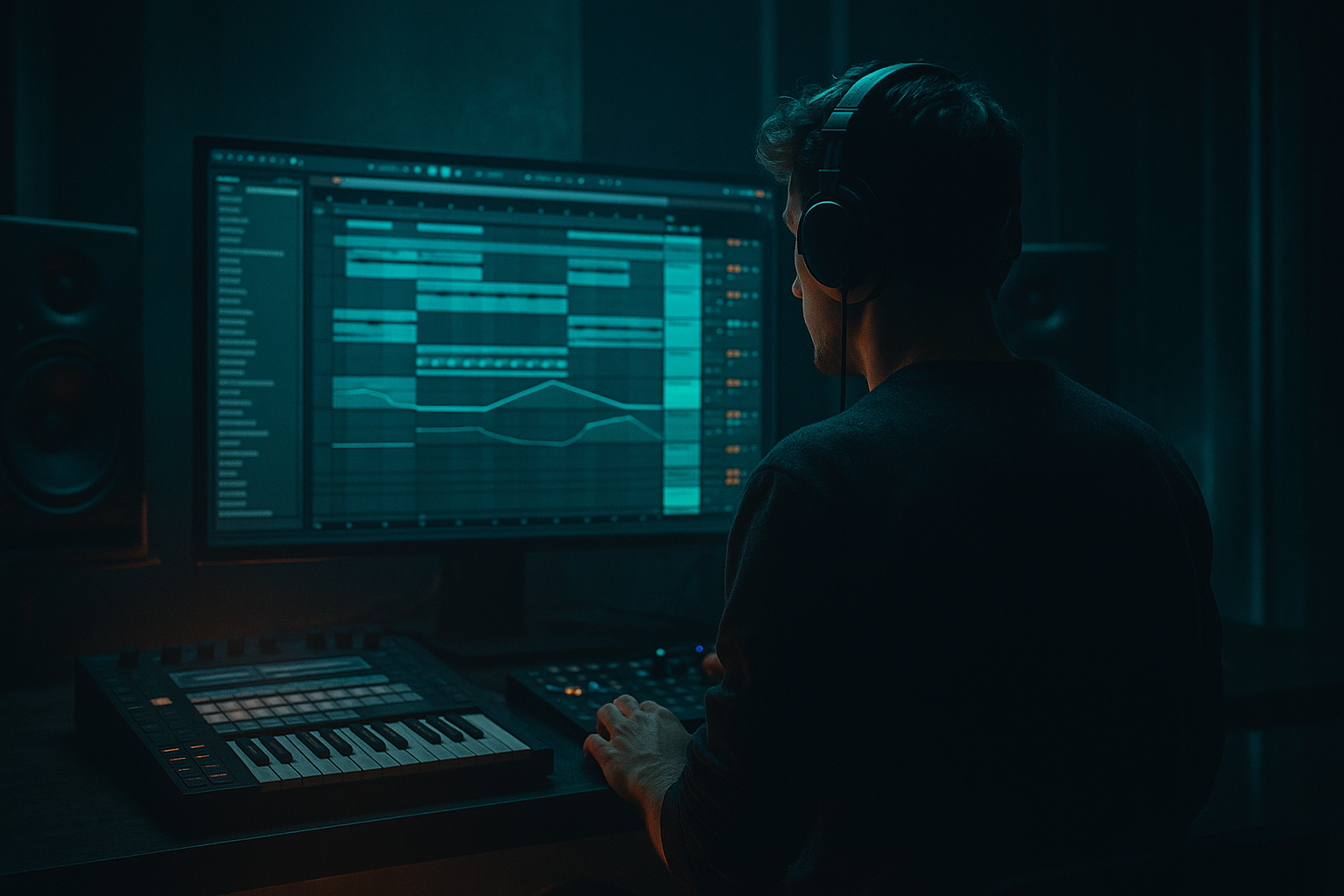
Main tutorial
```markdown
Echo Freeze as a Composition Tool (DnB in Ableton Live) 🎛️❄️
1) Lesson overview
Echo “freeze” techniques are one of the fastest ways to turn tiny moments into full sections in drum & bass: transitions, intros, breakdown texture, fills, tension ramps, and those glossy “time-stopped” stabs you hear in jungle and rolling neuro-leaning tunes.
In Ableton Live, we’ll treat delay feedback + capture/resample as a composition workflow, not just an effect. You’ll learn reliable methods using stock devices (Echo, Delay, Reverb, Gate, Auto Filter, Saturator, Utility) and arrangement tactics that feel native to 175 BPM music.
---
2) What you will build
A reusable “Echo Freeze Composer” setup that can:
- Grab a micro-slice (snare hit, vocal chop, reese stab, amen ghost) and turn it into a frozen drone / rhythmic loop
- Evolve that freeze with filtering, modulation, distortion, and gating
- Print it to audio (resampling) to create:
- Create Return A → add Echo.
- Suggested Echo settings for DnB freezing:
- Group Echo in an Audio Effect Rack.
- Map Feedback to Macro 1 called `FREEZE`.
- Map Input Gain (or the return track’s Utility Gain) to Macro 2 called `INPUT`.
- Map Filter Frequency to Macro 3 called `TONE`.
- Send your source (snare/vocal/stab) to Return A.
- At the exact moment you want to capture:
- Immediately pull the source send down (so the freeze sustains alone).
- In the 8 bars pre-drop, automate:
- Consolidate (`Cmd/Ctrl + J`) into clean chunks.
- Warp mode:
- Take the printed freeze, reverse it, fade in, and place it 1 bar before the drop.
- Layer a short snare fill on top. Instant “suck into the drop”.
- Intro (8–16 bars):
- Breakdown bed:
- Pre-drop tension (last 2 bars):
- Between phrases (every 8 bars):
- Letting the freeze keep low end: your sub will collapse. Always HP the freeze return (`120–250 Hz`).
- Feedback too high without a limiter: self-oscillation can spike. Put a Limiter at the end of the return (Ceiling `-1 dB`).
- Too wide in the low-mids: wide smeared delays at 200–600 Hz muddy the groove. Control width with Utility or mid/side EQ if you use EQ Eight.
- Freezing everything at once: pick one hero element per moment (snare OR vocal OR stab). DnB is dense—clarity wins.
- Not printing the best moments: if it sounds sick, resample it. Don’t rely on recreating a “perfect” freeze performance later.
- Neuro-style controlled menace:
- Make the freeze feel “mechanical”:
- Reese freeze without losing punch:
- Jungle artifact trick:
- Drop impact:
- Treat Echo freeze as a composition engine, not just a delay.
- Build a return-based setup with Echo + Filter + Saturation + Gate to make freezes musical and groove-locked.
- Resample your best freeze moments into audio and arrange them like samples.
- For DnB, protect the low end (HP!), keep it controlled (Limiter), and use gating/modulation for rolling movement.
- intro atmospheres
- breakdown beds
- pre-drop tension
- post-drop ear-candy fills
---
3) Step-by-step walkthrough
A) Session setup (so the timing hits right) ⏱️
1. Set tempo to 174–176 BPM.
2. Work with a typical DnB palette:
- Drum bus (break/amen layer + punchy one-shots)
- Bass (reese or wobble)
- Stab/Vocal (short, characterful)
3. Decide what you want to freeze:
- Snare = classic “time smear” and transition bed
- Vocal chop = instant hooks and callouts
- Reese stab = dark sustained texture
---
B) Method 1 — “True Freeze” with Echo (hold a moment indefinitely) ❄️
Goal: Hit a moment, freeze it, then perform it like an instrument.
#### 1) Put Echo on a Return track (recommended)
Using a Return makes it easy to freeze any element.
- Time: `1/8` (great for roll) or `1/4` (bigger space)
- Sync: On
- Feedback: start around `70–85%`
- Dry/Wet: `100%` (because it’s a return)
- Filter: HP around `150–250 Hz` to avoid sub mud
- Mod: keep subtle (`2–10%`) unless you want pitchy chaos
- Noise/Wobble: optional; tiny amounts add grit but can get messy fast
#### 2) Add a “Freeze switch” macro
Echo doesn’t have a single “Freeze” button like some plugins, so we build one:
- Set Macro range 85% → 110% (yes, allow it to push into self-oscillation territory).
How to use it live:
- Push `INPUT` up a touch if needed
- Snap `FREEZE` to ~`95–105%`
✅ DnB timing tip: freeze on the last snare before a drop or the last vocal syllable at the end of a 16.
---
C) Method 2 — Rhythm-locked freeze using a Gate (turn smear into a rolling pattern) 🔥
Goal: Your freeze becomes a new groove layer.
On Return A, after Echo, add:
1. Auto Filter
- Mode: LP24
- Freq: start `2–6 kHz`, automate down for tension
- Res: `10–25%`
2. Gate
- Turn on Sidechain (Gate → Sidechain)
- Audio From: your Drum bus (or a dedicated ghost trigger track)
- Adjust:
- Threshold: until it rhythmically opens
- Attack: `0.1–1 ms`
- Hold: `10–40 ms`
- Release: `40–120 ms` (shorter = choppier)
Now your frozen delay wash breathes with the drums, creating that rolling “pumped” movement that sits perfectly behind a 2-step.
Arrangement use:
- Gate Release down (tighter)
- Filter cutoff down (darker)
- Freeze feedback up slightly (more tension)
---
D) Method 3 — Resample freezes into audio (composition gold) 🎚️
Goal: Commit the freeze so you can edit it like a break sample.
1. Create a new audio track: `PRINT FREEZE`.
2. Set its input to Resampling.
3. Arm it and record while you perform the freeze:
- Freeze a snare tail
- Sweep filter
- Add distortion
- Kill it abruptly for impact
Then:
- Complex Pro for vocals/atmos
- Beats for rhythmic textures (try `Transient Loop` for crunchy jungle artifacts)
DnB composition trick:
---
E) Build a “Freeze Designer” device chain (dark but controlled) 🧱
Put this chain on the Return after Echo:
1. Echo (freeze source)
2. Auto Filter (tone shaping)
- HP at `120–250 Hz` (keep sub clean)
- LP automated for tension
3. Saturator
- Mode: `Analog Clip`
- Drive: `2–6 dB`
- Soft Clip: On
4. Redux (optional for jungle grit)
- Bit Reduction: subtle (`10–14`)
- Downsample: small amounts
5. Reverb (tiny, not a wash—DnB needs clarity)
- Size: `10–25%`
- Decay: `0.8–1.8s`
- HP/LP inside Reverb: keep lows out
6. Utility
- Width: `60–120%` (automate narrower near the drop if you want punch)
- Gain: for return level control
Why this works: Echo gives time smear; Filter carves space; Saturator stabilizes; Redux textures; Reverb glues; Utility manages mix + stereo.
---
F) Arrangement ideas specifically for rolling DnB / jungle 🥁
Use echo-freeze as section glue:
Freeze a vocal consonant or rimshot → filter sweep down → bring in hats quietly under it.
Freeze a reese stab (HP at 200 Hz) → automate LP from 12 kHz down to 2 kHz → add subtle noise (Echo noise or vinyl sample).
Freeze last snare → gate it with drums → automate Feedback up slightly → hard cut at bar line → drop hits.
Freeze a tiny drum fill → print it → chop into 1/16 stutters → sprinkle as ear candy.
---
4) Common mistakes ⚠️
---
5) Pro tips for darker/heavier DnB 🖤
After Echo, add Amp (Clean/Blues) very subtly + Cabinet low mix. Then HP again. Adds “speaker stress” without wrecking the mix.
Use Auto Pan after Echo:
- Rate: `1/8` or `1/16` (sync)
- Phase: `0°` for tremolo (mono chopping)
- Amount: `20–60%`
Duplicate bass track → on duplicate, high-pass at `200–400 Hz` → send only this to the freeze return. Your sub stays clean on the main bass.
Print freeze → Warp with Beats → lower Preserve to create crunchy repeats → resample again. Great for “ancient tape” vibes.
Kill the freeze exactly on the downbeat (automation to -inf or Feedback down). That silence makes the drop hit harder.
---
6) Mini practice exercise 🎯
Goal: Create a 16-bar pre-drop using echo freeze.
1. Pick a snare and a vocal chop.
2. On bar 13, send snare to Echo return and engage `FREEZE` for 1 bar.
3. Add Gate sidechained from your kick/snare pattern so the freeze pulses.
4. On bar 15, print the freeze to audio, reverse it, and place it leading into bar 16.
5. On bar 16 beat 4, hard-cut the freeze return and add a tiny 1/16 drum fill.
6. Drop at bar 17: keep the freeze muted for the first 1–2 beats for maximum punch.
Deliverable: a short section that feels like modern rolling DnB: tension, movement, clean low end, and a crisp drop.
---
7) Recap ✅
If you want, tell me your subgenre target (deep, jungle, neuro, dancefloor) and what element you freeze most (snare/vocal/bass), and I’ll suggest a tuned Echo rack with macro ranges for that style.
```

