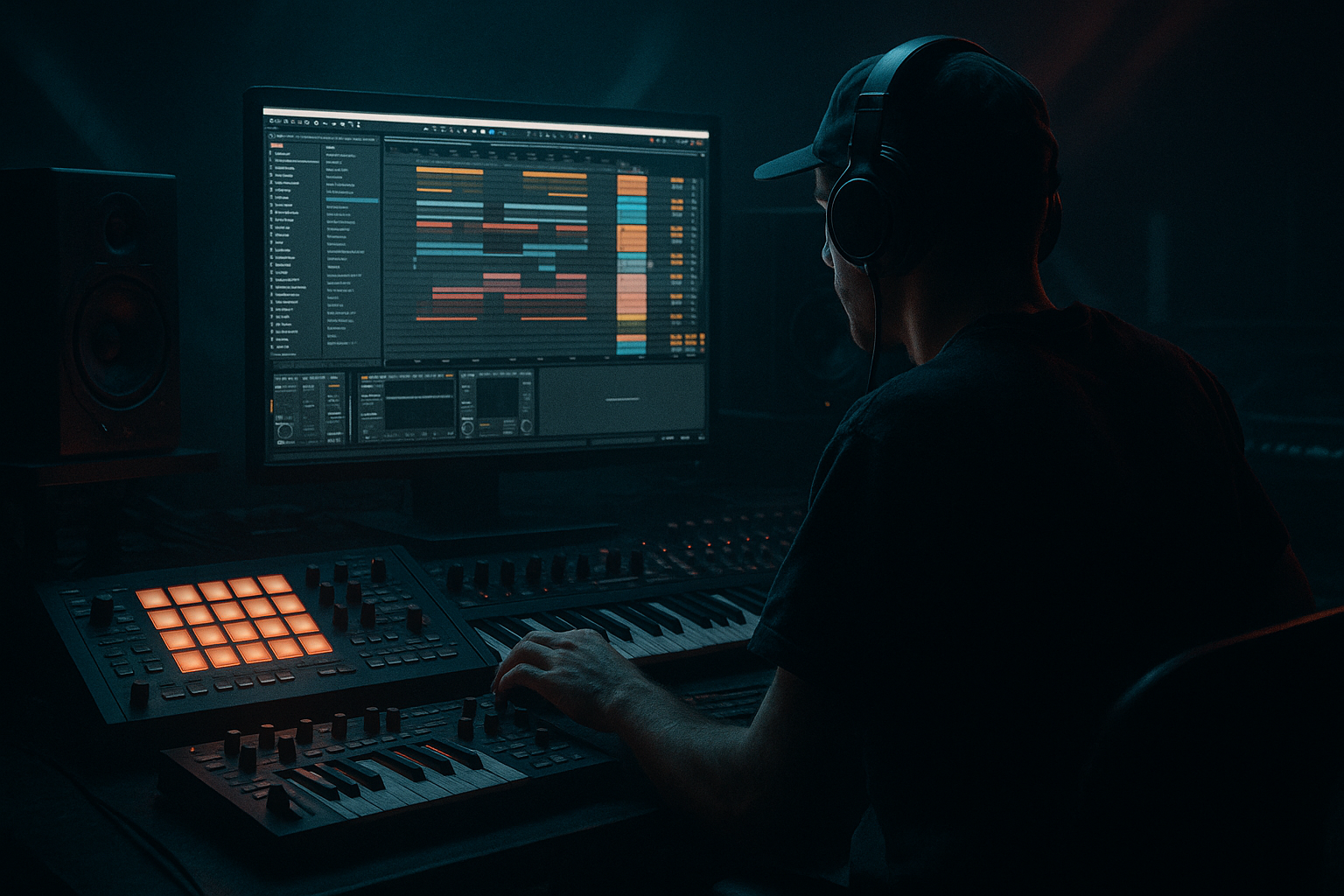
Main tutorial
Edit in Ableton Live 12: Push It With DJ‑Friendly Structure (Jungle/Oldskool DnB) — Basslines 🎛️
1) Lesson overview
In this lesson you’ll edit and arrange a bassline-focused jungle/oldskool DnB track in Ableton Live 12 with DJ-friendly structure: clean intros/outros, phrase-accurate drops, reloads, and mix points. We’ll go beyond “loop arranging” and build a proper 64/128-bar layout that feels like classic rave/jungle—while keeping the bass rolling, controlled, and translation-safe on big systems.
You’re advanced, so we’ll move fast: clip edits, resampling, macro mapping, arrangement automation, and mixdown-ready gain staging.
---
2) What you will build
A DJ-ready 174 BPM jungle/DnB arrangement with:
- 32-bar intro (drums + atmosphere + minimal bass teaser)
- 16-bar “mix-in” bass phrase (filtered/restricted, DJ-safe)
- 64-bar drop (full bass + drum breaks + variations)
- 8-bar breakdown / reload (oldskool vibe) 🔥
- Second 64-bar drop (heavier, more movement)
- 32-bar outro (elements peeled back for mixing)
- Instrument: Operator
- Effects:
- Instrument: Wavetable (or Operator saw)
- Effects:
- Compressor (or Glue Compressor) with Sidechain from Kick (or full drum bus for jungle pump):
- 1–17: Drums/hat loop + atmos. Bass muted or filtered very low.
- 17–33: Bring bass in filtered (LPF) + short stabs.
- Keep kick/breaks stable so DJs can beatmatch.
- Remove a layer every 8 bars.
- Add noise riser or tape stop.
- Bass: automate Auto Filter resonance slightly (careful—don’t spike).
- 49–81 (first 32): establish main bassline & break combo.
- 81–113 (second 32): introduce variations:
- Classic trick: hard cut bass for 1 bar, let crowd breathe.
- Drop in a vocal shot or horn stab.
- Use Reverb tail (Return track) then cut it for impact.
- Same groove, but:
- Peel back mid bass first.
- Keep sub minimal or filtered so DJs can mix out cleanly.
- Leave drums consistent to the end.
- Slice the resampled bass into 1/2-bar and 1-bar chunks.
- Create variation tricks:
- Track 1: SUB only (EQ lowpass ~120 Hz, mono Utility)
- Track 2: MIDS only (EQ highpass ~120 Hz, can be stereo)
- Intro: LPF low, Mid Level low
- Drop 1: open LPF, moderate Drive
- Breakdown: pull Sub Level down 2–4 dB, leave atmos
- Drop 2: slightly higher Drive + slightly stronger sidechain
- Sub bass doing “melodies.” Jungle bass can move, but sub should be simple and consistent.
- No clean 32-bar intro/outro. DJs need stable drums and predictable phrasing.
- Too-wide low end. Anything under ~120 Hz should be basically mono.
- Over-editing the bass. Your breaks already have chaos—bass should anchor the groove.
- Automation fighting the groove. Fast filter sweeps can destroy weight and make mixes unstable.
- Mid-bass distortion in parallel:
- Controlled reese nastiness (stock):
- Use Roar for “metal” harmonics:
- Make space at 200–350 Hz:
- Drop 2 impact trick:
- You structured the track in DJ-usable phrases (32 intro, 64 drops, clean outro).
- You built a two-layer bass (sub + mid) using stock Ableton devices.
- You used resampling + audio editing to add oldskool jungle variation without wrecking the sub.
- You automated with intention: macros + section-based moves, not random tweaking.
- You checked translation: mono low end, stable mix points, and phrase clarity.
Bassline goal: classic rolling sub + mid “reese-ish” movement, but arranged for DJs with clear cue points and consistent low end.
---
3) Step-by-step walkthrough
Step 0 — Session setup: tempo, markers, and phrase grid 🧭
1. Set tempo: `172–176 BPM` (choose `174` for authentic jungle feel).
2. In Arrangement View, set Locator markers every 16 bars:
- Right-click the timeline → Add Locator at: 1, 17, 33, 49, 65, etc.
3. Turn on Fixed Grid → `1 Bar` while structuring.
4. Create track groups:
- DRUMS, BASS, MUSIC/ATMOS, FX/VOX
Keep it organized—fast edits depend on it.
---
Step 1 — Build a DJ-friendly “mixable” intro (bassline perspective) 🎚️
Oldskool DJs need clean low end early on. The bass should be present only as a hint until the mix point.
Intro target: 32 bars where a DJ can cue and blend.
On the BASS group, do this:
1. Add an EQ Eight at the top of the group:
- Mode: Stereo
- HP filter at `~30 Hz` (24 dB/oct) to remove sub-rumble.
2. Add an Auto Filter after EQ Eight:
- Filter type: Lowpass 24
- Map cutoff to a macro called INTRO LPF
- Start cutoff around `150–250 Hz` (bass barely audible)
3. Automate INTRO LPF over bars `17–33` to gradually open to `~500–1.2 kHz`.
Why: DJs get a stable groove without you dumping full sub instantly, and the intro becomes a story rather than a loop.
---
Step 2 — Design a rolling jungle bass chain (stock devices) 🧱
We’ll build a reliable, mix-ready bass that works in clubs.
#### A) Create the bass instrument rack
1. Create a MIDI track: `BASS MAIN`.
2. Add Instrument Rack with two chains:
Chain 1: SUB (clean + mono)
- Osc A: Sine
- Pitch: 0
- Envelope: Attack 0 ms, Decay ~200 ms, Sustain -inf (or low), Release 80–120 ms (depends on note length)
- Saturator: Soft Clip ON, Drive `1–3 dB`
- EQ Eight:
- Low shelf or bell to taste at `50–70 Hz` (small moves, ±1–2 dB)
- Lowpass at `~120 Hz` (to keep sub pure)
- Utility: Width `0%` (mono), Gain trim to hit consistent level
Chain 2: MID (movement + character)
- Wavetable: basic saw/square blend
- Unison: 2–4 voices, low amount (don’t go trance wide)
- Auto Filter (for movement): notch/bandpass lightly modulated
- Saturator: Drive `3–6 dB` (Soft Clip ON)
- Chorus-Ensemble (subtle): Mix `5–15%`, keep low end clean
- EQ Eight:
- Highpass `~120 Hz`
- Tame harshness around `1.5–3 kHz` if needed
#### B) Glue the bass rhythmically with sidechain
On the BASS group, add:
- Ratio: `2:1–4:1`
- Attack: `3–10 ms` (let click through)
- Release: `80–160 ms` (tempo dependent)
- Aim for `2–5 dB` gain reduction on drops
---
Step 3 — Write a jungle-friendly bassline (notes + swing) 🥁➡️🎹
Oldskool rolling bass usually lives between F–G# range (but choose your key).
1. Clip length: 8 bars (gives room for variation).
2. Pattern approach:
- Use off-beat pushes and call/response with the breaks.
- Keep the sub notes longer, mid notes can be shorter/ghosted.
3. Groove:
- Apply Groove Pool: try an MPC swing around `54–58%`.
- Or extract groove from your main break and apply lightly (`10–25%`).
Tip: Keep sub hits consistent; make “interest” in the mid chain, not in unpredictable sub notes.
---
Step 4 — Make it DJ-structured: 16/32/64-bar logic + clean mix points 🧩
Here’s a tried-and-true jungle/DnB DJ layout (bars assume start at 1):
#### Intro (Bars 1–33)
#### Pre-drop / Tension (Bars 33–49)
#### Drop 1 (Bars 49–113) = 64 bars
- Add a call-and-response bass phrase every 8 bars
- Add a mid-bass “answer” with a different filter position
- Use fills: 1-bar drum edits, bass mutes, or reese stab
#### Reload / Breakdown (Bars 113–121) = 8 bars 🔄
#### Drop 2 (Bars 121–185) = 64 bars
- Open the mid chain slightly
- Add resampled bass variations (see Step 5)
- Increase drum “edge” with parallel saturation
#### Outro (Bars 185–217) = 32 bars
Ableton workflow: Use Arrangement “Consolidate” (Cmd/Ctrl+J) on bass sections to create clear blocks you can move around while preserving automation lanes.
---
Step 5 — Push the bass edits: resample, slice, and create variation (oldskool style) ✂️
This is where you stop sounding looped.
#### A) Resample bass to audio for edit power
1. Create a new audio track: `BASS RESAMPLED`.
2. Set its input to Resampling.
3. Solo the bass group and record 8–16 bars of the drop.
4. Warp mode: Complex Pro (for safety) or Beats (if you want crunch).
#### B) Create jungle edits from the audio
- Reverse a small mid-bass chunk (not sub-heavy) leading into a snare
- Pitch envelope with Clip Transpose: `+3` or `+7` semitones for stabs
- Gate using Auto Pan (Phase 0°, Shape square) for rhythmic chops
- Beat Repeat very lightly (1/8 or 1/16, low chance) for glitch fills
#### C) Keep sub stable while editing mids
If your resample includes sub, duplicate:
Edit mostly on mids so the low end doesn’t “trip” the system.
---
Step 6 — Automation that screams “pro DJ tool” 🎛️
On the BASS group, map key parameters into Macros (Instrument Rack or Audio Effect Rack):
Suggested macros:
1. LPF (Auto Filter cutoff)
2. Drive (Saturator drive on mid chain)
3. Sub Level (Utility gain on SUB chain)
4. Mid Level
5. Sidechain Amount (Compressor threshold)
6. Width (Utility width on MID chain only)
7. Notch (EQ Eight small cut around 200–300 Hz if it gets boxy)
8. Air Bite (EQ shelf 2–5 kHz, tiny boosts only)
Automation ideas by section:
---
Step 7 — DJ-friendly final checks (bass translation + mix points) ✅
1. Mono check:
- Put Utility on Master → Width `0%` briefly
- Make sure sub doesn’t disappear or get louder weirdly
2. Low-end discipline:
- Use Spectrum on the bass group:
- Sub should be strong but not a mountain compared to 100–200 Hz
3. Phrase integrity:
- Every 16 bars: something changes (even small)
4. Export-friendly:
- Keep -6 dB headroom on master pre-limiter
- If you have a limiter on while producing, keep it gentle (avoid lying to yourself)
---
4) Common mistakes
---
5) Pro tips for darker/heavier DnB 🖤
- Create a return track with Roar (or Saturator) + EQ, blend in subtly for menace.
- Wavetable → slight unison → Auto Filter movement → Saturator → EQ Eight dynamic cuts via automation.
- Keep it on the MID chain only. Filter before and after Roar to avoid mud.
- That’s where jungle often gets boxy with breaks + bass. Small EQ moves beat big ones.
- Duplicate bass MIDI for Drop 2 and add tiny note-length variations on mids only (sub stays same), then resample.
---
6) Mini practice exercise 🎯
Goal: Turn a single 8-bar bass loop into a DJ-ready 64-bar drop without changing the core vibe.
1. Take your 8-bar bass clip and duplicate it to 64 bars.
2. Every 8 bars, do one (only one) of the following:
- Mute bass for 1/2 bar before the snare
- Add a mid-only stab (transpose +7)
- Open LPF by ~10–15%
- Add 1 bar of resampled “chop” bass (mids only)
3. Add locators at 49, 65, 81, 97, 113 and label what changes.
4. Bounce a rough export and listen like a DJ:
“Can I mix into this cleanly for 32 bars? Is the drop obvious? Are the phrases predictable?”
---
7) Recap
If you want, tell me your key, tempo, and whether you’re using breakbeats or 2-step, and I’ll suggest a specific 64-bar bass variation plan (notes + automation moves) for your vibe.

