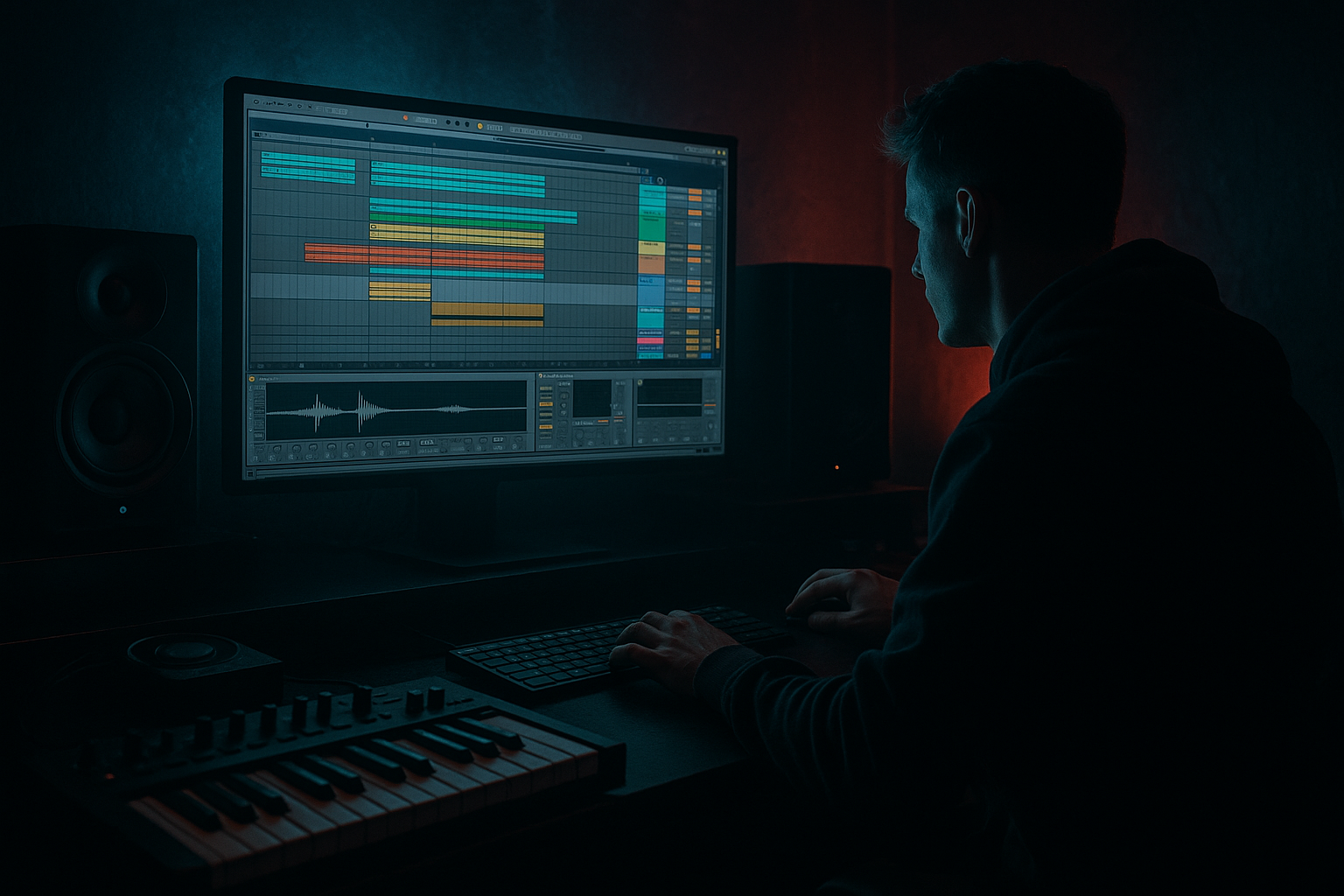
Main tutorial
Edit in Ableton Live 12: Resample It with Breakbeat Surgery (DnB Focus) 🥁⚔️
1) Lesson overview
In drum & bass, the break is often the groove engine—and the fastest way to get a unique, rolling drum identity is to surgically edit a breakbeat, then resample it into a new, tighter, heavier loop.
In this lesson you’ll use Ableton Live 12 tools (warp modes, slicing, Drum Rack, resampling, transient shaping, saturation, and buss processing) to turn a raw break into a modern DnB-ready loop that still feels human.
You’ll learn:
- How to prep and warp a break properly at DnB tempos (170–176 BPM)
- How to slice with intent (not random chopping)
- How to layer kicks/snares while keeping the break’s swing
- How to resample “your version” and re-edit for tightness + character
- How to build a clean drum bus chain using stock devices
- A 2-bar “surgically edited” break loop (main groove)
- Layered kick + snare (modern punch)
- A resampled “crushed” variation for fills
- A call-and-response arrangement (A/B drum energy)
- A drum bus chain that hits hard but stays controlled
- In the new `BREAK SLICE` track:
- Copy the generated MIDI from slicing (Ableton often creates a clip) and edit it:
- Add Groove Pool (Live’s grooves):
- On the break track (`BREAK SLICE`), use EQ Eight:
- On the snare break slices (if too boxy):
- Keep the break’s high end movement (that’s the vibe).
- Select `BREAK SLICE` + `KICK/SNARE LAYERS` → Group (`Cmd/Ctrl+G`) → name `DRUM BUS`
- Reverse a small snare/hat tail (single slice) before bar transitions
- Add 1/8 or 1/16 stutters at the end of bar 8/16
- Make a “pull-up” moment:
- Set resampled clip Warp mode to Beats
- Preserve Transients, Envelope around 30–50
- If there are flams, nudge a few warp markers—but only where it matters.
- Bars 1–8 (Intro groove):
- Bars 9–16 (Main groove A):
- Bars 17–24 (Groove B):
- Bars 25–32 (Fill + impact):
- Auto Filter on breaks (HP sweep down into the drop)
- Reverb throw (Return track) on a snare hit only (automate send)
- Over-warping the break: too many warp markers kills swing and makes it robotic.
- Slicing too granular without cleanup: tiny noisy slices = clicks, phasey hats, and mess.
- Layering without EQ separation: kick fights break low end → weak punch.
- Bus compression too heavy: 6–10 dB GR will smear transients and remove DnB snap.
- No resample stage: you miss the “commit and re-edit” power that creates signature loops.
- Parallel destroy channel (in-group Return):
- Pitch down micro-fills:
- Dark top control:
- Transient focus:
- Space with restraint:
- Warp the break cleanly (Beats mode, transient-preserving) so it loops right at DnB tempo.
- Slice to Drum Rack, then perform surgical MIDI edits to tighten groove and enhance roll.
- Layer modern kick/snare while EQ-splitting responsibilities.
- Build a stock Drum Bus chain for punch and cohesion.
- Resample your processed drums and do a second surgery pass for pro-level variations and fills.
---
2) What you will build
A 16-bar DnB drum section featuring:
Think: jungle heritage + modern rolling weight. 😈
---
3) Step-by-step walkthrough
Step 0 — Session setup (quick but important)
1. Set tempo to 174 BPM (good default).
2. Create tracks:
- Audio Track: `BREAK RAW`
- MIDI Track (Drum Rack): `BREAK SLICE`
- Audio Track: `RESAMPLE PRINT`
- Audio Track: `DRUM BUS` (optional for routing)
Workflow tip: Color code: raw (grey), sliced (blue), resampled (orange), bus (red). Keeps you fast.
---
Step 1 — Choose and warp the break properly
1. Drop a breakbeat audio file into `BREAK RAW`.
2. In Clip View:
- Turn Warp ON
- Set Seg. BPM roughly correct (doesn’t need to be perfect yet)
- Choose Warp mode:
- Beats for most breaks (tight, transient-friendly)
- Set Preserve: Transients
- Start with Envelope: 40–60 (higher = tighter/less tail)
3. Right-click the clip → Warp From Here (Straight) at the true downbeat (bar 1 beat 1).
4. Find the end of a clean loop (often 1 or 2 bars):
- Set loop braces to exactly 2 bars (common for DnB)
- Right-click → Set 1.1.1 Here on the start marker if needed
- Nudge warp markers only when necessary (don’t over-warp or you kill feel)
✅ Goal: The break loops seamlessly at 174, with transients aligned enough to slice cleanly, but still breathes.
---
Step 2 — “Surgery” pass: slice the break to a Drum Rack
You want control: separate kick/snare/ghosts, rearrange hits, and tighten groove.
1. Right-click the warped break clip → Slice to New MIDI Track
2. Settings (good starting point):
- Slice By: Transient
- Create one slice per: Transient
- Slicing preset: Built-in (or Empty if you want total control)
This creates a Drum Rack with each transient mapped to a pad.
Immediate cleanup (high impact):
1. Open Drum Rack → click a few pads
2. For pads that are clearly kick or snare, rename them (Kick, Snare, Ghost, Hat, etc.)
3. For messy slices with clicks:
- Open the Simpler on that pad
- Use Fade In very small (e.g., 1–5 ms) to remove clicks
- Adjust Start slightly forward if needed
---
Step 3 — Rebuild the groove with intent (not random chops)
Now you’ll create a 2-bar DnB pattern using the break’s DNA.
1. In `BREAK SLICE`, create a 2-bar MIDI clip.
2. Start by placing:
- Snare on beat 2 and 4 (classic DnB backbone)
- Then place a few ghost notes and hat slices around it (from the break)
Fast technique:
- Delete weak/washed hits
- Keep groove-critical ghosts
- Move a few hits by +/- 5 to 20 ms (feel surgery)
Groove control:
- Try a groove like Swing 16 style lightly
- Apply with Timing 10–25%, Velocity 5–15%
- You want roll without flammy chaos
---
Step 4 — Layer modern kick + snare while keeping break character
Break gives movement; layers give weight.
1. Add a new Drum Rack track called `KICK/SNARE LAYERS`.
2. Choose punchy one-shots:
- Kick: short, sub-controlled
- Snare: crisp transient + body around 200 Hz + crack 2–6 kHz
3. Program a simple DnB backbone:
- Kick: often on 1, plus a syncopated extra (varies by style)
- Snare: 2 and 4
Glue them to the break:
- High-pass around 30–50 Hz (remove rumble)
- If your layered kick is strong: dip 80–120 Hz slightly in the break
- Dip 250–500 Hz a couple dB
---
Step 5 — Create a Drum Bus chain (stock devices that slap) 🔥
Route both drum tracks to a group or a return bus.
Option A: Group them
Suggested DRUM BUS chain (in order):
1. EQ Eight
- HP at 25–30 Hz (gentle)
- Small dip if harsh: ~7–10 kHz (only if needed)
2. Drum Buss
- Drive: 5–15%
- Crunch: 0–10 (careful—goes fizzy)
- Boom: 0–20% around 50–60 Hz (only if it helps)
- Transients: +5 to +20 for snap
3. Glue Compressor
- Attack: 3–10 ms
- Release: Auto or 0.1–0.3 s
- Ratio: 2:1
- Aim for 1–3 dB gain reduction (DnB likes control, not squish)
4. Saturator
- Mode: Soft Sine or Analog Clip
- Drive: 1–4 dB
- Turn on Soft Clip
5. Limiter (only as safety)
- Catch peaks, don’t smash
✅ Goal: More density + punch without losing transient clarity.
---
Step 6 — Resample your drums (print the magic) 🎛️➡️🎚️
This is the secret weapon: commit to audio, then edit again.
Method (clean and repeatable):
1. Create an audio track: `RESAMPLE PRINT`
2. Set its input to:
- Audio From: your `DRUM BUS` (or group)
3. Arm `RESAMPLE PRINT`
4. Record 8–16 bars while you tweak bus settings and small variations (mutes, fills)
Now you’ve captured a performance print.
---
Step 7 — Second surgery: edit the resample for variations & fills
This is where DnB turns pro: micro-edits + fills without reprogramming everything.
1. Consolidate good sections:
- Select a clean 2-bar best loop → Consolidate (`Cmd/Ctrl+J`)
2. Duplicate it out to build a phrase:
- Classic: 8 bars A + 8 bars B (with variation)
Create variations quickly:
- Use Split (`Cmd/Ctrl+E`) + duplicate tiny bits
- Silence the last 1 beat before drop (or filter it)
Warp + tighten (again, lightly):
---
Step 8 — Arrangement ideas for rolling DnB
Here’s a reliable 32-bar drum arc:
- Break only (filtered a bit)
- Light hats, no heavy layers yet
- Add kick/snare layers
- Full bus chain engaged
- Swap to resampled variation
- Add extra kick ghost or snare drag
- 1-bar fill at bar 32
- Drop to the cleanest, punchiest 2-bar loop after
Automation that works:
---
4) Common mistakes
---
5) Pro tips for darker/heavier DnB 😈
- Add a Return inside the drum group:
- Saturator (Analog Clip, Drive 6–12 dB) → Redux (light) → EQ Eight (shape) → Compressor
- Blend at 5–20% for grit without losing punch.
- Take a 1/16 snare slice, pitch down -3 to -7 semitones (Simpler or Clip Transpose) for a brutal “drag.”
- If hats are harsh, use Multiband Dynamics gently:
- Tame highs above 6–8 kHz with small downward compression.
- On Drum Buss, push Transients up before adding lots of saturation.
- Use Hybrid Reverb very short rooms on snare only, high-passed return (HP at ~300 Hz). Keep the low end dry and lethal.
---
6) Mini practice exercise (20 minutes) ⏱️
1. Pick one classic-style break (any will do).
2. Warp it at 174 BPM using Beats / Preserve Transients.
3. Slice to Drum Rack by Transient.
4. Build two 2-bar clips:
- Clip A: faithful groove, just tightened
- Clip B: 4 edits (one reverse, one stutter, one ghost kick move, one hat swap)
5. Layer kick/snare one-shots.
6. Resample 8 bars of A→B performance.
7. From the resample, make:
- One clean 2-bar loop
- One 1-bar fill (end of bar 16)
Deliverable: a 16-bar drum arrangement with A (bars 1–8) and B (bars 9–16).
---
7) Recap
If you want, tell me your target vibe (liquid roller, techy minimal, or heavy jungle-core) and I’ll suggest a specific slicing map + bus settings for that style.

