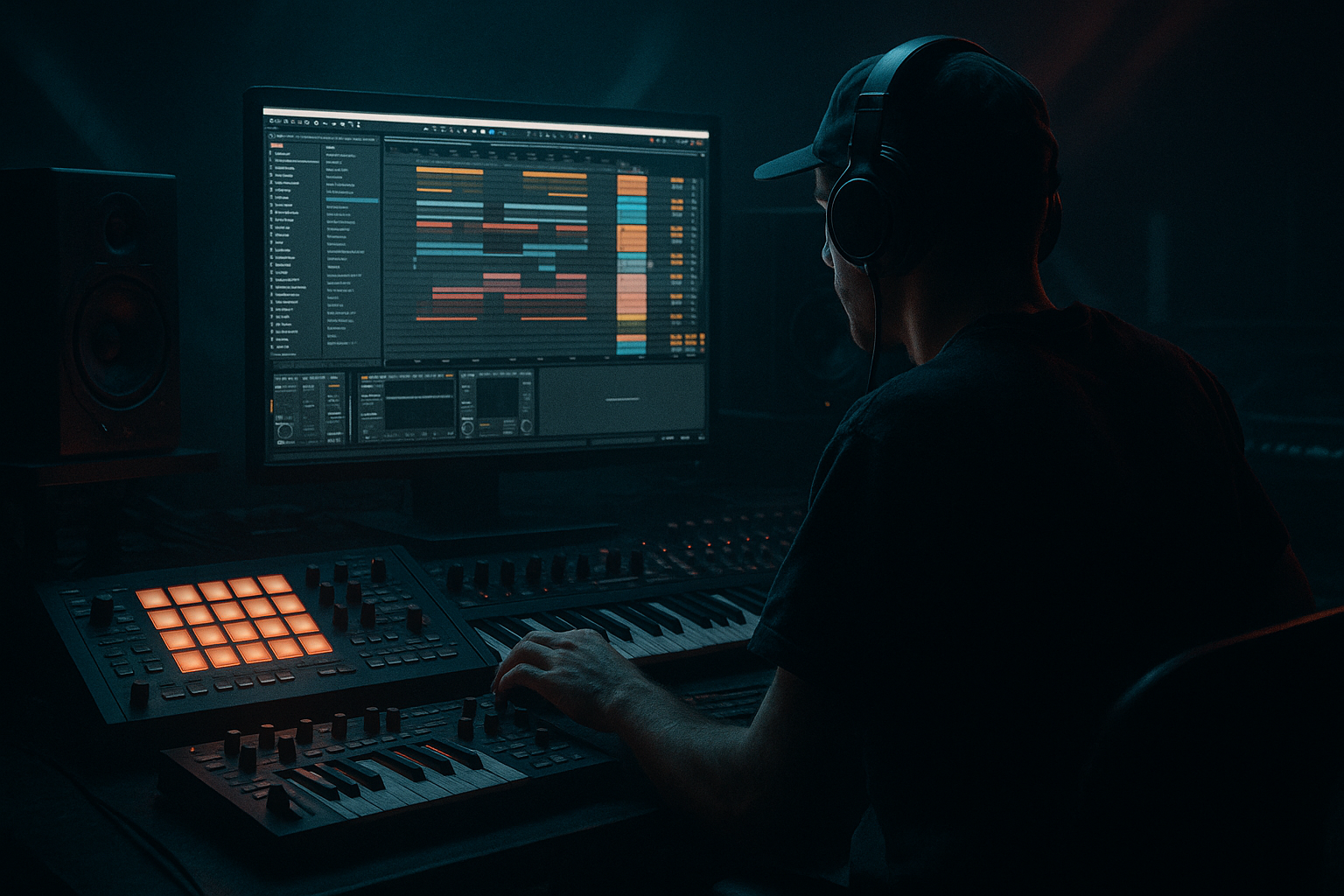
Main tutorial
Lesson Overview
In this lesson, you’ll build an edit sequence breakdown from scratch in Ableton Live 12 for an oldskool jungle / DnB vibe that feels like a proper DJ-tool section: functional for mixing, but still musical enough to keep energy moving between drops. The goal is not just “make a breakdown” — it’s to design a performance-ready arrangement bridge that gives the listener space, tension, and identity before the next impact.
This matters a lot in Drum & Bass because the breakdown is often where DJs breathe, phrase-match, and mix out or in. For club-ready DnB, your edit sequence should support:
- DJ-friendly phrasing: 8, 16, or 32-bar symmetry
- Clear low-end management: sub disappears or narrows when needed
- Break edits and atmospheric movement: enough jungle character to feel alive
- Controlled tension/release: so the next drop lands with force
- A drum break chop sequence using sliced break hits and ghost notes
- A sub-bass pullback with selective bass fragments, filter automation, and mono-safe low end
- A rave-stab or chord hit layer for classic tension
- A noise / atmosphere bed to glue the transition
- Delay throws, reverse swells, and fills that create forward motion
- A DJ-friendly intro/outro structure so the section works in a live mix
- First 4 bars: tension introduction, drums thinning out
- Bars 5–8: break fragments and bass teases
- Bars 9–12: deeper atmosphere, filtered stab responses, rising tension
- Bars 13–16: clear pre-drop build with fill, stop, or fake-out before the next impact
- Leaving too much low end in the breakdown
- Overusing risers and generic EDM transitions
- Making the breakdown too empty
- Ignoring phrase structure
- Letting delay and reverb wash out the groove
- Not testing on a mono system
- Use two bass layers: a true mono sub and a dirty mid-bass layer. Let the mid layer move, not the sub.
- Try Saturator before Auto Filter on a reese to push harmonics into the filter sweep.
- Keep the breakdown’s drum bus slightly compressed, but don’t flatten the transients. You want the eventual drop to feel bigger.
- Use resampled one-shots from your own track: a vocal chop, bass stab, or break hit can become a custom transition sound.
- For a darker edge, automate Redux very subtly on a stab or noise layer for a crushed digital texture.
- Use Echo with filtered feedback instead of huge reverb washes for more underground tension.
- If the section feels too clean, add a very low-level room ambience or vinyl texture under the breakdown. The trick is subtlety.
- Try a call-and-response between break chop and stab every 2 bars. This keeps the arrangement moving without overcrowding it.
- If your drop is neuro-influenced, make the breakdown’s last 4 bars subtly echo the drop’s rhythmic DNA — same syncopation, less harmonic density.
- Version A: more oldskool jungle, more break character
- Version B: darker / heavier, more filtered bass and tighter automation
For oldskool jungle specifically, the edit sequence breakdown is where you can reference the classic language: stretched break chops, rave stabs, reverse hits, dub delay tails, filtered bass fragments, and call-and-response phrasing. In darker / heavier DnB, you’ll use that same structure but shape it with cleaner low-end discipline, more aggressive automation, and smarter sound-design choices.
Why this technique matters in DnB: the breakdown is not a dead zone. It’s a designed contrast section that helps the drop feel bigger, keeps DJs in control, and lets your drums/bass re-enter with more impact. If the breakdown is built properly, the track feels mixable, professional, and intentional.
What You Will Build
You’re going to create a 16-bar edit sequence breakdown in Ableton Live 12 that sits between two drops in an oldskool jungle / DnB arrangement.
The result will include:
Musically, the breakdown will feel like:
You’ll end up with a breakdown that works in a roller, oldskool jungle, or dark DnB context — something a DJ can use, and something a producer can trust.
Step-by-Step Walkthrough
1. Set up a breakdown section with DJ phrasing in mind
Open a fresh Ableton Live 12 set and sketch a basic arrangement grid around 32-bar blocks. If you already have a track, locate the transition between Drop 1 and Drop 2. For this lesson, build the breakdown as a 16-bar segment starting after an 8- or 16-bar drop phrase.
Create these tracks:
- Drum Breaks
- Sub / Bass
- Stabs / Chords
- Atmos / Noise
- FX / Transitions
- Resample / Print (optional but very useful for advanced workflow)
Put a marker at bar 1 of the breakdown and think in 8-bar mini-phrases:
- Bars 1–8: reduction and reveal
- Bars 9–16: tension escalation into the next drop
Why this works in DnB: DJs rely on predictable phrase lengths to mix cleanly. A breakdown that resolves on a 16-bar boundary gives you instant usability in sets and keeps the arrangement feeling pro.
2. Build a break-edit source with Simpler and tight slicing
Load a classic break into a MIDI track and drop it into Simpler in Slice mode. Choose:
- Slice by: Transients
- Trigger mode: Gate for cleaner hits, or Trigger for more chopped, one-shot style behavior
- Warp: Off for one-shots if the break is already tight, or Beats if you need to lock timing
Use the MIDI editor to program a 1- or 2-bar chop pattern that emphasizes:
- Kick/snare punctuation
- Ghost notes between main hits
- Short answer phrases after the snare
- Occasional missing hits to create “broken” tension
Add Drum Buss after Simpler:
- Drive: 10–25%
- Crunch: 5–15%
- Boom: low or off if it muddies the sub
- Transients: +5 to +20 for snap
Then use EQ Eight to clean the break:
- High-pass around 100–140 Hz if the break competes with the sub
- Small cut around 250–450 Hz if it gets boxy
- Gentle high shelf if you want more air on hats
Advanced move: duplicate the break lane and create a second version with more aggressive chopping. Crossfade between the two by automating clip volume or track volume across the 16 bars.
3. Design the bass pullback with filtered motion and sub discipline
For the breakdown, don’t just mute bass completely unless the track demands it. In jungle and darker rollers, a selective bass tease keeps the section alive.
On your bass track, use:
- Operator for a clean sub tone or sine/triangle-based bass
- Wavetable if you want a moving reese-style layer
- Or resample your existing bass and chop it into fragments
Structure the bass in three states:
- Full bass before the breakdown
- Filtered/fragmented bass in the breakdown
- Re-entry bass in the pre-drop
Suggested automation:
- Auto Filter low-pass: start around 200–400 Hz, then slowly open to 1–3 kHz on the final bars
- Resonance: keep moderate, around 0.20–0.45, so it rings without whistling
- If using a reese, automate detune or modulation depth slightly during the breakdown for movement without dominating the mix
Add Utility to the bass chain:
- Set Bass to mono
- Width at 0% for sub layer
- Keep the upper bass layer wider only if it’s above the fundamental region
Why this works in DnB: the low end in DnB carries enormous weight, so the breakdown must create space without feeling empty. A filtered bass tease preserves identity and makes the drop hit harder because the listener still “feels” the bassline’s presence.
4. Layer a rave stab or chord hit for oldskool identity
Oldskool jungle breakdowns often lean on short rave stabs, chord hits, or filtered organ-like punches. In Ableton, this can be as simple as a sampled stab in Simpler or a synth chord processed aggressively.
Useful chain:
- Simpler or Sampler with a stab sample
- Auto Filter for sweep automation
- Saturator for edge
- Echo or Delay for throws
- Optional Reverb with short decay
Suggested settings:
- Auto Filter cutoff: automate from 300 Hz up to 5–8 kHz
- Saturator Drive: 2–6 dB
- Reverb decay: 0.8–1.8 s
- Pre-delay: 10–25 ms
- Echo feedback: 15–35% for controlled echoes
Place the stab on offbeats or at the ends of phrases. Let it answer the break edits, not fight them. A classic move is to place a stab on bar 3, bar 7, bar 11, and bar 15, each time with increasing filter openness or delay send.
This gives you a call-and-response structure that feels authentic to jungle and still translates in modern DnB.
5. Create atmosphere and tension with resampling and reverse FX
This is where the breakdown becomes cinematic without losing function. Take a portion of your break, bass, or stab and resample it into a new audio track using Resampling or Freeze/Flatten if needed. Then reverse select pieces to create swells.
Build a texture layer using:
- White noise from Operator or Analog
- A vinyl-style ambient sample
- Field ambience, room tone, or filtered crowd noise if it suits the vibe
Shape it with:
- Auto Filter: high-pass around 200–500 Hz on atmos
- Hybrid Reverb or Reverb: long decay, but low in the mix
- Redux very subtly if you want gritty digital texture
- Utility with Gain automation if you want swell control without re-creating clips
Suggested moves:
- Reverse a snare reverb tail into bar 13 or 15
- Automate a noise riser from -18 dB to -8 dB over 4 bars
- Add a reverse bass fragment that arrives just before the next downbeat
Advanced tip: render your atmos and reverse FX to audio once the timing feels right. Audio clips give you better control, cleaner CPU usage, and more natural editing for DJ-style transition work.
6. Shape the drums with ghost notes, fills, and bus control
Your breakdown should not sound like drums are simply “off.” Instead, it should feel like the drums are recomposed.
Build a Drum Rack or grouped drum bus with:
- Main break layer
- Top loop or hat layer
- Fill hits / toms / percussion
- Snare reverb return if needed
For the drum bus, try:
- Glue Compressor with 2:1 ratio, slow-ish attack, medium release
- Aim for 1–2 dB gain reduction on the bus
- Saturator after compression for density
- EQ Eight to notch harsh cymbals if needed
Program ghost notes deliberately:
- Lower-velocity snare taps before the main snare
- Small kick pickups leading into bar 8 and bar 16
- Hat flams or off-grid percussion to preserve movement
If using Groove Pool, try a subtle swing from an oldskool break or MPC-style groove, but keep it controlled. Too much swing can make the DJ tool less mixable.
The breakdown should still feel like it has a drum engine underneath it, even if the main impact is stripped away.
7. Automate tension with filters, sends, and track volume
Now turn the section into a proper sequence by automating movement across the 16 bars.
Focus on these automations:
- Bass low-pass cutoff
- Break drum bus volume
- Stab filter cutoff
- Reverb send amount
- Delay feedback or send
- Mastering-level-safe pre-drop lift via selected track gains, not master clipping
A strong pattern:
- Bars 1–4: reduce drum bus by 2–4 dB, keep atmos low
- Bars 5–8: bring in break chops and one stab phrase
- Bars 9–12: increase filter openness and delay throws
- Bars 13–16: thin the mix again, then spike tension with a fill or stop
On return tracks, keep effects disciplined:
- Return Reverb: high-pass the return if needed
- Return Delay: filter the repeats so they don’t clutter the low mids
- Echo: set dotted or straight values depending on tempo feel, but automate feedback rather than leaving it static
In DnB, automation is often the difference between a simple loop and a real arrangement. The breakdown needs progression, not just texture.
8. Use arrangement tricks that make the next drop land harder
To finish the edit sequence breakdown, design the last 1–2 bars as a deliberate pre-drop mechanism.
Good options:
- 1-bar drum stop with a fill tail
- Snare roll filtered upward into the drop
- Riser plus reverse crash with bass silence beneath it
- Half-time fake-out using only atmos and a single stab
- Pre-drop gap: silence on beat 4 of the final bar, then full impact
If you want a more classic jungle feel, use a small breakfill before the drop instead of a modern full riser. That keeps the vibe raw and works better with break-heavy material.
For a modern darker DnB edge, combine:
- Short filter-open on bass fragments
- Noise burst
- Snare fill with transient punch
- One final reversed stab into the downbeat
Make sure the last bar doesn’t overcomplicate things. The listener needs a clear reset before the next drop.
Common Mistakes
- Fix: mono the sub, high-pass atmos and breaks, and remove competing bass energy below ~120 Hz.
- Fix: use break edits, reverse snare tails, and filtered stabs that fit jungle/DnB language.
- Fix: keep ghost notes, bass fragments, or subtle noise movement so energy doesn’t die.
- Fix: build in 8- and 16-bar logic so the DJ can mix confidently.
- Fix: filter return channels and automate send levels only where needed.
- Fix: check bass and main drum transients in mono with Utility to ensure club compatibility.
Pro Tips for Darker / Heavier DnB
Mini Practice Exercise
Set a timer for 15 minutes and build a breakdown from scratch using only stock Ableton devices.
1. Load a break into Simpler and create a 2-bar chop pattern.
2. Add a bass layer using Operator or a resampled bass clip, then automate a low-pass filter across 16 bars.
3. Add one stab or chord hit and process it with Auto Filter, Saturator, and Echo.
4. Create a noise or atmos track with Operator noise, a sample, or a field texture.
5. Automate:
- drum bus volume
- bass cutoff
- stab filter cutoff
- one delay send throw
6. Finish the last 2 bars with a fill, stop, or reverse effect.
7. Bounce the breakdown to audio and listen back in the Arrangement View as if you were a DJ mixing in and out.
If you have extra time, duplicate the breakdown and make a second version:
Recap
A strong DnB breakdown is a functional DJ tool and a musical tension device. Keep the structure phrase-based, preserve movement with break edits and ghost notes, manage the low end carefully, and use automation to guide the energy into the next drop. In Ableton Live 12, stock devices like Simpler, Operator, Auto Filter, Drum Buss, Saturator, Utility, Glue Compressor, Echo, and Reverb give you everything you need to build a proper jungle-style edit sequence breakdown that feels authentic, heavy, and mix-ready.

