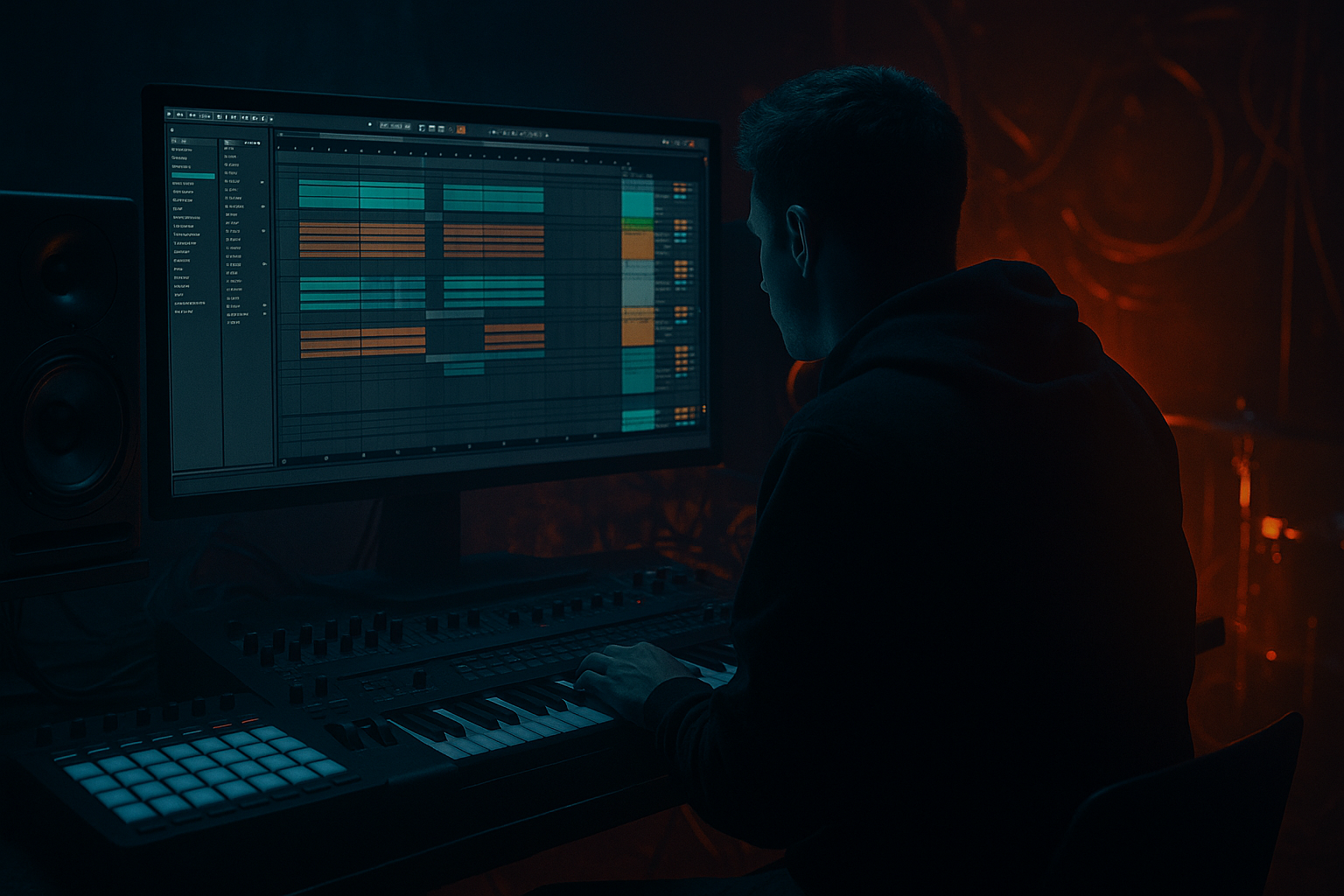
Main tutorial
Editing Drag Notes into Jungle Grooves (Ableton Live) 🥁⚡
Beginner • Drums • Drum & Bass / Jungle
---
1. Lesson overview
Drag notes are those short, tight “ghost” hits—usually snares—that pull into the main hit and create that signature jungle swing and urgency. In DnB, they’re the difference between a loop sounding “grid-locked” and sounding like it’s rolling forward.
In this lesson you’ll learn how to program and edit drag notes in Ableton Live using MIDI, Groove Pool, velocity shaping, and a few stock devices—so your breaks and 2-step patterns start feeling alive.
---
2. What you will build
You’ll build a 1-bar (then 2-bar) jungle-inspired drum groove featuring:
- A solid kick + snare backbone (think 2-step meets breakbeat)
- Snare drag notes leading into the main snare
- Ghost notes (quiet hits) for momentum
- Subtle swing and timing nudges without losing punch
- A simple processing chain using stock Ableton devices (Drum Buss, Saturator, EQ Eight)
- Kick: Beat 1 (1.1.1) and beat 3-ish (1.3.1 or 1.3.3 depending on feel)
- Snare: Beat 2 (1.2.1) and beat 4 (1.4.1)
- Place snare hits at 1.2.1 and 1.4.1
- Place kick at 1.1.1 and 1.3.1
- Right-click in MIDI editor → choose 1/32 (or Ctrl/Cmd+2 to narrow grid).
- Drag hits → Main snare
- Add a single ghost snare at 1.1.4.3 (a late 32nd) into 1.2.1.
- Lower velocity than the main snare
- Shorter (so they don’t smear)
- Main snare: 105–127
- Drag notes: 25–60
- Extra ghost notes: 15–45
- Main snare = bigger body
- Drag sample = lighter rim/ghost snare
- After the main snare: 1.2.3 or 1.2.4
- Before the second snare: 1.3.4 leading into 1.4.1
- Closed hats on 1/8 or 1/16 with slight velocity variation.
- For a classic rolling feel: accent offbeats slightly.
- Glue Compressor on the drum group:
- Bars 1–4: Basic groove, light drags
- Bars 5–8: Add extra ghost note or second drag into bar 8 snare
- Bars 9–12: Add a hat variation (remove some hats for space)
- Bars 13–16: Fill (e.g., double drag into the last snare) then drop
- In bar 16, add a drag into both snares or add a tiny snare roll at 1/32 for the last half-beat (keep velocity ramping up slightly).
- Layer a “tick” for drag definition:
- Midrange control = heavier mix:
- Parallel distortion for aggression (stock):
- Add subtle room for realism:
- Make the last drag mean something:
- Drag notes are quiet, tight hits before the main snare that create jungle momentum.
- The key controls are velocity, timing nudges, and sample choice (main snare vs drag layer).
- Use Groove Pool lightly for swing; keep main snares stable.
- A basic stock chain (EQ Eight → Drum Buss → Saturator) gives punch and grit without overcomplicating.
- Arrange your drags across 16 bars to create movement and transitions, not just a static loop.
Goal vibe: rolling, gritty, late-90s jungle energy with modern tightness. 🔥
---
3. Step-by-step walkthrough
Step 0 — Set up your session (quick + correct)
1. Set tempo to 165–172 BPM (start at 170 BPM).
2. Create a MIDI Track → load a Drum Rack.
3. Load core samples:
- Kick (short, punchy)
- Snare (bright crack or classic jungle snare)
- Closed hat
- Optional: rim/ghost snare (a lighter snare or clicky rim works great for drags)
Tip: If you’re using a break (Amen, Think, etc.), you can still add MIDI drags layered on top for extra snap.
---
Step 1 — Program the basic DnB skeleton (1 bar)
Open a 1-bar MIDI clip. Set grid to 1/16.
A common starting backbone:
In Live’s MIDI editor:
This is your “don’t fall apart” foundation.
---
Step 2 — Create the drag note(s) before the snare 🧲
A “drag” is typically 1–2 very short notes just before a main snare.
#### Option A: Classic 2-hit drag (simple + effective)
1. Zoom in near 1.2.1 (your main snare).
2. Add two snare notes just before it:
- Drag 1 at 1.1.4 (one 16th before)
- Drag 2 at 1.1.4.3 (if using finer grid like 1/32) or just slightly before the main snare by nudging
How to set the grid:
Now you have:
#### Option B: 1-hit drag (tight and modern)
This gives a slick “pull” without clutter.
---
Step 3 — Make drags feel real: velocity + length = groove
Drag notes should usually be:
Try these velocity ranges:
In Ableton:
1. Select the drag notes → drag velocity down in the velocity lane.
2. Shorten drag note lengths (doesn’t always affect drums, but helps clarity if your sampler responds to note length).
If your snare becomes machine-gunny: use two different samples:
This is very jungle and keeps it crisp.
---
Step 4 — Nudge timing for swing (without going sloppy) ⏱️
This is where jungle gets its “lurch.”
Method 1: Manual nudge
1. Turn grid off (Ctrl/Cmd+4).
2. Nudge drag notes slightly earlier or later:
- Usually a tiny bit early (1–6 ms) makes it feel like it’s pulling into the snare.
3. Keep the main snare on-grid (for punch).
Method 2: Groove Pool (super beginner-friendly)
1. Click the Groove Pool (hot-swap style icon on left panel).
2. Drag in a groove:
- Try MPC 16 Swing 55–65
- Or any “Swing” groove around 54–62
3. In your clip, choose that groove and set:
- Timing: 10–25%
- Velocity: 0–10%
- Random: 0–5%
Rule: Use Groove Pool subtly. Jungle is energetic, not drunk.
---
Step 5 — Add supporting ghost notes (the secret sauce)
Ghost notes make the groove talk.
Add quiet snare ghosts:
Keep them very low velocity (15–35).
Add hats:
---
Step 6 — Build a simple “jungle-ready” drum processing chain (stock devices)
On the Drum Rack (or the drum bus), add:
1. EQ Eight
- HPF around 25–35 Hz (remove rumble)
- Small dip 250–500 Hz if boxy
- Small boost 3–7 kHz if you need snap (careful)
2. Drum Buss 🧨
Suggested starting settings:
- Drive: 5–15%
- Crunch: 0–10% (use lightly)
- Boom: Off or 10–20% (only if it helps the kick)
- Damp: 10–30% (tame harshness)
- Transients: +5 to +20 for punch
3. Saturator
- Mode: Soft Sine or Analog Clip
- Drive: 2–6 dB
- Turn on Soft Clip
- Output down to match level
Optional (if needed):
- Attack: 3–10 ms
- Release: Auto
- Ratio: 2:1
- Aim for 1–3 dB of gain reduction
Important: Don’t crush your drag notes—if the compressor clamps them, reduce their velocities or adjust attack time.
---
Step 7 — Arrangement idea: make it musical (not just a loop)
Take your 1-bar groove to a 16-bar phrase:
Quick fill trick:
---
4. Common mistakes 🚫
1. Drag notes too loud
If drags compete with the main snare, the groove loses impact. Keep them ghosty.
2. Too many drags everywhere
If every snare has a heavy drag, it becomes predictable and messy. Use them as accents.
3. Dragging the main snare off-grid
Beginners often move the main snare—then the whole track feels late. Keep the main snare solid.
4. Over-swinging with Groove Pool
Timing at 50%+ often gets wobbly fast. Jungle likes energy + precision.
5. One snare sample doing everything
If your snare is big and long, drags will blur. Use a shorter drag layer.
---
5. Pro tips for darker/heavier DnB 🖤
Use a rim/click sample very quiet on drag hits. It cuts through distortion and reese bass.
Use EQ Eight to carve space around 200–400 Hz on drums if your bass is thick.
Create a Return track with Saturator + Drum Buss. Send snares/drags lightly (5–15%). Keeps punch but adds grit.
A tiny Hybrid Reverb room (short decay 0.3–0.7s, low mix 5–10%) can make drags feel “played,” not programmed.
Save the heaviest drag for transitions (bar 8/16/32). That’s classic dark DnB tension-building.
---
6. Mini practice exercise 🎯
Do this in 10 minutes:
1. Program a 1-bar kick/snare pattern at 170 BPM.
2. Add one drag into the snare at 1.2.1:
- Put it at 1/32 before the snare.
- Velocity 40.
3. Add a two-hit drag into the snare at 1.4.1:
- Two notes spaced by 1/32.
- Velocities 30 then 55 (slight ramp).
4. Apply Groove Pool swing:
- MPC 16 Swing 58
- Timing 15%
5. Export/bounce a quick audio loop and listen away from the screen:
- Does it pull into the snare?
- Does the main snare still feel like it “lands” hard?
If it feels messy: reduce drag velocity and bring main snare back to grid.
---
7. Recap ✅
If you want, tell me what kind of groove you’re aiming for (Amen-style chop, 2-step roller, or 94 jungle) and I’ll give you a specific 2-bar MIDI “drag map” to copy into Live.

