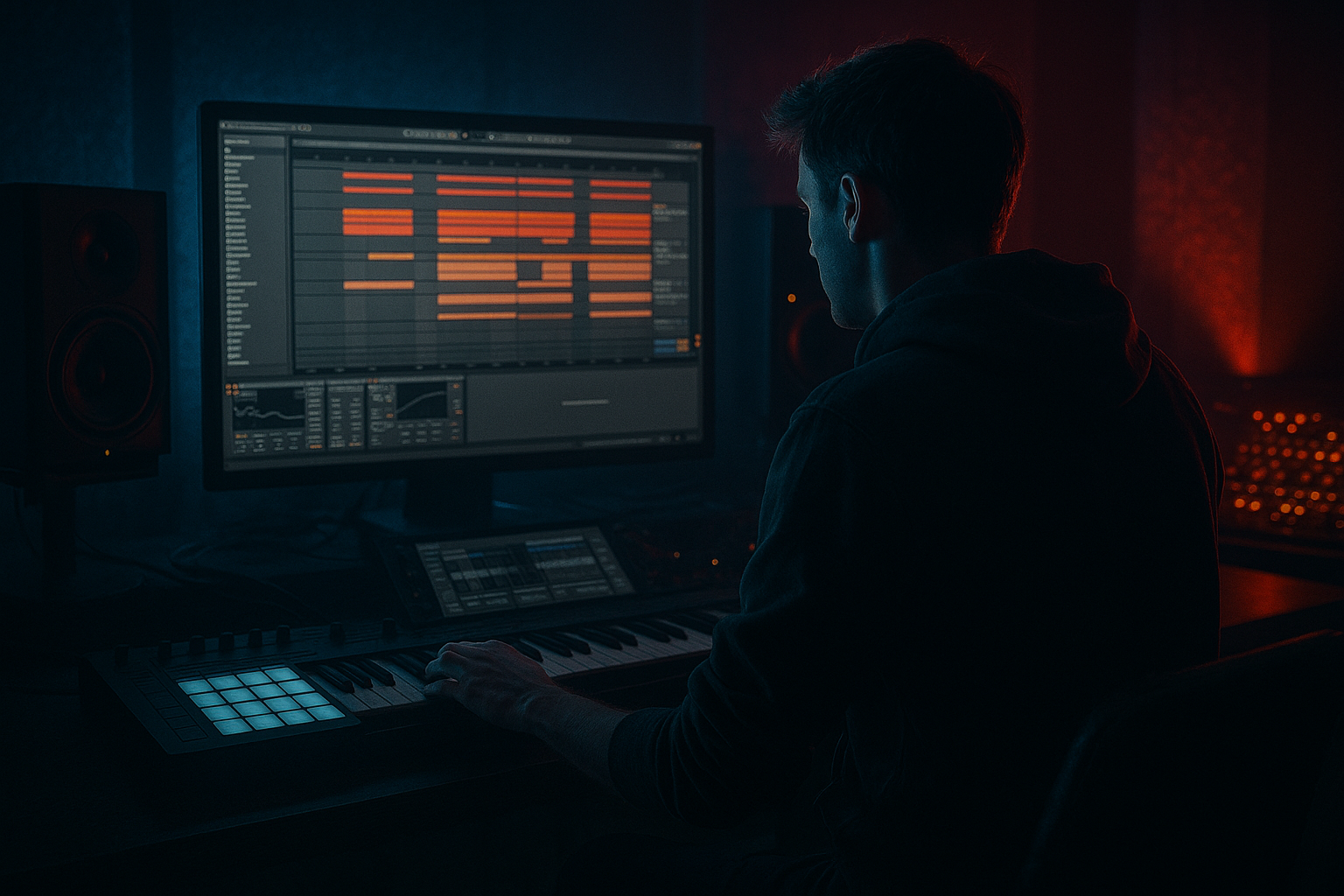
Main tutorial
1. Lesson overview
-------------------
Goal: Learn how to shape a clear, dynamic energy curve across a 64-bar drum & bass arrangement in Ableton Live. By the end you'll have a practical roadmap (with exact device-chain suggestions, automation targets, and arrangement moves) to take a simple loop and turn it into a full, rolling 64-bar section that breathes and hits where it should. Tempo assumptions and style: 174 BPM, modern/old-school DnB / jungle / rolling bass.
Tone: energetic, precise, teacher-focused — I’ll tell you what to click and what to tweak. Let's make things punchy and musical. 🎛️🔥
2. What you will build
-----------------------
A 64-bar DnB passage with:
- Tight drum arrangement (kick/snare/amen-style break + hi-hats/percs)
- Rolling bassline with sub and mid growl
- Two drops (at bars 25 and 57) with a contrasting breakdown in the middle
- Automation and device chains for perceived energy control (filter sweeps, sidechain, saturation, reverb sends)
- Reusable workflow: duplicate and edit 8-bar blocks to keep coherence
- Tempo: set to 174 BPM (common for DnB).
- Create tracks:
- Load samples: choose an amen/break for rolls + solid punchy 808-ish kick + sharp snare (or layered snares).
- On the Drum Rack output (the track):
- On Return B track: Saturator -> Compressor -> Utility
- Use Wavetable/Operator or Simpler with resampled sound.
- Device chain on Bass track:
- Insert Compressor after Saturator:
- Bars 1–8 (Intro / atmosphere)
- Bars 9–16 (Build 1)
- Bars 17–24 (Pre-drop & tension)
- Bars 25–32 (Drop 1 — full energy)
- Bars 33–40 (Variation / peak)
- Bars 41–48 (Breakdown & breathe)
- Bars 49–56 (Build 2)
- Bars 57–64 (Drop 2 + outro tease)
- Build content in 8-bar blocks: program one 8-bar loop and duplicate 7x, then edit each block — quick and coherent.
- Use Session View for sound-designing variations: create slots with different drum fills or bass versions and record into Arrangement for easy swapping.
- Use clip envelopes for quick micro-automation: pitch bend in a bass clip, sample start offset in a break, or transposition in a vocal chop.
- Use locators (Arrangement locators) at bars 1, 9, 17, 25, 33, 41, 49, 57 for quick navigation.
- Save device chains as presets (right-click device title → Save Preset) for reuse across tracks/projects.
- Too much everything: newbies often layer too many elements in the same frequency area. Use EQ Eight to carve space and keep the sub (20–120 Hz) dominated by one mono source (the sub bass).
- No contrast: static energy across 64 bars is boring — always plan “less” and “more” moments (mutes, filter cuts).
- Overuse of reverb on low frequencies: causes muddiness. High-pass reverb sends at ~200–400 Hz to keep tails airy.
- Sidechain overkill: too aggressive sidechain kills low-energy sustain of bass. Aim for 2–6 dB of ducking — enough to breathe but not to destroy the sub.
- Master bus over-processing: avoid heavy mastering compression before your mix is balanced. Glue, subtle saturation and a limiter are fine; aggressive loudness chasing early causes tonal issues.
- Sub mono: always keep the sub (below ~120 Hz) mono with Utility (Width 0%) to avoid club playback issues.
- Parallel distorted mids: duplicate your bass → high-pass duplicate at 120–5000 Hz → saturate/overdrive heavily on the duplicate → blend under main bass to add aggression without muddying the sub.
- Low Mid control: use Multiband Dynamics to compress the 200–600 Hz band to keep a dark growl under control.
- Snare depth: layer a low “thump” transient under your snare (a tuned tom or short sine) and low-pass it around 150–200 Hz to add weight.
- Aggressive fills & pitch tricks: for a jungle vibe, pitch a sliced amen up/down during fills and add formant shifts. Use clip transpose and Warp > Beats for tempo-synced warping.
- Lo-fi grit: try Redux or light Bit Reduction on atmospheric layers, not on the mix bus. Adds character to breaks and atmos.
- Stereo automation: during heavy sections automate mid/side processing to push harsh mids to the center, leaving edges for shimmer.
- Drum Buss + Distortion: on a duplicate drum group, add Drum Buss -> Overdrive -> Glue, then use it as a layer for “grit” clipped under clean drums.
- Do the drops feel heavier due to contrast? If not, increase the difference in low-end between break & drop.
- Is the bass ducking naturally with the kick? Adjust sidechain release.
- Are fills creating momentum toward the drop? If not, make fills longer or automate pitch more aggressively.
- A 64-bar DnB section is about contrast: plan “pull back” (filters, fewer low frequencies) then “hit” (full drums + bass).
- Use device chains: Drum Rack → EQ Eight → Saturator → Drum Buss / Glue; Bass → Saturator → Multiband Dynamics → Compressor (sidechain) → Utility.
- Automate filter cutoff, reverb sends, saturation, and sidechain parameters across key bar markers (1, 9, 17, 25, 33, 41, 49, 57) to control perceived energy.
- Work in 8-bar blocks and duplicate/modify — fast, consistent workflow.
- For darker/heavier DnB, keep sub mono, use parallel distortion on mids, and control low-mids tightly.
Ableton basics assumed: you can create tracks, load Drum Rack/Simpler/Operator/Wavetable, insert devices, create automation lanes, duplicate clips/regions, and set tempo.
3. Step-by-step walkthrough
---------------------------
General setup
- 1 MIDI: Drum Rack (Kick+Snare+Breaks+Hats+Perc)
- 1 MIDI: Bass (Operator or Wavetable / or Simpler with resampled bass)
- 1 MIDI: Pads/Atmos (Sampler or Wavetable)
- 1 Audio: Vocal chop or FX
- 1 Return A: Reverb (Verb)
- 1 Return B: Parallel Compression (Drum fattening)
- Master: Utility, Glue Compressor, Limiter (light)
Drum Rack chain (practical drum processing)
- Device chain: EQ Eight -> Saturator -> Drum Buss -> Glue Compressor
- EQ Eight: High-pass at 30 Hz (slope 24dB/Oct) to clean sub rumble, small boost 100Hz for kick presence (+2-3dB Q wide) and slight presence at 3–6 kHz for crack on snares (+2dB).
- Saturator: Drive 2–4 dB, Analog Clip mode. Add subtle harmonic grit.
- Drum Buss: transient shaping (Attack +20, Boom +2) — use sparingly to taste.
- Send some of the drum mix to Return B (parallel compression) at ~10–25%.
Return B (parallel compression chain)
- Saturator Drive 3–6
- Compressor: Ratio 6:1, Attack 0.5 ms, Release 200 ms, Threshold -15 dB (adjust so compressor is pumping)
- Utility: Gain -3 dB to balance back in.
Bass track (device chain and sidechain)
- EQ Eight (High-pass at 30 Hz on the mids? Actually keep sub mono)
- Saturator (Soft Clip, Drive 3–5)
- Multiband Dynamics (compress mids a bit to tame growl)
- Compressor (sidechain) set to kick+snare signal
- Glue Compressor on the bass group if needed
- Utility (Width automation; keep sub mono)
Sidechain Compressor settings (bass → drums)
- Sidechain: On, Audio From: Drum Rack (or a dedicated Kick/Drum bus)
- Filter the sidechain input (use EQ pre-sidechain or the Compressor’s sidechain highpass ~100Hz so only kicks trigger)
- Ratio: 4:1
- Attack: 5 ms
- Release: 45–70 ms (shorter for snappier pump)
- Threshold: adjust so the compressor ducks a few dB when kick hits (watch gain reduction meter)
Arrangement map: 64 bars (concrete actions per block)
- Elements: pad/atmo, filtered break loop (low-pass), subtle sub pad, gentle hats (sparse)
- Devices to automate: Drum Rack → Auto Filter (LPF) with cutoff starting ~800 Hz, resonance 0.3. Automate cutoff open to ~4 kHz by bar 8.
- Reverb send (Return A) set low (10–15%). Use long reverb tail on pads (Decay 1.2s).
- Workflow: program a 2-bar loop, then in Arrangement duplicate to 8 bars and automate filter open.
- Add: clap/snare on 2 + 4, stronger hi-hats, a textured mid-bass (filtered)
- Add white-noise riser starting bar 15 rising to bar 17 (use white-noise sample, Auto Filter cutoff automation sweeping up).
- Automate drum bus Saturator drive slightly up (+1–2) as you approach bar 17 to increase perceived loudness.
- Reduce low end (automate Utility gain or filter to cut 20–100 Hz on pads and bass) to create tension.
- Add snare roll: use Drum Rack slices or a duplicated snare clip with faster 1/16 – 1/32 notes increasing velocity. Add a pitch-up automation on the roll’s clip transpose (+2–5 semitones).
- Increase Reverb send on snare roll for long tails; automate dry/wet so the tail is fuller at the hit.
- Add a very subtle sub-drop silence (like -10 dB on sub) for 1/4 bar before drop to make the arrival feel heavier.
- Full drums, bass sub + mid growl, percussion layers, wide top-end hat program.
- Bass sidechain active: compressor ducks right when kick/snare hits.
- Glue Compressor on Drum Bus: Attack 3 ms, Release Auto, Ratio 4:1, Threshold -8 to -12 dB (light mix glue).
- Master/Group: small touch of Saturator on the master group (~1–2 dB Drive) — be conservative; check metering.
- Add top-end sparkle: a transient layer or short open hat pattern at 16th-notes.
- Introduce a variation: change bass rhythm slightly, add a modulated stab or growl; use an LFO on Wavetable to open filter on mids.
- Program a 2-bar drum fill at bars 39–40 using sliced break fill or a cut-up amen, pitched and with pitch envelope.
- Remove the kick or drastically reduce drums (keep snare or rim hit as landmarks).
- Bring pads, atmos and a focal vocal/chop or a sub-ambience sound.
- Long reverb on everything (Reverb Decay 1.5–2.5 s, Dry/Wet 35–50%). Automate low-pass on master pad from 8 kHz down to 1 kHz over bars 41–44 to calm energy.
- Reintroduce filtered bass melody (sub muffled) at very low level.
- Reintroduce percussive elements gradually: hats → mids → snare snaps → full drum loop.
- Create riser + pitch-up effect: take a 1-bar vocal/lead and pitch up 7–12 semitones over 8 bars using clip transpose automation, and increase Filter cutoff.
- Automate Master Return A (reverb) send down to tighten the mix as you approach second drop.
- Full force drop (similar to Bars 25–32) but add something extra: distortion on mid-bass, wider percussion programming, or a doubled snares layer to make second drop feel bigger.
- For bars 61–64 start to thin elements for an outro: reduce synth pads, leave drums + sub + small percussion loop, fade reverb tails.
- Use an automated Utility Width change: full width (80–100%) during drop, then down to 30–40% by bar 64 for a mono-friendly fade.
Practical tips for automation, clip usage & workflow
4. Common mistakes
-------------------
5. Pro tips for darker/heavier DnB
----------------------------------
6. Mini practice exercise
-------------------------
Time: 30–60 minutes. Objective: Turn a 2-bar loop into a full 64-bar sketch using the arrangement map.
Step-by-step:
1. Create Drum Rack and program a 2-bar break + kick/snare. Add hi-hats at 16th notes. (10 min)
2. Create a bass in Operator/Wavetable: simple 2-bar pattern with a sub sine + mid growl oscillator. Route bass to a Compressor with sidechain from Drum Rack. Use settings: Ratio 4:1, Attack 5 ms, Release 60 ms. (10 min)
3. Build 8-bar loop: duplicate the 2-bar twice. Insert Auto Filter on Drum Rack; set low-pass start at 800 Hz and automate open to 4 kHz by bar 8. Add subtle pad. (5 min)
4. Duplicate 8-bar block to make 64 bars (duplicate 7 times). Create locators at the 8-block boundaries. (2 min)
5. Follow the arrangement map above and at minimum:
- Bar 17: add snare roll with pitch-up
- Bar 25: unmute full bass + full drums (drop)
- Bar 41: mute drums except pads (breakdown)
- Bar 57: reintroduce full drums + extra saturation (second drop) (15–20 min)
6. Do quick mix checks: mute/solo groups, ensure sub is mono, add a small limiter at -0.1 dB.
What to listen for:
7. Recap
---------
Ready to try it? Start with your favorite two-bar break + a simple sub bass and map the 64 bars using the section map above. If you want, paste your Ableton track file (or describe your drums/bass), and I’ll give a tailored 64-bar plan and exact device parameter tweaks for your sounds. Let’s make it pound. 💥🥁

