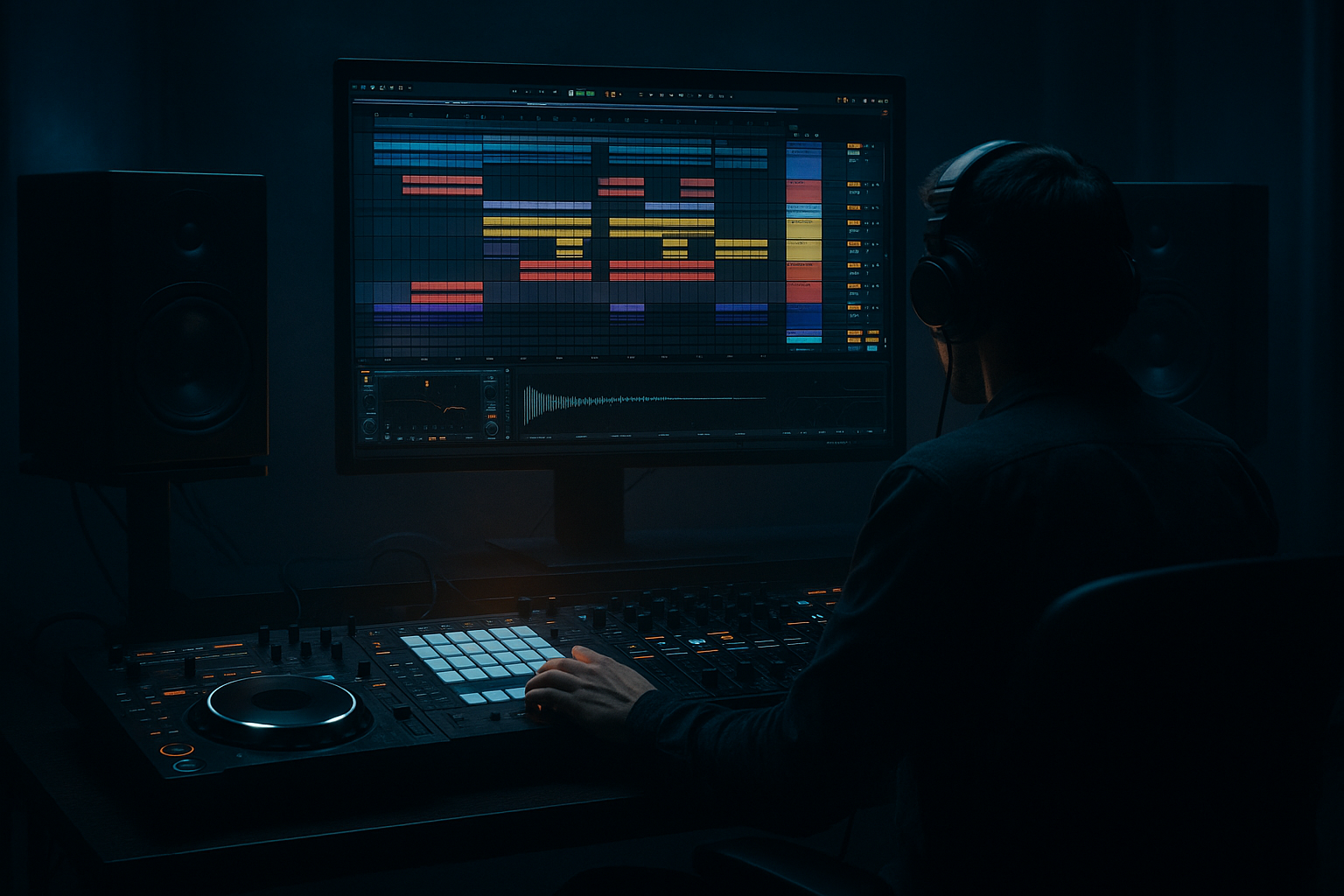
Main tutorial
1. Lesson overview
This lesson teaches you practical, Ableton-specific techniques to carve space between bass and drums in drum & bass. We’ll focus on frequency-slotting, dynamic EQ/ducking, stereo/mono control, and tasteful harmonic processing so your breakbeats and rolling bass sit together without fighting. Expect step-by-step device chains, concrete EQ settings, routing tips, and quick arrangement ideas for drops and breakdowns. Ready to make the low end breathe? Let’s go! 🚀🥁
---
2. What you will build
A small Ableton Live mixing chain and workflow that gives:
- Clean mono sub (solid foundation).
- Punchy drums with mid/high snap.
- Bass that fills midrange without masking drums.
- Dynamic frequency ducking so drums cut through without killing bass energy.
- Drum tracks → Drum-Bus (group)
- Bass track → Bass channel
- Drum-Bus → Multiband sidechain input (for bass ducking)
- Use Spectrum instances to visualize conflicts
- On Bass track, insert an EQ Eight before the Multiband dynamics and create a narrow bell boost at the problem frequency (e.g., +6 dB at 350 Hz). Route the bass output to a duplicate track, insert Multiband Dynamics on the duplicate, sidechain that to Drum-Bus and set heavy ducking only where the bell boost sits, then blend duplicate with original. This gives frequency-targeted ducking. (Advanced routing—useful if you want precise dips that follow drum hits.)
- In verses: reduce bass midrange (cut 200–600 Hz) slightly to give top-lines and pads space.
- In drops: bring mid-band back, but set Multiband Dynamics to duck less aggressively so bass roars with the drums.
- For breakdown / halftime moments: strobe a single layer of bass that takes the low-end entirely while drums simplify — this avoids masking.
- Over-cutting the sub: carving too much at 40–80 Hz can make bass lose weight. Always mono your sub and check on multiple systems. 🔊
- Using linear-phase EQ on transients: linear-phase introduces pre-ringing, which can smear drums. Prefer minimum-phase or EQ Eight default for percussive material.
- Ducking the entire bass: sidechaining the whole bass with a compressor kills the sustain and energy. Use Multiband ducking or only duck the mid/high bands.
- Too-wide low end: don’t stereo your sub. If sub isn’t mono, phase issues and weak low end will occur.
- Excessive boosts instead of cuts: often you can make space with a -3 dB cut instead of +3 dB boosts, which keeps headroom intact.
- Not checking in context: fixes that sound great soloed can ruin the track. Always check full mix with reference.
- Emphasize midrange grit: apply band-limited distortion to 200–800 Hz (e.g., Saturator with a Highpass before it, or Overdrive) to add aggression without muddying the sub. Drive 3–6 dB, WET 30–60%.
- Multiband saturation: use Multiband Dynamics (or chain EQ + Saturator) to saturate mid/high band only — keeps sub clean while adding gristle.
- Accent transients with Drum Buss + Sidechain: put a short, aggressive sidechain from the snare transient to a transient shaper or compressor on a mid-bass layer to create a tight rhythmic interaction.
- Replace low transient from breakbeats with a tight synthetic kick for more control: sample a short kick transient, layer under the break, and cut the break's low with EQ Eight. This gives clearer low-end without losing break character.
- Automate Multiband ducking: for drops, reduce duck amount; for sections where drums must dominate (fill/lead moments), increase duck amount. This keeps the arrangement dynamic and heavy without clutter. ⚡️
- Use a limiter on a sub-only bus (light brick) with ceiling -1 dB to prevent sub overshoot.
- Do kick transients read clearly on small speakers?
- Does the snare snap through the bass midrange?
- Is the sub consistent and not pumping?
- Use subtractive EQ first (narrow cuts where elements clash), add harmonics with Saturator, and keep sub mono (Utility).
- Prefer Multiband Dynamics sidechained to drums to duck problematic mid/high bands of the bass while keeping the sub intact.
- Sculpt drums with Drum Buss + EQ and add a parallel squashed bus for weight.
- Check with Spectrum and references; automate ducking amount across the arrangement for power and clarity.
- Avoid over-ducking or over-boosting; small, musical moves win in DnB.
You’ll use mostly stock Live devices: Drum Rack, EQ Eight, Multiband Dynamics, Utility, Saturator, Drum Buss, Glue Compressor, Spectrum and (optionally) Wavetable/Operator for bass.
Target tempo/genre context: 170–175 BPM rolling DnB / jungle, using breaks (e.g., Amen or chopped break) and a reese/sub hybrid bass.
---
3. Step-by-step walkthrough
Prerequisites: An Ableton Live set with a drum group (break or drum Rack) and a bass track. Tempo ~174 BPM. Route all drum tracks into a Drum-Bus group.
Overview of the routing we'll create:
A. Gain staging & reference
1. Set master peak around -6 dB (headroom).
2. Solo the drum-bus and bass individually, then both together to hear interaction.
3. Put a Spectrum on master (or individual tracks) to visualize masking. Set Spectrum to "averaging" for a second to identify dominant frequencies.
B. Drum-bus chain (device order and settings)
1. Drum Rack / samples → Drum-Bus track.
2. Drum Buss (stock device): Drive 2–4, Punch +2–4 dB, Transient: +8–15 to tighten hits. Use the Snap/Hi-Pass knobs subtly.
- Purpose: glue and transient shape. Use small settings; you want punch, not distortion.
3. EQ Eight (on the Drum-Bus) — surgical cleanup:
- High-pass (Filter 1): 30–40 Hz, slope 24 dB/oct — removes ultra-sub rumble
- Bell (1): +2–3 dB @ 3.5 kHz, Q 1.0 — brings snare/snap
- Bell (2): -3 dB @ 300–400 Hz, Q 1.5 — tame boxiness
- Optional: slight shelf boost +1.5 dB above 8–10 kHz for air.
4. Glue Compressor (optional): 3–4:1, Attack 10–30 ms (let transients through), Release 150–250 ms, 1–2 dB gain reduction — tightens bus.
C. Bass track chain (device order and settings)
Start with this chain on the bass track:
Utility (gain staging) → Saturator → EQ Eight → Multiband Dynamics (with sidechain to Drum-Bus) → Utility (mono below 120 Hz) → Spectrum
Concrete settings and why:
1. Utility (first): set gain so the bass peaks around -6 to -8 dB before processing.
2. Saturator: Soft Sine, Drive 2–4 dB, Dry/Wet 20–40% — adds harmonics above the sub to help bass be audible on smaller speakers.
3. EQ Eight (sub/mid sculpting):
- High-pass: if your synth has an isolated sub, set HP at ~22–28 Hz with slope 12–24 dB/oct (protects headroom)
- Bell cut: -3 to -6 dB @ 60–90 Hz, Q 1.5–2.0 — only if drums/kick need space. Find the kick/bass clash frequency by soloing drums and noting the spectral peak; carve the bass there.
- Bell boost: +2–4 dB @ 200–600 Hz, Q 0.7–1.2 — adds mid-body (use sparingly; can mask snare if overdone)
- Shelf/Treble: small boost +1–2 dB above 2.5–4 kHz if you want more harmonic presence.
4. Multiband Dynamics (key part—dynamic carving):
- Set crossover bands roughly at: Low band 0–120 Hz, Mid band 120–800 Hz, High band 800 Hz–20 kHz.
- Click the sidechain icon and select Drum-Bus (the grouped drum track) as the external input.
- Solo the mid band while the drums play, then set:
- Threshold: start around -20 dB, Ratio 3:1–6:1 (use your ears)
- Attack: 0–10 ms (fast)
- Release: 80–160 ms (musical with tempo)
- Range: 3–6 dB (controls how much the mid band ducks)
- Purpose: when drums hit, the mid-band of the bass is attenuated dynamically, giving drums transient space without killing overall bass body.
- For the low band (sub): set little or no ducking (Threshold high/Range small) so the sub remains solid.
5. Utility (post): set Stereo Width to 0% (mono) for everything below ~120 Hz.
- To do this: duplicate the bass track or use an EQ Eight to create a low-only chain and put a Utility set to Width 0% on that. Or use Utility with EQ Eight with low band solo to confirm.
D. Alternative: frequency-specific sidechain (if you want to duck only one frequency area)
E. Drums carve to match bass (reverse approach)
1. If you want drums to win certain bands (e.g., snare presence), use EQ Eight on bass and make a narrow cut where the snare’s "snap" is (2–7 kHz) with -2 to -4 dB Q ~1.5.
2. Or on Drum-Bus, add a transient emphasis and small boost in the snare area (2–6 kHz) to ensure the snare reads clearly.
F. Parallel drum body for darker/heavier sound
1. Duplicate Drum-Bus → Drum-Bus-Parallel.
2. On parallel bus: lowpass filter at 800–1200 Hz, Glue Compressor heavy (10:1), attack 5 ms, release ~200 ms to squish.
3. Blend this bus under main drums to add body/weight without adding top-end masking.
G. Arrangement suggestions
H. Visual check and final touches
1. Use Spectrum on both Drum-Bus and Bass soloed and together. Look for overlapping peaks in the 50–500 Hz and 2–6 kHz ranges.
2. Use Utility to mono below ~120 Hz and confirm phase coherence.
3. A/B with a reference DnB track (same tempo) to verify low-end balance and drum presence.
---
4. Common mistakes
---
5. Pro tips for darker/heavier DnB
---
6. Mini practice exercise
Goal: Carve bass and drums in a 16-bar loop (174 BPM) so the snare snaps and the sub stays solid.
1. Load an Amen (or other) break into a Drum Rack and create a 2-bar loop. Route all drum tracks to Drum-Bus.
2. Create a bass track with Wavetable/Operator: make a reese + sine sub split (or use two chains inside Simpler/Drum Rack).
3. Apply the Drum-Bus chain from section 3B (Drum Buss + EQ Eight + Glue).
- EQ8: HP=35Hz 24dB/oct, -3 dB @ 350 Hz Q=1.5, +3dB @ 3.8kHz Q=1.0
4. On Bass track apply:
- Saturator Soft Sine Drive 3 dB, Dry/Wet 30%
- EQ Eight: HP 24 Hz, Bell -4 dB @ 80 Hz Q=2.0 (if kick conflict), small +2 dB @ 300 Hz Q=1.0
- Multiband Dynamics: crossovers at 120 and 800 Hz; sidechain input = Drum-Bus. Mid band: Ratio 4:1, Attack 4 ms, Release 100 ms, Range 4 dB, Threshold tuned until you hear the mid duck with drum hits.
- Utility set to mono below 120Hz (Width 0% via an additional low-only chain or Utility after EQ).
5. Loop playback and adjust:
- Find the frequency where kick/snare clash using Spectrum (look 50–500 Hz and 2–6 kHz). Perform small narrow cuts (-2 to -5 dB) on the offending element.
- Save the preset for Bass Multiband Dynamics to reuse later.
6. Export a short reference loop, compare with a commercial DnB track to evaluate snap and sub solidity.
What to listen for:
---
7. Recap
Go apply this to a drop: carve the bass for the intro (gentle), then automate reduced ducking + more mid harmonic saturation during the drop for maximum aggression. Keep practicing the ear for masking spots — the more you do it, the faster you’ll find the sweet cuts. 💥🎛️
If you want, I can create a downloadable Ableton template chain with the exact device racks and settings described here — would you like that?

