Main tutorial
1. Lesson overview
-------------------
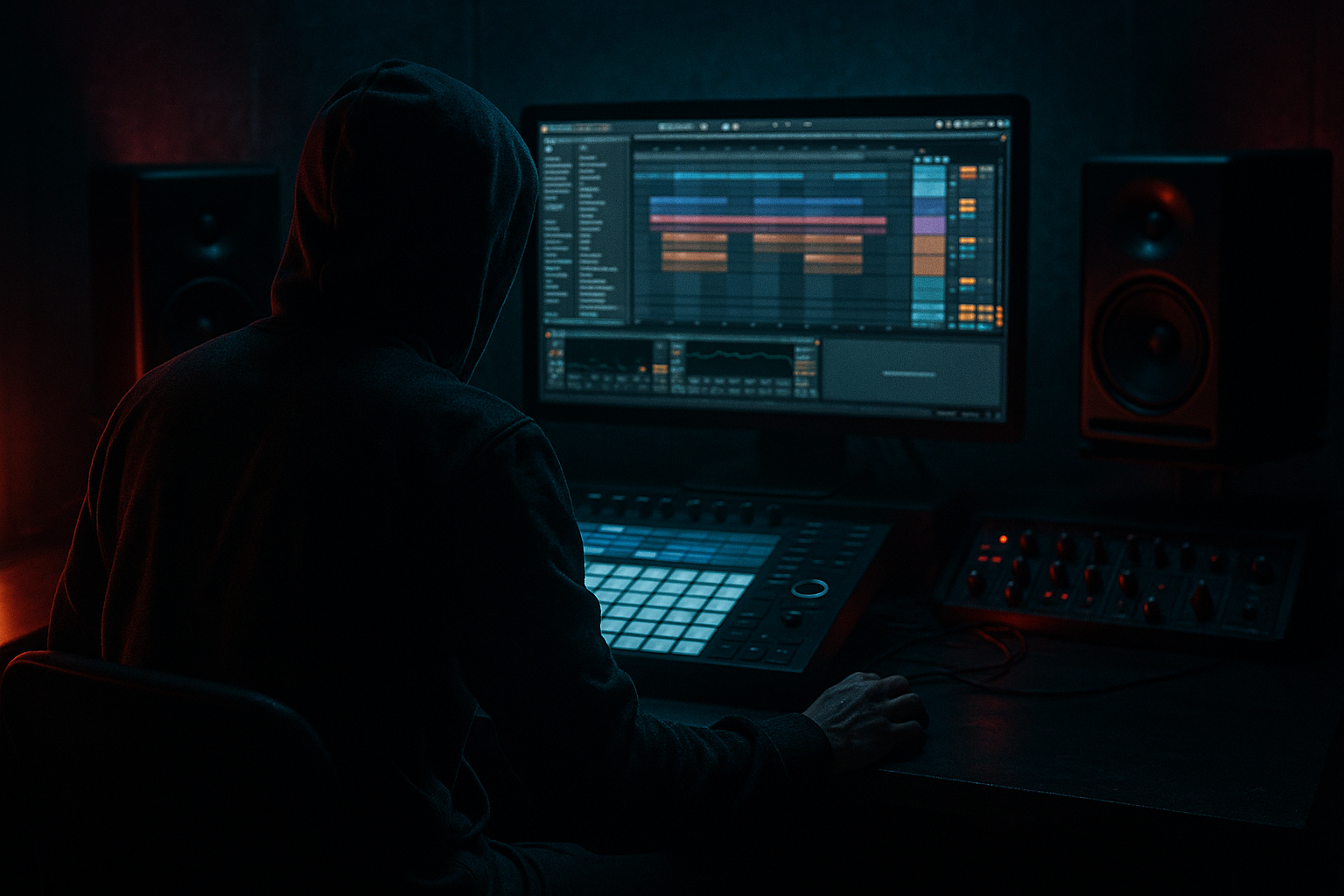
Welcome — today we’re building believable, spine-tingling fake-out builds for dark rollers in Ableton Live. Fake-outs are a powerful arrangement tool in drum & bass/jungle: they create expectation and then pull the rug out, making the real drop hit harder and keeping the energy unpredictable. This lesson is practical and Ableton-focused: device chains, parameter values, tempo/grid settings, and concrete arrangement steps you can drop into your project. Let’s make things tense, nasty, and musical. ⚡️🥀
2. What you will build
----------------------
You’ll create a short, reusable fake-out section (4–8 bars) that fits a 170–175 BPM DnB track. It will include:
- A rising noise/synth riser with pitch automation and filtering.
- A chopped/rolled breakbeat that looks like a drop is coming, then collapses.
- A snare/hihat roll that rhythmically teases the groove.
- A “silence / micro-drop” moment where nearly everything cuts out (or flips to a minimal element) before the real drop or next section.
- Automation macro controls so you can tweak the tension in real time.
- Ableton Live 10/11+.
- Tempo set to 174 BPM (common DnB range; use your track tempo).
- Basic drum rack and bass elements already exist in your project.
- Overcrowding: stacking too many risers/noise layers makes the fake-out muddy. High-pass and carve space with EQ Eight (surgical cuts at 200–400 Hz).
- Predictability: doing the same kind of fake every time kills surprise. Vary length and technique (mute vs. half-drop vs. micro-drop).
- Losing groove: chopping the drum loop until it loses swing. Keep subtle humanization and retain key transient timings.
- Over-compression: squash the dynamics and you’ll lose the tension. Use parallel compression on drums (group bus) rather than heavy single-chain compression.
- Too much FX tail on the silence: a giant reverb tail can blur the next section. Automate reverb/delay send levels to taste; cut high-end on reverb to keep it dark.
- Forgetting low-end rules: pulling bass out without ensuring the sub re-enters cleanly makes the drop feel weak.
- Sub control: Automate Utility Width to mono the low end (<120 Hz) during builds, then widen again on the drop. This keeps the low end focused and punchy.
- Mid-range dirt: Add targeted distortion on mid-range bass (use Saturator + EQ Eight and boost 200–600 Hz) to give bite when the bass returns after a fake-out.
- Dissonant movement: use a detuned sine or low vocal chop pitched down a semitone or tritone during the fake-out to create unease. Map pitch to an automation lane so it resolves after the drop.
- Rhythmic deception: shift the micro-drop element to slightly off-grid timing (e.g., 1/16 + 10 ms) — it feels “wrong” in a dark, satisfying way.
- Stereo chaos: during the build, open high-frequency elements left/right with Auto Pan and increase rate slightly toward the end; then collapse mid/side on the fake silence for a claustrophobic feel.
- Use Glue Compressor on drum groups for punch and transient enhancement; set Attack ~10 ms to preserve punch.
- Keep an alternate “real drop” bass ready: when you throw the fake-out, swap to a heavier bass sample or alternate low-pass setting for the real drop to reward patience.
Ableton devices used (stock): Drum Rack, Simpler, Sampler (optional), Wavetable, Auto Filter, EQ Eight, Saturator, Glue Compressor, Compressor (sidechain), Beat Repeat, Redux, Grain Delay, Utility, Gate, LFO (if using Max for Live — optional). You can do everything with core Live devices.
Project assumptions:
3. Step-by-step walkthrough
---------------------------
A. Prep and structure (0.5–1 hour)
1. Set tempo: 174 BPM. Create a marker at the bar where you want the fake-out to begin (Arrangement view). Label it “Fake-Out Start”.
2. Duplicate your current 8-bar section that leads to a drop into a new lane. Work non-destructively.
3. Create the following tracks (group them into a “Fake-Out” group for quick show/hide):
- Drums (Drum Rack with breakbeat cells)
- Riser (Simpler or Wavetable + Noise)
- Perc Rolls (blank MIDI + Drum Rack for snare/hats)
- FX (reverse impacts, cymbals, tone hits)
- FX Sends / Return (for return reverb/delay treatment)
B. Build the riser chain (noise + pitch + texture)
1. Create a Simpler (or Sampler) and load a white noise or filtered noise sample. Set Simpler to Classic + Filter enabled.
2. Device chain (Riser track, in order):
- EQ Eight: high-pass below 200 Hz (to keep riser airy).
- Auto Filter: mode = Highpass + Lowpass (use LP to create sweep). Set initial cutoff ~300 Hz.
- Wavetable (optional) or frequency shifter for tonal character.
- Saturator: Drive 3–6, Saturation type Analog Clip, Dry/Wet ~40%.
- Grain Delay (subtle): Grain Size 25–40 ms, Spray 10–20, Feedback 10–20% to add movement.
- Redux: Bit reduction ~6–12% to make it edgy (use sparingly).
- Glue Compressor on group bus: Attack 10 ms, Release 200 ms, Ratio 4:1, Gain make-up so level is consistent.
3. Automation for dramatic tension:
- Filter cutoff (Auto Filter) from ~300 Hz up to 8–10 kHz over the build (4–8 bars). Add resonance ~2-4 dB at peak.
- Pitch (Simpler Transpose) automates up +12–24 semitones across the last 2–4 bars for a classic riser.
- Optional: map Saturator Dry/Wet to a macro and increase toward drop.
C. Drum fake and chop techniques
1. Use a syncopated rolling break (classic jungle break or your loop). Warp it in Beats mode (transients preserved) at 174 BPM.
2. Create a copy of the break loop on a new track — call it “Break Chops”. Right-click → Slice to New MIDI Track (Preserve). Use transient slicing or fixed 1/16 to create MIDI slices you can trigger.
3. Apply a Gate / Compressor trick:
- Put Gate after Drum Rack. Set Threshold so it chops the loop to a tight rhythmic feel (try Attack 0.5 ms, Release 50–100 ms). Automate the Threshold to gradually increase during the build so the loop becomes more staccato.
4. Add Beat Repeat for glitchy stutter:
- Insert Beat Repeat on Break Chops. Settings for a tense 1-bar fake-out: Interval set to 1/8 or 1/16, Grid = 1/32 or 1/64, Snap On, Decay 1.0, Chance ramp from 0% to 80% in final bar. Map Repeat On to a macro for quick changes.
5. Half-drops and “false-drop” arrangement moves:
- Bar -2 to -1: Keep kick + snare pattern playing but reduce bass and low end progressively (automate EQ Eight low-frequency cut).
- Last half-bar: mute kick entirely (or drop it to a tiny click) so listeners expect a massive downbeat hit. Then cut everything to a minimal percussion + tiny filtered tonal element on the drop (fake!).
D. Snare/hihat rolls and rhythmic tension
1. Create a separate Perc Rolls track. Program a snare roll (MIDI) across the last bar using 1/32 or 1/64 notes. Velocity should increase progressively.
2. Use simple Device chain:
- Drum Rack > Compressor (sidechain to your main kick) to make the roll pump.
- Auto Filter (Band-pass) with LFO mapped to cutoff for movement (or use Utility > Width automation).
3. Humanize: add tiny timing shifts with the Groove Pool (swing) or manually nudge notes slightly off-grid. DnB groove is often slightly behind/forward the beat.
E. The “silence” / micro-drop technique
1. In the final beat before your actual drop, automate a hard cut:
- Group your main drums, bass, and synths in a track group. Draw automation to Unity Gain 0 (i.e., mute or volume -inf) for all group tracks on the bar of the fake-drop. Or use Utility > Gain to automate to -inf dB.
2. Replace that silence with a tiny, eerie element:
- A low filtered sub-bass stinger (one transient) OR a single distorted hat or “konk” sample placed at a different beat than expected (off-grid).
- Route this element to a return with long, dark reverb (use Reverb or Hybrid Reverb) and long delay tail. Make the tail audible during the silence to keep interest.
3. For a less absolute silence: reduce low-end to 20–200 Hz using EQ Eight (Band type Low-cut) and heavily reduce mids & highs so the track feels hollowed out rather than dead silent.
F. Create macro controls and automation lanes
1. Build an Instrument/Audio Effect Rack on the riser and break bus, then map:
- Riser cutoff
- Riser pitch transpose
- Break Beat Repeat chance/decay
- Group Utility gain (for the silence)
2. Automate these macros in the Arrangement view:
- Macro 1 (tension): opens filter + increases beat-repeat chance + raises saturation over 4 bars.
- Macro 2 (pull the plug): drops Utility gain to -inf at the final beat.
G. Final touches and mixing context
1. Sidechain the riser/ambience to the kick to keep the low-end clear during the build up until the micro-drop. Use Compressor with sidechain (Kick feed) — Attack ~5–10 ms, Release ~150 ms, Ratio 4:1.
2. For the “real” drop re-entry, reintroduce a different bass pattern (not the same as the teased one) to reward the listener. You can also reintroduce the original bass but transposed or distorted to feel heavier.
3. Bounce/export your fake-out section as a clip for reuse across tracks.
4. Common mistakes
-------------------
5. Pro tips for darker/heavier DnB
---------------------------------
6. Mini practice exercise
-------------------------
Goal: Build a 4-bar fake-out at 174 BPM.
Step-by-step (30–45 minutes):
1. Start with your main loop (drums + bass) playing up to bar 16.
2. Duplicate the last 8 bars into a new lane. Label “Fake-Out Test”.
3. Create a 4-bar riser: Simpler with white-noise, Auto Filter cutoff from 300 → 9000 Hz across 4 bars, Saturator Drive 4.
4. Create a break-chop: duplicate break loop → Slice to New MIDI Track → program a 1-bar 1/32 stuttering pattern on bar 15–16. Put Beat Repeat on with Interval 1/16 and automate Chance from 0 → 80%.
5. Program a snare roll on the last bar (1/32 notes, rising velocity). Put it through Auto Filter (BP) modulated slightly by the LFO.
6. On the last downbeat, set Utility gain to -inf for 1/4 beat (hard cut). Replace that moment with a single low filtered click + long dark reverb tail on the send.
7. Play back: adjust EQ so the riser sits above 250 Hz; ensure the sub is cut during the silence and returns full on the real drop.
8. Save as “fakeout_174_v1.als” and try variations: 8 bars, different beat-repeat grid, or micro-drop instead of full silence.
7. Recap
--------
Fake-outs are about expectation management. In drum & bass, they’re especially effective because the genre thrives on momentum and sudden hits. Use layered risers, rhythmic chops, snare/hihat rolls, and a decisive “pull-the-plug” moment. Keep low-end control, use Device Racks and macros for quick adjustments, and experiment with Beat Repeat, Grain Delay, and Auto Filter automation to craft tension. Finally, vary your fake-outs across a track and pair the fake with a different-sounding real drop for maximum payoff.
Go make something that makes people lean forward and then scream when it finally hits. Need an example Ableton Live project? I can sketch a template .als with the riser and chop chains ready to drag into your set. 🎛️🔥

