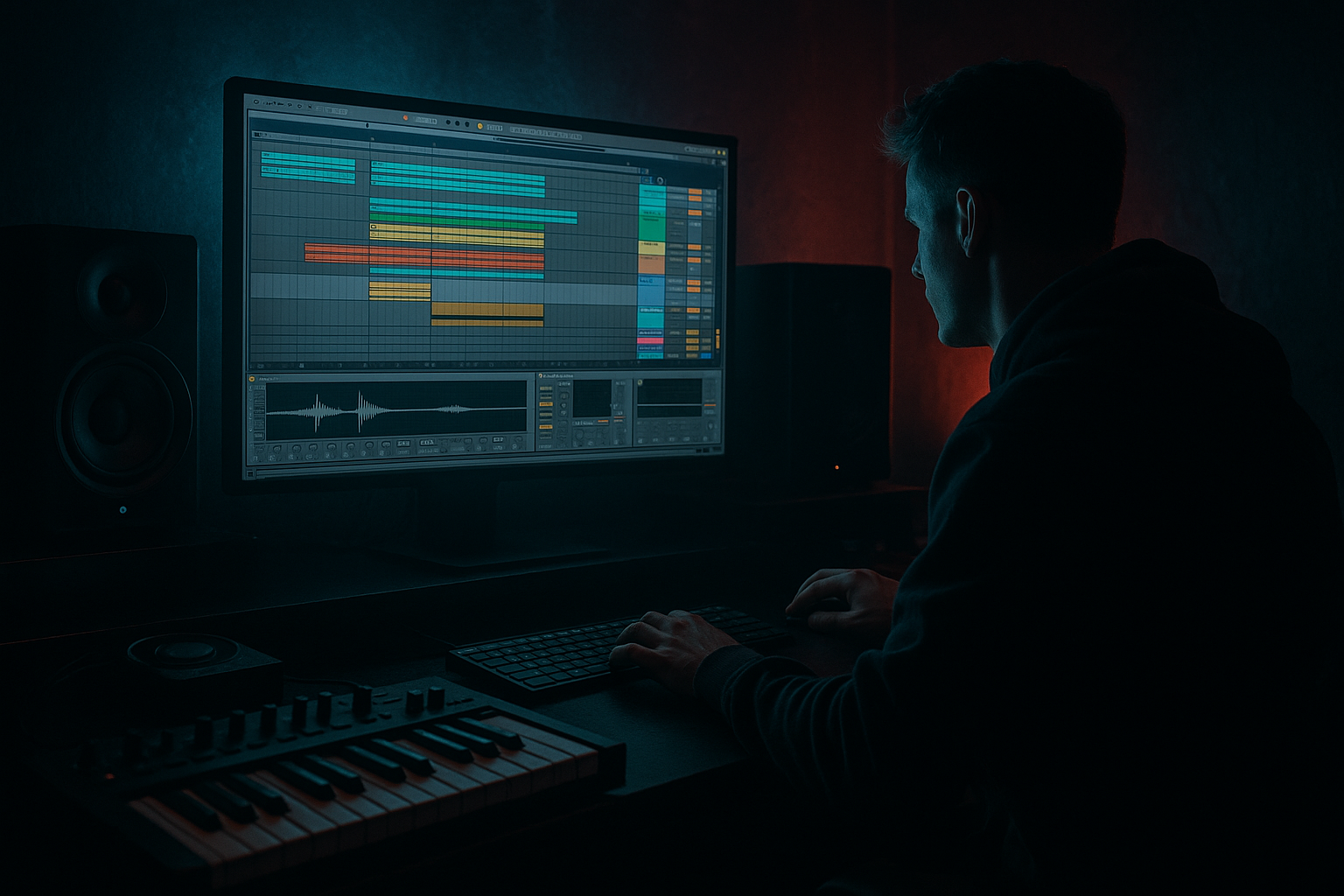
Main tutorial
```markdown
Fast A/B Referencing (Smoky Late-Night Moods) — DnB Mixing in Ableton Live 🌒🎛️
1) Lesson overview
Fast A/B referencing is the quickest way to lock your mix into a “real-world” target—especially for smoky, late-night drum & bass where the vibe lives in subtle balances: sub weight, drum bite, reverb haze, and top-end restraint.
In this lesson you’ll build a zero-friction A/B system inside Ableton Live so you can instantly compare:
- Your mix (what you’re working on)
- A reference track (a properly mastered DnB track with the mood you want)
- matches loudness fairly ✅
- avoids routing mistakes ✅
- lets you check specific vibe markers (low-end contour, drum transient shape, air vs fog) ✅
- A Reference Track lane routed to a Reference Bus
- Your entire mix routed to a Mix Bus
- A fast A/B switch using stock devices (no plug-ins required)
- Loudness matching using Utility + meters (so you don’t get fooled by volume)
- A “smoky mood checklist” you can run in under 30 seconds
- Similar BPM (170–175)
- Similar drum density (rollers vs halftime)
- Similar bass philosophy (sub-led vs mid-led)
- Similar “night” tone (controlled highs, roomy tails, not overly shiny)
- Vibe: atmosphere, darkness, haze
- Technical: drum punch, low-end translation, loudness
- Don’t send it to your reverbs/delays
- Don’t run it through your mix bus chain
- For every group/channel in your track (Drums, Bass, Music, FX), set:
- On `MIX BUS` set:
- On `REF` track:
- On `REF BUS`:
- Put Utility on `MIX BUS`
- Put Utility on `REF BUS`
- Map `REF BUS mute` and `MIX BUS mute` to the same button but in opposite states using a controller that supports toggle states, or use two adjacent keys (e.g., `A` for Mix, `B` for Ref).
- Press A: Mix plays, Reference muted
- Press B: Reference plays, Mix muted
- On `REF BUS`, add:
- On `PRINT / MONITOR`, add metering:
- Kick + snare apparent “forwardness”
- Sub weight in the room
- Vocal/atmos level (if present)
- Glue Compressor
- Saturator (Soft Clip ON)
- EQ Eight
- Drum Buss (very light)
- Hybrid Reverb
- Add Echo after Hybrid Reverb (optional)
- EQ Eight
- Saturator
- Auto Filter (very subtle)
- Utility
- Optional: EQ Eight for quick band soloing
- In Mono: do drums collapse nicely? does sub stay stable?
- If your ref stays strong in mono and yours doesn’t, it’s usually stereo low-end or phasey reverb.
- `Intro Atmos`
- `Pre-drop Tension`
- `Drop A (main groove)`
- `Mid-16 switch`
- `Drop B / Variation`
- `Outro / DJ-friendly`
- longer intros with filtered breaks/texture
- subtle drum evolution (ghosts, rides, shaker layers)
- restrained “festival” highs; the energy comes from groove + low-mid pressure
- Does my intro feel as “cinematic”?
- Is my drop too bright relative to the mood?
- Is my 2nd 16 adding interest without adding clutter?
- Use a “tilt mindset”: many late-night mixes have a slightly downward tilt (less 10–16k, more controlled low-mids). Use Spectrum to confirm, but decide by ear.
- Ghost notes = groove smoke: add very quiet snare ghosts and percs, then A/B if the reference has that rolling undercurrent.
- Sub discipline wins: keep sub mono, tune kick/sub relationship, and shorten sub tails if the reference sounds tighter.
- Darkness from space + saturation, not just EQ cuts:
- Snare body is the anchor in smoky DnB:
- You built a fast, reliable A/B system in Ableton using MIX BUS vs REF BUS routing.
- You level-matched with Utility so the comparison is fair.
- You learned a smoky late-night DnB checklist: sub contour, kick pocket, snare body/crack, restrained highs, haze/space, mono stability.
- You practiced the correct A/B mindset: instant switching + one-variable decisions.
You’ll do it in a way that:
---
2) What you will build
A ready-to-use referencing setup with:
You’ll end with a template you can drop into any rolling/half-time/techy jungle project.
---
3) Step-by-step walkthrough
Step 0 — Pick the right reference (smoky late-night DnB)
Choose 1–2 tracks max. You want references that share:
Pro move: use one “vibe reference” and one “technical reference.”
---
Step 1 — Import and isolate your reference (do NOT mix into it)
1. Create an Audio Track named: `REF`
2. Drag the reference track audio in.
3. Set it to Warp Off (in Clip View) if it’s already the correct tempo and you don’t want Live to alter transients.
- If you must warp: use Complex Pro sparingly, but prefer Beats for drums.
Important: disable any processing on the reference track that could change it accidentally:
---
Step 2 — Build Mix Bus vs Reference Bus routing
We’ll create two master paths so you can compare fairly.
#### A) Create two Audio Return-like busses using Audio Tracks
1. Create Audio Track named: `MIX BUS`
2. Create Audio Track named: `REF BUS`
3. Create Audio Track named: `PRINT / MONITOR` (this is your final listen path)
#### B) Route your whole mix to MIX BUS
- Audio To → MIX BUS
- Audio To → PRINT / MONITOR
#### C) Route reference to REF BUS
- Audio To → REF BUS
- Audio To → PRINT / MONITOR
✅ Now both your mix and the reference hit the same final monitoring path.
---
Step 3 — Add the fast A/B switch (stock, instant, safe) ⚡
On `PRINT / MONITOR`, drop an Audio Effect Rack called: `A/B SWITCH`.
Inside the rack:
1. Create 2 chains:
- Chain 1: `MIX`
- Chain 2: `REF`
2. Now route audio into each chain using External Audio Effect?
In Live, simpler is: don’t split inside the rack—instead we’ll mute/solo with MIDI mapping or use Utility on busses.
Fast and clean method (recommended):
Map their mutes:
1. Click MIDI Map (top right)
2. Map `MIX BUS → Utility → Mute` to a key/button
3. Map `REF BUS → Utility → Mute` to another key/button
Even faster (one-button toggle):
Goal behavior:
---
Step 4 — Loudness match the reference (critical for honest decisions) 🎚️
Your reference is mastered; your mix (mid-process) probably isn’t. If you don’t level match, you’ll “prefer louder.”
Setup:
1. Utility (for gain trim)
2. Limiter (optional safety, ceiling -1.0 dB)
- Spectrum (for tonal tilt)
- Meter (basic)
- If you have Live Suite, consider Spectrum with block size 4096 for stable low-end viewing.
Procedure:
1. Loop the drop (16–32 bars) in your mix.
2. Loop the same intensity section in the reference.
3. Use `REF BUS Utility Gain` to match perceived loudness:
- Start around -6 to -10 dB on the reference (often needed).
4. Confirm you’re not clipping `PRINT / MONITOR`.
DnB-specific tip: Loudness match while focusing on:
Not just peak level.
---
Step 5 — Build a “Smoky Mood” A/B checklist (30-second pass) 🌫️
When you switch, listen for one thing at a time:
1. Sub contour (30–60 Hz)
- Is your sub too pure/sine compared to ref?
- Is it too long (masking kick) or too short (feels weak)?
2. Kick vs sub relationship
- Does the kick have a defined pocket?
- Compare how much 50–90 Hz exists in the kick.
3. Snare snap vs haze
- Smoky DnB usually has present mids (180–250 Hz body + 2–5 kHz crack) but restrained harshness (7–10 kHz).
4. Top-end brightness
- Late-night references often have controlled air; hats feel “silky” not “glassy.”
- Compare 10–16 kHz energy using Spectrum.
5. Reverb tail density
- Is your space too clean/short?
- Or too wide/washed out, killing punch?
6. Stereo width discipline
- Sub is mono.
- Atmos can be wide, but drums should stay solid.
---
Step 6 — Use Ableton stock devices to steer your mix toward “late-night”
Here are fast moves you can make while A/B’ing:
#### A) Drum bus punch without extra brightness
On `DRUMS GROUP` (before sending to MIX BUS):
- Attack: 3–10 ms
- Release: Auto or 0.1–0.3 s
- Ratio: 2:1
- Aim: 1–2 dB GR on peaks
- Drive: 1–3 dB
- Color: Warmth slightly up if needed
- Keep it subtle; you’re adding “smoke,” not fizz.
#### B) Control harsh hats (keep it dark but detailed)
On hats/perc bus:
- Gentle shelf down 10–16 kHz by 0.5–2 dB
- Notch any “glass” at 7–9 kHz if needed (narrow Q, -1 to -3 dB)
- Drive: 2–5
- Crunch: 0–5
- Damp: use to tame excessive top
#### C) Atmos “haze” without drowning the mix
Create a return: `SMOKE VERB`
- Algorithmic: Plate or Chamber
- Decay: 1.2–2.8 s (depends on tempo density)
- Pre-delay: 15–30 ms
- High Cut: 6–10 kHz
- Low Cut: 150–300 Hz
- Time: dotted 1/8 or 1/4
- Feedback: 10–25%
- Filter: keep it dark
Send snare ghosts, rimshots, vocal chops, pads, not your main kick/snare transient (unless you know exactly what you want).
#### D) Bass “night” character: weight + controlled mid bite
On bass group:
- Keep sub mono (see next step)
- Reduce muddy buildup around 200–350 Hz if it clouds the drum body
- Drive 1–4 dB, Soft Clip ON
- Low-pass around 12–18 kHz if the bass resampling added fizz
---
Step 7 — Add a mono + low-end check inside the A/B workflow 🔍
On `PRINT / MONITOR` add:
- Map Mono toggle to a key
- Use a narrow band and boost temporarily to find issues (then reset!)
What you’re checking:
---
Step 8 — Arrangement-aware referencing (DnB specific)
Don’t just compare “drops.” Compare sections:
Create locators:
A smoky late-night track often has:
When A/B’ing, ask:
---
4) Common mistakes
1. Not level matching the reference (you’ll chase the wrong targets).
2. Reference routed through your master chain (you end up comparing two processed signals).
3. A/B switching too slowly (memory lies—make it instant).
4. Comparing different song moments (your 16-bar drop vs their breakdown is meaningless).
5. Fixing everything at once (A/B works when you isolate one variable: sub, snare crack, hat air, etc.).
6. Over-darkening: smoky ≠ dull. You still need definition around 2–6 kHz.
---
5) Pro tips for darker/heavier DnB 🖤
- Dark plates, filtered delays, subtle tape-ish saturation (Saturator/Drum Buss) go further than nuking highs.
- If your snare lacks 180–250 Hz (body), the track won’t feel “late-night heavy,” it’ll feel thin even if the sub is loud.
---
6) Mini practice exercise (15 minutes) ⏱️
1. Drop a smoky DnB reference into `REF`.
2. Build `MIX BUS`, `REF BUS`, `PRINT / MONITOR` routing.
3. Map:
- `A` = Mix on / Ref off
- `B` = Ref on / Mix off
- `M` = Mono toggle on `PRINT / MONITOR`
4. Loudness match the reference using `REF BUS Utility` (aim for similar perceived loudness in the drop).
5. Do three focused A/B passes (30–60 seconds each):
- Pass 1: sub + kick pocket
- Pass 2: snare crack/body
- Pass 3: hat air + reverb haze
6. Make one change only after each pass (e.g., -1 dB shelf at 12 kHz on hats, or +1 dB at 200 Hz on snare body), then re-check.
---
7) Recap
If you want, tell me one reference track you’re using (or describe it: roller/halftime, bright/dark, minimal/stacked) and I’ll suggest a laser-focused “targets list” (frequency areas + dynamics moves) for that exact vibe.
```

