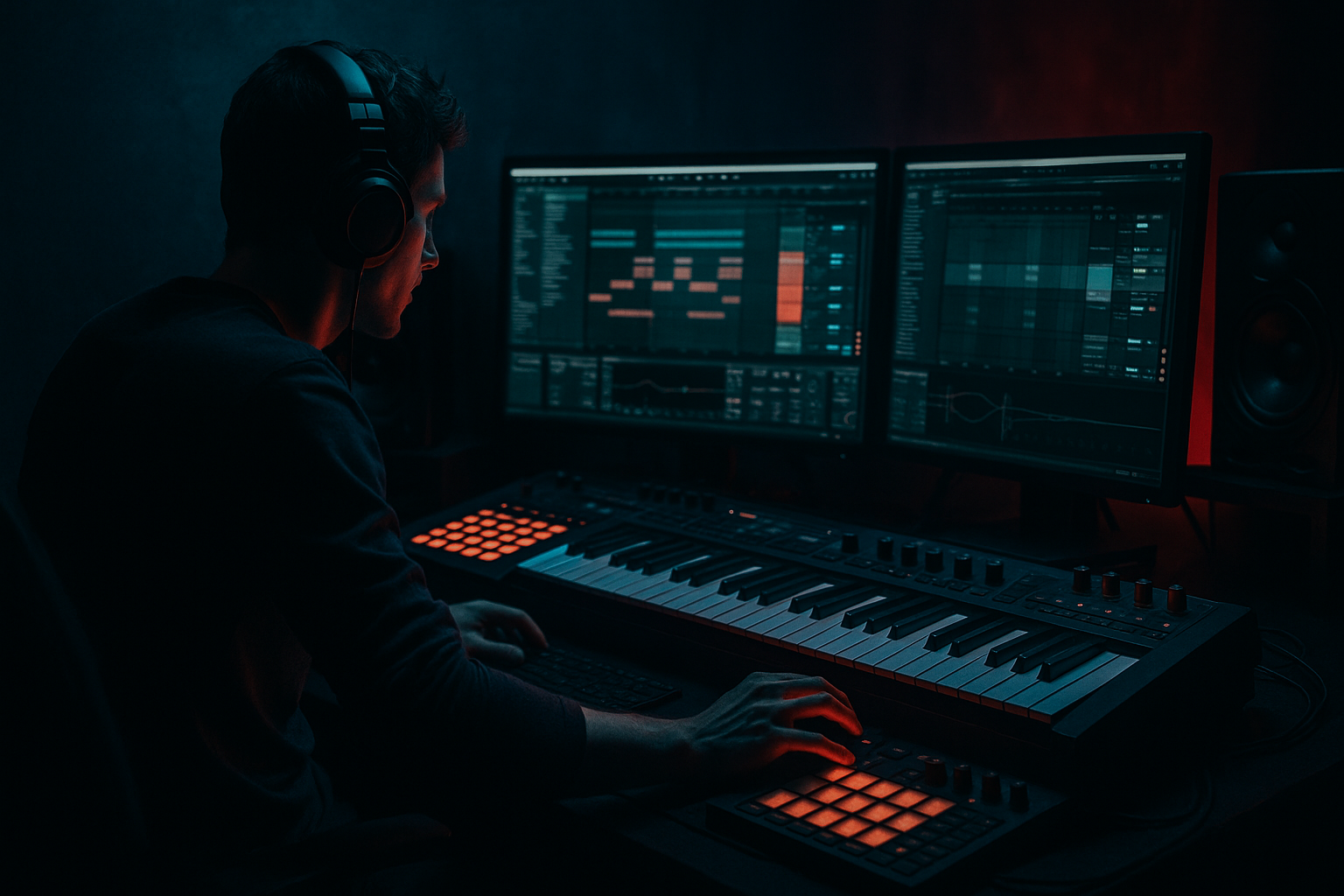
Main tutorial
```markdown
Fast A/B Referencing from Scratch for Jungle Rollers (Ableton Live) 🥁🔁
1. Lesson overview
A/B referencing means instantly switching between your mix (A) and a pro reference track (B) so you can match the big picture: low-end weight, drum-to-bass balance, brightness, punch, and loudness—without guessing.
In jungle rollers, tiny balance moves matter:
- The kick + sub relationship
- Snare crack vs. hat fizz
- Amen / break energy vs. clean drum hits
- Bass presence without washing out drums
- A Reference track lane that bypasses your master chain (so it doesn’t get “double processed”)
- A one-click A/B switch (clean, fast, no hunting around)
- Loudness-matched referencing (so louder doesn’t trick you)
- A simple jungle roller mix template to test against references:
- Similar tempo (e.g. 172–176 BPM)
- Similar vibe: jungle roller / break-driven / dark roller
- Clean low end + clear snare
- Your song = `MIX BUS`
- Your reference = `REF`
- Keep both `MIX BUS` and `REF` visible
- Use Solo buttons:
- Put `MIX BUS` and `REF` at the top of the session so you don’t scroll.
- Color code:
- Add Spectrum to Master (or better: on `MIX BUS` and on `REF OUT`)
- Use it as a sanity check, not the decision-maker.
- Enable a Low Pass around 90 Hz
- Steep slope (e.g. 48 dB/Oct)
- Is your sub too loud? Too quiet?
- Does your kick disappear when sub hits?
- High Pass at 150 Hz
- Low Pass at 4 kHz
- Is your snare body and crack present?
- Are the breaks masking the snare?
- High Pass at 6 kHz
- Are your hats too crispy?
- Is there enough top-end movement?
- Kick transient: do you feel it or only hear it?
- Sub: stable and round, or wobbly/boomy?
- Kick vs sub overlap: does one swallow the other?
- Snare: is it forward enough over the break?
- Break loop: does it add motion without clouding the kick/snare?
- Hats: do they drive groove without hissing?
- Are your reverbs too wide/long for fast drums?
- Does the mix collapse when bass enters?
- Drum Buss
- Saturator
- EQ Eight
- Utility
- EQ Eight
- Saturator (for mid presence)
- Compressor (gentle control)
- Sub discipline wins dark rollers: keep sub clean, steady, and mostly sine/triangle. Use distortion on a separate mid layer.
- Control 200–500 Hz: dark mixes often get “boxy” here, especially with reese + breaks.
- Don’t over-widen: keep low mids fairly centered; use width on tops/FX for atmosphere.
- Break management: high-pass breaks more than you think (often 150–250 Hz) so your kick/sub own the low end.
- Transient priority: if your snare disappears when the bass hits, try:
- Put your reference on a dedicated `REF` track and keep it easy to reach.
- Route your whole track into a `MIX BUS` so comparison is clean.
- Use Solo for instant A/B switching.
- Loudness match with Utility so you don’t get tricked.
- Use EQ Eight focus modes to compare sub, snare, and air like a pro.
- Make tiny moves, re-check fast, and keep the roller groove intact. 🥁🔁
This lesson shows a from-scratch, beginner-safe way to set up fast referencing inside Ableton Live using stock devices, with a workflow you’ll keep forever. ✅
---
2. What you will build
By the end, you’ll have:
- Kick
- Snare
- Break (Amen-ish loop)
- Hats / rides
- Rolling sub + reese layer
---
3. Step-by-step walkthrough
Step 0 — Pick good references (and why)
Choose 1–2 reference tracks max for one session. Too many = confusion.
Good roller reference traits:
Tip: Warp can change feel—don’t stretch references unless you must.
---
Step 1 — Create a “REF” audio track and import your reference
1. Create Audio Track → rename to: `REF`
2. Drag a reference track into it.
3. In the clip view:
- Warp: OFF (recommended if the track is already at the right tempo)
- If you must warp: use Complex Pro only for playback, but expect slight artifacts.
Arrangement tip: Drop the reference so the drop hits near bar 33 (common DnB drop spot), so you can compare drop-to-drop easily.
---
Step 2 — Route the REF track so it bypasses your Master processing 🚦
If your master has glue/EQ/limiter, you generally don’t want the reference going through it. Otherwise you’re comparing your mix vs. a processed reference, which is misleading.
Option A (Best): Use a separate “REF OUT” audio track
1. Create a new Audio Track → rename: `REF OUT`
2. Set `REF OUT` Audio To: `Ext. Out` (or your main output, e.g. `1/2`)
3. On the `REF` track, set Audio To: `REF OUT`
Now your reference plays through `REF OUT` and doesn’t need to touch your master chain if you keep your master chain minimal or manage routing carefully.
Important: In Ableton, tracks normally sum into the Master. By routing `REF` into a dedicated `REF OUT` track, you can keep referencing more controlled and separate from your main mix routing decisions.
---
Step 3 — Build a clean “MIX BUS” group for your entire track (so A/B is instant)
Instead of thinking “Master vs reference,” we’ll make your entire mix go through a MIX BUS. That gives you a single fader and a clean comparison point.
1. Select all your production tracks (Drums, Bass, FX, etc.)
2. Group them (`Cmd/Ctrl + G`)
3. Rename the group: `MIX BUS`
Now:
This is the core of fast A/B.
---
Step 4 — Create the A/B switch (fast mute workflow)
You want a single habit: one key press / one click, instantly switch.
Simple, reliable method (beginner friendly):
- Solo `MIX BUS` = A
- Solo `REF` = B
Make this even faster:
- `MIX BUS` = blue
- `REF` = red
Why Solo works: It’s instant and avoids “both playing at once” mistakes.
---
Step 5 — Loudness match the reference (so you don’t get fooled) 🔊
Human ears prefer louder. If your reference is 3–6 dB louder, you’ll chase the wrong problems.
Goal: Match perceived loudness quickly.
1. On `REF` track, add Utility
2. Start with Gain: -6.0 dB
3. A/B switch and adjust Utility gain until:
- The reference and your mix feel similarly loud at the drop
- Your ear stops “choosing the louder one”
Optional meter check (stock):
---
Step 6 — Add a “Reference Focus” EQ (to compare specific bands)
This is where A/B becomes laser-guided.
On both `MIX BUS` and `REF` (or `REF OUT`), add an EQ Eight in the same position.
Create 3 quick comparison modes using EQ Eight presets or manual toggles:
#### Mode 1: Sub Check (30–90 Hz)
Now A/B:
#### Mode 2: Snare Presence (150 Hz–4 kHz)
Now A/B:
#### Mode 3: Air/Harshness (6–16 kHz)
Now A/B:
Workflow tip: Map EQ Eight device On/Off to a key using Key Map Mode so you can quickly jump into these “focus checks.”
---
Step 7 — A/B like a jungle producer (what to listen for)
When you toggle A/B at the drop, focus on one question at a time:
#### Low end (roller fundamentals)
#### Drums (jungle roller energy)
#### Space + glue
---
Step 8 — Starter device chains (stock) to get closer faster
These aren’t “rules,” just practical starting points.
#### MIX BUS chain (light, beginner-safe)
On `MIX BUS`:
1. EQ Eight
- Optional tiny low shelf dip: -0.5 to -1.5 dB @ 200–300 Hz if muddy
2. Glue Compressor
- Attack: 10 ms
- Release: Auto
- Ratio: 2:1
- Aim for 1–2 dB gain reduction on loudest sections
3. Limiter (only for safety while producing)
- Ceiling: -1.0 dB
- Don’t smash it—just catch peaks
> You’ll reference better when your mix isn’t clipping and isn’t heavily limited.
#### Drum bus (tight roller punch)
On a `DRUM BUS` group:
- Drive: 3–8%
- Crunch: 0–10% (be careful)
- Boom: 0–10% (often off for DnB)
- Soft Clip: ON
- Drive: 1–3 dB
- Control harshness: small dip 7–10 kHz if needed
#### Bass bus (stable sub + controlled mids)
On `BASS BUS`:
- Bass Mono: ON (or Width 0% below ~120 Hz using other tools; keep it simple)
- Roll off unusable sub rumble: HP 20–30 Hz
- Drive: 1–5 dB (watch level!)
- Ratio: 2:1, Attack 10–30 ms, Release 50–120 ms
---
4. Common mistakes ❌
1. Not loudness-matching the reference
Louder will always “win,” and you’ll over-EQ your mix.
2. Letting the reference run through your master chain
Then you’re comparing your processed master to a doubly-processed reference.
3. A/B switching too slowly
If it takes 10 seconds to switch, your ear forgets the balance.
4. Trying to fix everything at once
Pick one target: low end, snare, hats, or width.
5. Referencing the intro against your drop
Compare like-for-like sections: drop vs drop, breakdown vs breakdown.
---
5. Pro tips for darker/heavier DnB 🖤
- Slightly reduce bass 1–3 kHz area (small dip)
- Or add snare snap around 2–4 kHz
- Or shorten bass release / reduce reverb tails
---
6. Mini practice exercise (15 minutes) ⏱️
1. Load a jungle roller reference into `REF`.
2. Build a basic loop (8 bars):
- Kick on 1 and the “and” (or your preferred roller pattern)
- Snare on 2 and 4
- Amen loop layered quietly
- Closed hats every 1/8 or shuffled 1/16
- Sub following root notes (simple 2-note pattern)
3. Set up A/B:
- Solo `MIX BUS` then Solo `REF`
- Add Utility on `REF` and loudness-match
4. Do three 2-minute checks:
- Sub check (LP @ 90 Hz)
- Snare check (HP 150, LP 4k)
- Top check (HP 6k)
5. Make only 3 moves total (example):
- Kick up +1 dB
- Break HP from 120 → 200 Hz
- Hat shelf -1.5 dB @ 10 kHz
The goal is training your ear to make small, confident adjustments.
---
7. Recap ✅
If you tell me one reference track you love (or your subgenre: jungle roller / techstep-ish / modern dark roller), I can suggest exactly what to listen for and a matching Ableton template layout.
```

