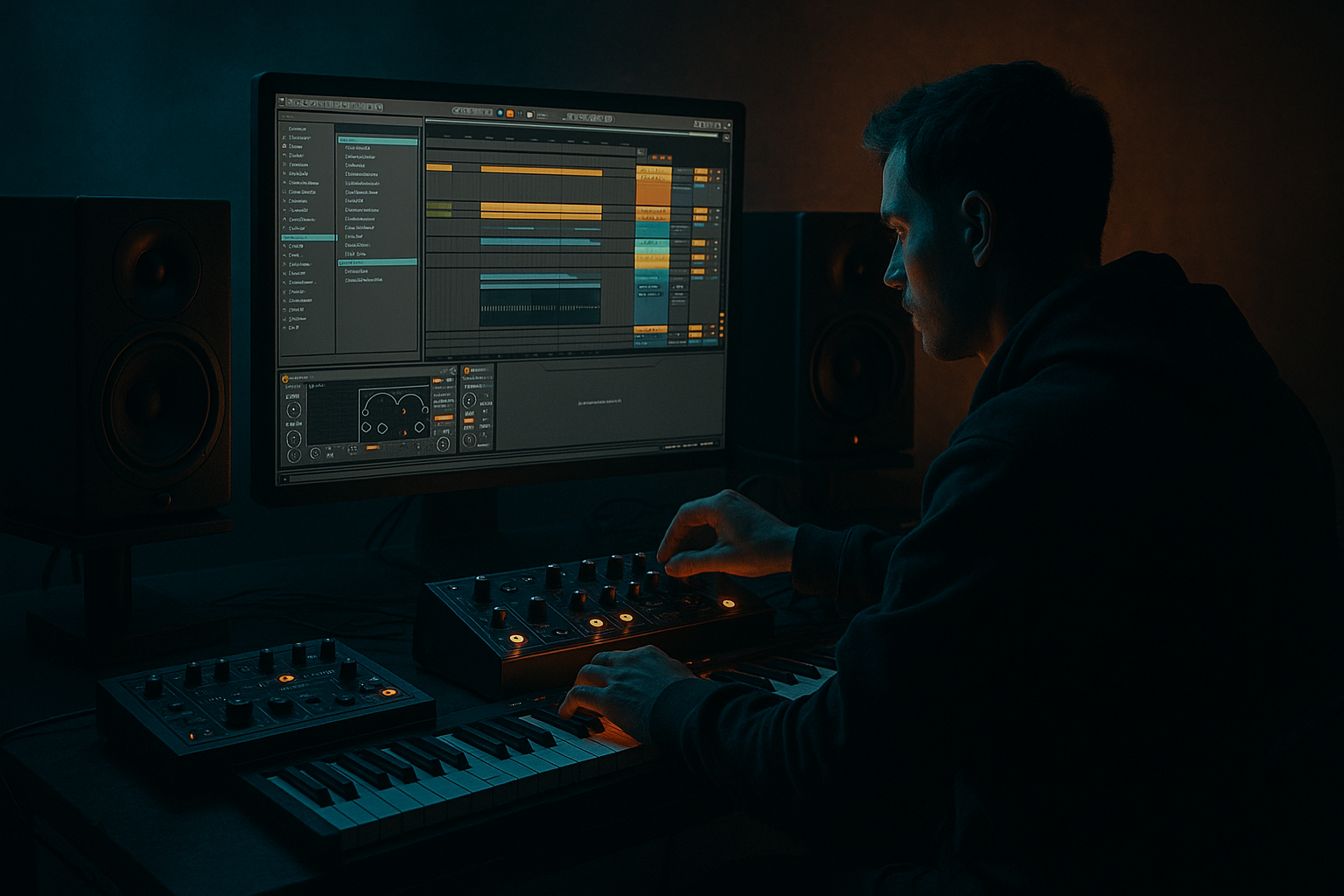
Main tutorial
```markdown
Fast Sketching of Jungle Chord Ideas (Ableton Live) ⚡️
Skill level: Advanced
Category: Composition (DnB/Jungle)
---
1. Lesson overview
This lesson is about speed: how to sketch authentic jungle/DnB chord progressions in minutes—without getting stuck sound-designing or overthinking harmony.
You’ll build a workflow that:
- Generates instant chord palettes (90s jungle vibe + modern rolling DnB weight)
- Locks chords to the rhythm of breaks (syncopation = everything)
- Lets you audition multiple variations quickly using Ableton’s MIDI tools, stock devices, and a few key templates 🎛️
- A 4–8 bar chord loop with rhythmic bounce
- A call/response A/B variation
- 2–3 “flips” (inversions, voicing shifts, resamples) that instantly sound like jungle
- Classic: lush minor 7/9 stabs over breaks
- Dark: tense diminished/cluster voicings, metallic reese support
- Modern: wide detuned pads chopped into stabs + movement FX
- Tempo: 165–174 BPM (start at 170)
- Create a 8-bar loop in Arrangement or Session
- Drop a simple drum reference so chords lock to groove:
- Load Groove Pool → try MPC 16 Swing 55–60 or any subtle swing.
- Apply groove to your chord clip later (not 100% timing-quantized = more jungle).
- Osc 1: Saw
- Osc 2: Saw (slightly detuned)
- Unison: 2–4 voices (don’t overdo)
- Filter: LP24, drive 5–15%
- Two saws, mild detune
- Filter env with short decay for stab behavior
- Hit accents around 90–120
- Ghost stabs around 40–70
- F → Db → Eb → C (moody and common)
- F → Ab → Eb → Db (uplift but still minor)
- F → E → Eb → Db (dark chromatic descent)
- For a darker color, try a minor 9 vibe:
- For tension, try sus/dim-ish clusters (use carefully):
- Amp Envelope:
- Amount: 10–25%
- Rate: 1/8 or 1/4 (sync)
- Phase: 0° for tremolo-ish, 180° for stereo movement
- HP filter automation on chords (Auto Filter cutoff rising)
- Sparse stabs + reverb tail
- Full stab rhythm
- Shorter reverb
- Add a second layer (see below)
- Swap to Chords B (different Chord offsets)
- Or keep harmony but change rhythm density
- Resampled stab chops + delay throws
- Strip drums for 2 bars then slam back
- Duplicate chord track
- Layer 2 uses Operator with a sine/triangle body
- Low-pass it (Auto Filter LP12 at ~800–2k)
- Use semitone tension notes: Move roots down chromatically (F–E–Eb–D) while keeping the same stab rhythm. Instant darkness.
- Parallel distortion:
- Reese glue trick: Sidechain your chord bus to the reese mid layer (Compressor sidechain). Subtle pump makes the drop feel bigger.
- Short gated verb:
- Pitch drops on resampled stabs: In Simpler, automate Transpose -2 to -5 over 1 bar for nasty pull-down energy.
- Build a one-finger chord generator using Chord + Scale to sketch fast.
- Start with rhythm and velocity, not complex theory.
- Create movement via root changes, then color via Chord offsets.
- For real jungle flavor: resample + chop your chords into audio/slices.
- Arrange quickly with A/B swaps, filter automation, and tight space.
---
2. What you will build
A reusable Ableton “Jungle Chord Sketch Rack” and a fast writing method that outputs:
Target vibe examples:
---
3. Step-by-step walkthrough
Step 0 — Session setup (so you don’t fight the grid) 🧠
- Add a MIDI track with Drum Rack
- Use a quick break-ish pattern: kicks on 1, snare on 2 & 4, hats running 1/8 or 1/16 with swing.
Groove:
---
Step 1 — Make a “Chord Sketch” instrument that’s instant 🎹
Create a MIDI track: “Jungle Chords” and build this stock chain:
#### Instrument (pick one for speed)
Option A (classic, immediate): Wavetable
Option B (more 90s): Analog
#### Device chain (fast vibe)
1. Chord (MIDI Effect)
- This is your “one-finger harmony generator.”
- Start with a minor 7-ish stack:
- Shift 1: +3
- Shift 2: +7
- Shift 3: +10
This gives you 1 – b3 – 5 – b7 (minor 7).
2. Scale (MIDI Effect)
- Set to the key you’re writing in (example: F minor).
- This keeps fast sketching from drifting out of key.
3. Arpeggiator (optional for rhythmic pulses)
- Style: Chord Trigger or Up/Down
- Rate: 1/8 or 1/16
- Gate: 40–60%
Use sparingly—jungle chords are often stabs, not constant arps.
4. Saturator
- Drive: 3–8 dB
- Soft Clip: ON
This makes stabs feel “printed” and less polite.
5. Auto Filter (movement + space control)
- HP12 around 120–300 Hz (depends on bass)
- Envelope: tiny amount for a bite on attack
6. Hybrid Reverb (or Reverb)
- Short plate or room
- Decay: 0.6–1.4s
- Predelay: 10–25 ms
- HiCut: 6–10 kHz
Keep it tight—DnB needs definition.
7. Utility
- Width: 120–160% (careful!)
- Or keep low-mids centered: use Utility + EQ below.
8. EQ Eight
- High-pass: 120–250 Hz
- Gentle dip at 250–500 Hz if muddy
- Small shelf if harsh around 3–6 kHz
Save this track as a Track Preset so you can pull it into any DnB project in 5 seconds.
---
Step 2 — Write chords like a junglist: rhythm first 🥁➡️🎹
Instead of “progression first,” start with stab placement that matches break syncopation.
1. Create a 1-bar MIDI clip on “Jungle Chords.”
2. Set grid to 1/16.
3. Place stabs on classic jungle syncopations:
- Strong: 1.1, 1.2.3, 1.3, 1.4.2
- Try leaving space after snares so chords “answer” the snare.
Velocity is key:
This gives bounce without needing complex harmony.
Duplicate to 4 bars once it grooves.
---
Step 3 — Make harmonic movement FAST (without rewriting everything) 🔁
Now you’ll create progression movement with minimal edits.
#### Method A: Bass-note movement (fastest)
Because you’re using the Chord MIDI effect, you can change the whole chord by moving one MIDI note.
In F minor, try roots like:
Keep the same rhythm; just change root notes per bar.
#### Method B: Automate chord color (instant “A/B”)
Duplicate the chord track: Chords A and Chords B.
On Chords B, change Chord device offsets:
- +3, +7, +10, +14 (adds the 9)
- +1, +6, +10 (crunchy; great under breaks)
Now you can alternate A and B every 2 bars for call/response.
---
Step 4 — Get the “jungle stab” feel (the envelope + resample trick) 🔪
Jungle chords often feel like they were sampled off vinyl/keys and chopped.
#### Make it stabby
On Wavetable/Analog:
- Attack: 0–5 ms
- Decay: 200–600 ms
- Sustain: 0–20%
- Release: 80–200 ms
Optional: Add Auto Pan
#### Resample for speed (and vibe)
1. Solo your chord track.
2. Resampling: Create a new audio track → set input to Resampling.
3. Record 8 bars of chords.
4. Now chop it like old-school:
- Warp mode: Complex Pro (or try Texture for grit)
- Slice transients manually or use Convert Drums to New MIDI Track (as a slicing hack)
- Drop slices into Simpler (Slice Mode)
Now you can rearrange chord hits like break edits. This is very jungle. 🧨
---
Step 5 — Arrange quickly into a DnB-ready 32 bars 🏗️
Here’s a proven jungle/DnB structure for chord-led ideas:
Bars 1–8: Intro tension
Bars 9–16: Drop A
Bars 17–24: Drop B (variation)
Bars 25–32: Breakdown / turnaround
Layer idea (fast):
This creates thickness without mud.
---
4. Common mistakes 🚫
1. Writing chords too sustained
- Jungle chords are often stabs that leave air for breaks and bass.
2. Too much low-end in chord layers
- If your chords fight the reese/sub, your mix will never punch. HP them.
3. No velocity variation
- Perfectly even chord hits sound like a preset demo, not a record.
4. Overcomplicated harmony before groove
- If the rhythm doesn’t bounce with the drums, fancy 9ths won’t save it.
5. Stereo too wide too early
- Wide pads + wide breaks = messy center. Keep control with Utility/EQ.
---
5. Pro tips for darker/heavier DnB 🖤
- Create a return track “Chord Dirt”
- Put Saturator → Overdrive → EQ Eight (HP 300Hz)
- Send chords lightly (5–15%). Adds grit without mud.
- Hybrid Reverb short plate + Gate after it
- Gate threshold so tails cut off rhythmically = punchy jungle space.
---
6. Mini practice exercise (10 minutes) ⏱️
1. Set tempo 170 and pick a key: F minor.
2. Build the “Jungle Chord Sketch” chain (Chord + Scale + Wavetable + Saturator + Reverb).
3. Write a 1-bar stab rhythm with velocity variation.
4. Duplicate to 4 bars.
5. Change roots each bar: F → Db → Eb → C.
6. Duplicate track to create Chords B and add a 9th (+14) in the Chord device.
7. Arrange 16 bars:
- Bars 1–8 = Chords A (filtered)
- Bars 9–16 = Chords B (full)
8. Resample 8 bars and chop one cool fill at bar 16.
Goal: You should have a loop that feels like it could sit under an Amen-style break and rolling bass immediately.
---
7. Recap ✅
If you want, tell me your target vibe (classic atmospheric, dark techstep-ish, or modern rollers) and I’ll give you 3 specific chord palettes + root progressions tailored to that sound.
```

