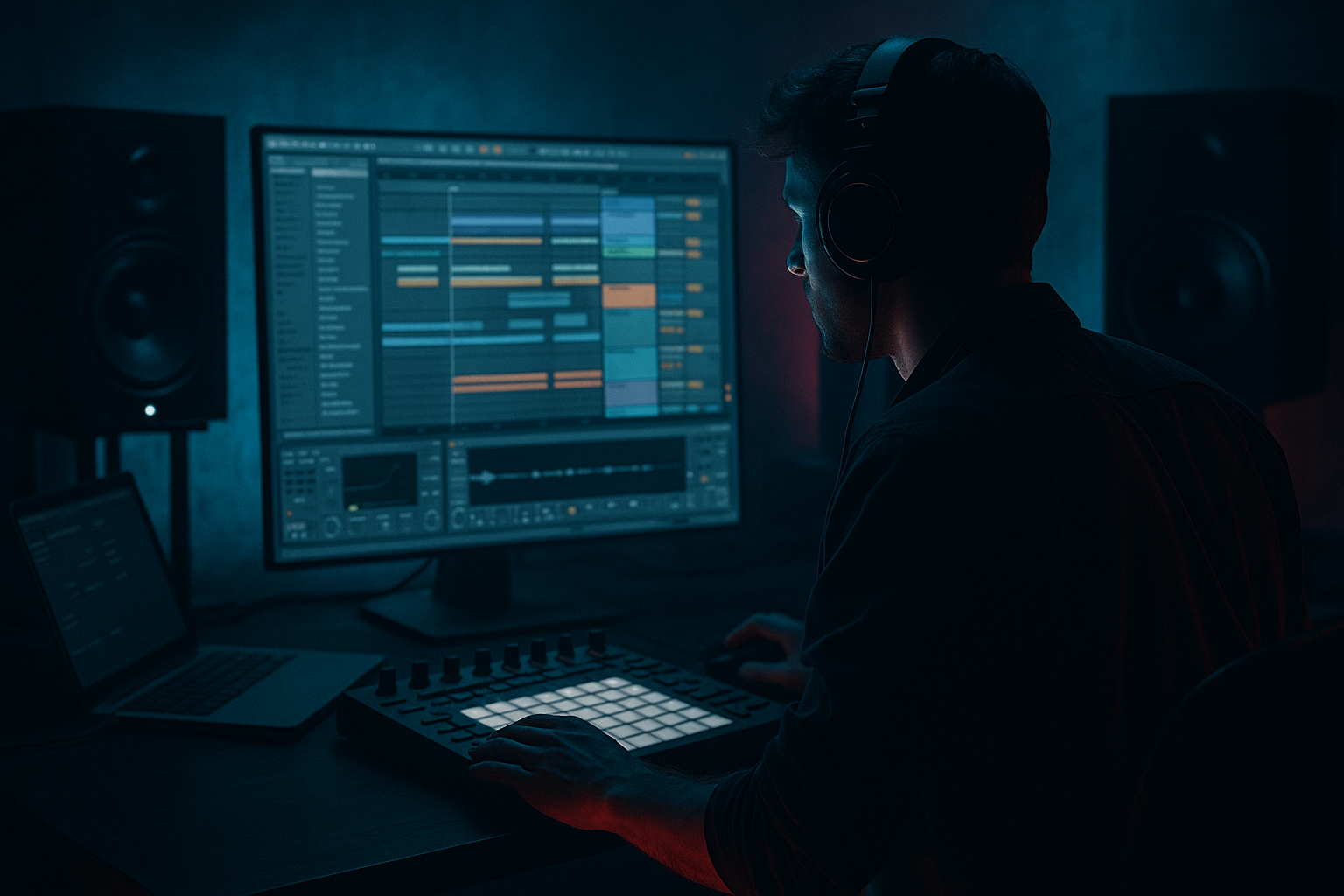
Main tutorial
```markdown
Fast Workflow: One Drum & Bass Tune a Week (Ableton Live) ⚡️🥁
1. Lesson overview
Your goal isn’t “perfect”—it’s finished. This workflow is designed to get you shipping one DnB tune per week using repeatable templates, fast sound decisions, and strict arrangement milestones inside Ableton Live.
We’ll focus on:
- A weekly schedule (sound design → arrangement → mix → polish)
- A ready-to-go Ableton template (drum bus, bass bus, pre-routed FX)
- A rolling DnB arrangement skeleton you can drop ideas into quickly
- Practical device chains using stock Ableton devices (plus a few optional “nice to have” habits)
- A full 3–5 min drum & bass track (liquid/roller/darker minimal — your choice)
- A working Ableton “One-Week DnB Template”
- A complete structure:
- A break + 2-step drum system
- A sub + reese/metallic mid-bass
- A simple but effective atmosphere + ear-candy lane
- Drums (kick/snare/hat + break layer)
- Bass (sub + mid)
- 8-bar vibe loop that slaps
- Intro bones + first build
- Basic call/response between drum fills and bass phrases
- Full track layout done (even if rough)
- Second drop variation planned
- Gain staging, EQ cuts, buss compression light
- Risers, impacts, fills, automation (reverb throws/delay throws)
- Reference check, mono check, low-end check
- Export, tag, bounce stems, quick notes for next week
- Tempo: 172–176 BPM (start at 174)
- Warp Mode: Complex Pro for long vocals, Beats for breaks, Tones for bass one-shots (case-by-case)
- Color code groups (drums red, bass green, music blue, FX purple)
- Kick
- Snare/Clap
- Hats (closed)
- Hats (open/ride)
- Percs
- Break 1 (amen/think/etc.)
- Break 2 (optional)
- Drum FX (impacts, fills)
- Sub (mono)
- Mid bass (reese/growl)
- Bass FX (shots, fills)
- Chords/pads
- Lead/hook (optional)
- Atmos/noise
- Risers
- Downlifters
- Sweeps
- A: Short Room (Hybrid Reverb)
- B: Long Verb (Hybrid Reverb)
- C: Ping Delay (Delay)
- D: Parallel Drum Smash (Glue Compressor + Saturator)
- E: Bass Space (VERY subtle: short verb or chorus—optional)
- Utility (gain trim, mono below ~120 Hz if needed)
- Limiter (ceiling -0.8 dB, just catching peaks)
- Spectrum (for quick checks)
- Place snare on 2 and 4 (classic)
- Kick pattern: start simple (1, “and” before 3, etc.)
- Add ghost snares around the main snare
- Drop an Amen/Think break into Break 1
- Warp: Beats mode, transient-preserving
- High-pass it: EQ Eight → cut below 150–250 Hz
- Reduce harshness: dip 3–6 kHz if needed
- Glue Compressor (ratio 4:1, fast attack, medium release, push into 5–10 dB GR)
- Saturator (drive)
- Blend return at -18 to -10 dB until it adds weight without crushing transients.
- Use Operator (fastest)
- MIDI pattern: lock with kick gaps (don’t fight the kick)
- Chain:
- Use Wavetable (fast + modern)
- Quick movement:
- Chain:
- Put Compressor on Sub and Mid Bass
- Sidechain input: Kick
- Settings:
- Bars 1–8: drums minimal + atmosphere + hint of bass
- Bars 9–16: add hats/percs, introduce hook elements
- Bars 17–24: tension (filter, riser, snare build)
- Bars 25–32: pre-drop fill + drop impact
- Duplicate your 8-bar drop loop to 16
- Remove elements for intro
- Add transitions:
- Hybrid Reverb: short room on snare; long hall on atmos
- Delay: 1/8 or dotted 1/8 for throws
- Auto Filter: “DJ filter” on groups during transitions
- Utility: quick gain automation and mono checks
- Intro: 16–32 bars (DJ mixable)
- Build: 16 bars
- Drop 1: 32–64 bars
- Break: 16–32 bars
- Drop 2: 32–64 bars (variation)
- Outro: 16–32 bars (DJ mixable)
- Swap kick pattern for 8 bars
- Remove hats for 4 bars, then slam them back
- Change bass MIDI rhythm (same patch)
- Automate:
- Add 1 new “hero” fill: a bass stab or cinematic hit
- Pull all faders down, then balance:
- Keep headroom: master peaking around -6 dB before limiter
- EQ Eight on most channels:
- Group Utilities
- 1 riser into each drop
- 1 impact on each drop
- 1 fill every 8 or 16 bars
- 2–4 micro FX total (don’t clutter)
- Take a snare hit → Freeze/Flatten with reverb → reverse it into the drop
- Use Grain Delay quietly on atmos for texture
- Automate Reverb send on the last snare before drop (big tail → cut)
- Reference 2–3 tracks (similar sub weight + drum punch)
- Check:
- If mix is loud but not punchy: reduce bus compression, increase transient clarity (less smash return, slightly shorter reverbs)
- If bass disappears on small speakers: add subtle harmonic layer (Saturator on mid bass, or duplicate sub and distort lightly, high-pass it)
- WAV, 24-bit, sample rate project rate (44.1 or 48k)
- Dither only if exporting to 16-bit
- Export a “pre-master” with limiter barely working (or none)
- What worked this week
- One thing to improve next week
- Use distortion in stages (better than one huge distort):
- Make the mid bass talk with movement:
- Create controlled aggression
- Drum weight without mud
- Tension through silence
- Atmos that feels “industrial”
- One tune a week is a system, not a mood.
- Build a template once: routing, returns, groups, light master chain.
- Day 1 is king: a strong 8-bar drop loop makes everything else easy.
- Arrange fast using a DnB skeleton + locators.
- Mix in two passes, keep processing simple, reference often.
- Finish, export, take notes, repeat next week.
---
2. What you will build
By the end, you’ll have:
- Intro (DJ-friendly)
- Build
- Drop 1
- Mid-break
- Drop 2 (variation)
- Outro (DJ-friendly)
And you’ll build it with:
---
3. Step-by-step walkthrough
A) The weekly schedule (non-negotiable) 📅
You’re going to work in milestones. Don’t let tasks bleed into each other.
Day 1 (2–3h): Core loop + palette
Day 2 (2–3h): Expand to 32 bars
Day 3 (2–3h): Full arrangement
Day 4 (2–3h): Mix pass 1 (static mix + cleaning)
Day 5 (1–2h): Ear candy + transitions
Day 6 (1–2h): Mix pass 2
Day 7 (30–60m): Print + post
Rule: If you miss a milestone, simplify the tune, don’t extend the week.
---
B) Set up a “One-Week DnB Template” in Ableton Live 🧰
Create this once, save it as your default template.
#### 1) Project settings
#### 2) Track layout (fast routing)
Create Groups with returns pre-made:
DRUMS (Group)
BASS (Group)
MUSIC (Group)
FX (Group)
Returns
#### 3) Master chain (keep it light—this is for vibe, not final mastering)
> Save heavier mastering for later. You’re trying to finish weekly, not chase a “label master” every session.
---
C) Day 1: Build an 8-bar loop that’s “drop-ready” 🔥
This is your weekly success hinge. If your loop hits, the rest becomes logistics.
#### 1) Drums: modern DnB = 2-step + break texture
Kick + Snare foundation
Break layer workflow (fast)
Drum Buss chain (on DRUMS group)
1. EQ Eight
- High-pass ~20–30 Hz
- Gentle dip around 250–400 Hz if boxy
2. Drum Buss
- Drive: 5–15 (taste)
- Boom: 0–10 (careful—DnB low end is mostly sub + kick)
- Damp: adjust to tame fizz
3. Glue Compressor
- Attack: 3–10 ms
- Release: Auto or ~0.1–0.3s
- Ratio: 2:1
- Aim: 1–2 dB GR for glue
4. Saturator
- Soft Clip ON
- Drive 1–4 dB (subtle)
Parallel drum smash (Return D)
#### 2) Bass: split sub and mid for speed + control
Sub track
- Osc A: Sine
- Add slight saturation later; keep it clean first
1. EQ Eight (low-pass around 80–120 Hz if you want pure sub)
2. Saturator (Soft Clip, Drive 1–3 dB)
3. Utility
- Width: 0% (mono)
- Gain: manage headroom
Mid bass (Reese)
- Osc 1: Saw
- Osc 2: Saw (detune slightly)
- Unison: 2–4 voices (don’t overdo)
- Filter: LP24 with slight drive
- Map Filter Cutoff to Macro 1
- Add LFO to cutoff (slow, subtle)
1. Saturator (drive 3–8 dB)
2. Auto Filter (movement or band-pass for growl moments)
3. Amp (optional for character)
4. EQ Eight
- High-pass around 90–150 Hz so it doesn’t clash with sub
- Notch any nasty resonances
5. Utility
- Width 120–160% only above low frequencies (or use EQ to keep lows mono)
Sidechain (fast + consistent)
- Ratio 4:1
- Attack 1–5 ms
- Release 50–120 ms (time to groove)
- Aim: 2–5 dB GR on sub, slightly less on mids
> For extra groove, sidechain the mid bass to the snare lightly too (1–2 dB).
---
D) Day 2: Expand your loop into 32 bars (intro → build → drop tease) 🧱
Use a DJ-friendly structure so arrangement decisions are fast.
Typical 32-bar pre-drop
Fast arrangement moves
- Reverse crash into snare
- Short delay throw on a vocal hit
- 1-bar drum fill every 8 bars (even a simple snare roll)
Stock FX suggestions
---
E) Day 3: Full arrangement in 60–90 minutes ⏱️
This is where weekly tracks are won. Don’t “produce”—arrange.
#### The “DnB skeleton” (copy/paste this as Locator markers)
At 174 BPM, try:
#### How to make Drop 2 fast (no new sound design)
Do variation, not reinvention:
- Filter cutoff
- Distortion drive
- Reverb send on snare for “space” moments
Time-saving rule: Maximum 1 new sound on Day 3.
---
F) Day 4: Mix pass 1 — the “static mix” 🧪
No fancy automation yet. Just make it clear and punchy.
Checklist
1. Kick
2. Snare
3. Sub
4. Hats
5. Break
6. Mids/music/FX
Quick cleaning
- High-pass non-bass elements (often 100–300 Hz)
- Remove harshness (often 2–6 kHz)
- Bass group: mono lows
- Drums group: check phase (flip if needed using Utility)
---
G) Day 5: Ear candy + transitions (minimum effective dose) ✨
Add small details that make it feel finished:
Fast ear candy tricks
---
H) Day 6: Mix pass 2 + referencing 🎧
- Mono (Utility on Master)
- Low end balance (Spectrum)
- Harshness at loud volume (turn down and see what still pierces)
Quick fix moves
---
I) Day 7: Print and move on ✅
Export settings (typical):
Make a quick note:
---
4. Common mistakes ❌
1. Sound design rabbit holes on Day 3–5
If the loop works, don’t restart. Finish arrangement first.
2. Too many bass layers
Weekly workflow loves: Sub + Mid + (optional) texture. That’s it.
3. Break too loud / too full-range
High-pass breaks so they add grit, not mud.
4. Over-processing the master early
Heavy limiting hides problems and kills punch.
5. No markers / no locators
If you don’t pre-label sections, you’ll endlessly “jam” instead of finishing.
---
5. Pro tips for darker/heavier DnB 🌑🔩
- Saturator → Overdrive (light) → Saturator (light)
- Auto Filter automation + subtle chorus (or Phaser-Flanger) on mids only
- Multiband Dynamics (gentle) on bass group to pin unruly mids
- Parallel smash return + careful EQ notch at 250–400 Hz on drum group
- Hard mutes for 1/4 or 1/2 bar before drop (classic neuro/minimal weapon)
- Record 10 seconds of noise (vinyl, room tone), then:
- EQ Eight (band-limit)
- Hybrid Reverb (big)
- Auto Pan (slow)
- Resample to audio
---
6. Mini practice exercise (45 minutes) 🎯
Goal: Build a “ready-to-arrange” 8-bar drop loop.
1. Set tempo to 174
2. Program:
- Kick + snare (2-step)
- Hats (16ths with small velocity variation)
3. Add a break layer, high-pass it at 200 Hz
4. Create:
- Sub (Operator sine)
- Reese mid (Wavetable saws)
5. Sidechain both bass tracks to kick:
- Ratio 4:1, attack 3 ms, release 80 ms
6. Add one transition element:
- Reverse crash or 1-bar snare fill
7. Bounce a quick audio export named:
- `WEEK01_DROPLOOP_174BPM.wav`
If it sounds like a drop, you win the session.
---
7. Recap 🔁
If you want, tell me what subgenre you’re aiming for (roller / jungle / neuro / liquid / minimal) and I’ll give you a specific 8-bar drum + bass MIDI blueprint and a matching Ableton device rack plan for that vibe.
```

