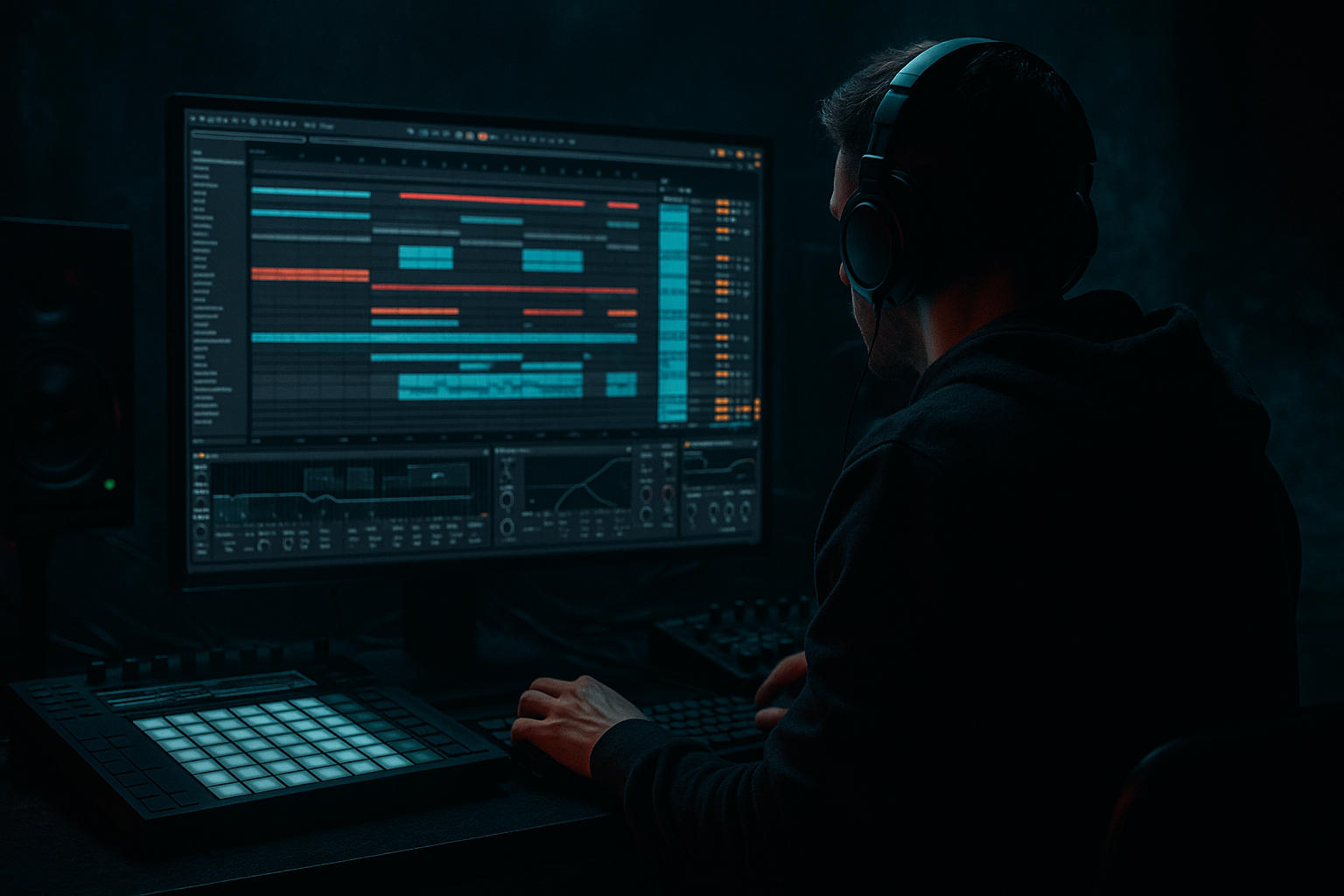
Main tutorial
Fill in Ableton Live 12: Pull It for Oldskool Rave Pressure (Advanced Automation)
1) Lesson overview
In DnB/jungle, a fill isn’t just “drums doing something”—it’s a tension device that yanks the listener into the next phrase. This lesson shows how to build pull fills in Ableton Live 12: fills that drag time, pitch, tone, and space backwards for a split second, then slam the drop back in with oldskool rave urgency. 🌀
We’ll focus on automation-first techniques using stock devices, fast routing, and arrangement habits that work in rolling, jungle, and darker DnB.
---
2) What you will build
You’ll create a reusable “Pull Fill Rack” you can drop at the end of 8/16-bar phrases, featuring:
- Micro time-stretch “pull” on drum/break audio (warped automation)
- Tape-stop / rewind illusion using Delay time + feedback automation
- Pitch dip + transient reshaping for that “sucked into the drop” feel
- Rave-style noise riser + short impact tail (but DnB tight)
- A clean A/B macro workflow so it’s fast in real projects 🎛️
- Warp: ON
- Try these:
- Do this only on the last half-beat before the drop to keep it tight, e.g. stretch beats 3.4.3 → 4.1 region.
- Add Shifter after Echo (or before, experiment)
- Mode: Pitch
- Coarse: 0
- Automate Fine down over the last 1/4 bar:
- Duplicate FILL_PRINT clip
- Automate clip Transposition down (e.g. 0 → -2 or -5 semitones) for the last 1/8
- Use a short Fade Out to avoid clicks
- Drive: 5–15
- Crunch: 0–20
- Damp: to taste (don’t kill top end)
- Boom: Off or very low (fills can get muddy fast)
- Utility Gain: dip -1 to -3 dB for 1/8 bar
- Auto Filter (HP): sweep up quickly to 200–600 Hz then release at the drop
- Macro 1: Pull Dirt → Drum Buss Drive + Crunch
- Macro 2: Rewind → Echo Feedback (15%→85%)
- Macro 3: Tighten → Echo Filter (HP up / LP down)
- Macro 4: Pitch Dip → Shifter Fine (-0 → -120 cents)
- Macro 5: Vacuum → Utility Gain (-0 → -3 dB) or Filter freq if inside rack
- Bar 8.4 (last beat of 8): micro pull + pitch dip → slam at bar 9
- Bar 16.3–16.4: more dramatic rewind (Echo feedback spike) for bigger sections
- Before switchups: let the pull fill “announce” the new drum pattern (e.g., swap to 2-step, half-time fakeout, then back)
- Over-long reverb tails that smear the downbeat. Keep returns filtered and automated.
- Echo feedback runaway without a limiter/safety. Always cap it.
- Pulling the timing too much so the drop feels late (unless you want a deliberate stutter-drop).
- Fills fighting the snare: if your snare is sacred on 2 and 4, don’t blur it—duck the fill or filter lows.
- Not committing to audio: advanced fills usually require resampling/printing so you can warp and edit cleanly.
- Keep subs clean: put an EQ Eight on FILL_PRINT and HP around 120–200 Hz. Let the sub return pure on the drop.
- Parallel distortion for menace:
- Use gating to make fills punchy:
- Add a micro-stutter before the pull:
- Texture with noise, not cymbals:
- “Pull fills” in DnB are about time + tension, not busy drumming.
- Print to audio, then use Warp marker bending to lean the groove back.
- Add controlled “rewind” with Echo (time + feedback automation), then a pitch dip (Shifter) and bite (Drum Buss).
- Create a vacuum with HP filtering + gain dip, then slam the drop with clean low end.
- Wrap it into a Macro Rack so you can deploy it every 8/16 bars like a weapon. 🔥
---
3) Step-by-step walkthrough
Step 0 — Prep your session (advanced workflow setup)
1. Set your phrase grid: Most DnB phrases are 8 or 16 bars. Place locators at bar 9, 17, 25…
2. Create these groups:
- DRUMS (kick, snare, hats, tops)
- BREAK (amen/chop layer if you have one)
- BASS
- MUSIC/FX
- RETURN FX (we’ll add one special return)
3. Put your main drum loop / break in Audio (not MIDI), because the best “pull” tricks come from audio warping + resampling.
---
Step 1 — The core “Pull” trick: warp automation on a resampled fill
This is the most authentic “rave pull” feel: time bending right before the next section.
#### A) Resample a 1-bar (or 2-beat) fill source
1. Select the last 1 bar of your drums+break (e.g., bar 8) and resample it:
- Create a new audio track called FILL_PRINT
- Set Audio From = DRUMS (Post-FX) (or your drum bus)
- Arm and record that last bar (or consolidate/copy it in)
2. Move that printed clip so it sits exactly where the fill happens (end of phrase).
#### B) Warp mode + settings
Open the clip in Clip View:
- Beats mode for punchy breaks
- Preserve: Transients
- Transient Loop Mode: Off (or “Forward” if it clicks)
- Complex Pro if it’s a full drum bus and you want smoother bending
- Formants: 0–30 (too high can get weird; that’s sometimes good)
#### C) The “pull” automation (time drag)
You’re going to “stretch” the end of the bar so it feels like it leans back.
Method (clean + controllable): automate clip tempo via Warp Markers
1. Add warp markers at:
- Beat 1
- Beat 3
- Beat 4 (end of bar)
2. Now drag the beat-4 warp marker slightly right (like 10–40 ms worth, depending on tempo). You’ll hear the bar “slow down” into the end.
3. Make it musical:
- For subtle rolling: move it just a touch (tiny lean-back)
- For rave pull: exaggerate it so the last 1/8 feels stretched
Pro arrangement move:
---
Step 2 — Add “rewind pressure” with Echo (stock) 🧲
Now we add a classic pseudo-rewind that doesn’t wreck your timing.
1. On FILL_PRINT, insert Echo:
- Mode: Sync
- Time: 1/8 (or 1/16 for faster jitter)
- Feedback: start at 10–20%
- Filter: HP around 200–400 Hz, LP around 6–10 kHz
- Reverb: 0–10% (keep it tight)
- Noise: 0–5% (tiny vibe)
2. Automate two parameters for the last 1/2 bar:
- Feedback: ramp from ~15% → 60–85% (careful!)
- Time: quickly jump 1/8 → 1/16 → 1/32 right at the end
This creates the “pulling into a vortex” sensation without needing external tape-stop plugins.
Safety tip: Put a Limiter after Echo (Ceiling -0.5 dB) because feedback can spike.
---
Step 3 — Pitch dip + transient smack (oldskool weight) 🎚️
This is where the fill gets that “rave cassette” vibe.
#### A) Pitch dip (stock)
Option 1 (fast): Shifter
- 0 cents → -30 to -120 cents, then snap back at the drop
Option 2 (more “turntable”): Clip Transposition
#### B) Transient control (keep it aggressive)
Add Drum Buss (yes, even on a break fill):
Automate Drive up slightly just for the fill (like +3 to +6) so it bites.
---
Step 4 — Space “suck” then slam (Return-based automation)
The trick: remove the room, then throw a tiny tail.
#### A) Create a dedicated Fill Reverb return
1. On a Return track (e.g., Return C), load:
- Hybrid Reverb
- Algorithm: Hall or Plate
- Decay: 1.2–2.5s (longer is okay if filtered)
- Pre-Delay: 10–25 ms
- EQ: HP at 300–600 Hz, LP at 8–12 kHz
- Then Auto Filter after it:
- HP 24 dB, around 500 Hz
- Then a Limiter (safety)
2. On FILL_PRINT, automate the Send C:
- Start low (0–5%)
- Spike to 15–35% only for the last hit/1/16
- Then instantly back down at the drop
This gives a classic “one last whoosh/tail” without washing your drop.
#### B) The “suck” effect (negative space)
Right before the fill hits, automate on your DRUMS bus:
That’s the vacuum moment. Then your sub and kick feel huge when they return.
---
Step 5 — Make it repeatable: build a Macro Rack for quick pull fills 🧰
On FILL_PRINT, select devices (example chain):
1. Drum Buss
2. Echo
3. Shifter
4. Utility
5. Limiter
Group them into an Audio Effect Rack and map macros:
Macro suggestions
Now you can draw 1 automation lane per macro and get consistent results fast. ⚡
---
Step 6 — Arrangement placement (DnB phrasing that hits)
Use these placements like a producer, not like a drummer practicing fills:
Golden rule: In rolling DnB, fills should be shorter and meaner. 1/2 bar is often enough.
---
4) Common mistakes
---
5) Pro tips for darker/heavier DnB 🌑
- Create Return D with Roar (or Saturator if you prefer), HP at 200 Hz, then blend tiny amounts on the fill only.
- Add Gate after reverb return (sidechain from snare) to get that tight “junglist space” feel.
- Duplicate the last 1/16 of the break, repeat it 2–4 times (grid = 1/16 or 1/32), then pull/rewind into the drop.
- A filtered noise burst (Operator noise or Analog noise) is often darker than extra hats.
---
6) Mini practice exercise (15 minutes) ⏱️
1. Pick an 8-bar drum+break loop at 170–175 BPM.
2. Print the last 1 bar to FILL_PRINT.
3. Do three versions of the same fill:
- Version A (Subtle roller): tiny warp pull, small pitch dip (-30 cents), mild echo (feedback max 45%)
- Version B (Rave pressure): stronger pull, echo time jumps to 1/32, pitch dip -1 semitone
- Version C (Dark switch): high-pass vacuum on drum bus + distorted echo return (Roar), no long reverb
4. A/B them by dropping each fill at bar 8 → bar 9 and listening:
- Does the drop feel bigger?
- Did you keep the snare impact intact?
- Is the sub return clean?
---
7) Recap
If you tell me your tempo and whether you’re more jungle-chop or modern roller, I can suggest exact warp distances and macro ranges that hit your pocket.

