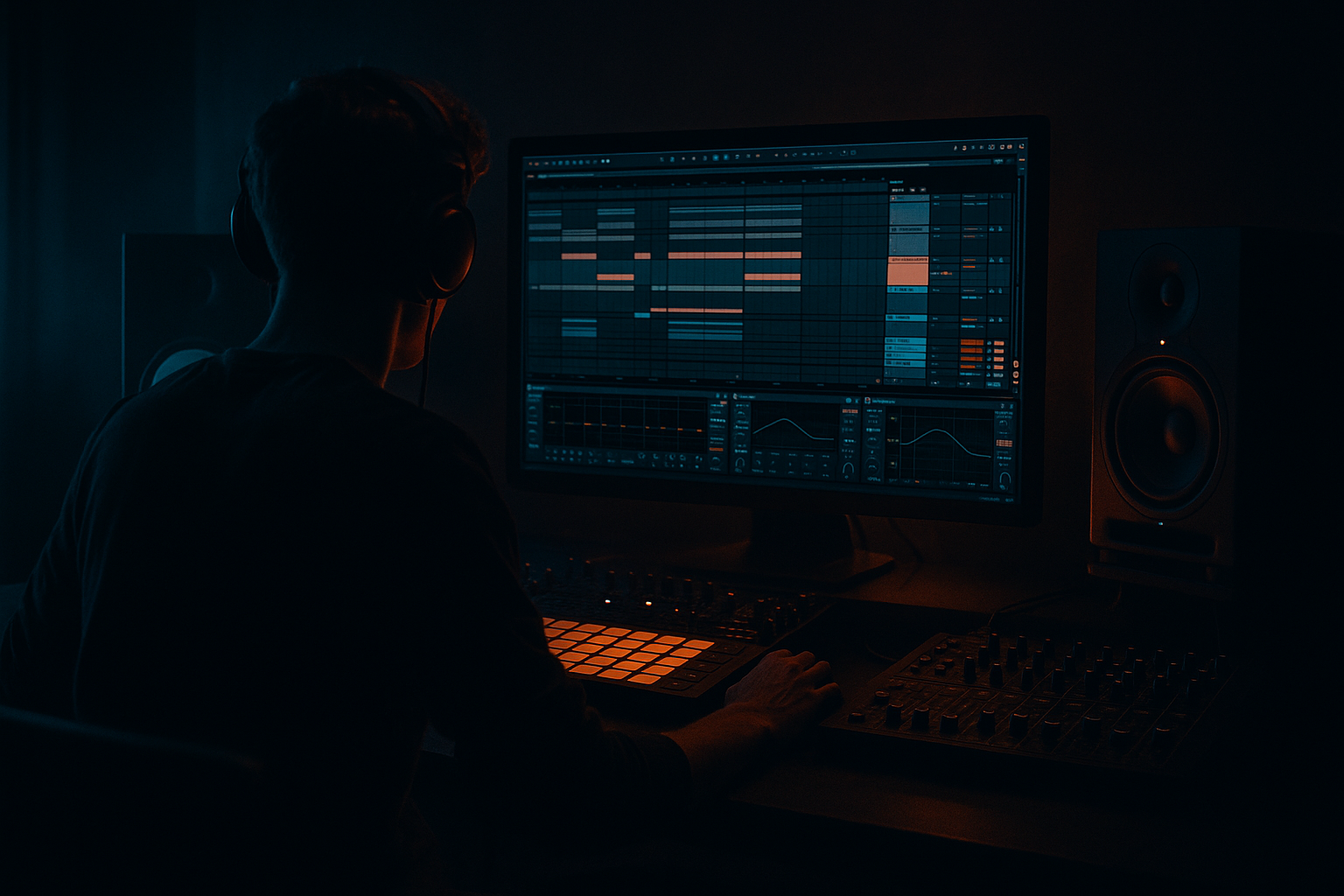
Main tutorial
```markdown
Filtered Impact Layers From Scratch (Arrangement View) — DnB FX Lesson 🎛️💥
1) Lesson overview
In drum & bass, impacts aren’t just “a boom.” They’re stacked, timed, filtered, and automated so they feel like the track just hit a new chapter. In this lesson you’ll build filtered impact layers from scratch in Arrangement View using Ableton Live stock devices, with a workflow tuned for rolling DnB / jungle energy: tight transitions, big subs, crisp tops, and controlled chaos.
We’ll focus on:
- Layer design (sub + body + snap + air + texture)
- Filter movement (the “filtered” part)
- Automation + resampling (fast, pro workflow)
- DnB-friendly mix control (mono lows, transient discipline, sidechain)
- Drop hits
- 32-bar transitions
- Fakeout into second drop
- Reese switch-ups / halftime switch moments
- A grouped Impact Bus with macros (optional)
- A printable resample you can reuse like a one-shot
- A filtered “sweep into hit” movement that reads clearly in a club mix
- Put a MIDI note exactly on the impact (e.g., C1 / C2, depending on your sub key).
- Length: short (like 1/16 to 1/8). We want a “thump,” not a bass note.
- Nudge BODY slightly after sub if needed (+2 to +8 ms) for clearer punch.
- Dead on the impact, no pre-delay. This is the “needle.”
- Show Auto Filter’s Cutoff automation lane.
- Create a curve:
- Automate Auto Filter Frequency with a fast dip/peak around the hit:
- Do this right before a drop where drums and bass “arrive.”
- If your track already has a riser, keep this automation shorter so it doesn’t fight the riser.
- Too much sub overlap: Your SUB THUMP + BODY + main drop sub can stack and clip. HP the BODY and keep SUB THUMP very short.
- Over-long tails: Impacts that ring for 2–4 bars will smear your drum groove. Gate or fade your AIR/SHIMMER.
- Harsh 3–6 kHz: That “pain band” builds fast with click + distortion + reverb. Use EQ Eight to notch if needed.
- Stereo low end: Wide subs can collapse in mono and weaken the drop. Use Utility Bass Mono.
- No transient definition: If the impact feels like a wash, your SNAP layer is too quiet or too soft.
- Use band-pass texture tuned to the key: Set Auto Filter BP frequency near a harmonic of the track (e.g., if Fm, try emphasizing around ~175 Hz / 350 Hz / 700 Hz zones depending on layer).
- Parallel distortion for nastier body:
- Micro-pitch drop on the whole impact: Print the impact, then automate clip Transpose from 0 to -2 st over ~200 ms for a “falling weight” feel.
- Sidechain the impact tail from your break: If you have a busy Amen/jungle break, put a Compressor on AIR/SHIMMER keyed from the break to keep rhythm clarity.
- Saturate into a low-pass: Distort first, then LP filter to remove fizz—classic dark roller tone.
- Minimal TEXTURE
- Tight SUB THUMP
- Short AIR tail (under 1 bar)
- More SNAP (clicky)
- Add a tiny vinyl/noise burst
- Slightly longer room reverb (Hybrid Reverb 1.8–2.2s)
- Strong TEXTURE with BP automation
- Parallel grit return
- Print + pitch drop (-2 st over 200 ms)
- Bar 33 (Drop 1)
- Bar 65 (Second drop / switch)
- Bar 97 (Outro hit)
- Does the hit still read when the full drums + bass are playing?
- Does the sub stay controlled (no ugly clipping on master)?
- You built a layered DnB impact: SUB + BODY + SNAP + AIR + TEXTURE.
- You made it filtered using Auto Filter automation (both per-layer and on the bus).
- You glued it with EQ Eight → Glue Compressor → Saturator → Utility for club-ready control.
- You resampled to commit and reuse impacts quickly across arrangements.
---
2) What you will build
A 4–6 layer impact stack that you can drop on:
You’ll end with:
---
3) Step-by-step walkthrough
Session setup (Arrangement View)
1. Set your project to your track tempo (typical DnB: 172–176 BPM).
2. Create a locator where the impact will land (e.g., bar 33 for the drop).
3. Turn on Automation Mode (`A`) so you can see lanes clearly.
---
Step A — Make an “Impact Group” with dedicated layers
Create 5 audio or MIDI tracks, then group them (`Cmd/Ctrl + G`) and name the group:
`IMPACT BUS`
Inside the group, create:
1) SUB THUMP (low sine/808-style transient)
2) BODY (mid punch, short)
3) SNAP/CLICK (attack definition)
4) AIR/SHIMMER (high tail / fizz)
5) TEXTURE/NOISE (filtered noise / industrial layer)
You can build these from samples, synthesis, or resampling—this lesson assumes from-scratch-ish using stock tools + optional samples.
---
Step B — SUB THUMP (tight, mono, controlled) 🔉
Option 1: Operator (recommended)
1. Create a MIDI track named `SUB THUMP`.
2. Load Operator.
3. Settings:
- Algorithm: A only (single sine)
- Osc A: Sine
- Pitch Env: On
- Env Amount: +12 to +24 st
- Decay: 80–140 ms
- Attack: 0 ms, Release: 50–120 ms
- Amp Env:
- Attack 0 ms
- Decay 120–220 ms
- Sustain -inf (or very low)
- Release 60–120 ms
4. Add Saturator after Operator:
- Drive: 2–6 dB
- Soft Clip: On
5. Add EQ Eight:
- HP at 25–30 Hz (24 dB slope)
- Gentle dip if needed around 200–300 Hz (mud zone)
Arrangement placement
DnB reason: This gives you the physical hit that translates on big systems.
---
Step C — BODY (mid punch + weight) 🥊
Use an audio sample (kick tail, tom, foley) or synth a quick mid thunk.
Quick stock method (audio)
1. Drag a short kick/tom/impact sample to `BODY`.
2. Add Auto Filter:
- Mode: LP24
- Cutoff: start 500–900 Hz
- Resonance: 10–25%
3. Add Drum Buss:
- Drive: 5–15%
- Boom: 0–10% (careful—sub layer already exists)
- Damp: 5–20%
- Transients: +5 to +20 (if it’s too soft)
Timing
(In Live, use track delay or clip start offset.)
---
Step D — SNAP/CLICK (the “it cuts through the mix” layer) ✨
This is the layer you hear on small speakers.
1. Use a short click sample, rimshot transient, or even a tiny bit of vinyl crack.
2. Add EQ Eight:
- HP at 2–4 kHz
- Small boost around 6–10 kHz if needed
3. Add Saturator or Overdrive:
- Overdrive: Frequency 4–8 kHz, Drive 10–25%
4. Keep it very short:
- Fade out aggressively or use Gate (Threshold until it’s just a tick).
Placement
---
Step E — AIR/SHIMMER (filtered tail that feels expensive) 🌫️
Make a bright layer that blooms after the transient without washing out drums.
1. Start with noise, cymbal swell, or a bright impact sample.
2. Add Hybrid Reverb (stock, very useful):
- Mode: Convolution + Algorithm (or Algorithm only for CPU)
- Decay: 1.2–2.8 s
- Predelay: 10–25 ms
- High Cut: 8–12 kHz (tame harshness)
- Low Cut: 400–900 Hz
- Wet: 15–35% (depends if you resample)
3. Add Auto Filter after reverb:
- Mode: HP12 or HP24
- Cutoff: ~1 kHz up to 6 kHz depending on how “airy” you want it
Key technique: Filter automation (Arrangement View)
- Start: higher cutoff (thin) right before impact (e.g., 5–8 kHz)
- Drop: quickly down to 1–2 kHz right after impact (adds “whoosh” body)
- Rise: sweep back up over 1/4–1 bar (returns to air)
This movement gives the ear a “bloom and lift” without adding raw volume.
---
Step F — TEXTURE/NOISE (movement + grit) 🧱
This layer sells aggression, especially for neuro-ish or darker rollers.
Build it with stock noise
1. Create a MIDI track or audio track with Analog or Operator generating noise:
- Operator: use Noise oscillator (or Analog’s noise)
2. Add Redux (subtle):
- Bit Reduction: 6–10 bits (don’t go full 4-bit unless you want chaos)
- Sample Rate: 8–15 kHz
3. Add Auto Filter:
- Mode: BP12 (band-pass is great for “filtered texture”)
- Resonance: 15–35%
4. Add Amp (stock) or Pedal:
- Amp: try “Rock” or “Blues” lightly
- Keep output controlled
Automation idea
- Pre-hit: sweep up (anticipation)
- On hit: snap down (impact)
- Post-hit: slow rise (tail movement)
---
Step G — Glue the stack (Impact Bus processing) 🧲
On the IMPACT BUS group, add:
1. EQ Eight
- HP at 25–30 Hz (protect headroom)
- Optional small dip around 250–400 Hz if it gets boxy
- Optional gentle shelf up at 8–12 kHz if it lacks shine
2. Glue Compressor
- Attack: 3–10 ms
- Release: Auto or 0.1–0.3 s
- Ratio: 2:1
- Aim for 1–3 dB gain reduction on the impact peak
3. Saturator
- Drive: 1–4 dB
- Soft Clip: On
- This helps the impact read louder without spiking
4. Utility
- Bass Mono: On (set around 120 Hz)
- Width: 80–110% (keep it sensible; DnB needs center punch)
---
Step H — Make it “filtered” in a DnB transition context (Arrangement move) 🚦
Now we’ll create the classic “filtered lead-in” into the impact.
1. Add Auto Filter at the very end of the IMPACT BUS chain (after saturation).
2. Choose:
- For “DJ-style slam”: LP24
- For “lift + air”: HP24
3. Automate Cutoff across 1/2 bar to 2 bars before the hit:
- Example (LP24):
- 2 bars before: Cutoff ~300–600 Hz (muffled)
- Approaching hit: open to 12–18 kHz rapidly in last 1/8–1/4 bar
- On hit: fully open, then optionally close slightly after (taste)
DnB placement tip
---
Step I — Resample and commit (advanced workflow) 🧾
This is how pros keep momentum.
1. Create a new audio track: `IMPACT PRINT`
2. Set its input to Resampling (or set to receive audio from IMPACT BUS).
3. Arm and record just the impact moment (include ~1 bar tail).
4. Consolidate (`Cmd/Ctrl + J`) and name it like:
- `Impact_Filtered_175_Fm`
5. Now you can:
- Disable the original layers (CPU saver)
- Treat the print like a single sample: reverse, stretch, chop, re-filter
Extra: Put the printed audio into Simpler (One-Shot mode) for a reusable rack.
---
4) Common mistakes 🚫
---
5) Pro tips for darker/heavier DnB 🕶️
- Create a return track `IMPACT GRIT` with Pedal (Heavy) + EQ Eight (HP 200 Hz) + Glue.
- Send BODY/TEXTURE into it lightly (-18 to -10 dB send).
---
6) Mini practice exercise 🧪
Build three versions of the same impact for a 32-bar DnB arrangement:
1) Clean Roller Impact
2) Jungle Rinse Impact
3) Heavy Neuro Switch Impact
Place them at:
Then A/B:
---
7) Recap ✅
If you want, tell me your track style (roller / jungle / neuro / dancefloor) and key (e.g., Fm), and I’ll suggest a specific automation curve + device chain tuned to that vibe.
```

