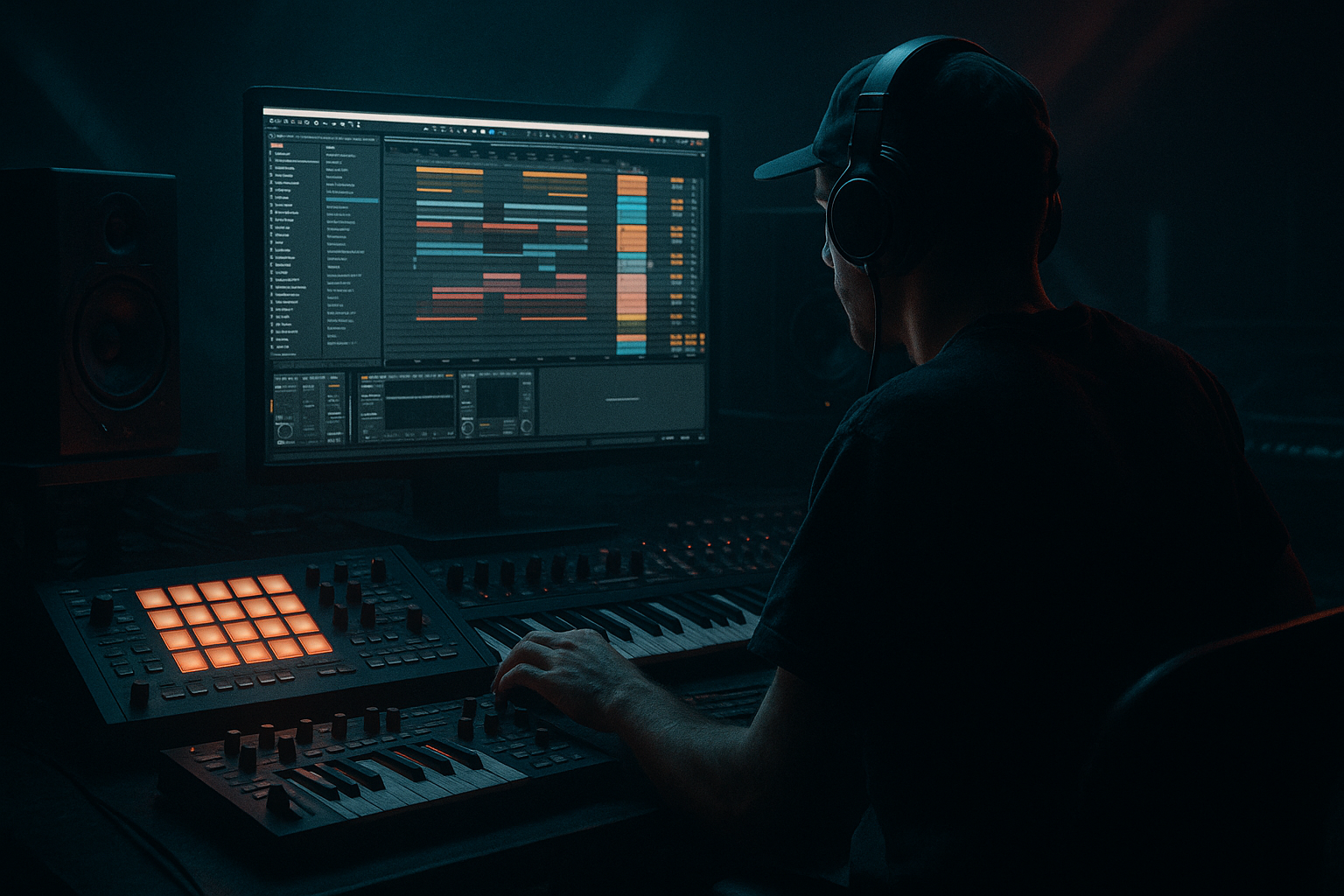
Main tutorial
Finishing Tracks Faster — Drum & Bass in Ableton Live
Energetic, clear, and practical — this lesson shows a beginner-friendly, fast workflow specifically for drum & bass (jungle/rolling DnB). We'll focus on decisions, Ableton stock device chains, concrete settings, and arrangement habits that get tracks from idea → finished draft fast. ⚡️🎧
---
1. Lesson overview
Goal: Turn an idea into a solid, finishable draft in one focused session (2–4 hours) and build a repeatable workflow for finishing tracks faster.
Key principles:
- Start with a playable skeleton (drums + bass + one lead/pad).
- Use templates, groups, and macros to make choices fast.
- Commit early via resampling/consolidation to avoid endless tweaking.
- Timebox tasks and follow a three-stage finish plan: Sketch → Build → Polish.
- Tight amen/processed break + punchy kicks (drum rack + sampled breaks)
- Rolling bass (sub + mid reese/lead bass)
- One focal lead or pad for melodic identity
- Basic arrangement with automation, transitions, and a rough mix bus
- Sub Operator: Sine, Octave -1/-2, Level -6 to -12 dB.
- Mid Wavetable: Osc A/B detune 2–6 cents, Filter cutoff around 800 Hz, Saturator Drive 3.
- Sidechain Comp: Ratio 4:1, Attack 1 ms, Release 80 ms, Threshold so gain reduction ~3–6 dB when drums hit.
- Chasing sounds forever: Limit sound design to 20–30 minutes per major element. Use presets + quick tweaks.
- No skeleton: Start arranging immediately (duplicate/drop loop into timeline) — then fill.
- Too many layers: If a part isn’t serving the track, mute it. Less is often more in DnB.
- Over-compressing master early: Keep master processing light until mix is balanced.
- Not using groups/macros: Map important controls (filter cutoff, saturation, dist) to macros so you can automate one knob instead of many.
- Not committing: If something works, resample/consolidate it — then treat the audio as “finished” for that session.
- Reese and width: For a darker mid-range reese, use two slightly detuned oscillators, route one through a chorus (or slight detune), then EQ out below 120 Hz and mono the sub. Use Utility width ~80–100% on mid, 0% on sub.
- Harsh mid aggression: Create a parallel distortion chain: Duplicate the mid bass track → add Saturator (Drive 6–12, Curve “Analog Clip”), then EQ high-pass > 200 Hz to feed only mids → blend low with original sub. This keeps sub clean while mids bite.
- Make drums nastier: On drum bus, place Saturator (Soft Clip), then a bit of EQ boost 2–5 kHz + small band around 200–400 Hz for grit. Use transient emphasis: Compressor with fast attack and short release on snare transient chain.
- Use Multiband Dynamics on master for heavy sound: Squeeze the mid band slightly (Threshold −12 to −6 dB, Gain make-up +1–2 dB) — subtle but thickening.
- Create dark atmosphere: Low-passed, heavily filtered pads with long reverb tails (Reverb Decay 4–8 s) and heavy low-cut to avoid mud. Automate resonance peaks for movement.
- Use harmonic enhancement: On the master or mid bus, gentle Saturator (Drive 1–3) in “Analog Clip” mode adds perceived loudness without killing dynamic punch.
- 0–5 min: Open template, set BPM 174, pick one break and one bass preset.
- 5–20 min: Create 8-bar loop (drums + bass + basic lead). Keep levels in check.
- 20–35 min: Duplicate to make drop (16 bars), add variation and one riser effect.
- 35–45 min: Arrange intro (8–16 bars), import basic transition elements (reverse clap, noise sweep).
- 45–60 min: Quick balance, add group compression, resample the drop and freeze heavy synths. Export a 60–90 s draft WAV (Master limiter −0.3 dB).
- Use a template and group tracks to remove setup friction.
- Start with a playable skeleton (drums + bass + one lead) and arrange fast.
- Split bass into sub + mid to control low end and character separately.
- Use Ableton stock devices: Drum Rack, Simpler, Operator/Wavetable, EQ Eight, Saturator, Glue Compressor, Auto Filter, Multiband Dynamics, Limiter.
- Commit early (resampling, freeze/flatten) to prevent infinite tweaking.
- Timebox and follow the Sketch → Build → Polish method to finish tracks faster.
- Provide a downloadable Ableton template (with the chains above).
- Walk through setting up the exact Drum Rack and bass patch in your Live version step-by-step.
DAW: Ableton Live (Stock devices used throughout: Drum Rack, Simpler, Operator/Wavetable, EQ Eight, Saturator, Compressor, Glue Compressor, Utility, Auto Filter, Reverb, Ping Pong Delay, Multiband Dynamics, Limiter).
Tempo suggestion: 170–175 BPM (174 is a sweet spot). 🎚️
---
2. What you will build
A 90–150 second DnB draft (intro → drop → break → second drop) with:
Outcome: A solid, mixable draft you can finish in later sessions.
---
3. Step-by-step walkthrough
A. Prep & Template (10–15 minutes)
1. Create a template project:
- Tempo: 174 BPM.
- Tracks:
- 1 Drum Rack (named DRUMS) → Group to “Drum Bus”
- 1 Bass Group (Sub + Mids)
- 1 Instrument for lead/pad
- 1 FX Group (risers, impacts)
- Master chain: Utility → EQ Eight (HP 20 Hz) → Saturator (Analog Clip, Drive 2) → Glue Compressor (fast) → Multiband Dynamics (gentle) → Limiter (−0.3 dB)
- Save as Live Template (File > Save Live Set as Default Set or specific Template).
2. Create Bus chains:
- Drum Bus chain: Utility (gain staging) → EQ Eight (HP 30 Hz, remove rumble) → Saturator (Drive 2–4) → Glue Compressor (4:1, Attack 5 ms, Release 0.1–0.3 s) → return to master.
- Bass Group: Sub track + Mid track (both in group). Keep separate for easier edits.
Why a template: removes setup friction so you can start composing immediately. ⏱️
---
B. Fast Drum Setup (20–30 minutes)
1. Grab a break (Amen, Think, or a clean break sample):
- Drag sample into an audio track. Warp mode: Beats, 1/4 or 1/8 preserve transient.
- Right-click → Slice to New MIDI Track → choose “Transients” or “Beats” and set the slicing preset to “Simpler” (or Sampler if you prefer). This gives you melodic flexibility with the break as a Drum Rack-kit.
2. Build core loop (8 bars):
- Use Kick + Snare from the sliced kit to craft a DnB groove at 174 BPM.
- Add hi-hats/ghost snares: program 16th/32nd rolls for movement.
- Add variation using velocity (velocity 70–120).
3. Drum Rack processing (per-pad or group):
- On Drum Rack chain for kicks/snare: Flexible chain FX → EQ Eight (HP 30 Hz, boost 2–4 dB around 3–6 kHz for snap) → Compressor (Ratio 4:1, Attack 1–5 ms, Release 50 ms) → Saturator (Drive 2–6, dry/wet to taste).
- On Drum Bus: Glue Compressor (4:1, Attack 3–6 ms), slight pump if compressing whole bus.
4. Quick fills & edits:
- Duplicate 1-bar variations, use clip automation for pitch and transient manipulation. Use Warp Mode Beats for stutters.
Why: Slicing + Drum Rack = fast rearrangement and consistent processing. 🥁
---
C. Rolling Bass (30–45 minutes)
Strategy: Two-layer bass — sub (pure low) + mid or reese for character.
1. Sub Layer (Operator or Simplified Wavetable)
- Device: Operator.
- Oscillator: Sine wave on Osc A. Octave: -1 or -2 depending on sample rate.
- MIDI notes: follow root notes (long notes). Use a small pitch envelope if needed.
- Chain: Operator → EQ Eight (Low Shelf boost at 60–80 Hz + HP 20 Hz) → Utility (Width 0% for mono low) → Compressor (sidechain later).
2. Mid/Reese Layer (Wavetable or Operator)
- Device: Wavetable (if available) or Operator using multiple detuned saws.
- Patch: Two detuned saws, mild FM or MOD to taste → Filter (Lowpass 6–12 dB) → Chorus/Delay lightly.
- Add movement: Auto Filter (Cutoff 150–800 Hz) with slow LFO (rate synced 1/4–1/2) for motion.
- Chain: Wavetable → EQ Eight (cut 50–100 Hz to avoid interfering with sub) → Saturator (Drive 3–6) → Glue Compressor.
3. Sidechaining (ducking)
- Compressor on bass group: Sidechain input = Drum Bus (or kick + snare group). Settings: Ratio 3–6:1, Attack 1–5 ms, Release 40–100 ms, Threshold so bass ducks on hits. This clears space and creates groove.
4. Glueing the bass
- Group Sub + Mid → add EQ Eight to carve space (notch 200–700 Hz if muddy).
- Add Multiband Dynamics if mix needs control (slightly compress mids/highs to glue).
Quick settings summary:
Why: Splitting allows you to treat mono subs independently from textured mids. 🔊
---
D. Lead / Pad (20–30 minutes)
1. Pick one focal sound — simple is better:
- Instrument: Wavetable, Operator, or Simpler with a sampled stab.
- Keep melody short (2–4 bars) and memorable.
- Put it on an Instrument Rack with one macro controlling filter cutoff + reverb send.
2. Space & FX:
- Use Auto Filter for movement (Auto Filter LFO rate 1/4–1/2, amount subtle).
- Add Reverb (Valhalla-like settings if using stock Reverb: Decay 2–4 s, Dry/Wet 10–20%) on return.
3. Arrangement placement:
- Intro: filtered lead pad (low energy).
- Drop: full lead with cutoff open + rhythmic gating.
Why: A single identifiable lead keeps the track coherent and finishable. 🎼
---
E. Arranging Fast (30–45 minutes)
Use a 3-stage arrangement method and timebox each stage.
1. Stage 1 — Skeleton (15–20 min)
- Build a 32–64 bar arrangement with sections: Intro (16 bars) → Build (16 bars) → Drop (16–32 bars) → Break (16 bars) → Drop 2 (32 bars).
- Place your loop in the drop area and duplicate for second drop; make minor variations (different bass notes, drum fills).
2. Stage 2 — Transitions (10–15 min)
- Add risers, impacts, white noise sweeps on FX return.
- Automate filter cutoff or volume for 4–8 bar risers.
- Use reverse clap + small pitch-up on last bar before drop.
3. Stage 3 — Quick Mix & Commit (15–20 min)
- Balance levels (drums + bass dominant). Use Utility to check mono compatibility.
- Color tracks: Name & color tracks; group and collapse.
- Freeze & Flatten heavy chains you’re happy with to save CPU.
- Resample a few sections: create audio versions (Resampling) of layered parts and replace MIDI to stop over-tweaking.
Why: Arrangement skeleton + quick transitions gets you to a finishable draft quickly.
---
4. Common mistakes (and how to avoid them)
---
5. Pro tips for darker/heavier DnB
---
6. Mini practice exercise (45–60 minutes)
Objective: Produce a finished 60–90 second draft.
Timebox:
Deliverable: One 60–90s draft that includes intro, drop, and one transition.
---
7. Recap
Finish this workflow a few times (even with different samples/presets) and you’ll dramatically speed up how many complete drafts you produce. Keep it focused, commit often, and don’t be afraid to throw away the extra 10% of detail that costs hours. Go make a heavy, rolling tune — and ship it! 🚀🔥
If you want, I can:

