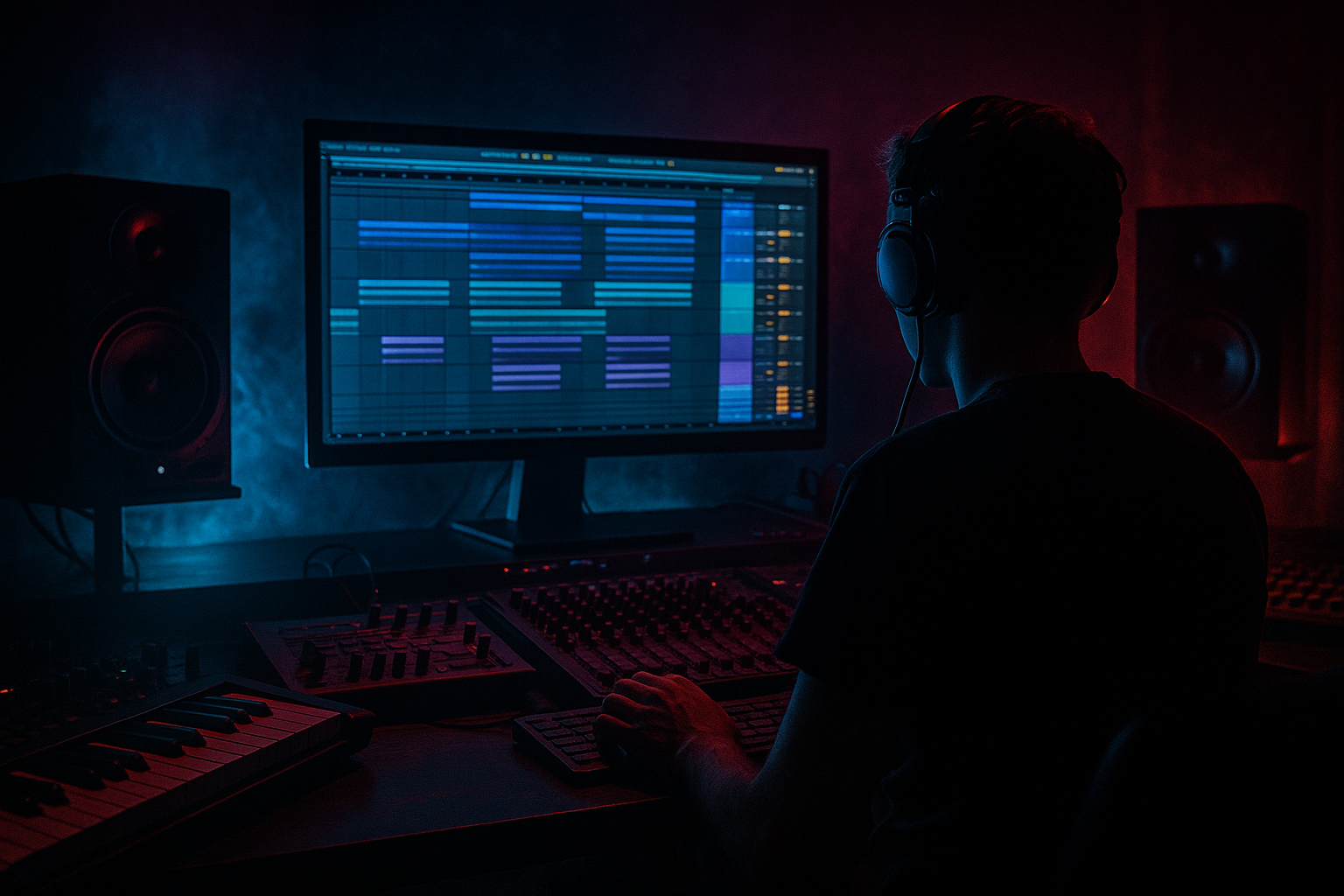
Main tutorial
1. Lesson overview
Energetic, focused lesson on laying out your first drop in drum & bass (jungle/rolling) using Ableton Live. You’ll learn practical arrangement habits, device chains, routing, and actionable steps to take a beat-and-bass idea into a tight 16–32 bar first drop that punches in clubs and on headphones. Perfect for beginners who know basic editing and clips in Ableton but want concrete arrangement workflows for DnB.
Expect hands-on Ableton advice (tempo, groups, stock devices like Drum Rack, Simpler/Sampler, Wavetable/Operator, EQ Eight, Glue Compressor, Saturator, Compressor, Auto Filter, Reverb, Delay, Beat Repeat, Utility). Let’s get heavy. ⚡️
2. What you will build
A simple but club-ready DnB first drop layout:
- Tempo set to 174 BPM (common DnB speed)
- 16–32 bar first drop with:
- Basic mixing decisions: low-cut, sidechain ducking, headroom -6 dB
- Forgetting to duck bass to the kick (muddied low-end = no club clarity). Fix: sidechain compressor on bass.
- Leaving everything in stereo down low. Fix: mono sub with Utility.
- Not carving space: letting bass, kick and low-mids fight. Fix: EQ Eight cuts — carve kick vs bass (shelving/peaks).
- Drop too static: repeating the same 4 bars forever. Fix: vary percussion, note pitch, add fills every 4–8 bars.
- Too much reverb on low elements — kills punch. Only send mids/highs to long reverbs.
- Over-processing Master during arrangement. Keep headroom and finalize mix later.
- Dual-bass approach: keep a pure sine sub (Operator) locked to root, and a distorted mid-range patch for character (Wavetable > Thick oscillator > Saturator > EQ Eight). Sidechain the entire bass bus.
- Distortion chain (stock devices): Saturator (Drive 3–7 dB, Soft Clip) → Redux (rate 8–12 kHz, 8-bit reduction subtle) → EQ Eight (surgical cut 200–400 Hz if muddy). Parallel blend to keep low-end clean.
- Use Multiband Dynamics (or OTT-style setting) on a parallel bus to make mids scream without ruining sub.
- Heavy transient shaping: use Compressor with fast attack then Utility to bring back punch; alternatively duplicate drum, saturate and high-pass to add crack.
- Gated reverb snares for that 90s jungle vibe: Snare → Send to Reverb (long decay) → On return put an Audio Effect Rack with Gate to chop tail rhythmically.
- Tune your kick and bass to the key of the track: use Ableton’s Tuner or Spectrum to check fundamental frequencies and avoid phasing.
- Use short, aggressive delays (Delay or Ping Pong) on mid-bass stabs with low feedback — creates rhythmic space.
- Create dark space: automate low-frequency roll-off on melodic elements (Auto Filter HP) and keep background pads far back with heavy high-cut and long predelay reverb.
- Keep tempo in the DnB sweet spot (170–176). Use groups, sends, and locators for clean arrangement.
- Build a focused drum bus with parallel compression and keep low-end clear via EQ and mono sub.
- Use a dual-bass approach: sine sub + distorted mid for grit; sidechain bass to kick for punch.
- Structure the first drop as a dynamic 16–32 bar block with small internal variations, snare rolls, risers, and a possible half-bar cut for impact.
- Use Ableton stock devices: Drum Rack, Simpler/Sampler, Wavetable/Operator, EQ Eight, Glue Compressor, Saturator, Compressor, Auto Filter, Reverb/Delay, Beat Repeat to execute these ideas quickly.
- Avoid common mixing mistakes (no ducking, wide subs, over-reverb) and keep headroom.
- Punchy kick + snare/break backbone (drum bus with parallel compression)
- Rolling break or programmed drums (chopped Amen or custom pattern)
- Layered bass: clean sub + distorted mid-bass for grit
- Lead stab/atmos and small melodic hook
- Build-to-drop transitions: riser, snare roll, half-bar silence or cut
- FX sends for reverb/delay and a Drop bus for automation
3. Step-by-step walkthrough
Follow these concrete steps in Ableton Live (Arrangement View recommended for learning layout).
A. Project setup
1. Set tempo: 174 BPM. (D&B often 170–176; 174 is a great spot.) 🎚️
2. Create tracks and color/group them:
- Drum Group (create a Group Track): Kick, Snare, Breaks, Percs
- Bass Group: Sub, Mid Bass (distorted), Bass FX
- Synths/Hook Group: Lead stab/atmo
- FX/Return Tracks: Reverb (Return A), Delay (Return B), Riser FX (Return C)
- Master: keep simple, no heavy processing yet
3. Set a Locator (right-click in Arrangement → Add Locator) for Intro, Build, Drop 1.
B. Basic drum backbone
1. Load a Drum Rack into Drum Group > Create a MIDI track → Drag Drum Rack.
2. Populate Drum Rack:
- Kick: choose a DnB kick sample (longer punchy 808-style with click).
- Snare: tight snare + layered clap or break snare (place snare on 2 and 4).
- Break: drag an Amen or Funk break onto a Simpler, set to Slice mode.
3. Tempo-match the break:
- Drop the break sample into Simpler (Slice mode) or into an audio track.
- Warp it at 174 BPM (Complex Pro or Beats warp mode).
- Chop into 1/16 or transients and re-arrange to taste (play with ghost hits).
4. Drum Bus processing:
- Route kick/snare/breaks into a Drum Group and on the group place:
- EQ Eight: high-pass from 18–30 Hz (to remove inaudible rumble), boost 100–200 Hz for body if needed.
- Glue Compressor: Ratio ~4:1, Attack 10–30 ms, Release 0.2–0.5 s, Makeup to taste — for bus glue.
- Utility: set width to 100% or narrow for club.
- Create a parallel compression chain:
- Duplicate Drum Group (or use a send return). On the parallel channel: Saturator > Compressor (heavy) > lower volume and blend with dry to taste. This keeps transients but adds weight.
C. Bass design and routing
1. Sub bass (audio or MIDI):
- Use Operator or Wavetable to make a sine/sub oscillator. Low-pass at ~200 Hz, filter envelope if desired.
- EQ Eight: kill everything above 120–150 Hz (low shelf) — this track is JUST sub.
2. Mid bass / growl:
- Use Wavetable or Sampler with a wavetabled lfo, distortion chain: Saturator > Overdrive (or Redux for bitcrush) > EQ Eight.
- Route both sub and mid to a Bass Group. On Bass Group:
- Multiband Dynamics (or Compressor on mid): compress mids for consistency.
- Glue Compressor lightly.
3. Sidechain ducking:
- On Bass Group or Bass Bus, drop a Compressor (sidechain input: Kick/Drum transients).
- Settings: Ratio 3–6:1, Attack 1–5 ms, Release 40–120 ms (fast release for DnB). Threshold so the bass ducks when kick hits.
4. Frequency separation:
- Use Utility/Split: keep subs mono. On Sub track use Utility > Mode Mono. On mid-bass keep stereo width.
D. Lead/hook and atmos
1. Stabs/pads:
- Use Wavetable or Sampler; keep high-passed to avoid masking bass (HP @ ~300–600 Hz).
- Short stabs that accent hits or a sparse melody looped across the drop.
2. Reverb/delay:
- Use Return A (Reverb): Decay 0.8–1.5s, Dry/Wet 20–30% on send. For snares, send short reverb, for tail use automation.
- Use Return B (Ping Pong Delay): Sync 1/8 or 1/16 dotted, Feedback 30–40%, Dry/Wet 20–35%. Automate sends at transitions.
E. Arrangement: building the drop
1. Draft sizes: common layout = Intro (32 bars) → Build (8–16 bars) → Drop (16–32 bars).
2. First drop placement:
- Typical club tracks: drop at bar 33 or after first 48 bars. But for practice, place Drop 1 at bar 33 (after 32-bar intro).
3. Create a 16-bar Drop block:
- Bars 33–48 = Drop 1. Loop or duplicate patterns into that range.
4. Dynamics & variation within drop:
- Bars 33–36: Full drums + bass + stab. (Intro into full energy.)
- Bars 37–40: Remove one percussive element (e.g., remove hat loop) to create movement.
- Bars 41–44: Introduce short fill + modified bassline (octave jump).
- Bars 45–48: Pre-drop small riser or half-bar cut for continuity into next section.
5. Pre-drop tension:
- Build technique: automate a low-pass filter (Auto Filter on Drum Group or Master bus) sweeping up over 4–8 bars, then open. Create a snare roll: copy snare hit and create a 1/16 or 1/32 roll, automate velocity increase, or use Drum Buss + Saturator.
- Use Beat Repeat on a drum fill for glitchy roll: Interval 1/16, Grid 1/32, Chance 70%, Gate short.
- Consider a 1/8 or 1/4 bar half-silence right before drop to maximize impact (cut everything except sub or reintroduced sub on the downbeat).
6. Transitions and FX:
- Create white-noise riser on a return or audio track: simple noise sample in Simpler, filter sweep with Auto Filter (resonance 20–30%), drive with Saturator. Automate send for riser volume.
- Use short reverse cymbal or reversed clap right before drop.
F. Automation & polish
1. Automate send levels and Reverb/Delay throws into the drop transitions.
2. Automate low-cut on instruments leading to drop to reduce mud.
3. Use clip envelopes for filter cutoff, pitch, and volume for variation.
4. Keep Master gain headroom: aim for peaks around -6 dB before any mastering processes. Don't squash with heavy master compression during arrangement.
4. Common mistakes
5. Pro tips for darker/heavier DnB
6. Mini practice exercise (30–60 minutes)
Goal: Build a 16-bar first drop loop and a 4-bar pre-drop build in Arrangement View.
1. Project basics (5 min)
- Set tempo to 174. Create tracks: Drum (audio + Drum Rack), Bass Sub (Operator), Bass Mid (Wavetable), Lead (Sampler), Return A Reverb, Return B Delay.
2. Drums (10–15 min)
- Load a break in Simpler (slice) and align to 174 BPM. Program a 2-bar break-based loop (kick on 1, snare on 2/4 + break overlay).
- On Drum Group add EQ Eight (HP @ 30 Hz), Glue Compressor (4:1), Saturator (drive 2–4).
3. Bass (10–15 min)
- Sub: Operator, sine wave, low-pass 200 Hz, tune to root.
- Mid: Wavetable, saw with wavetable position mod, Saturator + EQ Eight.
- Sidechain bass bus to kick: Compressor set Ratio 4:1, Attack 1–3 ms, Release 60 ms, Threshold to taste.
4. Drop arrangement (10–15 min)
- Create Locator at bar 33. Place your 16-bar drop between 33–48.
- Arrange: full drums + both basses for bars 1–4 of drop; remove hat/percs on bars 5–8; add bass variation on bars 9–12; on bars 13–16 add short snare roll to lead into next section.
- Add a white-noise riser across the last 4 bars of build (automate filter cutoff open to 10 kHz).
5. Quick polish (5 min)
- Add return sends for snare + lead. Short delay on lead (Sync 1/8 dotted, feedback 25%).
- Set master peak around -6 dB.
Evaluation: If the drop hits with clear low-end, a tight kick presence, and some variation/fills across the 16 bars, you’ve succeeded. Export a rough bounce and listen on headphones and phone.
7. Recap
Go build a heavy first drop now — loop, listen, tweak, and repeat. If you want, send me your arrangement sketch and I’ll give exact suggestions for improving clarity and impact. Let’s make it hit hard! 🔊🔥

