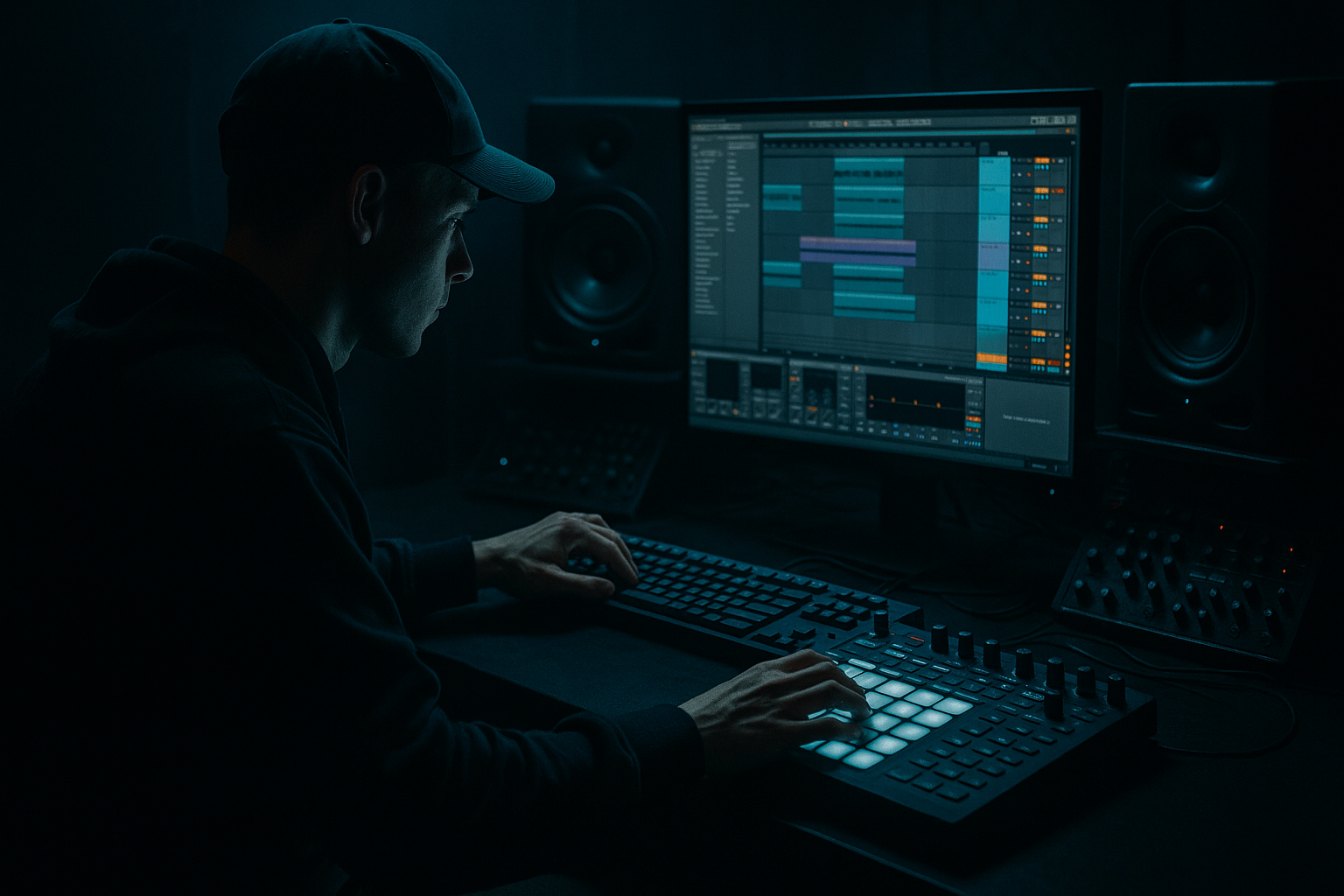
Main tutorial
Flip an Amen Variation for Sunrise Set Emotion in Ableton Live 12 ☀️🥁
1. Lesson overview
In this lesson, you’ll learn how to take an Amen-style drum break variation and turn it into an emotional sunrise-set DnB groove inside Ableton Live 12.
We’re not just making a break sound “busy.” We’re shaping it so it feels:
- lifted
- hopeful
- rolling
- human
- ready for a dawn crowd
- slice and reshape the break
- control swing and ghost notes
- add warmth and weight
- create space for a bassline to breathe
- arrange the loop so it feels like a real sunrise moment 🌅
- a 2-bar Amen variation
- subtle ghost-note movement
- a sunrise-style drum groove
- a bassline-friendly pocket
- a simple 8-bar intro-to-drop arrangement idea
- early morning dancefloor energy
- emotional but still driven
- breakbeat detail with clean low-end
- “the crowd is tired, but the tune is lifting them up”
- Amen break or Amen-style loop
- Drum Rack
- Simpler or Slice to New MIDI Track
- EQ Eight
- Drum Buss
- Glue Compressor
- Utility
- optional Delay / Reverb for atmosphere
- kick/snare backbone
- ghost snare flicks
- small hat or shuffly percussion hits
- one or two surprise break fills
- Bar 1: establish the groove
- Bar 2: add variation and emotional lift
- Snare on 2 and 4
- kick just before the snare for drive
- small ghost hits between the main backbeats
- one extra break chop at the end of bar 2 to signal movement
- strong hits = emotional anchors
- quiet hits = motion and realism
- High-pass around 25–35 Hz if needed
- Cut muddy low-mids around 200–400 Hz if the break sounds boxy
- Add a gentle shelf around 7–10 kHz if you want more air and snap
- Drive: 5–15%
- Crunch: low or off for sunrise vibes
- Boom: use carefully; if needed, keep it subtle and tune it to the track key
- Transients: slightly up for bite
- Ratio: 2:1 or 4:1
- Attack: 10–30 ms
- Release: Auto or around 0.3–0.6 s
- Aim for just a few dB of gain reduction
- reducing width if the break feels too messy
- checking mono compatibility
- controlling gain before the bass enters
- a shaker
- a soft ride
- a filtered top loop
- Decay: 1.2–2.5 s
- Pre-delay: 10–25 ms
- Low cut: around 200–400 Hz
- Dry/Wet on return: 100%
- send only a little from snare accents or atmospheric chops
- simple
- warm
- sub-focused
- call-and-response with the drums
- not overactive
- EQ Eight: low-pass or cut unnecessary highs
- Saturator: very gentle drive for audibility
- Utility: mono the low end
- optional Compressor with sidechain from the kick/snare if needed
- root notes
- octave shifts
- one or two passing notes
- notes that answer the break, not fight it
- filtered break loop
- light ambience
- no bass yet
- bring in the full Amen variation
- introduce sub bass quietly
- keep percussion minimal
- open the filter on a top loop or bass layer
- add a short fill at the end of bar 6
- full break energy
- bassline established
- a small reverb throw or snare delay for lift
- Increase Drum Buss Transients
- Add a little Drive
- Shorten break tails if you want a tighter, harder impact
- boost subtly around 150–300 Hz
- emphasize tom-like chops or snare weight
- avoid making it muddy
- short room reverb
- gated ambience
- minimal delay throws
- add distortion
- use FM movement
- layer a mid-bass growl above the sub
- automate filter movement for tension
- drop elements out before the next phrase
- use a snare fill that feels like a warning
- keep the break sharper and more relentless
- soft swing
- ghost notes
- clean sub bass
- gentle reverb
- bright but restrained top end
- tighter quantization
- stronger transient punch
- more saturated break
- aggressive bass
- less reverb, more impact
- velocity
- swing amount
- bassline note length
- drum bus processing
- atmosphere
- Slice the break for control
- Program a 2-bar variation with space and movement
- Use swing lightly
- Shape ghost notes with velocity
- Clean the break with EQ Eight, Drum Buss, Glue Compressor, and Utility
- Build a bassline that leaves room for the drums
- Arrange the track so it feels like a gradual dawn lift ☀️
- a step-by-step Ableton session template
- a MIDI drum pattern example
- or a bassline tutorial that matches this Amen groove
This approach is ideal for liquid, rolling, jungle-influenced, and melodic drum & bass.
You’ll use stock Ableton devices to:
---
2. What you will build
By the end, you’ll have:
Target vibe
Think:
Core elements
---
3. Step-by-step walkthrough
Step 1: Load an Amen break into Ableton Live 12
1. Drag your Amen break sample into an audio track.
2. Set the project tempo to around:
- 172–174 BPM for classic DnB
- 170 BPM if you want a slightly looser sunrise feel
3. Warp the sample:
- turn Warp on
- set mode to Complex Pro if needed for a full loop
- if the break is short and percussive, Beats mode can work well
Goal
You want the break to feel tight enough to program from, but still a little organic.
---
Step 2: Slice the break for control
You have two good beginner-friendly options in Live 12:
#### Option A: Slice to New MIDI Track
Best if you want total control over each hit.
1. Right-click the break clip.
2. Choose Slice to New MIDI Track.
3. In the slicing menu, use:
- Transient for detailed break slicing
- or 1/16 if the break is messy and you want predictable chunks
Ableton creates a Drum Rack with each slice on pads. Perfect.
#### Option B: Use Simpler in Slice Mode
Best if you want a cleaner, more contained workflow.
1. Create a MIDI track.
2. Drag the break into Simpler.
3. Switch Simpler to Slice mode.
4. Set slicing by Transient.
Recommendation
For beginners, I’d start with Slice to New MIDI Track because it gives you a visual drum pad workflow that feels very DnB-friendly.
---
Step 3: Build a 2-bar Amen variation
Open the MIDI clip and place notes manually.
#### Basic drum pattern idea
Use the slices to place:
Practical pattern approach
Try this mindset:
#### Example structure
How to program it
1. In the MIDI clip, place the main snare slices first.
2. Add a kick slice slightly before the snare to create momentum.
3. Fill in with:
- quiet ghost hits
- tiny rolls
- offbeat hats
4. Make sure the groove is still easy to follow.
Important
Sunrise emotion usually comes from space and phrasing, not from overfilling the break.
---
Step 4: Add swing and human feel
This is where the groove starts to breathe.
#### Use Groove Pool
1. Open the Groove Pool.
2. Try a groove like:
- MPC 16 Swing
- a subtle MPC 16 groove preset
3. Apply it lightly:
- Timing: around 15–30%
- Random: very low, around 0–10%
- Velocity: small amount if needed
Why this works
A sunrise DnB groove should feel human and buoyant, not too rigid.
A touch of swing gives the break that late-night-to-morning lilt.
---
Step 5: Shape the break with velocity
Ghost notes matter a lot in jungle and DnB.
1. Open the MIDI note velocity lane.
2. Set your main hits higher:
- snare backbeats: 100–127
3. Set ghost notes much lower:
- ghost snare / hat flicks: 20–70
4. Add velocity variation across repeated hits.
Rule of thumb
This contrast is what makes a break feel alive.
---
Step 6: Clean the drums with a practical device chain
Put this chain on your Drum Rack or on the break group:
#### Suggested stock Ableton chain
1. EQ Eight
2. Drum Buss
3. Glue Compressor
4. Utility
#### EQ Eight settings
Use EQ Eight to clean mud and shape brightness.
Keep it subtle. You’re cleaning, not redesigning.
#### Drum Buss settings
Great for punch and glue.
#### Glue Compressor settings
Good for making the break feel like one unit.
#### Utility
Use Utility for:
---
Step 7: Make it feel like sunrise emotion
A sunrise set usually needs less aggression and more lift.
Try these techniques:
#### A. Leave space in the break
Do not fill every gap.
Let the tail of the snare breathe.
#### B. Use brighter percussion, but softly
Add:
Keep them low in the mix, just enough to create sparkle.
#### C. Add a gentle reverb send
Use Reverb or Hybrid Reverb on a return track.
Suggested settings:
This gives the break a misty, early-morning halo 🌫️
---
Step 8: Build the bassline around the break
Because this lesson is in the Basslines category, the break needs to support a bassline that feels emotional and rolling.
For sunrise DnB, a bassline often works best when it is:
Easy bass approach in Ableton Live 12
Use Wavetable, Operator, or Analog.
#### Simple Operator bass chain
1. Create a MIDI track with Operator
2. Use a sine or sine-like waveform for the sub
3. Add a second oscillator or a layer for mid presence if needed
4. Keep the MIDI pattern minimal
#### Bass processing chain
Bassline writing tip
For sunrise emotion, use longer notes and fewer note changes than in a neuro or tearout tune.
Try:
---
Step 9: Use sidechain to make the groove breathe
Sidechain helps the drums and bass cooperate.
#### On the bass:
1. Add Compressor
2. Activate Sidechain
3. Choose the kick or a ghost kick layer as input
4. Set:
- Attack: 1–5 ms
- Release: 80–150 ms
- Ratio: 2:1 to 4:1
- lower threshold until the bass ducks naturally
Result
The bass lets the break shine and the groove feels open and emotional.
---
Step 10: Arrange it like a sunrise moment
Here’s a simple 8-bar arrangement idea:
#### Bars 1–2: Intro
#### Bars 3–4: First lift
#### Bars 5–6: Emotional push
#### Bars 7–8: Arrival
Useful arrangement trick
Automate a high-pass filter or Auto Filter on your drum bus during the intro, then open it gradually.
That creates the feeling of the sun coming up.
---
4. Common mistakes
1. Overediting the break
Too much quantizing or chopping can kill the Amen feel.
Fix: Leave tiny timing imperfections. Let the break groove naturally.
2. Too many hits
Beginners often add every possible chop.
Fix: Prioritize the backbone first. Add detail only where it supports the groove.
3. Weak velocity contrast
If all hits are similar in volume, the break feels flat.
Fix: Make the main hits strong and ghost notes quiet.
4. Over-heavy bass
A sunrise set usually needs bass that supports emotion, not dominates it.
Fix: Keep the sub clean and the mids controlled.
5. Too much reverb on drums
This can smear the break and remove punch.
Fix: Use sends lightly and high-pass your reverb return.
6. Ignoring mono
DnB low end must stay solid in mono.
Fix: Use Utility to mono the bass below about 120 Hz.
---
5. Pro tips for darker/heavier DnB
If you want to take this same Amen variation into a darker direction, here’s how to flip the energy.
A. Use more aggressive transient shaping
B. Push the low mids
Dark DnB often benefits from more body in the break.
C. Replace sunrise reverb with short space
Instead of dreamy long reverb, use:
D. Make the bass more threatening
In Wavetable, Operator, or Analog:
E. Darker arrangement trick
Use less harmonic lift and more negative space:
In short
Sunrise version = open, warm, floating
Dark/heavy version = dense, tense, driving
---
6. Mini practice exercise
Try this in your next session:
Exercise: Build two versions of the same Amen variation
Make:
#### Version A: Sunrise set version
#### Version B: Darker club version
Task
Use the same Amen slices, but change:
Goal
Learn how the same raw break can tell two completely different emotional stories.
---
7. Recap
You’ve now got a practical workflow for turning an Amen variation into a sunrise-ready DnB groove in Ableton Live 12.
Key takeaways
Final mindset
For sunrise DnB, the goal is not just “hard drums.”
It’s emotion + motion + clarity.
If you want, I can also turn this into:

