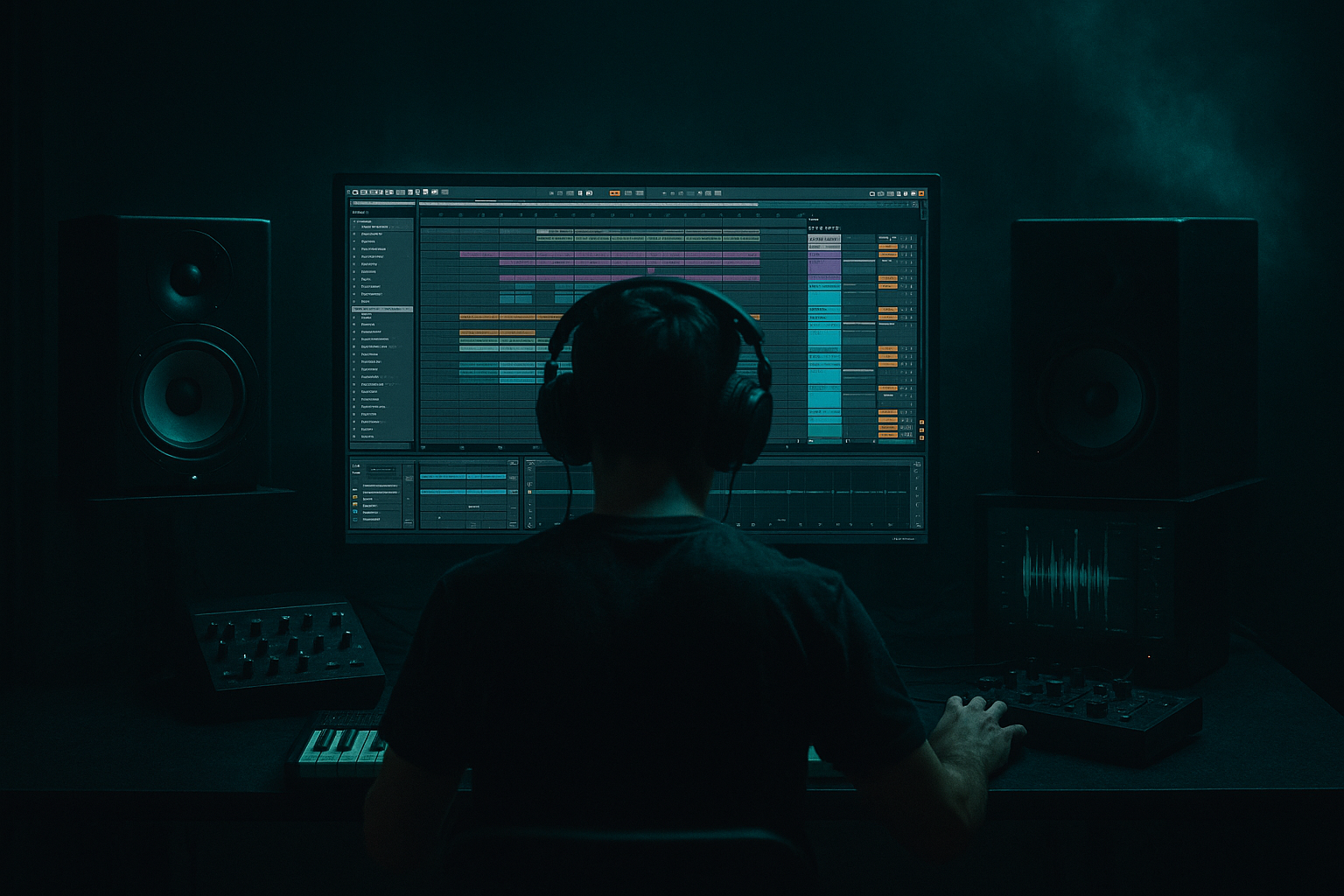
Main tutorial
Lesson Overview
This lesson is about turning a plain break roll into a proper jungle/DnB weapon: sharp enough to punch through a drop, dusty enough to feel like old sampled hardware, and controlled enough to sit with a heavyweight bassline. In Ableton Live 12, the goal is not just to “edit drums” — it’s to flip a break roll so it behaves like a musical phrase: it builds tension, opens space for the drop, and keeps that classic oldskool swing without sounding generic or over-processed.
In advanced DnB, the difference between a filler roll and a memorable one is usually:
- transient shape
- micro-groove
- midrange texture
- and how the roll interacts with the bass and arrangement
- slice and rephrase a break
- create ghost-note movement
- sharpen attack without flattening the groove
- add lo-fi grit in the midrange
- and automate the roll so it feels alive in the arrangement
- Crisp transient hits on the kick/snare accents
- Dusty midrange body from a resampled break layer
- Controlled low end so it doesn’t fight the sub
- A rising, tension-filled motion suitable for 170–175 BPM DnB
- A believable oldskool character without losing mix punch
- at the end of a 16-bar drum phrase before the drop
- in the last bar before a switch-up
- or as a response to a bass call-and-response phrase in a darker roller
- Over-sharpening everything
- Too much low end in the break layer
- Grid-locked roll with no human movement
- Over-compressing the break until it sounds flat
- Making the roll too bright
- Using reverb on the full roll
- Print the dusty layer twice
- Use Drum Buss transient shaping before saturation
- Band-limit the grit
- Automate a brief drop in dry level before the final hit
- Try call-and-response with bass
- Use tiny delay throws on ghost notes
- Keep one element slightly imperfect
- reads fastest
- carries the most character
- and leaves the bassline room to hit
- Slice a character break and rephrase it as a musical roll, not a loop.
- Keep the transients crisp with Drum Buss, EQ, and controlled compression.
- Build dusty mids using resampling, Saturator, and light Redux.
- Use micro-timing, ghost notes, and swing to get the jungle feel.
- Automate the roll so it functions as a transition event in the arrangement.
- Protect the sub and low-end clarity so the drums hit hard without masking the bass.
This technique matters because jungle and rollers rely on drum momentum as much as bass pressure. If your break roll has crisp transients and dusty mids, it can act like a bridge between sections: from groove to impact, from breakdown to drop, or from 8-bar hypnotic loop to 16-bar lift. Done well, it sounds intentional, not pasted in.
You’ll use Ableton stock tools to:
What You Will Build
You will build a 2-bar break roll fill that sounds like a chopped jungle turnaround with modern clarity:
Musically, it’s the kind of roll you’d place:
Think: tight break science meets grimey jungle energy.
Step-by-Step Walkthrough
1. Choose and prep the break source
Start with a break that already has character: Amen, Think, Funky Drummer-style material, or a dusty loop with real room tone. Drag it into a fresh audio track and warp it in Beats mode if needed.
Useful starting moves:
- Set Preserve to transients
- Keep Transient Loop Mode off unless you need a very specific repeat
- Try Warp Marker cleanup only if the source drifts
- If it’s too clean, do not over-fix it — a little instability helps the oldskool feel
For advanced DnB, the source break should already contain usable ghost notes and hat chatter. Those tiny details are what make the roll breathe. If the break is too pristine, it’ll sound like a plugin loop instead of a record chop.
2. Slice the break to MIDI for surgical control
Right-click the break and choose Slice to New MIDI Track. Use a slicing preset like Built-in: Transients or Warp Marker depending on how tight the source is.
Once sliced:
- Rename the track clearly, e.g. `BRK Roll Main`
- Consolidate the slices you actually want to use
- Pull the MIDI clip into a 1-bar or 2-bar region
- Start with the original order, then begin rephrasing
Why this works in DnB: drum breaks in jungle aren’t just loops; they’re phrases. Slicing gives you direct control over the call-and-response between kick, snare, hats, and ghost notes. That means you can shape anticipation before the drop instead of relying on a generic build-up.
3. Build the roll as a phrase, not a straight repeat
Inside the MIDI clip, create a bar 2 turnaround that gets denser, not just louder. Keep the core snare/kick accents readable, then add ghost hits leading into them.
Practical pattern ideas:
- Bar 1: sparse break chops, lots of groove space
- Bar 2 beat 3 onward: increase note density
- Final 1/4 bar: rapid hats or snare ghost clusters
- End the phrase with one intentional accent or choke
Try this structure:
- Main snare hit on 2 and 4
- Ghost snare notes at 1/16 or 1/32 before the main hit
- A kick pickup before the final snare
- A short hat burst at the end of the phrase
Keep velocity variation strong. Use velocities in a rough range like:
- main snare: 110–127
- ghost notes: 35–80
- hat chatter: 25–70
This is where the jungle feel happens. The roll should sound like a drummer pushing forward, not a machine spamming notes.
4. Shape the groove with timing offsets and swing
Open the MIDI clip and use Groove Pool with a swing source that feels right for breakbeat material. A subtle groove often beats a heavy one. For oldskool DnB, you want the shuffle to feel human, not drunken.
Suggested approach:
- Try MPC-style swing from Ableton’s groove library
- Keep Timing around 10–35% for subtle movement
- Keep Random low, around 0–8%
- Apply Velocity from the groove only if it enhances the break’s natural dynamics
Then manually nudge a few notes:
- push some ghost notes slightly late
- keep certain snare anchors slightly ahead for urgency
- let hats fall behind the grid a touch for dust
Advanced tip: use this contradiction on purpose. In DnB, a roll often feels exciting because some elements push forward while others sit behind. That tension creates motion without needing extra FX.
5. Route the roll through Drum Rack-style transient control
If your slices are in a Drum Rack or on separate tracks, group them into a Drum Group so you can process the roll as a unit. Add Drum Buss on the group first.
Start with:
- Drive: 5–20%
- Transient: +10 to +30
- Boom: low or off, especially if the bassline is already sub-heavy
- Damp: moderate if the top end is too harsh
Then add EQ Eight after Drum Buss:
- High-pass gently around 25–35 Hz if any low rumble appears
- Cut a little 250–500 Hz if the roll gets boxy
- If needed, add a small presence boost around 2–5 kHz for attack
The point is not to make the roll bright and polished. It’s to make the transients cut through a dense DnB mix while keeping the meat of the break intact.
6. Create the dusty mids with resampling and saturation
Now the character step: resample the roll into audio so you can treat the midrange like a sound design layer. Create a new audio track, set input to the drum group or the roll track, and resample the phrase.
Once recorded:
- Consolidate the best 2 bars
- Add Saturator
- Try Analog Clip or Soft Sine depending on how aggressive you want it
- Drive: 2–8 dB to start
- Use Output compensation to keep level honest
Then try Redux lightly for dusty mids:
- Sample rate reduction: subtle, not crushed
- Bit reduction: minimal if you want texture without obvious aliasing
- Mix it in parallel or automate it only on the tail of the roll
A very usable chain:
- Saturator
- Redux
- EQ Eight
- optional Compressor
The dusty mids are what make the roll sound like it came from a box, a sampler, or a rough dubplate chain. In jungle and darker DnB, midrange grit is emotional information — it tells the listener “this is real, not polished EDM filler.”
7. Tighten the transient layer separately from the texture layer
For advanced control, split your roll into two layers:
- a clean/transient layer
- a dusty/body layer
Make the transient layer:
- shorter
- brighter
- less saturated
- more compressed if needed
Make the dusty layer:
- slightly lower in level
- band-limited with EQ
- more saturated and lo-fi
- maybe widened subtly using Utility with width only on mids/highs if it’s safe
On the transient layer, try:
- Transient Shaper via Drum Buss
- Compressor with fast attack and medium release
- Attack around 3–10 ms
- Release around 40–120 ms
On the dusty layer, try:
- Auto Filter with gentle band-pass automation if you want it to “speak” only in the fill
- Saturator before EQ for richer harmonics
- Gate if room tone is cluttering the tail
This split gives you the best of both worlds: punch for the front edge, grime for the middle. That’s the core of the technique.
8. Automate the roll so it lands like an arrangement event
Don’t leave the roll static. Automate movement across the final bar so it feels like a transition, not just a loop.
Strong automation options:
- Auto Filter cutoff gradually opening on the dusty layer
- Reverb Dry/Wet rising only on the tail hits
- Saturator Drive increasing into the final beat
- Utility Gain dropping slightly before the next drop to create headroom
- Delay on selective ghost notes for a dubwise tail
Good arrangement context example:
In a 16-bar drop, place the break roll in bar 15. Let the bassline simplify in the final 2 beats, then let the drum roll occupy the space. End with a single snare hit or chopped crash into the drop on bar 17. This gives DJs and listeners a clear phrase boundary while preserving momentum.
For dark rollers, the best fills often don’t explode — they tighten. Pull elements away, increase rhythmic density, and let the bass return hit harder because of the contrast.
9. Glue the roll to the bassline without masking it
This is where a lot of drum edits fall apart. Use sidechain compression or simple arrangement discipline so the roll doesn’t blur the sub.
On the drum group or dusty layer:
- Use Compressor sidechained from the bass or sub
- Try a subtle setting: 2–4 dB gain reduction
- Fast attack, medium release, so the kick/snare edges remain intact
Also check:
- Mono compatibility on the low end with Utility
- Keep the dusty layer mostly above the sub region
- If the break has low kick energy, consider high-passing the dusty layer around 80–120 Hz and let the clean drum layer handle the punch
In DnB, the drum roll should feel like it’s riding on top of the bassline, not fighting it. The sub owns the floor. The roll owns the motion above it.
10. Final polish: clip, group, and commit
Once the roll works, commit it. Render or freeze it into a track you can treat as a performance element. Add a soft Limiter only if needed for safety, not for loudness.
Final checks:
- Is the first transient distinct enough?
- Do the ghost notes still read at low volume?
- Does the dusty midrange feel present on small speakers?
- Does the roll help the drop rather than filling space aimlessly?
If yes, save it as a reusable rack or audio clip. Advanced producers in DnB often keep a private library of break turns, because a great fill can become part of your sonic identity.
Common Mistakes
- Fix: keep only the main accents crisp; let ghost notes stay softer and rounder.
- Fix: high-pass the dusty layer and let the bass/sub own the bottom.
- Fix: offset ghost notes and use modest Groove Pool timing.
- Fix: use parallel processing or split layers so transients remain alive.
- Fix: focus on the 1–5 kHz area for perception, not excessive top-end hiss.
- Fix: automate reverb only on select tail notes or send just the final accent.
Pro Tips for Darker / Heavier DnB
- One clean-ish resample, one dirtier resample. Blend the two for movement and depth.
- This can give you a nastier front edge without needing extreme drive.
- Let the dirty layer live mostly in the mids. That keeps the sub clean and makes the break feel “older.”
- Even a small dip makes the last accent feel larger and more dramatic.
- Let the roll answer the bass phrase, especially in darker rollers where space is part of the groove.
- A short ping-pong or simple delay send on just a few notes can create that haunted, dubby jungle feeling.
- Leave a tiny bit of room noise or swing inconsistency. That “broken” human quality is part of the charm in oldskool DnB.
Mini Practice Exercise
Spend 10–20 minutes building three versions of the same 2-bar roll from one break:
1. Version A: Clean punch
- Minimal saturation
- Strong transient control
- Tight swing
- Focus on impact
2. Version B: Dusty mids
- Resample the roll
- Add Saturator and light Redux
- High-pass below the body you don’t need
- Focus on texture
3. Version C: Drop-turn transition
- Add automation on filter cutoff and send reverb
- Increase note density in the final half-bar
- End with a single accent or choke
- Focus on arrangement energy
Then compare them at low volume and in mono. Pick the one that:
Your goal is not perfection — it’s learning what makes the roll feel alive, dusty, and DnB-ready.
Recap
If you get the balance right, the roll becomes more than a fill — it becomes a signature moment in the track.

