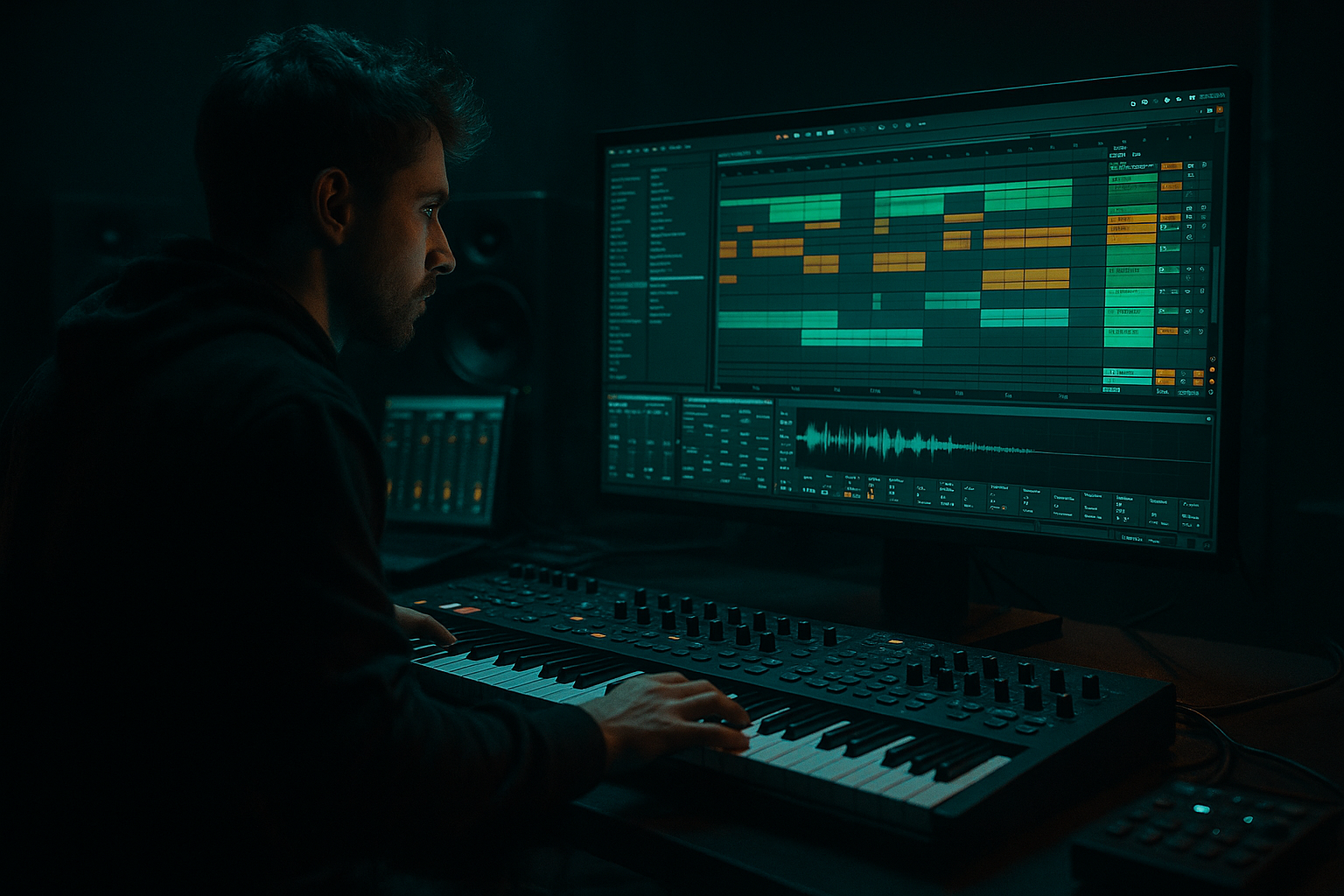
Main tutorial
Flip Jungle Drum Bus for Smoky Warehouse Vibes in Ableton Live 12
1. Lesson overview
In this lesson, you’re going to resample and flip a jungle drum bus into a smoky, warehouse-style drum & bass layer in Ableton Live 12. The goal is not just to make the drums “heavier,” but to make them feel like they’ve been captured, abused, and recontextualized into something that sounds like it belongs in a dark London basement at 2 a.m. 🌫️
This is an advanced resampling workflow focused on:
- turning a clean or busy jungle break bus into a textural, controlled, gritty performance layer
- using Ableton’s stock devices to sculpt tone, transient shape, and space
- building a process you can repeat across tracks for consistent DnB character
- Resampling
- Drum Bus
- Saturator
- Roar
- EQ Eight
- Auto Filter
- Transient shaping with Drum Buss
- Echo / Reverb / Hybrid Reverb
- Simpler / Slice mode
- optional Warp tricks for ghosting and swing
- jungle breaks under rolling basslines
- halftime-to-double-time flips
- intro/outro texture beds
- transition fills in dark rollers
- warehouse pressure layers under the main drums
- dusty, compressed, and atmospheric
- slightly blown out, but still punchy
- like the drums are moving through fog, concrete, and low-end pressure
- suitable for 170–174 BPM drum & bass / jungle
- a classic break: Amen, Think, Funky Drummer, Hot Pants, or a chopped jungle break
- a kick/snare layer reinforcing the break
- light percussion: hats, rims, ghost snares, ride taps
- optional foley or vinyl noise for texture
- Don’t over-compress the source yet
- Leave some transient detail and groove so the resample has character
- Aim for a bus peak around -8 to -6 dBFS before processing
- Capture a few bars where the break is sparse, busy, and transitioning
- Include fills, ghost notes, and any group automation
- Record more than you need — selection is part of the sound design
- Use Transient when the break has clear accents
- Use 1/8 if you want a rhythmic, loop-like reinterpretation
- Use 1/16 for hyper-edits and glitchy warehouse fills
- kick hits
- snare hits
- ghost notes
- noise tails
- little “mistake” artifacts that often become the best bits
- High-pass around 80–120 Hz
- Cut a bit around 200–400 Hz
- Slight boost around 700 Hz–1.5 kHz
- Low-pass around 8–12 kHz
- Drive: 10–25%
- Crunch: 5–15%
- Boom: low, or off
- Transients: depending on source
- Mode: start with a warm or distorted profile
- Drive: moderate
- Tone/filter: roll off excessive brightness
- Modulation: very slight movement if you want the break to “breathe”
- grime
- harmonic density
- aggressive midrange texture
- Add Redux
- Reduce bit depth subtly
- Lower sample rate a touch
- Bit Reduction: small to moderate
- Sample Rate: just enough to roughen, not destroy
- Use Saturator
- Drive: 2–4 dB
- Soft Clip: On
- low-pass cutoff automation from 12 kHz down to 4–6 kHz over 8 bars
- add a tiny amount of resonance for a nasal, tunnel-like sweep
- use LFO for subtle motion on long intro sections
- open the filter during build tension
- close it for breakdowns
- automate for FX-like drum transitions
- Sync: 1/8D, 1/4, or 1/16
- Feedback: 10–35%
- Filter inside Echo:
- Add a touch of modulation if desired
- Keep dry/wet modest on the insert, or use a return track
- Pre-delay: 10–30 ms
- Decay: 0.8–2.0 s
- Low cut: 200–400 Hz
- High cut: 5–8 kHz
- Wet: keep subtle if on insert
- send the drum layer to a return track with reverb
- HP filter the return aggressively
- keep the main layer punchy
- Kick on 1, snare on 2 and 4
- Ghost snare leading into the main snare
- tiny break tick just before the snare for forward motion
- chopped 1/16 fill into the last beat of the 8-bar phrase
- Keep your original drum bus punchier and cleaner
- Use the resampled layer for:
- Main drums: front and present
- Resampled layer: 6–12 dB lower than the main kit
- High-pass the resampled layer so it doesn’t fight the kick and sub
- If the snare gets too thick, notch around 180–240 Hz
- Compress harder than the main layer
- Drive into distortion
- Roll off lows below 100–150 Hz
- Blend underneath the clean layer
- bigger drops
- build swells
- breakdown drum atmospheres
- aggressive halftime switchups
- Intro (1–16 bars): introduce the resampled layer filtered and roomy
- Build (17–32 bars): automate the filter open, increase drive
- Drop A: main drums hit clean, resampled layer appears underneath for grit
- Drop B / Variation: bring in sliced fills and rhythmic stutters
- Breakdown: let the resampled layer carry atmosphere alone
- Outro: filter out the top end and leave dust trails
- Auto Filter cutoff
- Drum Buss drive
- Echo feedback
- Reverb send level
- Roar drive or tone
- Utility gain for drop-to-drop energy shifts
- one version cleaner
- one version more distorted
- one version filtered and roomy
- filter cutoff
- Drum Buss drive
- Echo feedback
- send levels
- Beats mode for punchy re-chops
- Complex Pro for smeared texture
- transient preserve settings for different feels
- Utility on the resampled layer
- make low frequencies mono if needed
- avoid wide low-mid smear
- clipped tails
- room hiss
- bit reduction artifacts
- odd ghost hits
- slightly unstable loop edges
- it was printed from a broken PA system
- but still locks with the main drums
- and supports a rolling bassline without clutter
- Build a musical jungle drum bus
- Resample it in Ableton Live 12
- Use the printed audio as raw material for slicing and re-grooving
- Process the resampled layer with EQ Eight, Drum Buss, Roar, Saturator, Auto Filter, Echo, and Reverb
- Keep it smoky, controlled, and textural
- Blend it under your main drums to create warehouse pressure and jungle energy 🌑
You’ll use Live 12 tools like:
This technique works especially well for:
---
2. What you will build
By the end, you’ll have:
1. A jungle drum bus with breaks, ghost hits, and percussive layers grouped together
2. A resampled audio print of that bus
3. A smoky, dark processing chain for the resampled material
4. A main drum bus and a parallel “warehouse dirt” layer
5. A practical arrangement method for introducing the flipped texture in a DnB track
The finished sound should feel:
---
3. Step-by-step walkthrough
Step 1: Build a source jungle drum bus
Start with a clean drum foundation. This technique works best if your source has movement and detail, not just a static loop.
Suggested ingredients:
Routing:
1. Put all drum elements into a Drum Group
2. Name it something like Jungle Drums
3. Create a return or parallel group for later use if needed
Balance tip:
---
Step 2: Shape the drum bus before resampling
Before you print anything, do a little “pre-smoke” on the group. You want the resampled file to already contain the vibe.
#### Suggested drum bus chain:
1. EQ Eight
- High-pass at 25–35 Hz to clean rumble
- Gentle dip at 250–400 Hz if the break is boxy
- Small boost around 2–5 kHz if you need snap
2. Drum Buss
- Drive: 5–15%
- Crunch: very low or off at first
- Transients: +5 to +20
- Boom: keep subtle, tune to key if needed
3. Saturator
- Mode: Soft Sine or Analog Clip
- Drive: 2–6 dB
- Soft Clip: On
4. Auto Filter
- Low-pass very gently around 12–16 kHz if the break is too bright
- Or use a band-pass for a more claustrophobic feel
5. Optional: Glue Compressor
- Ratio: 2:1
- Attack: 10 ms
- Release: Auto
- Aim for only 1–2 dB gain reduction
Keep it alive, not crushed. The point is to print a characterful source, not flatten everything yet.
---
Step 3: Resample the drum bus
Now we print the result into audio. This is where the “flip” begins.
#### Option A: Fast resampling inside Live
1. Create a new audio track called Resampled Drums
2. Set Audio From to Resampling
3. Arm the track
4. Record 8 or 16 bars of your drum bus playback
This is the cleanest method if you want Live to capture exactly what the master/output is doing.
#### Option B: Internal routing for more control
1. Create an audio track called Print Bus
2. Set Audio From to your Jungle Drums group
3. Choose Post FX or Post Mixer depending on what you want to capture
4. Arm and record
This is better if you want to capture just the drum group, not the whole session.
Recording tip:
---
Step 4: Slice the resampled audio into playable parts
Once you’ve recorded the bus, treat it like raw material.
#### Workflow:
1. Drag the recorded clip into a new audio track or into Simpler
2. Right-click the clip and choose:
- Slice to New MIDI Track
3. Use slicing by:
- Transient
- or 1/8 / 1/16 if you want more uniform hits
#### Best slicing approach for jungle flips:
This gives you a playable kit of:
---
Step 5: Build a smoky warehouse chain on the resampled layer
Now we turn the printed drum audio into something darker and more atmospheric.
#### Suggested chain for the resampled layer:
1. EQ Eight
2. Drum Buss
3. Roar
4. Redux or Saturator
5. Auto Filter
6. Echo
7. Hybrid Reverb or Reverb
Let’s break that down.
---
#### 5.1 EQ Eight: carve and focus
Use EQ to make the layer sit underneath the main drums.
- This keeps low-end clean for your sub and kick
- Reduces mud from the break body
- Brings forward the dusty “cardboard” crack if needed
- This helps with the smoky warehouse feel
You’re trying to make it feel like a darker echo of the main drums, not a second full kit.
---
#### 5.2 Drum Buss: glue the chop
Use Drum Buss to make the resampled layer hit like a system recording.
Suggested starting point:
- positive for snap
- negative for softer, smeared tone
If the resampled break is too spiky, push Transients slightly negative and let saturation do the work.
---
#### 5.3 Roar: add modern grit and movement
Roar is excellent for darker DnB textures in Live 12.
Try a subtle chain:
Use Roar for:
Don’t overcook it. The goal is warehouse haze, not crunchy EDM distortion.
---
#### 5.4 Redux or Saturator: aliasing and dust
If you want a more broken, digital edge:
Settings to start:
If you prefer a more controlled analog-style weight:
This is a great place to make the break feel like it’s being replayed through a battered system.
---
#### 5.5 Auto Filter: warehouse movement
Put Auto Filter after distortion to animate the layer.
Ideas:
This is especially useful in DnB arrangement:
---
#### 5.6 Echo / Reverb: smoky space without washing out the groove
For warehouse vibes, the space should feel distant but rhythmic.
##### Echo settings:
- high-pass the delay
- low-pass around 4–8 kHz
##### Reverb / Hybrid Reverb:
For cleaner control, often better:
That creates the illusion of a room around the drums without killing the attack.
---
Step 6: Rebuild the groove from the resampled slices
Now use the chopped audio like percussion Lego.
#### Practical method:
1. Load slices into a MIDI track via Slice to New MIDI Track
2. Program a new groove at 170–174 BPM
3. Emphasize:
- offbeat ghost snares
- syncopated kick hits
- short break accents before the main snare
- “answer” hits between the bass notes
#### Common jungle/DnB phrasing ideas:
Your resampled layer should act like a shadow performance under the primary kit.
---
Step 7: Layer it with the main drum bus
Now combine the new flipped layer with your original drums.
#### Strategy:
- texture
- weight in the mids
- groove glue
- atmospherics
#### Balance tips:
A great trick is to make the resampled layer feel like the room mic for your entire drum concept.
---
Step 8: Add parallel processing for extra warehouse pressure
If you want more attitude, create a parallel return or duplicate track.
#### Parallel dirt chain:
1. EQ Eight
2. Saturator
3. Drum Buss
4. Compressor or Glue Compressor
5. Optional Redux
Settings:
This parallel path is perfect for:
---
Step 9: Arrange it like a DnB record
A smoky resampled drum bus is not just a sound design trick — it’s an arrangement tool.
#### Example arrangement use:
#### Great automation targets:
In warehouse DnB, contrast is everything. The drums should feel like they’re evolving between spaces, not just looping.
---
4. Common mistakes
1. Resampling something already overcompressed
If your source drum bus is slammed before resampling, the printed result often sounds flat and brittle.
Fix: leave more transient and dynamic life in the source.
2. Letting the resampled layer fight the kick and sub
This is the fastest way to muddy a DnB drop.
Fix: high-pass the resampled layer and carve low mids carefully.
3. Overusing reverb on the main drum bus
That kills punch and makes the groove drift.
Fix: use sends or a separate atmospheric layer instead of drowning the whole kit.
4. Slicing too tightly without groove awareness
If you chop every transient into rigid 1/16s, the break loses swing.
Fix: preserve swing, use transient slicing thoughtfully, and nudge hits by ear.
5. Distorting the top end into harshness
Jungle breaks can turn brittle fast.
Fix: use saturation in stages and tame highs with EQ or filter after distortion.
6. Forgetting the arrangement role
A flipped drum bus should create tension, movement, or atmosphere — not just exist as extra noise.
Fix: automate it in and out strategically.
---
5. Pro tips for darker/heavier DnB
Use multiple prints
Print the drum bus more than once:
Then blend them like layers of a scene. This gives you more control than one “magic” resample.
Try resampling through movement
Before printing, automate:
The printed result will have built-in performance energy.
Use warping creatively
After resampling, try:
Make the break “answer” the bassline
In darker DnB, drums and bass should converse. Let the resampled layer hit between bass notes or fill the gaps after sustained bass stabs.
Use utility and mono discipline
Keep low-end-focused elements tight:
Embrace imperfect noise
Some of the best smoky warehouse character comes from:
Don’t clean everything to death.
---
6. Mini practice exercise
Exercise: build a 16-bar smoky drum flip
#### Goal
Create a 16-bar section where a jungle drum bus is resampled, sliced, and layered into a dark DnB groove.
#### Steps
1. Pick one 2-bar jungle break loop
2. Add kick/snare reinforcement and one percussion layer
3. Process the group lightly with:
- EQ Eight
- Drum Buss
- Saturator
4. Resample 8 bars of movement
5. Slice the resample to a new MIDI track
6. Program a new 16-bar pattern:
- bars 1–4: sparse introduction
- bars 5–8: groove build
- bars 9–12: full groove with extra ghost hits
- bars 13–16: fill-heavy variation
7. Add a parallel dirt send with:
- Roar
- Drum Buss
- EQ Eight high-pass
8. Automate a low-pass filter to open across the 16 bars
#### Challenge
Make the resampled layer feel like:
---
7. Recap
Here’s the core idea:
If you do this well, you’ll get drum layers that feel alive, gritty, and deeply rooted in DnB culture — not generic distortion, but a proper resampled drum identity.
If you want, I can also turn this into:
1. a device-chain preset recipe,
2. a sample-by-sample Ableton rack, or
3. a full 8-bar example arrangement for 174 BPM jungle DnB.

