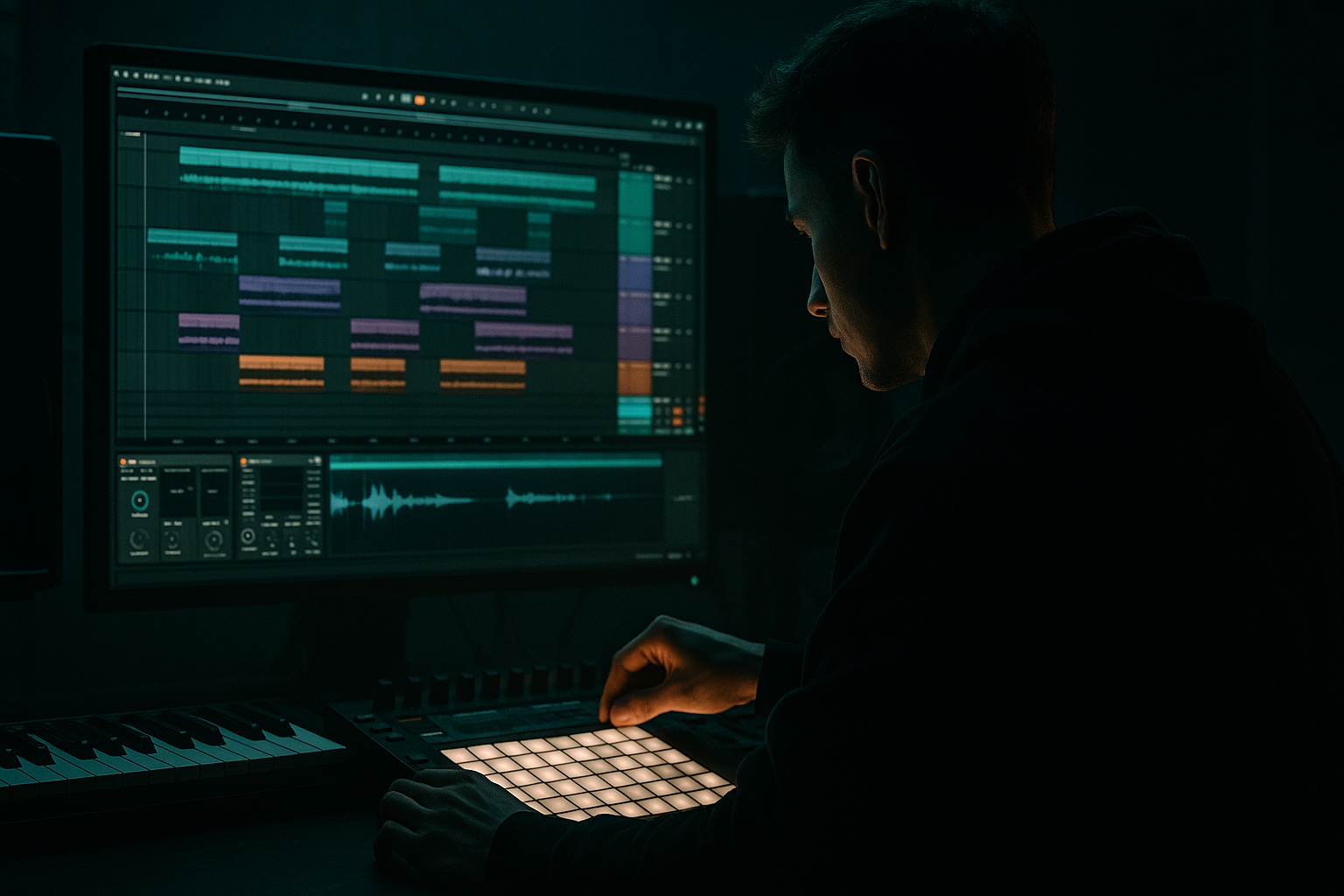
Main tutorial
Foley Percussion Inside Jungle Grooves (Ableton Live) 🥁🔩🌧️
1. Lesson overview
Foley percussion is the “real-world” layer that makes jungle and drum & bass grooves feel alive: clicks, cloth hits, keys, lighters, coin drops, can taps, vinyl crackle, chair squeaks—anything with texture. In this lesson you’ll learn how to record/find, shape, and place foley so it supports classic jungle breaks (Amen-style energy) without cluttering your mix.
You’ll do this with stock Ableton devices and a simple workflow you can repeat in every track.
---
2. What you will build
A 16-bar rolling jungle drum loop at 170–174 BPM with:
- A breakbeat foundation (e.g., an Amen-ish loop)
- Tight DnB kick/snare reinforcement
- Two foley layers:
- A clean routing setup (Drum Buss + groups + sends)
- A simple arrangement idea (energy ramp across 16 bars)
- Your phone mic (seriously works for ticks)
- Sample packs
- Random household stuff
- Keys / coins / pen clicks (tight transients)
- Cardboard / paper / cloth (soft shuffles)
- Bottle taps / metal hits (bright, crisp accents)
- Door latch / lighter (nice mid transients)
- Put soft ticks on:
- Add one brighter tick slightly before snare moments:
- Hybrid Reverb
- EQ Eight
- Echo
- Utility (optional): Width 120%
- Bars 1–4: Break + basic foley ticks (minimal)
- Bars 5–8: Add texture layer quietly + extra tick variation
- Bars 9–12: Add an “accent foley” (one metal hit every 2 bars)
- Bars 13–16: Pull texture down, add a mini fill (remove ticks last 1/2 bar)
- Use Auto Filter automation on texture (open up into bar 9)
- Add a reverse foley into a snare hit (classic energy lift)
- Use foley ticks for micro-groove and “hands-on” energy.
- Use foley texture for movement, mood, and continuity across bars.
- Keep foley filtered, grooved, and sidechained so jungle breaks stay punchy.
- Ableton stock essentials here: Drum Rack/Simpler, EQ Eight, Drum Buss, Hybrid Reverb, Echo, Compressor (sidechain), Auto Pan, Auto Filter, Saturator/Roar.
1. “Tick layer” (tiny transient foley = groove glue)
2. “Texture layer” (longer foley tails = vibe + movement)
---
3. Step-by-step walkthrough
Step 0 — Session setup (30 seconds)
1. Set tempo to 172 BPM.
2. Set loop brace to 16 bars.
3. Create 3 MIDI tracks and 2 audio tracks:
- DRUMS (Group) – will contain break + one-shots
- FOLEY TICKS (MIDI) – short percs (Drum Rack)
- FOLEY TEXTURE (Audio) – longer clips/ambience
- RETURN A – Short Verb
- RETURN B – Delay
---
Step 1 — Build a jungle drum backbone 🧱
You’ve got two quick options:
#### Option A: Use a break loop (fast + authentic)
1. Drop a breakbeat audio loop onto an Audio track inside DRUMS group.
2. Enable Warp.
3. Warp Mode:
- Beats
- Preserve: 1/16
- Transients: 100 (start here)
4. Add Drum Buss on the break track:
- Drive: 5–10%
- Crunch: 0–10% (subtle)
- Boom: 0–20%, Freq: 50–70 Hz (careful—jungle is snare-led)
#### Option B: MIDI break-style programming (more controlled)
1. Make a Drum Rack with kick/snare/hat.
2. Program a classic fast break pattern, then add ghost notes.
3. Swing later with Groove Pool (we’ll do that in Step 4).
> Goal: get a solid “break speaks on its own” groove before foley.
---
Step 2 — Source your foley (fast + practical) 🎙️
You can use:
Great starter foley sources:
#### Quick recording in Ableton (beginner-friendly)
1. Create an Audio track named `FOLEY REC`.
2. Arm it, set input, record 30–60 seconds of random hits.
3. Consolidate (Cmd/Ctrl+J) useful chunks.
4. Drag the best hits into FOLEY TICKS Drum Rack (next step).
---
Step 3 — Create the “Foley Ticks” Drum Rack (micro-groove layer) 🪵
1. On FOLEY TICKS (MIDI), load a Drum Rack.
2. Add 6–12 one-shots: tiny clicks, key taps, stick ticks, coin hits.
3. For each pad, do quick cleanup:
- Add Simpler (one-shot mode is fine)
- In Simpler:
- Fade In: 1–3 ms (removes clicks if needed)
- Fade Out: 10–40 ms (tightens tail)
- Filter: HP around 150–400 Hz (depends on sample)
#### Add a control chain on the Drum Rack (classic foley shaping)
On the FOLEY TICKS track, add:
1. EQ Eight
- HP filter: 200–500 Hz (start at 300 Hz)
- If harsh: dip 3–6 kHz by 2–4 dB
2. Drum Buss
- Drive: 3–8%
- Transients: +5 to +20 (brings out ticks)
3. Utility
- Width: 120–160% (only if it doesn’t mess mono—check!)
> Foley ticks should feel like “air + fingers,” not like another snare.
---
Step 4 — Place foley so it locks with jungle swing 🧠
This is where beginners usually miss the magic: foley isn’t random—it’s rhythmic.
#### A simple 1-bar foley tick pattern (great starter)
In a 1-bar MIDI clip (1/16 grid):
- 1.2, 1.2.3, 1.3.2, 1.4
- e.g., 1.2.4 or 1.4.4 (depending on your break)
Then duplicate across 16 bars, and vary every 4 bars (remove/add 1–2 notes).
#### Groove Pool: make it swing like a break 🌀
1. Open Groove Pool.
2. Drag in a groove like MPC 16 Swing or any shuffle groove.
3. Apply groove to:
- FOLEY TICKS clip
- (Optionally) hats and ghost snares
4. Groove settings:
- Timing: 40–70
- Random: 5–15
- Velocity: 5–25
> Pro beginner move: use the same groove on break + foley ticks so they “breathe” together.
---
Step 5 — Build the “Foley Texture” layer (movement + mood) 🌧️
This layer is longer: shuffles, cloth, room tone, vinyl, rain-ish noise.
1. On FOLEY TEXTURE (Audio), drop a longer foley recording.
2. Warp:
- Mode: Complex (or Complex Pro)
- Formants: 0 (start)
3. Add this device chain:
1. EQ Eight
- HP: 250–600 Hz
- Gentle shelf down above 10 kHz if hissy
2. Auto Filter
- Mode: LP 12
- Freq: 6–12 kHz
- Envelope: tiny (optional)
3. Auto Pan
- Amount: 20–40%
- Rate: 1/2 or 1 bar (sync)
- Phase: 180 (wide movement)
4. Saturator
- Drive: 1–4 dB
- Soft Clip: On
#### Make it pump with the drums (clean jungle vibe)
Use sidechain compression:
1. Add Compressor after Saturator
2. Enable Sidechain
3. Input: your DRUMS group (or kick/snare bus)
4. Settings:
- Ratio: 2:1 to 4:1
- Attack: 5–15 ms
- Release: 80–160 ms
- Reduce: aim 2–5 dB on hits
> Texture should “duck” out of the way when the break smacks.
---
Step 6 — Returns (space without washing the groove) 🧼
Create two return tracks:
#### Return A — Short Jungle Room Verb 🏚️
- Algorithmic > Room/Chamber
- Decay: 0.4–0.9 s
- Pre-delay: 10–25 ms
- High Cut: 6–9 kHz
- HP: 300–600 Hz
Send FOLEY TICKS lightly (like -18 to -12 dB send).
Send FOLEY TEXTURE a bit more if needed.
#### Return B — Slap Delay (character) ⏱️
- Time: 1/8 or 1/16
- Feedback: 10–25%
- Filter: HP 300 Hz, LP 6–8 kHz
- Mod: tiny (subtle)
Use sparingly—DnB grooves get messy fast.
---
Step 7 — Arrangement idea: 16 bars that evolve 🚦
A simple jungle-friendly structure:
Quick transitions:
---
4. Common mistakes ❌
1. Too much low-mid foley (200–600 Hz)
Makes breaks sound boxy. High-pass more aggressively.
2. Foley fighting the snare
If your tick lands on the snare transient, it can dull impact. Nudge it earlier/later.
3. Over-widening
Wide foley is nice, but check mono. Keep the main break strong in mono.
4. Randomness without rhythm
Jungle is chaotic but intentional. Lock to swing/groove.
5. Too much reverb
In fast DnB, long reverb smears transients. Keep it short and filtered.
---
5. Pro tips for darker/heavier DnB 🖤
1. Resample foley through distortion, then re-filter
- Put Roar (or Saturator/Overdrive) on foley, resample to audio, then HP + LP it.
- Result: gritty “found percussion” that feels neuro-ish but still jungle-friendly.
2. Pitch foley down for menace
- In Simpler: transpose -3 to -12 semitones
- Then HP it—counterintuitive but works (you keep the weighty transient character).
3. Gate the texture for that tight, industrial pulse
- Use Gate keyed by drums for rhythmic chopping.
4. Use Corpus for metallic resonances
- On a short tick: Corpus
- Type: Tube/Plate
- Tune to taste (try 150–400 Hz, then HP after)
5. Parallel crunch on a foley bus
- Duplicate foley track, distort hard, filter to band-pass (e.g., 1–5 kHz), blend quietly.
---
6. Mini practice exercise (15 minutes) ⏲️
1. Build a 1-bar break loop at 172 BPM.
2. Add 3 foley tick samples (keys, coin, cloth).
3. Program a 1-bar tick pattern with at least:
- 4 soft hits
- 1 bright accent
4. Apply a groove (Timing 60, Random 10).
5. Add FOLEY TEXTURE (one longer recording), then:
- HP at 400 Hz
- Sidechain compress 3 dB
6. Export a quick loop and A/B:
- With foley vs without
- Ask: does it feel more “human” without getting cluttered?
---
7. Recap ✅
If you tell me what kind of jungle you’re aiming for (classic 90s, modern rollers, halftime switchups), I can suggest a specific foley palette + a 2-bar pattern that matches it.

