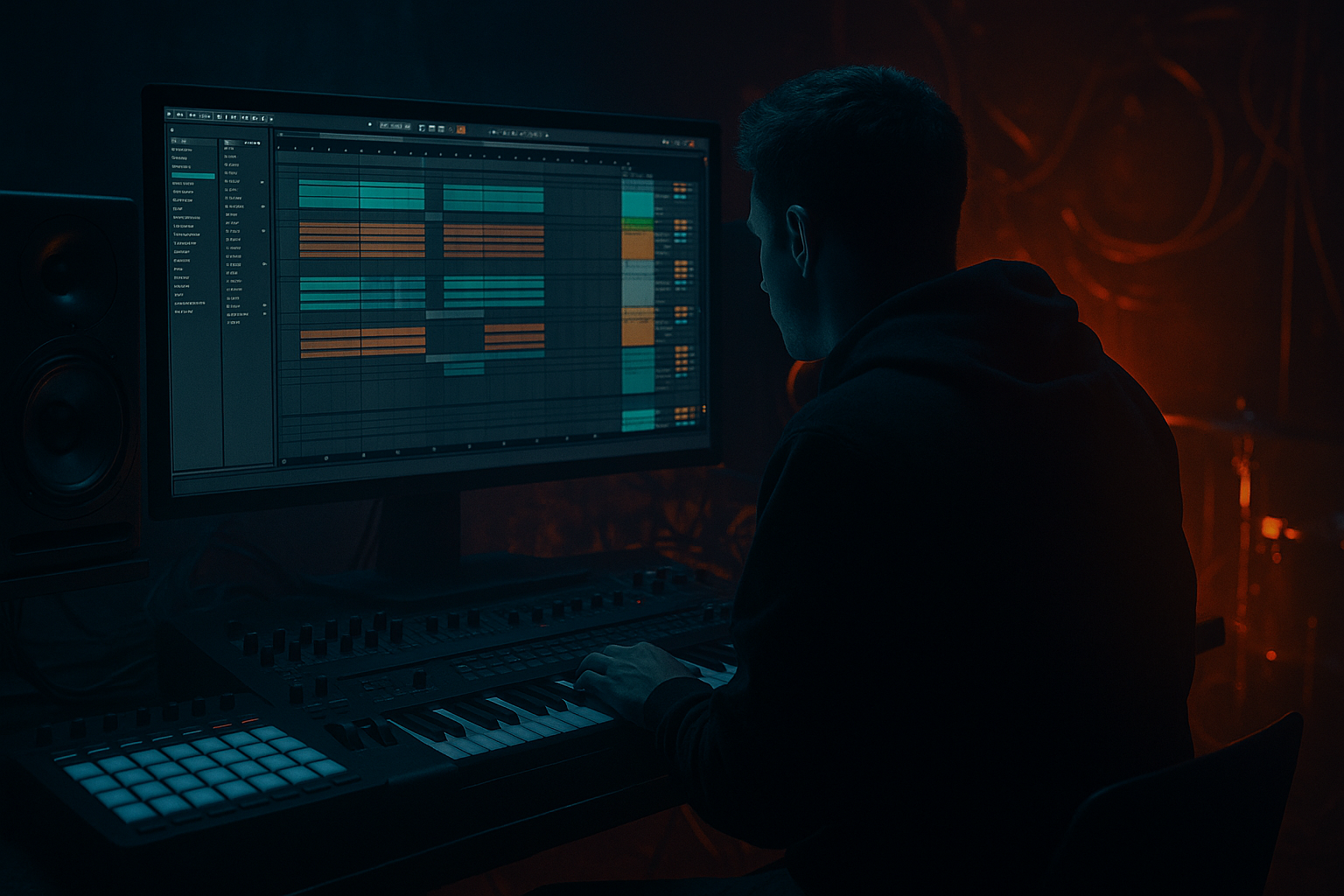
Main tutorial
```markdown
Formant Automation on Vocal Snippets (DnB in Ableton Live) 🎛️🗣️
1. Lesson overview
Formant automation is one of the fastest ways to turn a basic vocal chop into a signature DnB hook: creepy textures, call-and-response riffs, or that “talking synth” energy—without changing the musical pitch. In this lesson you’ll build a tight workflow in Ableton Live using mostly stock devices (plus Live’s built-in audio warping) to create formant movement that sits perfectly over rolling drums and bass.
We’ll focus on short vocal snippets (1–4 words or a single syllable), then automate formant for groove, tension, and transitions. ⚡
---
2. What you will build
By the end, you’ll have:
- A vocal chop rack with:
- A 16-bar DnB arrangement concept where formant automation creates:
- Clip Transpose automation moves: -3, -5, -7 semitones for darker throatiness
- Or +2, +5 semitones for chipmunk/spy voice (use sparingly in DnB)
- Drop bar 1–4: mostly neutral (0 to -2)
- Bar 5–8: deeper dips (-5 to -7) on the last chop of each 2-bar phrase
- Bar 9–16: ramp automation into fills
- Filter type: Band-Pass 12 or Band-Pass 24
- Frequency: 400 Hz – 2.5 kHz (this is where “vowel” lives)
- Resonance: 0.70 – 1.20
- Drive: 2–6 dB (if available in your filter model)
- “Ah”: ~700–1k
- “Oh”: ~400–700
- “Ee”: ~1.8k–2.5k
- Mode: Analog Clip
- Drive: 3–8 dB
- Soft Clip: ON
- High-pass at 100–160 Hz (keep room for sub + kick)
- Optional dip at 2.5–4 kHz if it gets harsh when resonance sweeps
- Bar 1: formant “neutral” (Macro around 40–50%)
- Bar 2: push it darker (Macro 20–30%) on the last 2 hits
- Bar 1: steady
- Bar 2: slight rise on the offbeats
- Bar 3: deeper dips for tension
- Bar 4: ramp up into a fill (then hard reset on the drop repeat)
- Slam resonance slightly up
- Sweep band-pass down quickly
- Add a short reverb bloom (automate Reverb Dry/Wet from 8% → 18% just for the fill)
- Mild Auto Filter movement
- Light saturation
- Redux:
- Overdrive:
- Auto Filter (LP24):
- Optional: Grain Delay (very low mix):
- Bars 1–4: Hook introduced (minimal automation, establish identity)
- Bars 5–8: Increase formant movement on every 2nd phrase (variation)
- Bars 9–12: Add parallel dark layer + slightly higher resonance (intensity)
- Bars 13–16: Big automation ramp into a fill/switch, then reset
- Over-automating every hit: it stops feeling like a hook and starts sounding like a plugin demo.
- Too much resonance without EQ control: you’ll get piercing peaks around 2–4 kHz that fight snares and cymbals.
- Leaving lows in the vocal: anything below ~120 Hz is usually just mud in DnB.
- No timing intention: formant sweeps that ignore phrasing will feel “off,” even if they sound cool solo.
- Not gain-staging: saturation + resonance can jump in volume—use Utility or Compressor to control it.
- Automate into the snare gaps: put the biggest formant moves between snare hits so the snare stays dominant.
- Make it “answer” the bass: if your bass has a call phrase, automate the vocal formant to respond on the next 1/2 bar.
- Use subtle pitch dips + formant dips together: a quick -1 or -2 semitone dip plus a darker sweep sells “menacing” instantly.
- Sidechain the vocal to the kick + snare:
- Print & resample: once you’ve got a great automation pass, Freeze → Flatten or resample to audio, then re-chop for even tighter jungle-style edits.
- Use Warp modes (especially Complex Pro) to preserve vocal identity and enable controlled transformations.
- For musical “formant-like” movement that reads in a mix, Auto Filter band-pass + resonance + saturation is a killer stock combo.
- Map controls to Macros, automate with intention (2/4/8-bar phrasing), and build variation like you would with bass design.
- For heavier DnB, add a parallel dark chain (Redux/Overdrive/LP filter) and keep it tucked under the clean layer.
- Warp mode choices for clean vs gnarly results
- A formant control macro you can automate
- A parallel “dark” layer for heavier DnB
- A hook in the drop
- Variation every 4 bars
- Tension ramps into fills and switches
---
3. Step-by-step walkthrough
Step 0 — Prep: choose the right vocal source
Goal: clean, short, and expressive.
1. Pick a vocal line with clear vowel tone: “ah”, “oh”, “yeah”, “come”, “run”, etc.
2. Keep it short: 100–600 ms works great for DnB chops.
3. If it’s a full phrase, chop it down later—don’t try to automate formants on a messy, reverby long take (yet).
DnB vibe tip: One dry vocal chop often hits harder than a lush vocal in the drop—space is for drums + bass.
---
Step 1 — Warp the vocal correctly (this is where “formant” really lives in Live)
Ableton doesn’t have a universal “Formant” knob on every device, but Warp modes give you formant-ish behavior that you can automate via clip settings and transposition workflows.
#### Option A (clean + controllable): Complex Pro
1. Double-click the vocal clip.
2. Turn Warp on.
3. Set Warp Mode: Complex Pro.
4. Start settings:
- Formants: ON
- Envelope: 80–130 (lower = more robotic/phasey, higher = smoother)
Why: Complex Pro preserves vocal character better and is reliable for automation-style sound design.
#### Option B (gnarly jungle texture): Texture mode
1. Warp Mode: Texture
2. Try:
- Grain Size: 20–60
- Flux: 10–30
3. This can smear into a wicked “ghost” vocal when automated and filtered.
---
Step 2 — Make it playable (Slice to a Drum Rack)
This is the classic DnB workflow: chop → trigger rhythmic patterns → automate for movement.
1. Right-click the warped audio clip → Slice to New MIDI Track.
2. Choose:
- Slice by: Transients (good starting point)
- Or Slice by: 1/8 or 1/16 for more “machine-gun” chops
3. This creates a Drum Rack where each slice is on a Simpler.
Workflow suggestion: Rename the rack “Vox Chop Rack” and color it so you can find it fast in a big session.
---
Step 3 — Put each slice into a formant-friendly Simpler mode
1. Open one Simpler in the Drum Rack.
2. In Simpler, switch to Classic mode (or keep One-Shot if you prefer, but Classic gives better control).
3. Set:
- Trigger (for consistent playback on MIDI notes)
- Voices: 1 (prevents overlap mud)
- Filter: ON (we’ll automate this later optionally)
4. Copy settings to other slices:
- In Drum Rack, right-click the Simpler pad → Copy
- Multi-select other pads → Paste
---
Step 4 — Create the “Formant” movement (two practical methods)
#### Method 1: Formant-style motion using warp transposition + pitch compensation
This is a very “Ableton” way to get vocal character shifts while keeping musical pitch stable enough for DnB.
Concept: Automate clip transposition (changes timbre/formant feel) while compensating with pitch at the instrument stage.
How:
1. In the original audio clip (before slicing), duplicate it into two tracks:
- Track A: “Vox Formant”
- Track B: “Vox Reference” (optional)
2. On Track A, automate Clip Transpose (in Clip View).
3. Then, after slicing, tune the Simpler slices back using Transpose inside Simpler so the hook stays in key.
Settings to try:
Arrangement use:
This method is “feel-based,” but it’s very effective in a mix.
---
#### Method 2: “Talking” formants via Auto Filter + resonant movement (stock + extremely DnB-friendly)
Not true formants scientifically, but musically it reads as vowel movement—perfect for rolling bass music.
Device Chain (per vocal rack track):
1. Auto Filter
2. Saturator
3. EQ Eight
4. Reverb (short, dark)
5. (Optional) Compressor (sidechain from drums)
Auto Filter settings (start here):
Automation target:
Automate Frequency to sweep through “ah → oh → ee” impressions:
Add bite: Saturator
This helps the resonant peaks speak in a dense DnB mix.
Clean-up: EQ Eight
---
Step 5 — Map it to Macros for fast automation (essential for arrangement)
If you’re using a Drum Rack, you can macro-control the whole vocal bus.
1. Put your FX chain on the Drum Rack return chain or on the track hosting the rack.
2. Group the effects: select devices → Cmd/Ctrl + G (Audio Effect Rack).
3. Map key controls:
- Macro 1: “Formant Sweep” → Auto Filter Frequency
- Macro 2: “Nasal/Res” → Auto Filter Resonance
- Macro 3: “Grit” → Saturator Drive
- Macro 4: “Air Cut” → EQ Eight high shelf gain (or a low-pass cutoff)
Now you can write one automation lane per macro and get consistent, musical motion. ✅
---
Step 6 — Write DnB automation that grooves (not random wiggles)
Rule: Automate to the grid and phrasing, not constantly.
Try these patterns:
#### Pattern A: Call & response (2 bars)
MIDI idea: vocal hits on 1.2, 1.4, 2.2, 2.3.3 (syncopated, rolling)
#### Pattern B: 4-bar evolution
#### Pattern C: “Switch cue” automation (classic DnB trick)
In the final half bar before a drop switch:
---
Step 7 — Add a parallel dark layer (for heavy rollers) 😈
Duplicate the vocal track (or create an Audio Effect Rack with parallel chains).
Chain 1: Clean
Chain 2: Dark
- Downsample: 2–6
- Bit Reduction: 0–2 (subtle)
- Freq: 700–1.2k
- Drive: 20–45%
- Cutoff: 2–6 kHz
- Resonance: 0.3–0.7
- Dry/Wet: 3–8%
- Freq: 1–2 kHz
- Random Pitch: 0.10–0.25
This adds that haunted, metallic edge without washing out the groove.
Blend dark chain at -10 to -18 dB under the clean chain.
---
Step 8 — Place it in a 16-bar DnB drop arrangement
A practical template:
Key DnB principle: automation should support the drum energy—let the snare hits and bass phrases breathe.
---
4. Common mistakes
---
5. Pro tips for darker/heavier DnB
Ableton Compressor sidechain, 2–4 dB GR, fast-ish attack, medium release—keeps vocals tucked into the roll.
---
6. Mini practice exercise (15 minutes) 🧪
1. Find a 1-word vocal (“yeah” works great).
2. Warp it in Complex Pro (Formants ON, Envelope 100).
3. Slice to Drum Rack (Transients).
4. Add FX chain on the track:
- Auto Filter (BP24, Res 0.9)
- Saturator (Analog Clip, Drive 6 dB, Soft Clip ON)
- EQ Eight (HP at 140 Hz)
5. Map Auto Filter Frequency to a macro called Formant.
6. Program a 2-bar MIDI loop at 174 BPM with 6–10 vocal hits.
7. Automate Formant:
- Bar 1: 900 Hz → 1.4 kHz (gentle rise)
- Bar 2: dip to 500–700 Hz on the last two hits
8. Bounce/resample the loop and chop the best 2 hits into a fill.
Deliverable: a 2-bar vocal hook that evolves without getting messy.
---
7. Recap
If you want, tell me your subgenre (rollers, neuro, jungle, dancefloor) and the type of vocal (male/female/rap/acapella), and I’ll suggest a specific macro range + 16-bar automation plan that matches that vibe.
```

