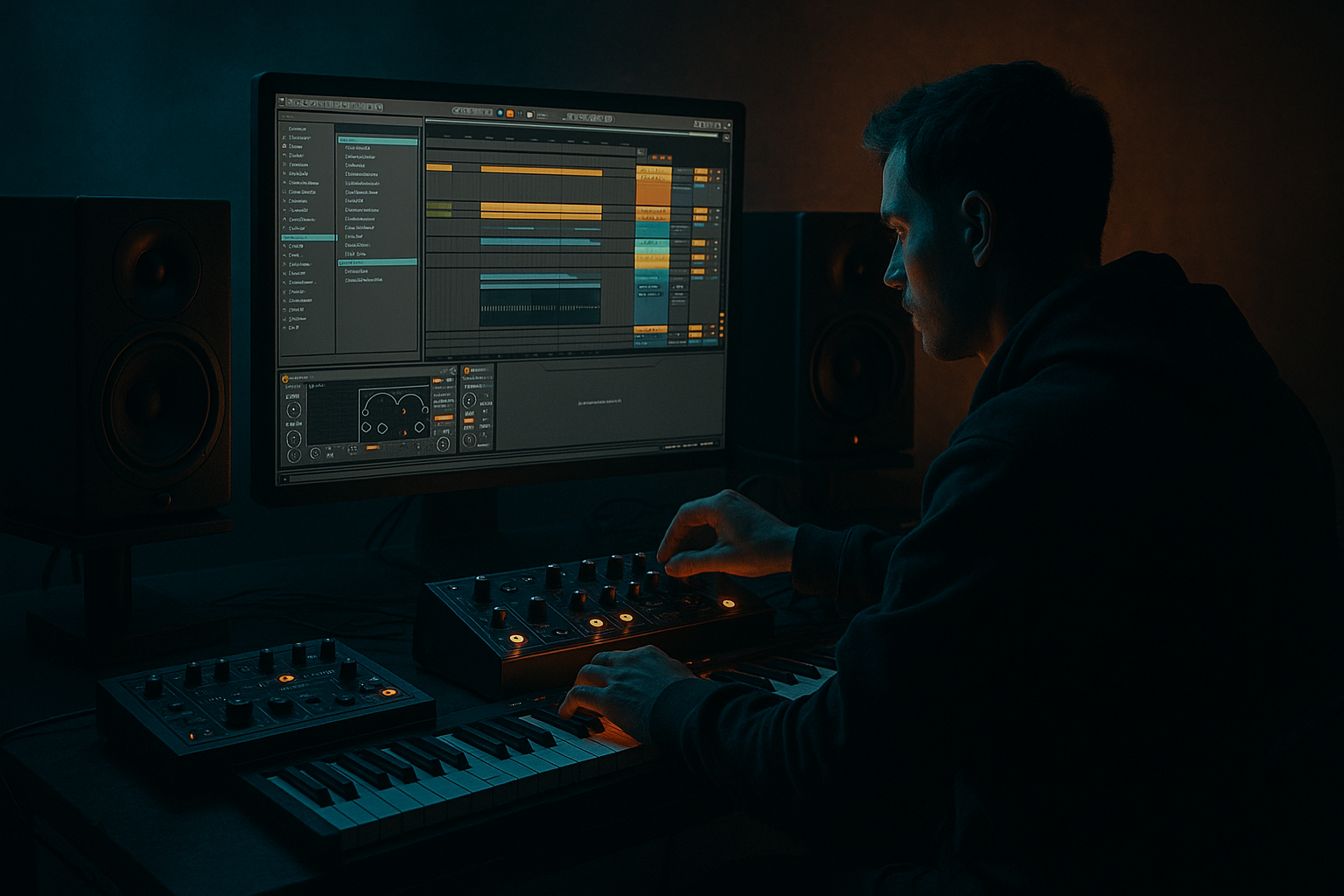
Main tutorial
Formula for a Dub Siren with Crunchy Sampler Texture in Ableton Live 12
Beginner tutorial for jungle / oldskool DnB vibes 🔥
---
1. Lesson overview
A dub siren is one of the classic sounds of jungle and oldskool drum and bass: sharp, warbly, urgent, and full of attitude. When you combine it with a crunchy sampler texture, you get that gritty, worn, tape-like feel that sits perfectly over breakbeats, reggae-style basslines, and ravey atmospheres.
In this lesson, you’ll build a simple but very usable dub siren patch in Ableton Live 12 and give it a sampled, dirty texture using stock devices. The goal is not a clean EDM lead — it’s a raw, characterful, oldskool DnB weapon.
You will learn how to:
- design a siren using stock Ableton synth devices
- add movement with LFO-style modulation
- degrade it with sampler-style crunch
- process it for jungle / DnB grit
- arrange it in a way that works in a breakbeat track
- a dub siren synth made with Operator or Wavetable
- a Sampler/Simpler texture layer for crunchy character
- a device chain for dirt, width, and space
- a short 8-bar performance loop you can drop into a jungle arrangement
- old tape echo
- rave alarm / siren tone
- chopped sample grime
- lo-fi crunch
- heavy delay tails over rolling breaks
- Oscillator A: Sine
- Filter: On, low-pass
- Attack: 0 ms
- Decay: short to medium
- Sustain: low
- Release: short
- G3
- A3
- C4
- more pitch depth
- faster decay
- slightly shorter notes
- draw MIDI notes moving upward
- automate Transpose
- or automate Macro/Expression if using an Instrument Rack
- Auto Filter
- Shaper or LFO if available in your pack/version setup
- or simple MIDI automation in clips
- map it to Pitch
- set a slow rate around 4–7 Hz
- keep depth small
- bounced to tape
- re-sampled from vinyl
- passed through a cheap sampler
- damaged just enough to sound exciting
- Mode: Classic or One-Shot
- Turn on Warp if needed
- Lower Filter slightly to dull the top end
- Reduce Start a tiny bit to give a chopped sampler start
- Volume: lower it a little
- Transpose: maybe -12 for a darker version
- Filter: low-pass at 8–12 kHz
- Glide/Portamento: light glide if you want that slippery oldskool feel
- Drive: 3–8 dB
- Soft Clip: ON
- Output: trim to avoid clipping
- Bit Depth: 8–12 bits
- Downsample: subtle to moderate
- Dry/Wet: 10–35%
- Low-pass cutoff: 2–6 kHz
- Resonance: 20–40%
- Add a tiny envelope if the filter should open on the attack
- pull cutoff down more
- automate it slowly over 8 bars
- Delay Time: 1/4 or 3/8
- Feedback: 30–60%
- Filter: roll off highs in the repeats
- Warp: use subtly for tape-style movement
- Dry/Wet: 15–35%
- Decay: 1.5–4 seconds
- Pre-delay: 10–25 ms
- Low Cut: enough to keep low end clean
- Dry/Wet: 5–20%
- mono the low end if necessary
- reduce width if the siren is too wide
- trim gain
- old reggae vocal stab
- record crackle
- AM radio noise
- broken horn hit
- jungle FX hit
- short human voice fragment
- it should add grain and attitude
- not become the main sound unless you want it to
- main siren track at full level
- sampler layer around -12 to -18 dB quieter
- High-pass around 120–200 Hz
- Cut harshness around 2.5–5 kHz if needed
- Slight boost around 700 Hz–1.5 kHz if the siren needs presence
- reduce the top end a bit
- let the delay provide the brightness instead of the dry sound
- Bar 1: G3, rest, G3, A3
- Bar 2: C4, rest, A3, G3
- use short notes for stabs
- use longer held notes for alarm-style sweeps
- automate filter cutoff and delay feedback for transitions
- before the drop
- in the 2nd half of a 16-bar phrase
- at the end of a breakdown
- as a response to a vocal or bass call
- more reverb
- more delay feedback
- slightly wider stereo image
- filter opening gradually
- reduce reverb
- shorten delay
- tighten the filter
- keep the siren punchy and rhythmic
- automate Echo feedback up for 1–2 bars
- automate filter cutoff open
- add a quick reverse reverb-style swell
- cut the siren suddenly before the drop hits
- D2–A3
- light gain reduction
- just enough to let drums breathe
- vinyl crackle
- rain ambience
- distant jungle FX
- filtered amen loop beds
- delay time
- feedback
- filter on repeats
- Version A: cleaner, more dubby
- Version B: dirtier, more chopped and distorted
- start with a simple synth siren
- add pitch movement and filter motion
- resample it for oldskool character
- crush it lightly with Saturator and Redux
- shape it with EQ, delay, and reverb
- arrange it as a call-and-response DnB element
- simple
- gritty
- rhythmically aware
- full of movement
- a device-by-device Ableton chain diagram
- a step-by-step rack using Instrument Rack macros
- or a full jungle intro arrangement using this siren sound
---
2. What you will build
By the end, you’ll have:
Sound target
Think:
---
3. Step-by-step walkthrough
A. Create the base dub siren
Option 1: Use Operator for a clean but flexible siren
1. Create a MIDI track.
2. Drop in Operator.
3. Set the oscillator to a sine wave or triangle wave.
- Sine = smoother, more classic dub
- Triangle = slightly brighter and more audible in a mix
Basic Operator settings
Play a simple note pattern
Use a single note like:
Dub sirens often work best as simple pitch-based phrases, not full chords.
---
B. Make it “siren-like” with pitch movement
The classic siren effect comes from pitch modulation.
In Operator:
1. Go to Pitch Envelope.
2. Set:
- Amount: around +7 to +12 semitones
- Attack: very short
- Decay: around 200–600 ms
3. This creates that rising/falling alarm feel when you trigger a note.
If you want a more aggressive jungle rave vibe, try:
Alternative: automate pitch manually
You can also:
This works well for short call-and-response siren phrases in your breakdown.
---
C. Add vibrato and wobble
A dub siren feels alive when it has a slight unstable motion.
Easy method with Auto Filter + LFO-style movement
Ableton Live 12 stock devices to use:
#### In Auto Filter:
1. Add Auto Filter after Operator.
2. Choose Low-Pass.
3. Set:
- Cutoff: around 400 Hz to 2 kHz depending on brightness
- Resonance: 15–35%
4. Modulate cutoff slightly with:
- clip automation
- envelope movement
- or an LFO device if you use one
#### Vibrato idea
If you have a modulation device available:
You want movement, not a cartoon wobble.
---
D. Crunch it with sampler texture
This is where the sound becomes more jungle.
You want the siren to feel like it has been:
Method 1: Resample the siren into Simpler
1. Create a new Audio Track.
2. Set its input to Resampling or route from the siren track.
3. Record a few siren notes into audio.
4. Drag the audio into Simpler on a new MIDI track.
Now you have a sampled version you can abuse.
In Simpler:
Crunch settings in Simpler
Try:
---
E. Add dirt and sampler-style degradation
Now make it sound gritty.
Suggested stock device chain
Use this order:
1. Operator or Simpler
2. Saturator
3. Redux
4. Auto Filter
5. Echo
6. Reverb
7. Optional: Utility
---
1) Saturator
Add Saturator for harmonics and bite.
Suggested starting point:
This gives you that slightly blown-out jungle hardware feel.
---
2) Redux
Add Redux if you want sampler crunch.
Suggested settings:
Don’t overdo it unless you want a very broken texture. A little goes a long way.
---
3) Auto Filter
This helps the sound sit like a sampled oldskool FX stab instead of a clean synth.
Suggested starting point:
For darker jungle:
---
4) Echo
A dub siren absolutely loves delay.
Use Echo and set:
For oldskool DnB, the delay should feel like it’s smearing into the break, not fighting it.
---
5) Reverb
Use Reverb lightly.
Suggested:
Keep the reverb controlled. Jungle mixes get muddy fast.
---
6) Utility
Use Utility at the end to:
This helps the siren stay focused in the mix.
---
F. Make a crunchy sampler layer
To get more oldskool texture, layer the siren with a chopped noise or vocal sample.
Great sample types:
How to layer:
1. Put the sample into Simpler.
2. Set mode to One-Shot.
3. Pitch it down slightly.
4. Add:
- EQ Eight
- Saturator
- Redux
- Auto Filter
The trick
Blend the sampler layer quietly under the main siren:
Try:
---
G. Shape it with EQ
Use EQ Eight to keep the siren mix-friendly.
Basic EQ idea
For darker DnB:
---
H. Build a simple jungle phrase
Now make it musical.
Example 2-bar MIDI pattern
Use short notes with rests:
Performance idea
Good placement in a DnB arrangement
Put the siren:
It should feel like a warning signal or rave statement, not constant wallpaper.
---
I. Add arrangement energy
For a full jungle vibe, automate the siren across sections.
Breakdown
Drop
Transition into the drop
Try:
That sudden silence makes the break drop feel harder.
---
4. Common mistakes
1. Too much reverb
This is the fastest way to lose impact. Jungle arrangements are dense, so keep space under control.
2. Too much low end
A siren does not need bass energy. High-pass it and leave space for the sub.
3. Over-crunching
Redux and Saturator are great, but if you destroy the harmonics too much, the sound turns into mush.
4. No rhythm context
A siren soloed might sound cool, but it must work with the breakbeat. Always audition it with drums and bass.
5. Static automation
A jungle siren should evolve. Even tiny changes in cutoff, delay, and level make it feel alive.
---
5. Pro tips for darker/heavier DnB
Tip 1: Pitch the siren lower
Try starting notes around:
Lower sirens feel more menacing and work well in dark rollers.
Tip 2: Use distortion in parallel
Instead of fully crushing the main sound:
1. duplicate the track
2. distort the copy heavily
3. blend it quietly underneath
This keeps the original clarity while adding weight.
Tip 3: Sidechain the siren slightly
Use Compressor with sidechain from the kick or break bus if needed.
Tip 4: Combine with vinyl noise or atmospheres
A siren sounds bigger when surrounded by:
Tip 5: Use the delay like an instrument
Automate:
That’s a classic dub technique and it works beautifully in DnB breakdowns.
---
6. Mini practice exercise
Exercise: Build a 4-bar dub siren phrase
Do this in Ableton Live:
1. Make a siren with Operator
2. Resample it into Simpler
3. Add:
- Saturator
- Redux
- Auto Filter
- Echo
4. Write a 4-bar MIDI phrase using only 3 notes:
- G3
- A3
- C4
5. Automate:
- filter cutoff
- echo feedback
- dry/wet amount
Goal
Make it feel like a jungle warning call that rises into a drop.
Challenge
Create two versions:
Compare which one hits harder over your breakbeat loop.
---
7. Recap
You now have the basic formula for a dub siren with crunchy sampler texture in Ableton Live 12:
The key mindset
In jungle and oldskool DnB, the best FX are usually:
If you keep the siren short, dirty, and well-placed, it will immediately sound like it belongs in a proper breakbeat session. 🔥
If you want, I can also turn this into:

