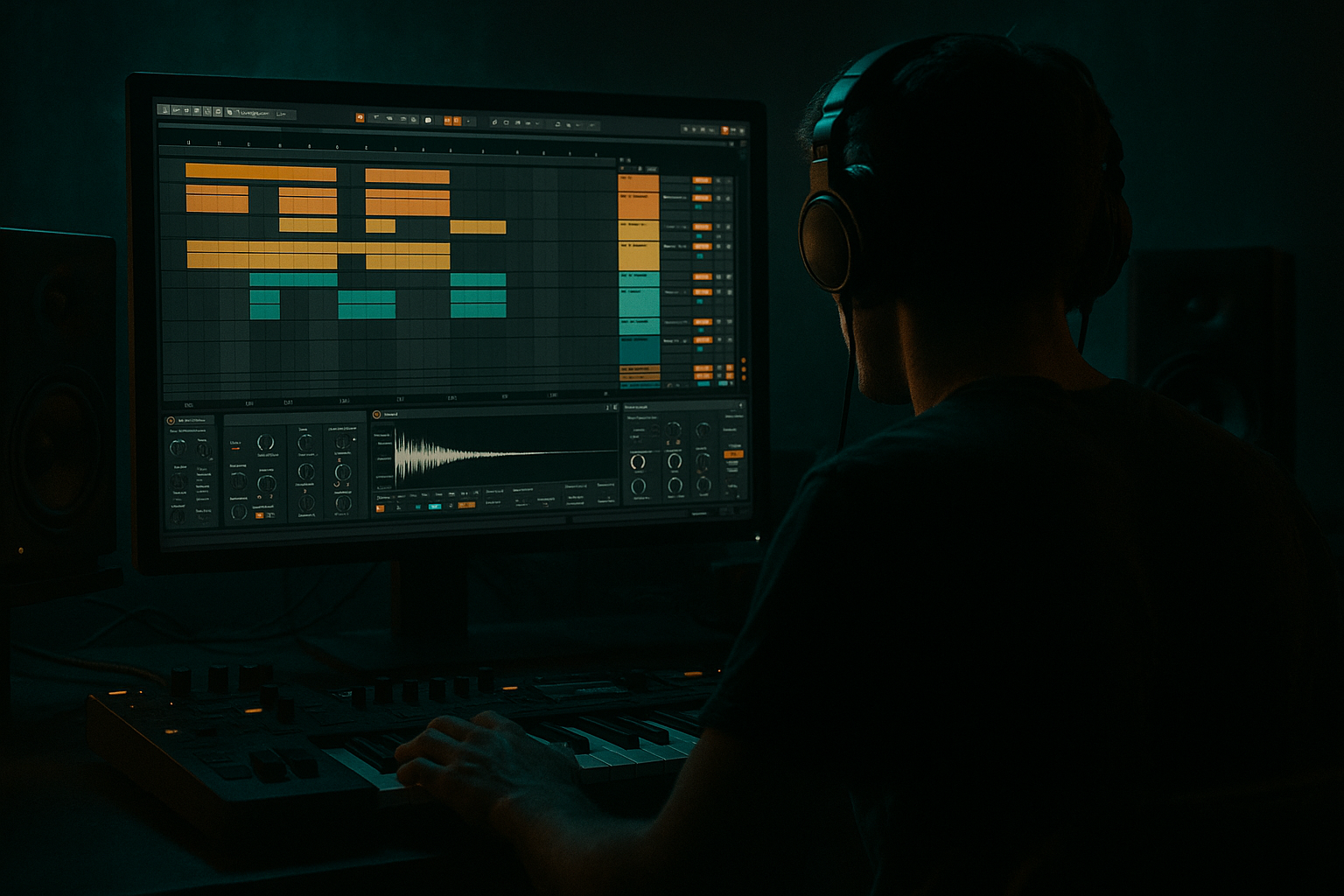
Main tutorial
```markdown
Formula for a Jungle/Oldskool DnB Mid Bass (Stock Devices Only) — Ableton Live 12
Skill level: Beginner | Category: Vocals (we’ll also show how to “vocal-sidechain” your bass for space and clarity 🎤)
---
1. Lesson overview
In jungle/oldskool DnB, the mid bass is the “speaker glue” between the sub and the breaks. It’s not just a synth patch—it’s a repeatable formula:
Simple wave → distortion/saturation → filtering → movement → mono + mix control.
In this lesson you’ll build a classic rolling mid bass using only Ableton Live 12 stock devices, then learn how to make room for vocals/MC shouts using ducking and EQ moves that keep the groove intact. ⚡
---
2. What you will build
You’ll create a two-layer bass system (very DnB-standard):
- SUB track: clean sine/triangle (weight, stable mono)
- MID track: distorted/reese-ish mid bass (character + audible bass on small speakers)
- A device chain you can save as a preset
- A MIDI pattern that rolls like jungle
- Sidechain/ducking that also reacts to vocals 🎤
- Algorithm: A only
- Oscillator A: Sine (or Triangle if you want a touch more harmonics)
- Envelope:
- Add Auto Filter
- Add Utility
- Osc 1: Basic Shapes
- Osc 2: On
- Unison: 2 voices
- Attack: 0–5 ms
- Decay: 250–400 ms
- Sustain: 0 to -6 dB
- Release: 80–150 ms
- Mode: Analog Clip
- Drive: +6 to +12 dB
- Output: compensate so level stays controlled
- Soft Clip: On
- Mode: Overdrive
- Drive: 20–40%
- Tone: 40–55% (don’t go too bright yet)
- Level: adjust
- Type: Lowpass 24
- Cutoff: 200–800 Hz (set by ear)
- Resonance: 0.90–1.20 (for a bit of bite)
- Envelope Amount: 10–25%
- Envelope Decay: 200–400 ms
- Add LFO
- High-pass: 80–120 Hz, 24 dB/oct
- Width: 0–30% (mostly mono)
- (Optional) Bass Mono: If available in your Utility version, mono everything below ~120 Hz.
- Start with notes around F1–A1 (or whatever fits your key)
- Use a pattern like:
- Sidechain: On
- Audio From: your Kick (or a drum bus)
- Ratio: 4:1
- Attack: 1–5 ms
- Release: 60–120 ms
- Threshold: aim for 2–5 dB reduction
- Sidechain: On
- Audio From: your Vocal track (MC, phrase, shout, etc.)
- Ratio: 2:1
- Attack: 5–15 ms (let consonants through naturally)
- Release: 80–180 ms
- Threshold: only 1–3 dB reduction
- Intro (8–16 bars): breaks filtered + FX, tease bass with high-pass
- Drop (16–32 bars): full bass + breaks
- Switch-up (8 bars): change bass rhythm or filter movement
- Second drop: bring a variation (different cutoff/LFO rate)
- Drop 1: cutoff around 350–600 Hz
- Switch: cutoff down to 200–350 Hz (darker)
- Drop 2: bump to 500–900 Hz (more bite)
- MID layer has too much low end → you’ll get flab and no headroom. High-pass the MID at 80–120 Hz.
- Bass too wide → jungle low end must be stable. Keep bass mostly mono; widen only higher harmonics.
- Too much distortion too early → makes the bass fizzy and steals space from hats/vocals. Distort, then filter/EQ.
- No envelope shaping → bass notes click or blur. Use short releases and consistent note lengths.
- Sidechain too extreme → you’ll hear pumping instead of groove. Aim subtle: 2–5 dB for drums, 1–3 dB for vocals.
- Use Roar (stock in Live 12) instead of (or after) Saturator for heavier, controlled aggression:
- Split-band distortion (still stock):
- Add “air movement” with subtle chorus only above mids:
- Short room reverb on the MID only (super subtle) for oldskool vibe:
You’ll end with:
---
3. Step-by-step walkthrough
Step 0 — Session setup (fast + practical)
1. Set tempo to 165–172 BPM (classic jungle: ~165–170).
2. Drop in a simple break loop or Drum Rack beat (even a placeholder).
3. Create two MIDI tracks:
- `BASS - SUB`
- `BASS - MID`
Group them into an Audio Effect Rack later for easy control.
---
Step 1 — Build the SUB (clean, consistent)
On `BASS - SUB` add Instrument: Operator.
Operator settings (simple but effective):
- Attack: 0 ms
- Decay: ~300 ms
- Sustain: -inf (or very low if you want held notes)
- Release: 50–120 ms (avoid clicks, keep it tight)
Add a filter (optional but useful):
- Type: Lowpass
- Cutoff: ~120 Hz
- Resonance: 0.70 (low)
This keeps the sub “subby” and avoids accidental mid buildup.
Utility (important):
- Width: 0% (mono)
- Gain: adjust so your sub is strong but not clipping
✅ Sub rule: clean + mono + stable.
---
Step 2 — Build the MID (the actual “mid bass formula”)
On `BASS - MID`, add Instrument: Wavetable (stock, perfect for modern control but still oldskool if you keep it simple).
#### 2A) Wavetable oscillator setup (start basic)
- Position: between Saw ↔ Square (start around 70% toward Saw)
- Also Basic Shapes
- Tune: +7 semitones (or +12 for a more “hollow” layer)
- Detune: 10–20 cents (small!)
- Amount: 20–35%
- Keep it subtle—oldskool mids aren’t huge trance supersaws.
Amp envelope:
#### 2B) Distortion/Saturation (this is where jungle attitude comes from)
Add Saturator after Wavetable.
Saturator settings (starter):
Then add Pedal (yes, stock, and great for bass grit):
✅ You’re creating harmonics so the bass speaks on small speakers.
#### 2C) Filter + “talking movement” (classic rolling character)
Add Auto Filter next:
Now add LFO (Live 12 modulation device) to move the filter cutoff:
- Shape: Sine (smooth roll) or Random (more oldskool wobble)
- Rate: 1/8 or 1/16 (sync)
- Amount: small at first (map to Auto Filter Cutoff)
Map LFO to the Auto Filter cutoff and keep movement subtle—jungle basses often “breathe” more than they wobble.
#### 2D) Control the low end in the MID layer
Add EQ Eight:
This ensures your MID layer doesn’t fight the sub.
Add Utility:
---
Step 3 — Glue SUB + MID into one controllable rack
1. Select both bass tracks → Group Tracks (Ctrl/Cmd + G) → name it `BASS BUS`.
2. On the `BASS BUS`, add:
- Glue Compressor (gentle)
- Attack: 3 ms
- Release: Auto
- Ratio: 2:1
- Threshold: aim for 1–3 dB gain reduction
- EQ Eight
- Tiny dip around 200–350 Hz if it gets boxy
- Tiny dip around 1–2.5 kHz if it masks vocals
This makes your bass feel like “one instrument.”
---
Step 4 — Make it roll like jungle (MIDI pattern)
Classic jungle bass patterns often answer the breaks and emphasize offbeats.
In a 1-bar loop (4/4 at ~170):
- Hit on 1
- Rest/short note on 1.2
- Hit on 1.3.3 (a little push)
- Hit on 2.3
- Repeat variations
Practical tip: Keep note lengths short-ish (1/8 to 1/16) for mid, slightly longer for sub if desired. Jungle feels punchy when bass is rhythmic, not just held.
---
Step 5 — Sidechain the bass to the kick AND the vocals (category tie-in 🎤)
DnB needs bass space for drums—and if you have MC/vocal samples, you want the bass to “bow” slightly when the voice hits.
#### 5A) Duck bass to kick/snare (classic)
On `BASS BUS`, add Compressor:
#### 5B) Duck mid bass to vocals (subtle, super effective)
On `BASS - MID` (not the whole bass), add another Compressor:
This keeps vocals upfront without thinning the entire low end.
Bonus (cleaner vocal space):
On `BASS - MID`, use EQ Eight and automate or modulate a small dip around 1–4 kHz only when vocals are present (or keep it static if you’re a beginner).
---
Step 6 — Arrangement idea (oldskool structure that works)
A classic jungle arrangement trick:
Easy switch-up:
Automate `Auto Filter Cutoff` on the MID layer:
---
4. Common mistakes
---
5. Pro tips for darker/heavier DnB 🖤
- Start with a preset like a gentle drive, then:
- Drive low/moderate, filter after, and keep lows clean.
Use Audio Effect Rack on `BASS - MID`:
- Chain A (Low-Mid): HP at 150 Hz, mild Saturator
- Chain B (High-Mid): HP at 600 Hz, heavier Pedal/Roar
Blend for weight + grit without harshness.
Put Chorus-Ensemble on a parallel chain, then EQ it to remove lows (<500 Hz).
- Reverb: Decay 0.4–0.8s, low-cut ~400 Hz, very low wet (2–6%).
This can add that warehouse smear without muddying the sub.
---
6. Mini practice exercise (15 minutes) ⏱️
1. Build the SUB + MID exactly as above.
2. Program a 1-bar rolling pattern.
3. Make three variations using only:
- MID Auto Filter cutoff automation
- LFO rate change (1/8 → 1/16)
- Distortion amount (Saturator Drive +/- 3 dB)
4. Add a short vocal phrase (MC shout).
5. Sidechain MID to the vocal for 2 dB ducking.
6. Export a 16-bar loop and listen on:
- headphones
- laptop speakers
Your goal: bass still audible on laptop (mid layer) but not overpowering (sub stable).
---
7. Recap
Your jungle mid bass formula in Ableton Live 12 (stock only):
1. Simple oscillator (Wavetable/Operator)
2. Add harmonics (Saturator + Pedal/Roar)
3. Shape tone (Auto Filter + EQ Eight)
4. Add controlled movement (LFO to cutoff)
5. Keep lows clean & mono (EQ + Utility)
6. Glue + duck (Glue Compressor + sidechain to drums and vocals 🎤)
If you want, tell me your BPM and key (or drop a screenshot of your chain), and I’ll suggest a tight starting MIDI groove + exact cutoff ranges for that era-authentic roll.
```

