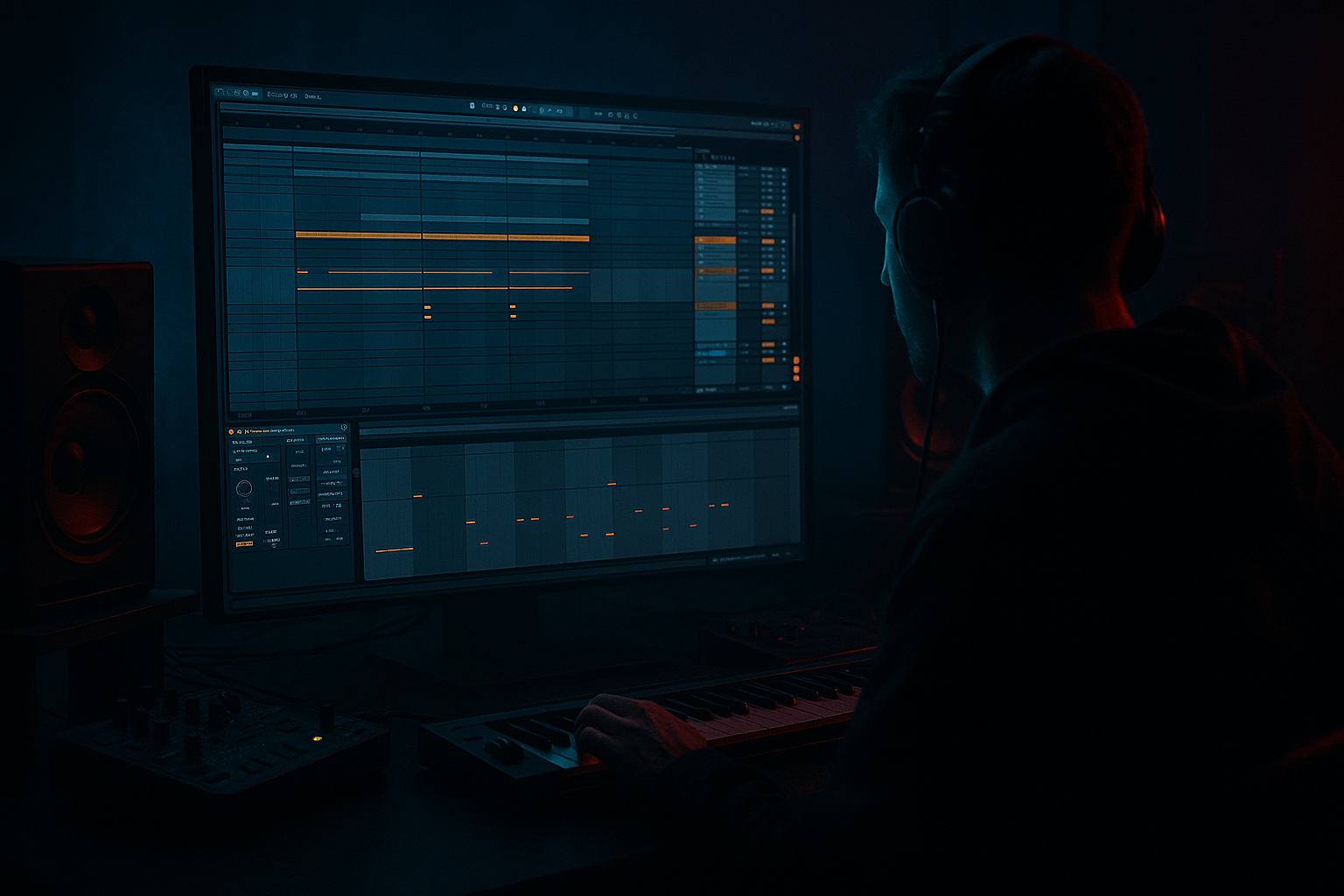
Main tutorial
```markdown
Four-Bar Drum Motifs in Jungle (Ableton Live) 🥁⚡
1. Lesson overview
A four-bar drum motif is a repeating rhythmic “sentence” that makes jungle feel alive—not just a 1-bar loop pasted forever. In jungle and rolling DnB, the magic comes from micro-variations, fills, ghost notes, and small edits that repeat every 4 bars to create momentum.
In this lesson you’ll build a classic jungle-style 4-bar break motif in Ableton Live, using stock devices, simple sampling/editing, and arrangement tricks that instantly feel more “real” and energetic.
---
2. What you will build
By the end, you’ll have:
- A 4-bar drum clip with:
- A drum rack workflow for jungle breaks (kick/snare layers + hats + ghosts)
- A basic processing chain that makes it punchy and gritty (without overcomplicating)
- Turn on Warp preferences: Preferences → Warp/Fades → Auto-Warp Long Samples = Off (so Live doesn’t guess wrong).
- If it feels late/early, try Warp Mode: Complex briefly to locate the correct start, then switch back to Beats for punch.
- Snare: 2, 4
- Kick: 1, 1e or 1a, and maybe 3 (taste-dependent)
- Main snare: ~95–115
- Ghosts: ~20–50
- Hats: ~50–80 with tiny variation
- Set Random: 5–15 for subtle humanization.
- Bar 1: Establish the groove (clean)
- Bar 2: Same groove + tiny variation (1 extra kick or hat switch)
- Bar 3: Add movement (more ghost notes / small re-trigger)
- Bar 4: Turnaround fill (signature edit that leads back to bar 1)
- Add a kick on the “& of 3”
- Swap one hat for an open hat
- Add a very short snare flam (two fast snares, low velocity then high)
- Add a syncopated kick (off-beat)
- Add a tiny break “stutter”: duplicate a snare slice for 2 x 1/16 notes
- Add extra ghost snares around beat 4 (but keep them quiet)
- Classic jungle turnaround: rapid slice sequence in the last half-bar
- Tape-stop style edit (quick and easy):
- Silence + impact: remove the last kick, leave a small gap before bar 1 hits again.
- On the layer track, try -5 ms to -15 ms (pull earlier) or +5 ms (push later). Small moves = big difference.
- Limiter (very gentle): just catching peaks
- Or Glue Compressor (light) to unify
- Intro (8–16 bars): use bars 1–2 only (less busy)
- Drop: full 4-bar motif repeating
- Every 16 bars: swap the bar 4 fill to a slightly different one (keep listeners locked)
- Breakdown: remove layers, keep only break + hats, then bring back full motif
- Parallel dirt:
- Mono your low end:
- Short room for menace:
- Controlled aggression with Drum Buss:
- Risers from breaks:
- Jungle grooves come alive with 4-bar motifs, not static 1-bar loops.
- Build it like a drummer:
- Use Slice to Drum Rack for fast break editing.
- Layer kick/snare for weight, then glue it with EQ Eight → Drum Buss → Glue Compressor.
- Keep ghosts quiet, warping minimal, and variation intentional.
- A stable “anchor” groove (bars 1–2)
- Variation (bar 3)
- A small fill / turnaround (bar 4)
Target vibe: classic Amen / Think-style energy, rolling, slightly chaotic, but controlled 🔥
---
3. Step-by-step walkthrough
Step 0 — Project setup (2 minutes)
1. Set tempo to 170–174 BPM (start at 172 BPM).
2. Create one Audio track called `BREAK`.
3. Create one MIDI track with a Drum Rack called `DRUM LAYERS`.
Optional but helpful:
---
Step 1 — Choose and prep a break
1. Drop a classic break sample onto `BREAK` (Amen, Think, Hot Pants, etc.).
2. In the clip view:
- Enable Warp
- Set Warp Mode: Beats
- `Preserve: Transients`
- Turn Transient Loop Mode: Off
- Set Envelope: 0–20 (tighter hits)
3. Find a clean 1-bar or 2-bar section. Make sure it loops cleanly.
Quick timing check:
---
Step 2 — Slice the break to a Drum Rack (jungle-friendly workflow)
1. Right-click the audio clip → Slice to New MIDI Track…
2. Settings:
- Slice by: Transients
- Create one slice per: Transient
- Slicing preset: Built-in → Slice to Drum Rack
3. You now have a Drum Rack with break slices mapped to pads.
Why this matters: now you can write motifs like a drummer—rearrange hits, add ghosts, and create fills.
---
Step 3 — Build the “anchor” groove (Bar 1)
1. Create a MIDI clip of 4 bars on the sliced Drum Rack track.
2. Start by programming a simple jungle backbone:
- Put a snare on beat 2 and 4 (classic DnB backbeat).
- Add a kick on beat 1, and another kick just before/after snare depending on the break feel.
Beginner-friendly pattern (in 1 bar, 16th grid):
In jungle, the exact placements depend on the break slices—trust your ear and the “push/pull” of the original.
Ableton tip:
Set grid to 1/16, then use Ctrl/Cmd+4 to toggle narrower grid when needed.
---
Step 4 — Add hats and ghost notes (Bar 1–2 = stable loop)
Now we make it roll 🏁
1. Pull in a closed hat sample (or use a bright break slice).
2. Add hats on every 1/8 note (1 & 2 & 3 & 4 &) as a base.
3. Add ghost snares:
- Very quiet snare hits just before beat 2 and/or 4 (e.g., 1a, 3a)
- Lower velocity to 20–45 so they whisper, not slap.
Velocity matters in jungle:
Ableton tool:
Use the Velocity MIDI effect (stock) before the Drum Rack if your playing is uneven.
---
Step 5 — Make it a 4-bar motif (the key!)
Here’s a simple structure that works in real tracks:
#### Bar 2 variation ideas (choose 1)
#### Bar 3 variation ideas (choose 1–2)
#### Bar 4 fill ideas (choose 1)
- Example: in the last 2 beats, place 1/16 slices like:
`snare ghost → hat → snare → kick → snare` (use your break slices)
- On the break audio track, automate Transpose Envelope down briefly (or use Pitch MIDI effect on slices).
Rule of thumb:
Make bar 4 recognizable but not too busy. You want “rewind energy” without derailing the groove.
---
Step 6 — Tight layering (kick/snare reinforcement)
Breaks are character. Layers are power 💪
1. In `DRUM LAYERS` Drum Rack:
- Add a solid subby kick (short, clean)
- Add a tight snare (or clap) to reinforce the break snare
2. Program layers to follow the main hits:
- Kick layer hits only where your main kick is
- Snare layer on 2 and 4 (match timing tightly)
Tightening tip:
If the layer flam sounds messy, use Track Delay:
---
Step 7 — Jungle-appropriate processing chain (stock devices)
Keep it punchy, crunchy, and controlled.
#### On the Break Drum Rack track (slices)
Suggested chain:
1. EQ Eight
- HP filter around 30–40 Hz (remove rumble)
- Small cut 250–450 Hz if boxy (1–3 dB)
- Small shelf boost 7–10 kHz if dull (careful)
2. Drum Buss
- Drive: 5–15
- Crunch: 5–20 (taste)
- Boom: Off or very subtle (jungle breaks can get woofy)
- Damp: adjust so hats don’t hiss too much
3. Glue Compressor
- Attack: 3 ms
- Release: Auto
- Ratio: 2:1
- Aim for 1–3 dB gain reduction
#### On the Layer Drum Rack track
1. Saturator
- Mode: Analog Clip
- Drive: 2–6 dB
2. EQ Eight
- Cut lows on snare layer below 120 Hz
- Cut highs on kick layer if clicky (optional)
#### Optional: Drum Bus (group both tracks)
Group break + layers → `DRUM BUS` then:
---
Step 8 — Arrangement idea (how to use the motif in a track)
A strong motif becomes a section tool.
This is how jungle stays hypnotic without being repetitive 🎯
---
4. Common mistakes
1. Everything changes every bar
Jungle needs a stable anchor. Keep bars 1–2 consistent.
2. Ghost notes too loud
If you hear ghosts like main hits, they’re too hot. They should be felt.
3. Over-warping destroys transients
If the break loses bite, try fewer warp markers or adjust Beats envelope.
4. Layers flam and smear
Fix with track delay, nudging notes, or tighter samples.
5. Too much distortion without EQ
Distortion boosts ugly mids fast—EQ before/after to keep it musical.
---
5. Pro tips for darker/heavier DnB 🖤
Send drums to a return track with Saturator + Drum Buss, then blend in quietly (10–30%).
Use Utility on the drum bus: Bass Mono (if available) or set Width low below ~120 Hz via EQ techniques (or keep kick layer mono).
Use Hybrid Reverb on a send:
- Algorithmic Room
- Decay: 0.3–0.7s
- Pre-delay: 10–25ms
- HP filter: 300–600 Hz
This gives “warehouse air” without washing out transients.
Turn up Drive, then reduce Transients slightly if it gets clicky.
Resample a bar of your break, reverse it, high-pass it, add reverb—instant jungle tension.
---
6. Mini practice exercise (10–15 minutes)
1. Build a 4-bar motif using only:
- 1 break (sliced)
- 1 kick layer
- 1 snare layer
- hats from either slices or one hat sample
2. Rules:
- Bar 1 and 2 must be nearly identical
- Bar 3 must include at least 2 ghost notes
- Bar 4 must include a fill in the last 1/2 bar
3. Bounce/export a loop and listen away from the DAW:
- Does bar 4 clearly “turn over” into bar 1?
- Does it still groove if you mute the layers?
Bonus: Make Version B where bar 4 fill is different, then alternate them every 16 bars.
---
7. Recap ✅
- Anchor (bars 1–2)
- Variation (bar 3)
- Turnaround fill (bar 4)
If you want, tell me your preferred break (Amen/Think/etc.) and I’ll suggest a specific 4-bar motif pattern (where to place the signature stutters/fills) based on that break’s natural accents.
```

