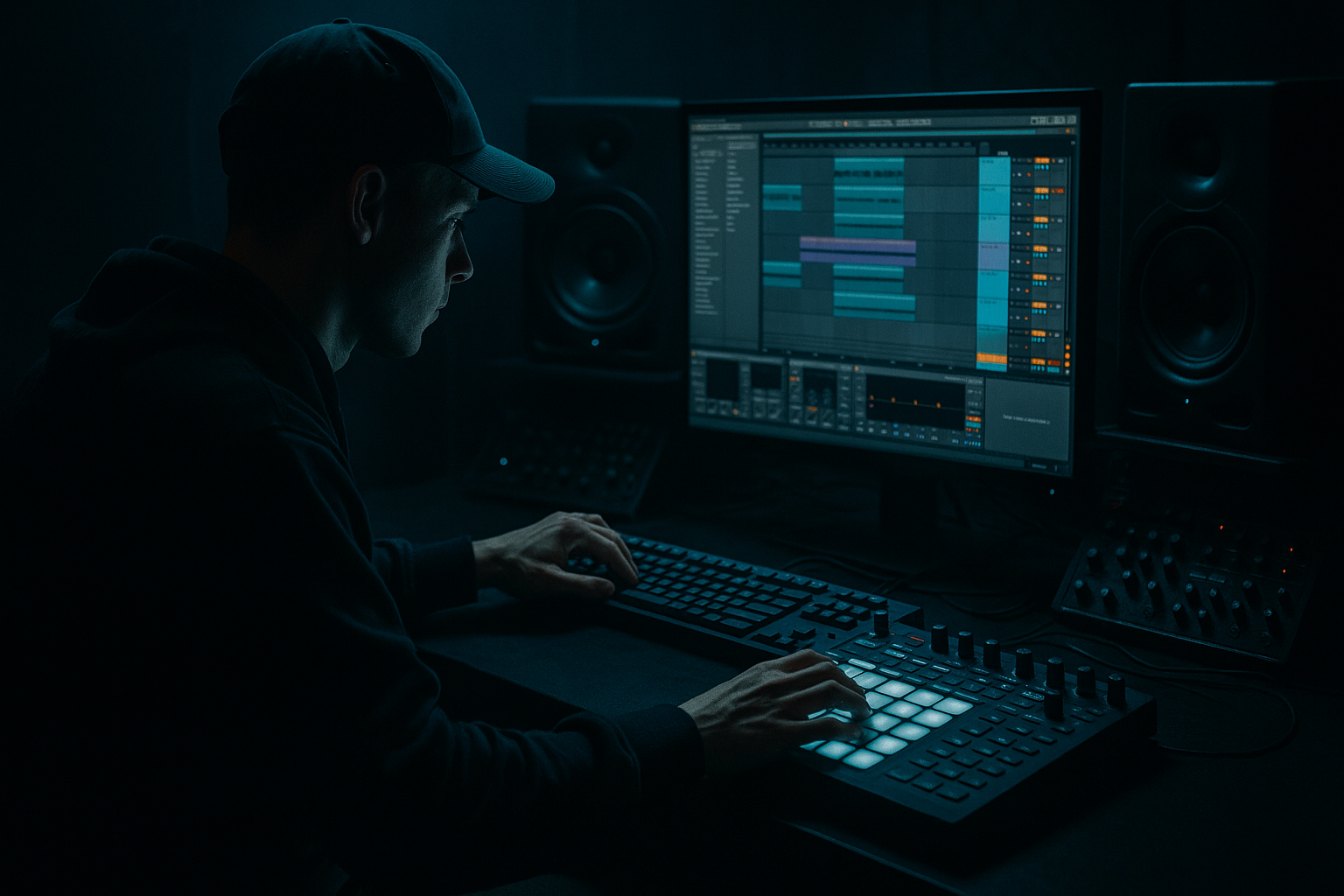
Main tutorial
Framework for a DJ Intro with Modern Punch + Vintage Soul (Jungle / Oldskool DnB) in Ableton Live 12
Skill level: Beginner • Category: Automation 🎛️
---
1. Lesson overview
A great DnB/Jungle DJ intro does two jobs:
1) Gives the DJ time to mix (8–32 bars of clean, predictable phrasing)
2) Sets the vibe (atmosphere + rhythm cues) without stealing energy from the drop
In this lesson you’ll build a classic oldskool jungle-style intro with vinyl soul, tight modern punch, and automation-driven tension—all using Ableton Live 12 stock devices. 💥
We’ll focus heavily on automation: filters, reverb throws, tape/vinyl movement, and gradual “unveiling” of drums.
---
2. What you will build
A 32-bar DJ-friendly intro at 170 BPM with:
- Atmospheric pad + jungle texture
- Vinyl/soul sample “tease” (filtered + widened)
- Tight drum signposts (hats/shakers, ghost snare, occasional kick)
- Riser + crash into bar 33
- Automation lanes that evolve every 8 bars so it feels alive
- Bars 1–8: Atmos + filtered sample, no heavy drums
- Bars 9–16: Add hats + light percussion, subtle movement
- Bars 17–24: Add ghost snare / break hints, more energy
- Bars 25–32: Tension ramp (filter opens, reverb throws, impact prep)
- Bar 33: Drop (outside this lesson, but we’ll prepare for it)
- Choose a soft pad preset, or do this quick patch:
- Osc 1: Sine or Basic Shapes, Position ~10–30%
- Filter: LP24, cutoff around 300–800 Hz
- Amp Env: Attack 80–150 ms, Release 2–4 s
- Add LFO to Filter cutoff: Rate 0.07–0.15 Hz, Amount small (5–10%)
- Automate Hybrid Reverb Mix from ~18% → 10% by bar 25 (tightens before drop).
- Automate Filter cutoff gradually opening: 400 Hz → 2–4 kHz across 32 bars.
- Click the device parameter (e.g., Filter Cutoff), then draw automation in arrangement (or record it by moving the knob while playing).
- Turn Warp ON
- Mode: Complex Pro (for melodic samples)
- If it’s short + percussive, try Beats mode
- Auto Filter cutoff:
- Utility Width:
- Echo Mix throw (one moment):
- Load closed hats + shakers from core library
- Put hats on 1e&a 2e&a 3e&a 4e&a but remove a few hits for groove
- Add a shaker on off-16ths for swing
- In Clip View: add Groove (try MPC-style swing). Start subtle: 10–20%
- Automate Drum Buss Drive from 2 → 4.5 over 32 bars (slow energy lift).
- Automate hat volume up in tiny 1–2 dB steps each 8 bars.
- EQ Eight (high-pass ~150 Hz)
- Reverb (short plate)
- Automate Reverb Mix slightly up approaching bar 32 (more “space” before drop).
- Add a reverb throw on the final snare before bar 33 (mix up briefly, then snap back).
- Warp Mode: Beats
- Preserve: 1/16
- Transients: adjust so it stays punchy
- Bring the ghost break in after bar 16 quietly.
- Automate Auto Filter cutoff opening slowly.
- Automate track volume so it “breathes” (tiny 0.5–1 dB waves).
- Auto Filter cutoff: ~600 Hz → 12 kHz
- Reverb Mix: 10% → 25% (then cut suddenly right before drop)
- Volume: fade up gradually, then hard mute 1/8 or 1/4 before bar 33 (creates the “gap”)
- Reverse a crash audio clip, place it ending at bar 33.
- Automate its reverb send up into the drop, then cut.
- EQ Eight high-pass at ~80–120 Hz (intro only; you can automate back later)
- If you have no kick yet, you can still keep lows tidy:
- Automate MUSIC Group high-pass from 120 Hz → 60 Hz across 32 bars (sub slowly appears).
- Alternatively keep it high-passed the entire intro if the DJ intro must be super mixable.
- Glue Compressor on Master (very light)
- Don’t overdo—save punch for the drop.
- Dark tension = controlled midrange + movement
- Neuro-style intro punch without ruining jungle vibe
- Scary space trick
- Stop-time gap
- Atmos + vinyl/soul sample teased with filter automation
- Hats + ghost snare for rhythmic signposting
- Ghost break texture for jungle DNA
- Riser + reverb/echo throws for tension moments
- Clean low end and phrasing every 8 bars so DJs can mix confidently 🎚️
Arrangement goal (simple + mixable):
---
3. Step-by-step walkthrough
Step 0 — Project setup (fast + correct) ✅
1. Set Tempo: 170 BPM (or 168–174 depending on vibe).
2. Create groups:
- ATMOS (pads, noise, FX)
- MUSIC (soul sample, stabs)
- DRUMS (all drums)
- MASTER FX (optional, for intro-only tricks)
3. Turn on Arrangement View (press `Tab` if needed).
4. Enable automation view: press `A` (Automation Mode).
---
Step 1 — Build the Atmos bed (vintage air + space) 🌫️
Track: MIDI track → instrument: Wavetable (stock) or Drift
Wavetable pad quick-start
Device chain (ATMOS track):
1. EQ Eight
- High-pass at ~30 Hz (remove rumble)
- Gentle dip around 250–400 Hz if muddy
2. Hybrid Reverb
- Algorithm: Hall / Shimmer subtle
- Decay: 4–8 s
- Mix: 10–25%
3. Saturator
- Drive: 1–3 dB
- Soft Clip: ON (optional)
✅ Automation idea (Bars 1–32):
How to automate:
---
Step 2 — Add vinyl soul “tease” (but DJ-friendly) 💿
Track: Audio track → drop in a soul/jazz chord, vocal phrase, or Rhodes lick.
Warping (important for jungle feel):
Device chain (MUSIC sample):
1. Auto Filter
- Mode: Low-pass
- Cutoff: start low (200–500 Hz)
- Resonance: 0.80–1.20 (careful—too much whistling)
2. Vinyl Distortion (stock)
- Tracing Model: 0.5–1.5
- Pinch: 0–0.5
- Drive: 1–3
3. Utility
- Width: start 120–160% (intro = wide vibe)
4. Echo
- Time: 1/8 dotted or 1/4
- Feedback: 15–30%
- Wobble: 0.2–0.6
- Mix: 8–18%
✅ Automation plan (classic tease):
- Bars 1–8: ~250 Hz
- Bars 9–16: ~600–900 Hz
- Bars 17–24: ~1.2–2 kHz
- Bars 25–32: rise to ~4–8 kHz, then quick dip right before drop (creates “suck-in”)
- Start wide (150%), then slowly narrow to 110–120% by bar 32 (makes the drop feel bigger when you widen/center correctly)
- Pick a vocal word at bar 24 or 32 → automate Echo Mix up to 35–50% for 1 beat, then back to normal. That’s a “throw.” 🎯
---
Step 3 — Drums: signposts first (hats/perc), then break hints 🥁
Your intro should suggest jungle without fully dropping the break.
#### 3A) Hats/Shuffle layer (clean and mixable)
Track: MIDI → Drum Rack
Pattern suggestion (16th-based shuffle):
Device chain (Hats track):
1. EQ Eight
- High-pass 300–600 Hz
- Gentle shelf dip above 10 kHz if harsh
2. Drum Buss
- Drive: 2–5
- Crunch: 5–15%
- Boom: OFF (keep low end clean in intro)
✅ Automation:
#### 3B) Ghost snare / clap hint (oldskool cue)
Add a light snare on 2 and 4 or a classic jungle “hint” hit.
Chain:
- Decay: 0.6–1.2s
- Mix: 8–15%
✅ Automation:
---
Step 4 — Break texture without committing (the “ghost break” trick) 👻
This is a jungle classic: you hint the Amen/Think break but keep it tucked.
Track: Audio → load a break slice/loop
Device chain (Ghost Break):
1. EQ Eight
- High-pass at 250–500 Hz (kills bass so it doesn’t clash)
- Optional: dip around 2–4 kHz if it fights hats
2. Auto Filter
- Band-pass or low-pass
3. Redux (optional for crunchy old sampler vibe)
- Downsample: 2–8
- Bit Reduction: 0–3
- Mix low if needed
✅ Automation:
This gives vintage soul and oldskool DNA without stepping on the DJ’s mix.
---
Step 5 — Tension tools: noise riser + impact prep (automation-driven) 🚨
Track: MIDI (or Audio) noise riser
Option A (easy): Use Wavetable noise oscillator
Option B: Use a white noise sample loop
Device chain:
1. Auto Filter (LP)
2. Saturator (Drive 2–6 dB)
3. Hybrid Reverb (Decay 6–12s, Mix 10–20%)
✅ Automation (Bars 25–32):
Add a crash or reverse cymbal into bar 33:
---
Step 6 — Make it DJ-clean: control the low end + master movement 🧼
During intros, DJs want low end controlled so it layers well.
On DRUMS Group and MUSIC Group, add:
On MUSIC Group:
On DRUMS Group:
- EQ Eight high-pass ~30–40 Hz
✅ Automation for “unveiling”:
Optional master intro glue (subtle):
- Threshold for only 1–2 dB gain reduction at peaks
- Attack: 10 ms
- Release: Auto
---
4. Common mistakes (and how to fix them)
1. Too much sub in the intro
- Fix: High-pass MUSIC/ATMOS. Keep sub mostly for the drop.
2. Automation ramps are linear and boring
- Fix: Use stepped changes every 8 bars + one “moment” (throw/fill) near bar 32.
3. Over-widening everything
- Fix: Wide atmos is fine; keep key rhythmic elements more centered. Use Utility to manage width.
4. Reverb washing out transients
- Fix: Reduce reverb mix, shorten decay, or automate reverb only on specific hits (throws).
5. No clear phrasing for DJs
- Fix: Make changes at bars 9, 17, 25 (every 8 bars). Add a clear cue at bar 32.
---
5. Pro tips for darker/heavier DnB 🖤
- Automate a gentle EQ Eight bell dip moving around 300–700 Hz on atmos (subtle “shifting air”).
- Add Roar (stock) lightly on a texture bus:
- Drive low, Mix 10–20%, then automate Mix up slightly toward bar 32.
- Put Hybrid Reverb on a Return track, freeze a tiny hit, then automate return send on one snare at bar 32.
- Mute drums for 1/4 or 1/2 bar before the drop, but keep a tail (reverse cymbal or reverb tail) so it doesn’t feel empty.
---
6. Mini practice exercise (15 minutes) ⏱️
Create an 8-bar intro loop that evolves:
1. Add an atmos pad. Automate filter cutoff from low to slightly brighter over 8 bars.
2. Add a soul sample. Automate Auto Filter cutoff to reveal it gradually.
3. Add hats with groove. Automate Drum Buss Drive from 2 → 4 over 8 bars.
4. Add one reverb throw on the last snare of bar 8 (Reverb Mix up for 1 beat, then back).
Goal: When you loop it, it should feel like it’s “going somewhere” even in only 8 bars.
---
7. Recap
You built a beginner-friendly DJ intro framework for jungle/oldskool DnB that feels modern and punchy but still warm and vintage:
If you want, tell me whether you’re aiming for Amen-heavy jungle, 1994 rollers, or modern jungle techno, and I’ll give you a specific 32-bar template with exact drum placements and automation breakpoints.

