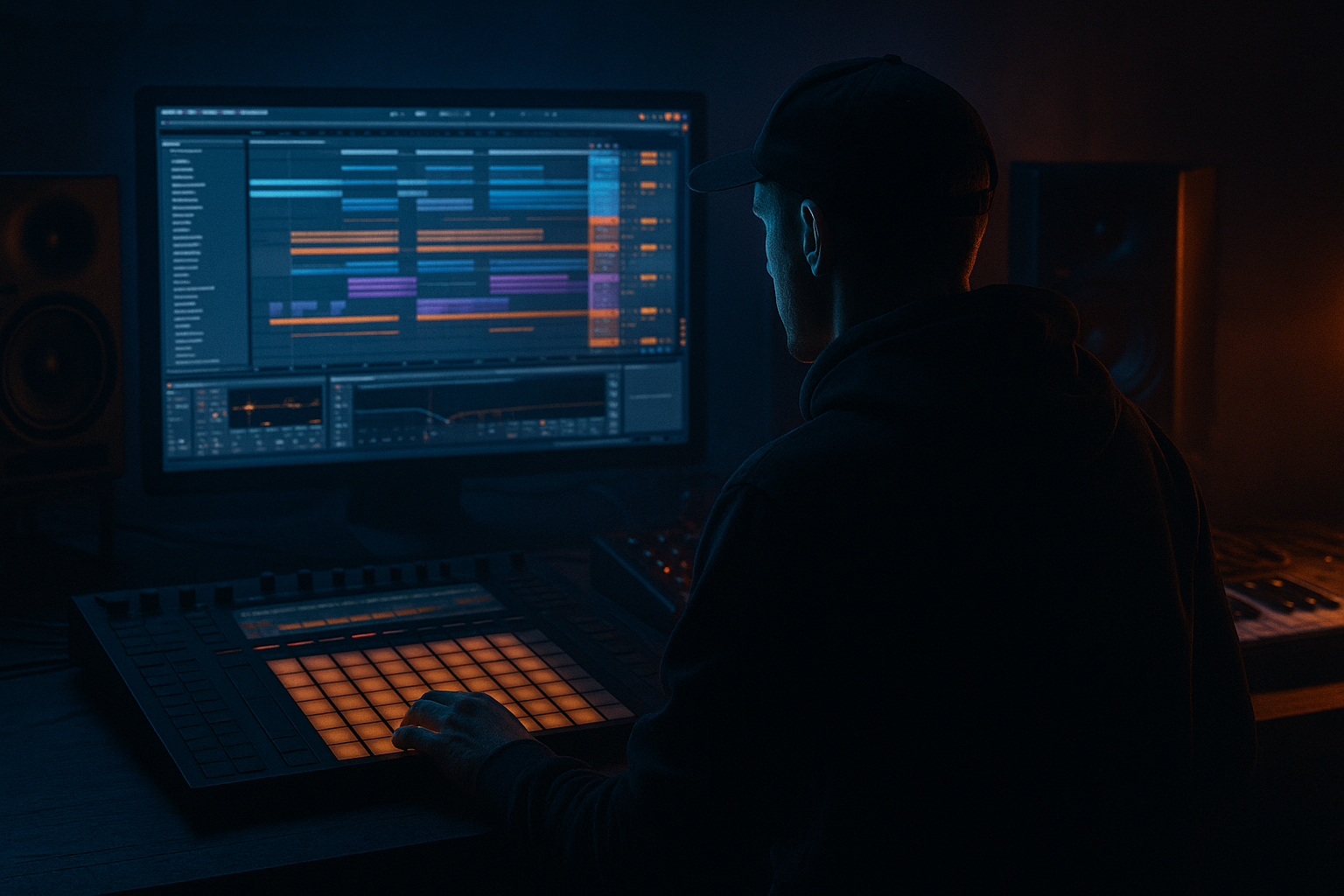
Main tutorial
```markdown
From Hum to Hook Workflow (Drum & Bass in Ableton Live) 🎛️🥁
1) Lesson overview
This lesson is a repeatable, advanced workflow for turning a quick vocal hum (or any rough melodic idea) into a fully arranged drum & bass hook in Ableton Live—fast, clean, and with production decisions that sound like DnB, not generic EDM.
You’ll learn how to:
- Capture a hum and extract usable MIDI (even if it’s off-key)
- Convert it into hook candidates (lead, reese motif, vocal chop, pad stab)
- Make it roll with rhythmic phrasing, call/response, and arrangement tactics
- Lock it to DnB drum architecture (drop impact, 16-bar logic, reloads, variations)
- Build a hook that survives dark/heavy sound design without losing clarity
- A memorable hook derived from your hum (lead/reese/vocal stab)
- A complementary bassline that supports the hook (not fighting it)
- A rolling drum groove with fills and variation
- A basic arrangement: intro cue → build → drop A → drop A variation
- A: Short Verb → Hybrid Reverb (Room/Chamber, short)
- B: Long Verb → Hybrid Reverb (Hall, long)
- C: Delay → Echo
- D: Drum Room → Reverb (tiny room for glue)
- Right-click the clip → Convert Melody to New MIDI Track.
- Duplicate the hum clip.
- Use Tuner (stock) after the audio:
- Manually draw MIDI notes in a new MIDI clip using the hum as reference.
- `Hook Lead`
- `Hook Reese`
- `Hook Vox/Resample`
- Osc 1: Saw, unison 2–4 voices, slight detune
- Osc 2: Square or another saw, detune different
- Filter: LP24, Drive up a bit
- LFO1 to Filter Freq: subtle wobble (Rate: 1/4 or 1/8 synced)
- Simpler
- Pitch: shift slices to match key
- Beat Repeat (very light, for stutters)
- Redux (tiny bit for grit)
- Hybrid Reverb (short room on send)
- Auto Pan (slow, subtle for movement)
- Kick: 1.1, 1.3 (and occasional ghost kick)
- Snare: 1.2, 1.4 (strong backbeat)
- EQ Eight: carve a little 200–300 if boxy
- Saturator: 1–3 dB
- Glue Compressor: light, 1–2 dB GR
- EQ Eight: HP ~120, presence boost 2–5k if needed
- Drum Buss: Drive 5–15, Boom low (careful)
- Transient shaping (stock): Drum Buss “Transient” knob or Saturator + Envelope shaping via Simpler
- Program 1/8 or 1/16 hats, then apply Groove Pool:
- Use Auto Filter to animate hats slightly.
- `Sub` track:
- `Mid Bass` track:
- Put Compressor on Sub and Mid:
- Bars 1–2: Statement
- Bars 3–4: Answer (tiny change: last note, rhythm, octave, or gap)
- 1–8: Hook A (stable)
- 9–16: Hook A variation (one twist)
- Remove the hook for 1 bar before a fill (negative space)
- Add a pickup note on the last 1/16 into the next phrase
- Octave jump on the final note of bar 8/16
- Swap to vocal slice hook for 2 bars (call/response)
- Filtered drums + tension riser
- Hook teaser (high-passed or pitched up)
- 1-bar silence or impact before drop
- Bars 1–4: Full groove + hook statement
- Bars 5–8: Add break layer or extra hat
- Bar 9: Micro drop (remove kick for 1/2 bar) then slam back
- Bars 9–12: Hook variation
- Bars 13–16: Fill + turnaround (snare fill, reverse crash, vocal stab)
- Change bass rhythm or hook layer (not both at once)
- Use Locator markers: `DROP A`, `VAR`, `FILL`, `TURNAROUND`.
- Use Follow Actions in Session View to audition 4-bar combinations quickly.
- Send small amounts to Short Verb.
- Use Echo with 1/8 or 1/4 dotted for rhythmic tail—filter it heavily so it doesn’t wash out the drop.
- Over-quantizing the hook: DnB hooks often need human push/pull. Quantize partially.
- Too many competing motifs: one main hook + one supporting layer is usually enough.
- Hook in the same frequency lane as the reese: if hook is mid-heavy, keep reese simpler or lower it.
- Ignoring negative space: a hook that never breathes won’t feel heavy.
- Break layer too loud: breaks are seasoning unless you’re going full jungle.
- Sidechain too slow: if your release is too long, the groove drags and the hook loses punch.
- Use harmonic minor or phrygian moments (sparingly) for menace—keep the hook short and repeatable.
- Resample the hook:
- Controlled distortion:
- Add “metal” without harshness:
- Impact discipline: big bass moments need less reverb, not more.
- Capture hum → warp tight → convert to MIDI → simplify into strong DnB phrasing.
- Generate multiple hook candidates, then commit to one main identity.
- Build drums and bass around the hook using frequency lanes and sidechain discipline.
- Arrange with 16-bar DnB logic: statement, variation, fills, negative space.
- Resample and iterate—hooks in DnB often become iconic through processing and rhythm, not just melody.
---
2) What you will build
A 16–32 bar drop with:
Target tempo: 172–176 BPM
Vibe reference: rolling DnB / jungle-leaning minimal / heavy neuro-adjacent
---
3) Step-by-step walkthrough
Step 0 — Session setup (fast, pro template)
1. Set tempo to 174 BPM.
2. In Preferences → Record/Warp/Launch:
- Auto-Warp Long Samples: Off (reduces weirdness on recorded vocals)
3. Create groups:
- DRUMS (Kick, Snare, Hats, Percs, Break)
- BASS
- HOOK
- FX / RISERS
- REFERENCE (for imported track)
Return tracks (recommended):
---
Step 1 — Record the hum (capture > perfection) 🎙️
1. Create an Audio Track named `Hum`.
2. Arm it, monitor Auto, and record 8–16 bars of humming your idea.
3. Immediately do a cleanup pass:
- Utility: set gain so peaks hit around -12 to -6 dB
- EQ Eight:
- HP filter around 80–120 Hz
- Gentle dip around 250–400 Hz if boxy
- Optional small boost 2–5 kHz if it needs clarity
Tip: Record 3 takes. Hooks often come from take #2 when you relax.
---
Step 2 — Warp and time-lock it to DnB grid 🧲
1. Double-click the hum clip.
2. Turn Warp: On.
3. Set Warp Mode: Complex Pro (better for vocal-ish material).
4. Find the first strong note, right-click → Set 1.1.1 Here.
5. Adjust Seg. BPM until it feels locked.
Goal: Your hum should sit rhythmically inside 16ths/8ths typical of DnB phrasing.
---
Step 3 — Convert the hum into MIDI (multiple ways)
You want options. Do at least two conversions:
#### Option A: Convert Melody to MIDI (fast)
Now you have a MIDI track that’s usually messy. That’s fine.
#### Option B: Manual “best notes” extraction (more control)
- Watch the pitch center of each phrase.
Why this matters: DnB hooks often need simple, intentional intervals—not every pitch wobble.
---
Step 4 — Quantize rhythmically, not robotically 🧠
On the MIDI clip:
1. Select all notes.
2. Quantize Settings (Ctrl/Cmd+Shift+U):
- Start with 1/8
- Amount: 60–75%
- Add Swing later (Groove Pool), not here.
3. Now do “DnB phrasing edits”:
- Shorten most notes to 1/8 or 1/16.
- Leave one longer “anchor note” per 2 bars (creates identity).
- Create call/response: bar 1 answers bar 2.
DnB hook rule: If it doesn’t feel memorable with a plain sine sound, it’s not a hook yet.
---
Step 5 — Lock the hook to a key (and choose harmonic context)
1. Pick a key that suits darker DnB: F minor, G minor, A minor are common.
2. Use Ableton tools:
- Scale MIDI Effect (stock):
- Set to your chosen scale (e.g., Natural Minor).
- Or use MIDI Transform → Fit to Scale (Live 12) if available.
Advanced move: Use Phrygian or Harmonic Minor for darker tension, but keep the hook simple.
---
Step 6 — Turn MIDI into 3 hook candidates (sound design triage) 🎨
Duplicate the MIDI clip across 3 tracks:
#### Candidate 1: Hook Lead (Operator, clean + sharp)
Device chain (stock):
1. Operator
- Osc A: Saw, Level ~ -6 dB
- Osc B: Sine, Level low (adds weight)
- Filter: LP24, Drive slightly
- Amp Env: Short decay if you want stabby; longer if you want sing-y
2. Saturator
- Mode: Analog Clip
- Drive: 2–6 dB (don’t crush yet)
3. EQ Eight
- HP at 120–200 Hz
- Small dip 2–4 kHz if harsh
4. Auto Filter (movement)
- LP, Envelope amount small, Rate slow (or map to macro)
5. Utility (mono control)
- Bass Mono: On (if you keep any low content)
#### Candidate 2: Hook Reese Motif (Wavetable or Operator)
Wavetable settings idea:
Chain:
1. Wavetable
2. Pedal (Overdrive mode) or Roar (if you have it) for bite
3. EQ Eight (cut mud 200–400)
4. Compressor (light leveling)
5. Chorus-Ensemble (tiny, keep mono compatibility in mind)
6. Utility: Width down if it gets phasey
#### Candidate 3: Vocal/Resample Hook (texture + identity)
1. Take your original hum audio → Slice to New MIDI Track:
- Right-click clip → Slice to New MIDI Track
- Slicing: Transient or 1/8
2. Load into Simpler (Slice mode) automatically.
3. Program a new rhythm using slices.
Chain:
Decision point: Choose one main hook (lead/reese/vox) and one secondary layer. Too many hooks = no hook.
---
Step 7 — Build the drums so the hook rolls (DnB drum architecture) 🥁
Start with a clean foundational groove before adding breaks.
#### Core drum pattern (2-step base)
Use Drum Rack with these processing guidelines:
Kick chain (example):
Snare chain (example):
Hats / rides:
- Add a groove (e.g. MPC-ish swing)
- Amount: 15–30%
- Random: 5–15
#### Add a break layer (jungle flavor) 🧬
1. Put a break on an audio track (`Break`).
2. Warp mode:
- Beats (Preserve Transients)
- Transients: 1/16
3. High-pass at 150–250 Hz so it doesn’t fight kick/bass.
4. Blend it in quietly for movement.
---
Step 8 — Make hook + bass coexist (don’t let them wrestle)
Now create a bassline that supports the hook:
#### Bass approach A: Sub + mid bass split (classic rolling)
- Operator sine
- Notes: simpler than hook, often root + passing notes
- Utility: Width 0% (mono)
- EQ Eight: low-pass around 80–120 Hz
- Wavetable/Operator reese
- EQ Eight: high-pass 90–130 Hz
- Distortion (Pedal / Saturator)
- Movement: Auto Filter / LFO
Sidechain:
- Sidechain from Kick (and optionally Snare)
- Ratio: 3:1–6:1
- Attack: 1–5 ms
- Release: 50–120 ms (tune to groove)
- Aim: 2–5 dB GR for musical pump
Important: If the hook is mid-heavy, keep bass motif simpler (rhythm can be busy, pitch should be stable).
---
Step 9 — “Hook mechanics”: repetition + variation + ear candy
A DnB hook usually lands because it repeats, but evolves.
Use 4-bar logic:
Then for 16 bars:
Practical variation ideas:
---
Step 10 — Arrangement blueprint (16–32 bars that hit hard) 🚦
Here’s a reliable DnB drop structure:
Pre-drop (4–8 bars):
Drop A (16 bars):
Drop A2 / Variation (optional 16 bars):
Ableton workflow tip:
---
Step 11 — Finalize hook presence (mix moves that matter)
On the hook bus (`HOOK` group), try:
1. EQ Eight
- Remove low clutter below 120–200 Hz
- Small dip where snare lives if needed (180–250 body or 2–4k crack area depends)
2. Saturator (glue)
- Soft Clip On, Drive 1–3 dB
3. Glue Compressor
- 1–2 dB GR max, slow-ish attack to keep punch
4. Utility
- Width: 80–120% (careful—check mono)
Space:
---
4) Common mistakes
---
5) Pro tips for darker/heavier DnB 🕶️
- Freeze/Flatten the hook track
- Re-warp it with Texture mode for eerie artifacts
- Re-chop in Simpler for new rhythms
- Distort mids, protect sub.
- Split with Audio Effect Rack:
- Chain 1 (Sub): clean, mono
- Chain 2 (Mid): Saturator/Pedal/Redux
- Use Auto Filter automation to open slightly at phrase ends
- Add a tiny Corpus or resonant peak to give “edge”
---
6) Mini practice exercise (15 minutes) ⏱️
1. Record a 10-second hum.
2. Convert to MIDI and create two hook candidates:
- Operator lead
- Simpler slice hook
3. Build a 4-bar loop at 174 BPM:
- Kick/snare 2-step
- Hats with Groove Pool swing
- Sub following the hook root notes
4. Make a variation in bars 3–4:
- Remove hook for 1 beat, then bring it back with a pickup.
Deliverable: export a 4-bar loop and a 16-bar drop sketch.
---
7) Recap ✅
If you want, tell me what subgenre you’re aiming for (liquid, jump-up, minimal roller, jungle, neuro) and I’ll tailor a hook sound chain + 16-bar arrangement map for that exact vibe.
```

