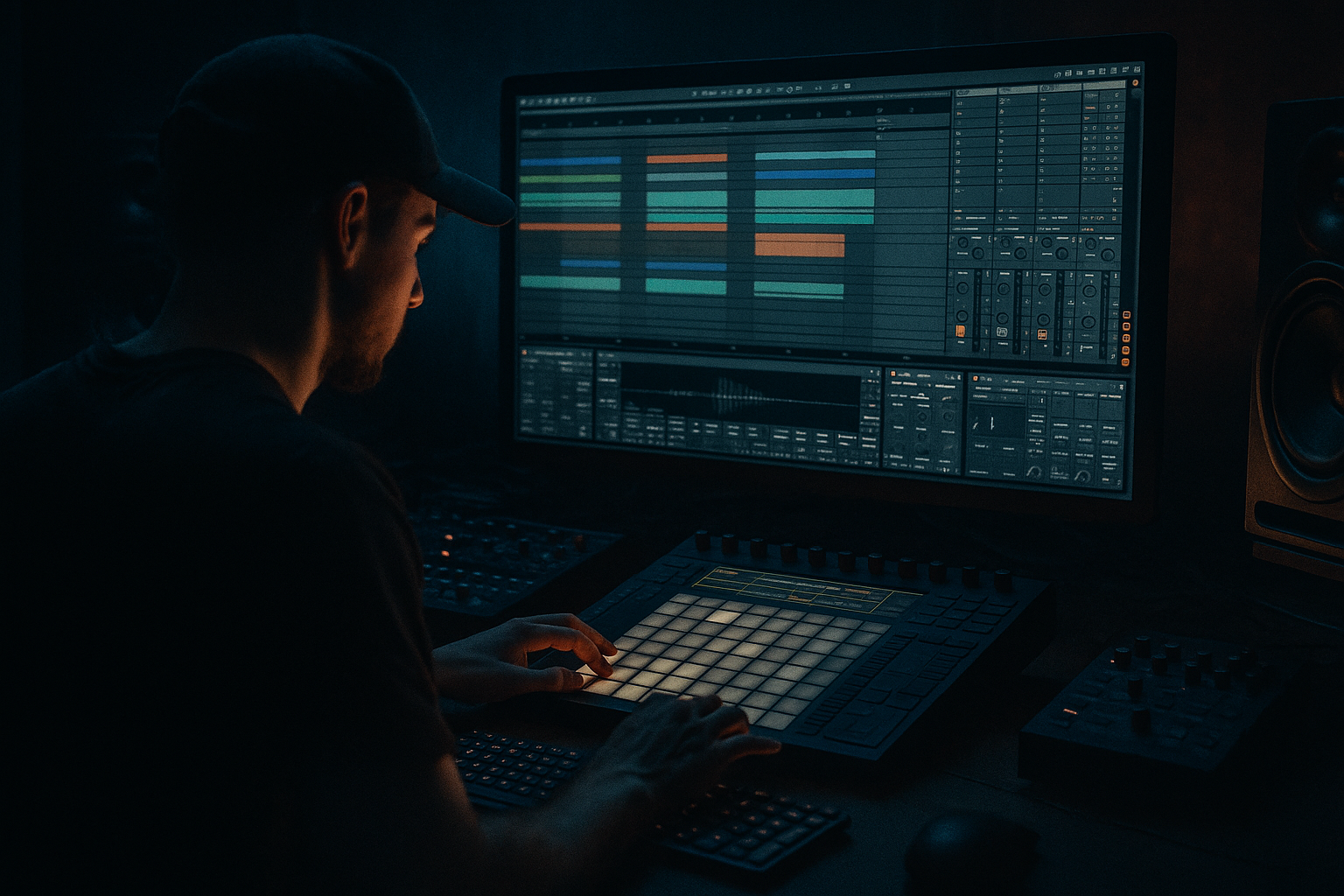
Main tutorial
```markdown
Funky Drummer Ableton Live 12 FX Chain Session (DJ-Friendly) — Jungle / Oldskool DnB Vibes 🥁⚡
Skill level: Beginner
Category: DJ Tools
DAW: Ableton Live 12 (stock devices)
---
1. Lesson overview
In this lesson you’ll build a DJ-friendly Ableton Live session centered around a Funky Drummer-style break (classic jungle energy), with a clean FX chain for quick performance moves: filtering, dub echoes, distortion, reverb throws, and tight bus processing.
The goal: a reliable “tool session” you can jam like a DJ—launch clips, build tension, and drop back into the groove—while keeping the drum break sounding punchy and oldskool. 🎛️
---
2. What you will build
You’ll end up with:
- A 2-deck style layout (A + B) for breaks (great for DJ-style switching)
- A drum-break FX chain you can control from 8 Macros
- Return tracks for dub delay + reverb throws (classic jungle moves)
- A drum bus with glue + punch + controlled grit
- A simple DJ-friendly arrangement structure: Intro → Build → Drop → Switch → Outro
- A Funky Drummer break sample (or a similar classic break like Amen, Think, Hot Pants)
- Or any 2-bar funky break
- A different break, OR
- The same break with different processing later (great for “A/B deck” vibes).
- Leave the break mostly as-is.
- Use Warp Markers only to fix obvious drift every bar or so.
- Device: Auto Filter
- Filter type: Highpass (Clean or OSR)
- Map Frequency: 30 Hz → 350 Hz
- Set Resonance: ~0.70
- Use this to “thin out” before a drop.
- Auto Filter (or a second Auto Filter if you prefer)
- Filter type: Lowpass
- Map Frequency: 18 kHz → 1.2 kHz
- Great for breakdowns and transitions.
- Device: Drum Buss
- Set:
- Map Transient: 0 → 60
- Adds snap to the break without needing fancy processing.
- Device: Saturator
- Mode: Analog Clip
- Set Drive: start at 3 dB
- Map Drive: 0 dB → 10 dB
- Optional: enable Soft Clip
- This is your “old sampler grit” vibe.
- Device: EQ Eight
- Make a bell boost around 3.5–6 kHz
- Start: +2 dB, Q ~1.2
- Map Gain: 0 dB → +5 dB
- Helps the snare speak on club systems.
- EQ Eight high shelf around 10–12 kHz
- Map Gain: -6 dB → +3 dB
- Useful when distortion adds harshness.
- Device: Compressor
- Ratio: 2:1
- Attack: 10 ms
- Release: Auto
- Threshold: set for 1–3 dB gain reduction
- Map Threshold: (range depends on level; set by ear)
- Makes it feel “together” without flattening.
- Device: Utility
- Map Gain: -6 dB → +6 dB
- Keeps your rack from clipping when you crank Crunch/Punch.
- Click disk icon on the rack → name it
- Little delay on fills 🎯
- Big reverb throw on the last snare before drop 🧨
- Keep BREAK A playing
- Launch BREAK B on the next bar
- Use track volume faders to “mix” between them
- BREAK A → A side
- BREAK B → B side
- Intro (16 bars): filtered break + light delay sends
- Build (16 bars): open filter, add small fills
- Drop (32 bars): full break + bassline
- Switch (16 bars): swap to BREAK B, add reverb throw on last snare
- Second drop (32 bars): heavier processing / extra tops
- Outro (16 bars): lowpass + delay tail
- HP filter up slightly
- Big reverb throw on the snare
- Cut everything for 1/4 bar (tiny silence)
- Resample your break after the rack (Freeze/Flatten or record to audio), then:
- Add Roar (stock Live 12) gently after Drum Buss for modern aggression:
- Use multiband control (stock):
- Parallel crunch:
- Tension trick:
- A/B “deck” structure for breaks
- A macro-controlled FX rack for quick, musical moves
- Return tracks for dub delay + reverb throws
- A simple arrangement template for intros, builds, drops, and switches
Sound target: shuffled, funky, slightly crunchy breakbeat with tight subs and space for bassline.
---
3. Step-by-step walkthrough
Step 0 — Project setup (DJ-friendly from the start)
1. Tempo: set to 165–172 BPM (try 170 BPM).
2. Global Quantization: set to 1 Bar (top middle of Live).
- This makes clip launches feel like DJ mixing—everything lands on the bar.
3. Create tracks:
- Audio Track 1: `BREAK A`
- Audio Track 2: `BREAK B`
- Group them (select both → Cmd/Ctrl+G) → name group `BREAKS`
- Add Audio Track 3: `BASS (placeholder)` (even if you don’t write bass yet)
- Add MIDI Track: `STABS/FX` (optional)
4. Create Return tracks:
- `A - DUB DELAY`
- `B - REVERB THROW`
🎯 Why: This is the foundation of a performance-ready session. You’ll be able to “mix” between BREAK A and B and use sends like a DJ.
---
Step 1 — Get and prep your Funky-style break
You can use:
On BREAK A:
1. Drop a break sample into an empty clip slot.
2. Double-click the clip to open Clip View.
3. Turn Warp ON.
4. Set Warp Mode: Complex Pro (good all-round for breaks).
5. Set Seg. BPM close to original (Live usually guesses).
6. Right-click the clip → Warp From Here (Straight) if timing is off.
7. Set clip length to 2 bars (common jungle loop size).
Do the same on BREAK B, but use:
---
Step 2 — Make it groove like jungle (quantize without killing funk) 🎚️
We want it tight enough to slam with bass, but not robotic.
Option A (simple beginner method):
Option B (more control):
1. Right-click the clip → Slice to New MIDI Track
2. Choose:
- Slicing preset: Built-in (or “Transients”)
- Slicing: Transients
3. Now you’ve got a Drum Rack with slices.
4. In MIDI clip, you can:
- Nudge snares slightly late for swing
- Duplicate ghost notes
- Remove messy hits
✅ If you’re a beginner, start with Option A today. Slicing is powerful, but can be a rabbit hole.
---
Step 3 — Build the core FX chain on the BREAKS group (macro-controlled)
Click the BREAKS group and add an Audio Effect Rack. This rack is your “DJ tool” layer.
#### Inside the Audio Effect Rack, add these devices in order:
1. EQ Eight
2. Drum Buss
3. Saturator
4. Auto Filter
5. Compressor (sidechain-ready, optional)
6. Utility
Now map key parameters to 8 Macros (click Map in the rack).
---
Step 4 — Suggested macro mapping + starter settings (practical and usable)
Here’s a solid beginner macro set for oldskool jungle:
#### Macro 1: HP Filter (DJ Cut)
#### Macro 2: LP Filter (Muffle)
#### Macro 3: Punch
- Drive: 5–15%
- Boom: Off or very low (Boom can mess with bass)
#### Macro 4: Crunch
#### Macro 5: Snare Bite (Presence)
#### Macro 6: Air / Top Control
#### Macro 7: Glue
#### Macro 8: Output Trim
🎛️ Workflow tip: Once mapped, save the rack:
“Jungle Break DJ Rack (Live12)”
---
Step 5 — Create DJ-style Return FX (the real jungle sauce) 🌫️
Return tracks are where “DJ moves” come alive.
#### Return A: `DUB DELAY`
Add:
1. Echo
- Time: 1/8 Dotted (or 1/4 for slower bounces)
- Feedback: 35–55%
- Filter: HP around 250 Hz, LP around 6–8 kHz
- Reverb: small amount (10–20%) if desired
2. Saturator (optional)
- Drive: 2–6 dB (for gritty tape vibe)
#### Return B: `REVERB THROW`
Add:
1. Hybrid Reverb
- Algorithm: Hall or Plate
- Decay: 2.5–5.5 s
- Predelay: 15–30 ms
- High Cut: 6–9 kHz (prevents harsh splash)
2. EQ Eight
- Highpass at 200–300 Hz (keep low end clean)
Now use Send knobs on BREAK A / B like a DJ:
---
Step 6 — Add a “Deck” workflow (A/B breaks like mixing) 🎚️
To make it feel DJ-friendly in Session View:
1. Put 4–8 clips on BREAK A:
- Clean loop (2 bars)
- Slightly filtered loop
- One with extra distortion
- One with a short “stop” (1 bar)
2. Put complementary clips on BREAK B:
- Alternate break
- More hats / more shuffle
- A variation with less low-mids (for bass-heavy sections)
Crossfade-style approach (easy):
Optional: enable Live’s Crossfader (View → Crossfader) and assign:
Now it feels like two decks.
---
Step 7 — Quick DJ-friendly arrangement idea (oldskool structure) 🏁
Even if you mostly perform in Session View, it helps to build a simple Arrangement skeleton:
At 170 BPM:
Classic jungle move:
On the last bar before the drop, automate:
Then slam back in.
---
4. Common mistakes
1. Over-warping the break
- Too many warp markers = weird phasey hats and flat groove. Fix only what’s needed.
2. Too much low-end in the break
- Break low end fights the bass. Highpass breaks gently (often 30–80 Hz).
3. Clipping after distortion
- Saturator/Drum Buss adds gain fast—use the Utility Output Trim macro.
4. Drowning everything in reverb
- Jungle uses reverb as a throw, not a permanent wash (unless you’re doing atmospheric).
5. No contrast between A and B
- If both decks sound identical, switching feels pointless. Make B brighter, darker, or more crushed.
---
5. Pro tips for darker/heavier DnB 🖤
- Chop tiny edits (1/16–1/8) for gritty fills
- Reverse a snare tail into the drop
- Use subtle drive and keep low end controlled with filtering
- Multiband Dynamics: tame harsh highs or boxy mids
- Try a small reduction in 300–600 Hz if it’s muddy
- Duplicate BREAKS group into a “CRUSH” group
- Smash it (Saturator + Compressor)
- Blend quietly under the clean drums (10–25%)
- Automate HP filter rising over 8 bars + increase Echo send slightly
- Then cut sends to zero right on the drop for impact
---
6. Mini practice exercise (15 minutes) ⏱️
1. Load one break into BREAK A and warp it cleanly.
2. Build the Audio Effect Rack on the BREAKS group with 8 macros.
3. Create Return A (Echo) and Return B (Hybrid Reverb).
4. Make 3 clips on BREAK A:
- Clean
- Crunchy (Macro 4 up)
- Filtered (Macro 1 up)
5. Perform a 32-bar mini-mix:
- Bars 1–8: Clean loop
- Bars 9–16: slowly raise HP filter
- Bar 16: snare reverb throw + tiny pause
- Bars 17–32: drop back in with Crunch + Punch
Record your performance into Arrangement (hit Global Record) so you can listen back.
---
7. Recap ✅
You built a beginner-friendly jungle/DnB DJ tool session in Ableton Live 12:
If you want, tell me the exact break you’re using (or upload a screenshot of your rack), and I’ll suggest macro ranges and EQ points tailored to that sample.
```

