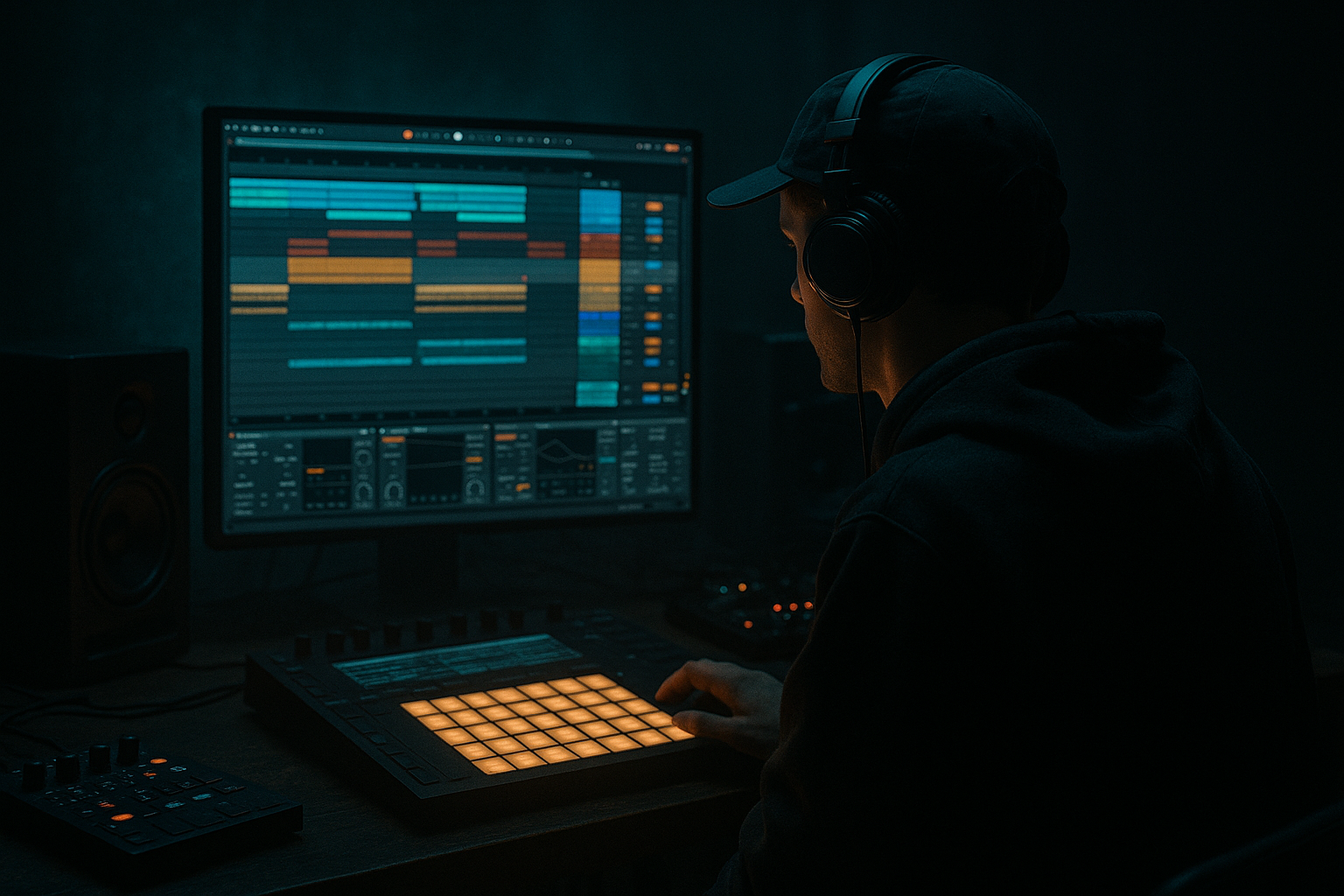
Main tutorial
Lesson Overview
This lesson is about building a Funky Drummer–style jungle arp inside Ableton Live 12 that feels like it was lifted from a battered vinyl loop, then reshaped for modern DnB / jungle / rollers energy. The goal is not to make a clean “arp synth preset” — it’s to create a chopped, rhythmic melodic engine that sits between breakbeats and bass, adding movement, tension, and old-school character without cluttering the low end.
In a real DnB track, this kind of part usually lives in the midrange lane: it can carry the hook in the intro, push momentum into the drop, or provide a call-and-response layer above the drums and sub. The “Funky Drummer” reference matters because the feel is all about syncopation, swing, humanized timing, and gritty source material — the exact ingredients that make jungle feel alive rather than grid-locked.
Why this technique matters in DnB:
- It gives you a memorable melodic hook without needing a full chord progression.
- It creates a vinyl-cut, sampled identity that instantly reads as jungle/old-school break culture.
- It helps you arrange more effectively because the arp can be muted, filtered, chopped, and reintroduced across sections.
- It leaves space for sub weight, reese movement, and drum transients, which is essential in heavier DnB.
- A short 2-bar or 4-bar melodic motif
- Chopped, vinyl-like articulation with tiny gaps and imperfect timing
- A ghosted, syncopated rhythm that locks with breakbeat energy
- Midrange grit from Saturator, Corpus or Amp, Auto Filter, and subtle resampling
- A version that can work as:
- a sampled Rhodes stab
- a detuned synth pluck
- a vinyl-sliced melodic fragment
- a rolled arp with broken timing
- Making the arp too busy
- Leaving too much low end in the arp
- Using perfect quantization on every note
- Overdoing reverb and delay
- Saturating before controlling transients
- Ignoring arrangement context
- Print two versions: one clean, one abused
- Use band-limited distortion
- Layer a subtle ghost octave
- Let the arp duck to the snare
- Automate filter movement in phrases, not continuously
- Use short reverse chops before key hits
- Keep the bass and arp in different emotional lanes
- Build the arp around the drums first, not as a separate idea.
- Use a short, syncopated, humanized phrase with gaps.
- Resample and re-chop it to get the vinyl-slice character.
- Keep the sound gritty but controlled with Ableton stock devices.
- Automate filters, sends, and density so the arp evolves across the arrangement.
- Protect the mix: mono discipline, low-end separation, and drum/bass balance are non-negotiable in DnB.
We’re going to use Ableton’s stock tools to build the part in a way that is fast to edit, easy to resample, and strong in arrangement. Expect a workflow that mixes MIDI sequencing, audio chopping, groove extraction, resampling, and bus shaping — all focused on creating a chopped-vinyl character that can survive a proper sub-heavy mix. 🔥
What You Will Build
You will build a loopable jungle arp phrase with the following traits:
- an intro hook
- a pre-drop tension layer
- a drop-topper above drums and bass
- a switch-up element for a second drop
Musically, think of a loop that sits somewhere between:
By the end, you’ll have a part that feels like it was built from chopped records but designed with modern Ableton precision.
Step-by-Step Walkthrough
1. Start with a break-first session setup
Before writing the arp, establish the drum context. In DnB, the arp should feel like it belongs to the break, not float above it.
- Set your project around 170–174 BPM.
- Build or import a classic break pattern, even if it’s just placeholders for now.
- Put the drum bus on its own group and leave headroom: aim for peaks around -6 dB on the master while sketching.
- If you already have a break loop, use Clip View → Groove Pool and extract swing from it. Try MPC 16 Swing 54–58% or a lightly shuffled break groove.
- If the break is busy, simplify the arp rhythm. If the break is sparse, the arp can be more active.
Why this works in DnB: the break and arp need to “breathe” together. A jungle arp feels authentic when it behaves like another percussion instrument, not a separate synth line.
2. Design the source sound as a sampled-vinyl hybrid
Create a new MIDI track and load Analog, Wavetable, or even Sampler if you want to lean into a sample-like feel. For a darker jungle character, a slightly imperfect pluck or reed-like tone works best.
Good starting points:
- Oscillator 1: saw or triangle-based tone
- Oscillator 2: a slightly detuned saw or pulse
- Unison: keep it modest, around 2–4 voices
- Detune: small to moderate, roughly 0.08–0.18
- Filter: low-pass with a bit of resonance, cutoff around 700 Hz to 2.5 kHz depending on tone
- Amp envelope: Attack 0–5 ms, Decay 150–350 ms, Sustain 0–25%, Release 40–120 ms
Then process it in-chain:
- Saturator: drive around 2–6 dB, Soft Clip on if needed
- Auto Filter: map cutoff to a macro for later automation
- Erosion: very subtle, around 0.5–2.5 kHz mode, low amount, for dusty edge
- Redux: use lightly, not as a destroyer — just enough to imply source degradation
If you want a more sampled identity, resample this synth later and treat it like audio. That gives you the vinyl-chop illusion without needing actual records.
3. Program a narrow, hooky MIDI phrase with gaps
This is where the musical identity comes from. Don’t write a full line — write a fragment that implies a melody and leaves space for drums.
Use a short phrase in a minor key or modal feel:
- Keep the range tight, usually within a 5th to an octave
- Use repeated notes and small interval jumps
- Include one or two syncopated “answers” after the main hit
Practical pattern idea:
- Beat 1: short note on the off-beat or a pickup
- Beat 2: another short note a 1/16 late or early
- Beat 3: small leap upward for tension
- Beat 4: a clipped ending note, then silence
Make the notes short:
- Note length: 1/16 to 1/8, with some even shorter
- Velocity variation: 45–110 depending on accent
- Leave deliberate rests so the break can speak
Advanced move: duplicate the phrase, then alter only one or two notes every second bar. This keeps the loop from feeling robotic while preserving a recognizable motif.
4. Turn the MIDI into a chopped-vinyl rhythm
Now make the phrase feel like it came from a sampler. The trick is not just sound — it’s articulation and micro-timing.
Workflow options in Ableton:
- Use Note Repeat-style density manually with short MIDI notes and slight timing offsets
- Quantize at 1/16, then loosen some notes by hand
- Apply groove after the fact using Groove Pool
- Nudge selected notes 5–15 ms late for laid-back pocket, or 5–10 ms early for urgency
Add chop character:
- Slice the phrase by duplicating and muting note tails
- Use Note Length in the MIDI editor to create different note durations within the same bar
- Vary velocity to make certain notes trigger harder or softer
- Introduce one “broken” note that lands slightly off-grid for humanized vinyl feel
A strong jungle arp often has a slightly unstable feel, but the instability should be intentional. Too much randomization sounds messy; too little sounds sterile.
5. Resample the phrase and re-chop it as audio
This is where the workflow gets premium. Render the MIDI part to audio so you can treat it like a sample library and slice it like a break.
In Ableton:
- Freeze and Flatten, or better, Resample to a new audio track
- Consolidate the best 2 bars
- Right-click and choose Slice to New MIDI Track
- Slice by Transient or 1/8 depending on how rhythmic the phrase is
Then:
- Rearrange the slices into a more broken, vinyl-like pattern
- Leave a few slices slightly late
- Double one slice for emphasis
- Remove one slice to create a “missing sample” effect
If you want the cut-up feel to be stronger, put the sliced audio into Simpler in Slice mode and perform the part like a drum instrument. This is especially useful for advanced workflow because it lets you improvise fills and variations quickly.
6. Shape the tone with filter, dirt, and space
The sound should feel dusty, but not washed out. The goal is controlled age, not mush.
On the arp group or audio track, try this stock chain:
- Auto Filter: low-pass with a gentle resonance bump; automate cutoff between 400 Hz and 4 kHz
- Saturator: drive 3–8 dB, Soft Clip on
- Drum Buss: very light Drive, around 5–15%, and a touch of Crunch if the source needs bite
- Echo: 1/8 or dotted 1/8 for occasional throws, but keep feedback low, around 10–25%
- Reverb: short room or plate, decay around 0.5–1.4 s, low mix, high-cut aggressively
A useful trick: put the reverb or echo on a Return track so you can automate sends during arrangement. That gives you cleaner control over buildup and drop transitions.
If the arp competes with snare crack or reese mids, carve a pocket with EQ Eight:
- High-pass gently around 120–200 Hz
- Tame any harshness around 2.5–5 kHz
- If it gets boxy, dip 300–600 Hz slightly
7. Make it groove with the drums, not against them
The best jungle arps feel like they were performed in the same rhythmic universe as the break.
Routing and groove ideas:
- Group the arp and route it through a shared drum/music bus if it needs cohesion
- Sidechain it lightly to the kick or full drum bus using Compressor or Glue Compressor
- Keep sidechain subtle: just enough to create space, not obvious pumping
- Experiment with Groove Pool on the arp and break together so they feel like one organism
Advanced arrangement idea:
- Let the arp answer the snare or ghost note pattern
- Place key accents right after snare hits to create forward motion
- If the break is busy, let the arp hit fewer notes but stronger accents
- If the break is minimal, let the arp carry more rhythmic detail
This is especially effective in rollers: the arp can act like a rolling top-line that keeps energy moving without stealing from the bassline.
8. Automate movement for drop design and switch-ups
In DnB, an arp should evolve across the arrangement. Static loops are easy to ignore.
Useful automation targets:
- Auto Filter cutoff
- Resonance
- Delay send
- Reverb send
- Saturator drive
- Sample start if using Simpler
- Transpose in small intervals for tension rises
Arrangement context example:
- Intro: filtered, lo-fi arp with lots of space, maybe only every second phrase
- Build: increase cutoff and send a few notes into delay throws
- Drop: remove reverb, tighten the chops, and let the drums dominate
- Second drop switch-up: mute every fourth bar, then bring in a more aggressive re-chop version
For a darker neuro-adjacent tune, automate the arp into a more metallic, narrow-band version in the last 4 or 8 bars before the drop. This makes the return of the full-spectrum version hit harder.
9. Finish with resampling passes and mix discipline
The final step is to commit to sound. Advanced workflow in DnB often means printing the idea, then refining the print.
Do at least one of these:
- Resample the arp with effects on
- Print a dry version and a wet version
- Create a second layer an octave up, low-passed and tucked under the main line
- Bounce the best 4 bars and use them as a structural element in the arrangement
Mixing checks:
- Mono check the arp to ensure the midrange still reads
- Keep the sub and arp separated; the arp should not own the low end
- If the stereo field feels too wide, use Utility to narrow it
- Watch for harshness when saturation and filtering combine; tame with EQ Eight
A polished DnB workflow often comes from printing decisions early. Once the arp is resampled, you can edit it like an audio loop, which is perfect for quick arrangement and stronger commitment.
Common Mistakes
- Fix: reduce note density and let the breakbeat carry motion. Jungle energy comes from interplay, not constant note spam.
- Fix: high-pass more aggressively, often above 150 Hz or even 200 Hz if the bass is dense.
- Fix: loosen a few notes by hand or apply groove. Slight human timing is a big part of chopped-vinyl character.
- Fix: use sends sparingly and automate throws only on selected transitions. Too much space blurs the drum impact.
- Fix: shape the envelope or clip the audio cleanly first, then add drive. Otherwise the part can get spiky and harsh.
- Fix: test the arp against the drop, not in isolation. A great loop can fail if it masks the snare or fights the bassline.
Pro Tips for Darker / Heavier DnB
- Keep a more neutral arp for intros and a dirtier resampled version for drops. This gives you instant switch-up material.
- Push saturation mostly in the mids, not the sub. In Ableton, combine EQ Eight and Saturator so the grit stays focused.
- Add a very quiet octave-up layer with a fast decay and narrow stereo field. It adds urgency without clutter.
- A small sidechain dip keyed from the drum bus can make the arp feel glued to the rhythm section.
- Sudden 2-bar or 4-bar moves feel more intentional in DnB than endless sweeping.
- Reverse one slice or pre-hit in audio mode to create tension before the drop or a turnaround.
- If the bass is aggressive and neuro, let the arp be more dusty and melodic. If the bass is dark and minimal, the arp can be more haunting and active.
Mini Practice Exercise
Spend 15 minutes building a 2-bar jungle arp that can sit in a DnB intro and survive a drop.
1. Set tempo to 172 BPM.
2. Build a simple break loop or use a pre-existing drum group.
3. Create an Analog or Wavetable pluck with short decay and modest detune.
4. Write a 2-bar phrase with no more than 6–8 notes total.
5. Add slight timing offsets to 2–3 notes and vary velocities.
6. Resample the phrase to audio and slice it to a new MIDI track.
7. Rearrange the slices into a more broken rhythm.
8. Add Auto Filter automation and one short Echo throw.
9. High-pass it, then check it in mono against the drums.
10. Bounce the result and listen for whether it feels like a chopped record, not a preset.
Goal: make one loop that feels old-school, rhythmic, and usable in a full DnB arrangement.

