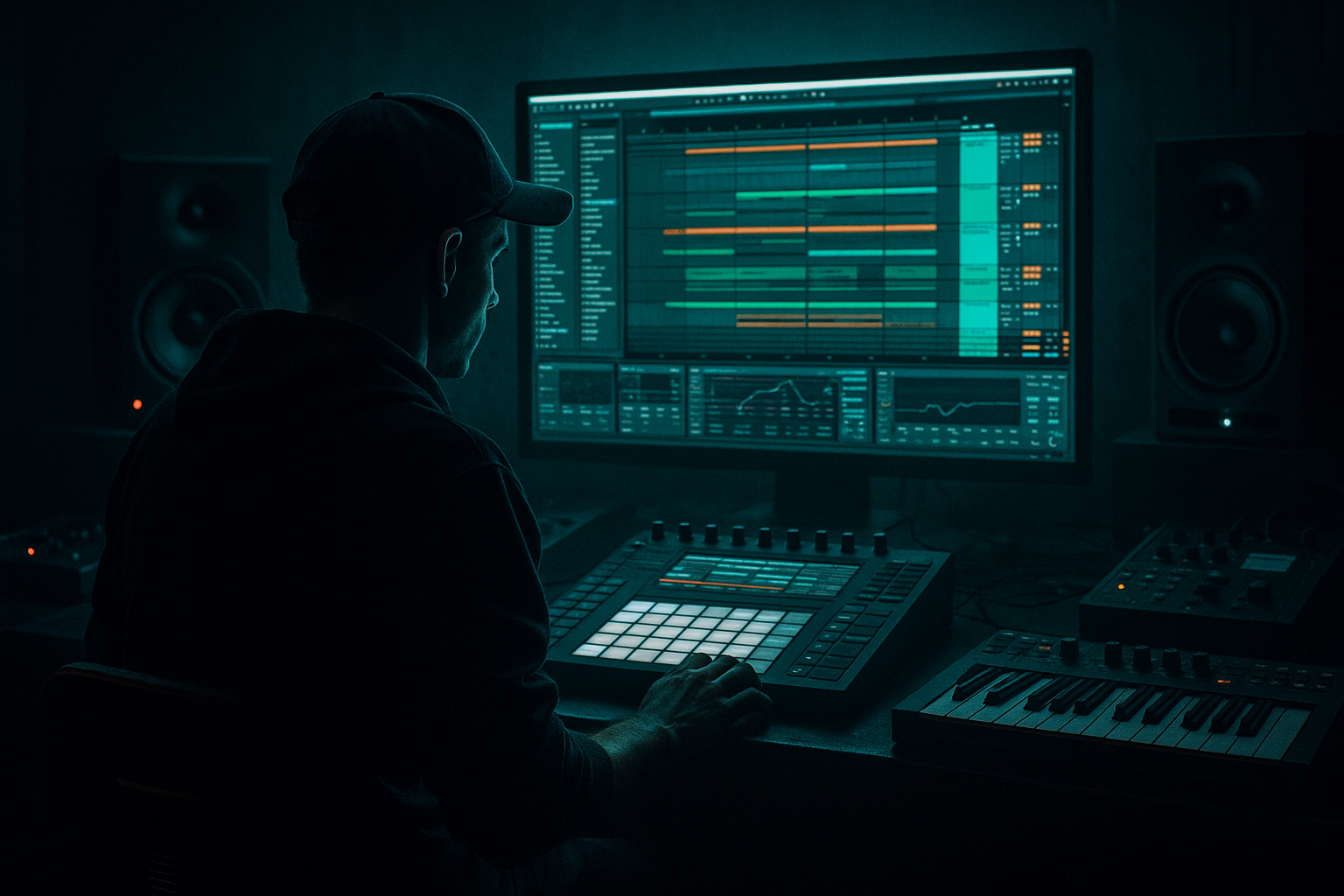
Main tutorial
```markdown
Funky Drummer Jungle Mid Bass: Blend & Arrange in Ableton Live 12 🥁⚡️
Skill level: Beginner
Category: Sound Design (with real arrangement + mix workflow)
---
1) Lesson overview
In this lesson you’ll build a classic jungle/DnB mid-bass that locks with a Funky Drummer-style break, then learn how to blend, automate, and arrange it into a rolling 32–64 bar idea in Ableton Live 12.
You’ll focus on:
- Making a mid-bass that speaks on small speakers (the “growl/knock” layer)
- Leaving space for sub and break transients
- Using stock Ableton devices to shape tone, movement, and groove
- Arranging like real jungle: intros, drops, edits, fills, and switches
- A mid-bass rack (mid-only) that you can reuse
- A break-driven groove with tight timing and punch
- A simple arrangement:
- Automation for filter, drive, and movement to keep it rolling 🎛️
- EQ Eight
- Drum Buss
- Glue Compressor
- SUB (mono, clean, low)
- MID BASS (character, movement, audible on phones)
- Short notes
- Call-and-response
- Offbeats
- Little slides
- Notes: A1, G1, C2, D2 (adjust octave to taste)
- Rhythm idea:
- On `BREAK`, ensure there’s no massive low sub:
- On `MID BASS`:
- Add Utility at end of `MID BASS` chain:
- If you later add sub: keep sub at 0% width (mono).
- Break filtered (use Auto Filter on BREAK)
- Add tiny ear candy:
- Mid-bass: tease it (low volume or filtered)
- Full break + mid-bass
- Add a crash on bar 17
- Add a 1-bar fill at bar 32 (slice a snare roll from the break)
- Change bass rhythm slightly (remove a note, add a syncopated hit)
- Or switch the bass tone:
- Add a break edit (drop kick for half a bar, let snares run)
- Introduce a new bass “reply” phrase
- Or swap to a second mid-bass rack (copy the track and tweak)
- Make the mid-bass dirtier, not louder:
- Narrow the mid-bass, widen the tops:
- Use a “reese-like” variation:
- Darkness = controlled highs:
- Tension edits:
- Break prep: Warp (Beats), slice, groove
- Mid-bass: Wavetable + Saturator + Filter + EQ + Compression
- Blend: EQ separation + sidechain ducking + stereo control
- Arrange: intro → drop → variation → (optional) switch
- Movement: automation = energy
---
2) What you will build
By the end you’ll have:
- 16 bars intro (DJ-friendly)
- 16 bars drop A
- 16 bars variation/fill
- (optional) 16 bars drop B switch
---
3) Step-by-step walkthrough
Step 0 — Project setup (DnB basics)
1. Tempo: Set to 165–172 BPM (try 170).
2. Warp mode: Keep drums crisp—make sure your break is in Beats warp mode.
3. Create tracks:
- Audio Track: `BREAK`
- MIDI Track: `MID BASS`
- (Optional later) MIDI Track: `SUB`
- Return Tracks: `A - SHORT ROOM`, `B - DUB DELAY` (optional)
---
Step 1 — Load and prep a Funky Drummer-style break 🥁
1. Drag your break sample onto `BREAK`.
2. In Clip View:
- Turn on Warp
- Warp mode: Beats
- Preserve: Transient
- Set Transient Loop Mode: Forward
- Adjust Start Marker so the first kick lands exactly on 1.1.1
3. Slice the break (beginner-friendly method):
- Right-click the clip → Slice to New MIDI Track
- Slicing preset: Built-in → Slicing
- Slice by: Transients
Now you have a Drum Rack with break hits.
Goal: We’ll keep the break’s vibe, but tighten its relationship with the bass.
---
Step 2 — Make the break roll (basic jungle edits)
1. In the sliced MIDI clip, program a simple 1-bar loop:
- Keep the main kick/snare cadence intact
- Add a couple of ghost notes (quiet snares/hats) between hits
2. Groove without getting messy:
- Select the MIDI notes → Quantize Settings
- Quantize Amount: 70–85%
- Add a little swing: Groove Pool → try MPC 16 Swing 55–60 (subtle)
Quick tone shaping on the BREAK track (stock chain):
- HP filter around 30–40 Hz (remove rumble)
- Small cut 250–400 Hz if boxy
- Gentle boost 6–9 kHz if dull (careful!)
- Drive: 5–15%
- Boom: 0–10% (don’t overdo; breaks can get flubby)
- Crunch: 0–20% (taste)
- Attack: 3 ms
- Release: Auto
- Ratio: 2:1
- Aim for 1–3 dB gain reduction on peaks
---
Step 3 — Build the jungle mid-bass (the “speaker bass”) 🎚️
Important concept: In DnB you usually split bass into:
This lesson focuses on MID BASS.
#### Option A (fast & effective): Wavetable mid-bass
1. On `MID BASS`, load Wavetable.
2. Settings:
- Osc 1: Basic Shapes → Square (or Saw for brighter)
- Osc 2: Off (for simplicity)
- Voices: 1 (Mono)
- Glide/Portamento: 40–80 ms (for slinky movement)
- Filter: MS2 (or PRD) low-pass
- Cutoff: start around 250–600 Hz
- Resonance: 10–25%
3. Add movement:
- LFO 1 → map to Filter Cutoff
- Rate: 1/8 (sync)
- Amount: small to medium (enough to “talk”)
#### Mid-bass processing chain (stock, practical)
After Wavetable, add:
1. Saturator
- Mode: Analog Clip
- Drive: 3–8 dB
- Soft Clip: On
2. Auto Filter (movement + control)
- Filter: Low-pass
- Envelope: tiny positive amount (optional)
- Map cutoff for automation later
3. Amp (optional but great for grit)
- Preset style: start with Clean or Blues
- Gain: low (don’t explode the mix)
4. EQ Eight
- High-pass at 120–180 Hz (this makes it mid bass, not sub)
- Dip harshness at 2–4 kHz if needed
- If it’s too nasal, cut 700–1.2 kHz
5. Compressor (or Glue)
- Ratio: 4:1
- Attack: 10–30 ms
- Release: 80–150 ms
- Aim: stabilize it, not squash it to death (2–5 dB GR)
Why HP at 120–180 Hz?
Because your mid-bass should not fight the sub and kick. It should add texture + note definition.
---
Step 4 — Write a bassline that fits jungle (simple but authentic)
DnB/jungle basslines often lean on:
In a 1-bar loop, try this starter pattern in A minor:
- Hit on 1.1
- Short note on 1.2.3
- Another on 1.3
- Rest + hit on 1.4.2 (syncopation)
Keep notes short (1/8 or 1/16). Jungle is about space and groove.
---
Step 5 — Blend bass and break (the “lock”) 🔒
This is where most beginners lose the vibe. Do these in order:
#### A) Make room with EQ (fast win)
- HP at 30–40 Hz
- HP at 120–180 Hz (as above)
- Keep it present around 200–800 Hz, but not honky
#### B) Sidechain the mid-bass to the break’s kick/snare
You want the mid-bass to duck slightly so the break punches through.
Method (simple):
1. Add Compressor to `MID BASS`.
2. Enable Sidechain.
3. Input: `BREAK` (or better: a separate kick ghost trigger if you have one).
4. Start settings:
- Ratio: 4:1
- Attack: 1–3 ms
- Release: 80–140 ms
- Threshold: lower until you see 2–6 dB gain reduction on drum hits
#### C) Control stereo: keep bass stable
- Width: 80–120% (careful—too wide gets phasey)
---
Step 6 — Add “jungle movement” with automation 🎛️✨
DnB basslines stay interesting through automation, not constant new notes.
In Arrangement View:
1. Automate Auto Filter cutoff on `MID BASS`:
- Close slightly during busy drum fills
- Open on the “answer” phrase
2. Automate Saturator Drive:
- +1 to +3 dB in the drop
- Pull it back in breakdowns
3. Optional: automate LFO amount (Wavetable):
- Less movement in intro
- More movement in drop
Think: A section = stable, B section = slightly wilder.
---
Step 7 — Arrange a real jungle/DnB structure (32–64 bars)
Here’s a beginner-friendly arrangement you can copy:
#### Bars 1–16: Intro (DJ-friendly)
- Start cutoff around 500–1kHz, open gradually
- One-shot FX
- A hat loop
#### Bars 17–32: Drop A (full energy)
#### Bars 33–48: Variation
- Increase drive
- Open filter
#### Bars 49–64: Drop B (optional)
Classic jungle trick: drop the bass for 1/2 bar before a phrase restart → instant hype.
---
4) Common mistakes (and how to fix them)
1. Mid-bass fighting the break’s punch
- Fix: sidechain ducking + reduce 200–400 Hz on bass if it masks snare body
2. Too much low end in the mid-bass
- Fix: HP at 120–180 Hz on mid-bass (keep sub separate)
3. Over-warping breaks (smearing transients)
- Fix: use Beats mode, preserve Transient, avoid extreme stretching
4. Bass sounds cool solo but weak in the track
- Fix: add harmonics (Saturator), keep notes shorter, automate cutoff
5. Arrangement feels looped
- Fix: add fills every 8 or 16 bars, automate drive/filter, remove elements briefly
---
5) Pro tips for darker/heavier DnB 🖤
Use Roar (if available in your Live version) or Saturator + Amp to add grit without blowing headroom.
Keep bass relatively centered; widen hats/atmos with Utility or Chorus-Ensemble.
Duplicate the MID BASS track → detune Osc 1 slightly or add Osc 2 with small detune → then HP it so it stays mid-only.
Roll off harsh top end with EQ Eight (gentle shelf down from 8–10 kHz) while keeping snare crack present.
Drop drums for 1 beat, keep bass tail, then slam back in. Jungle lives on edits.
---
6) Mini practice exercise (15–25 minutes) ✅
1. Make a 4-bar loop with your break and mid-bass.
2. Create 2 bass variations:
- Variation 1: change rhythm only
- Variation 2: automate filter cutoff differently
3. Arrange 16 bars:
- Bars 1–8: filtered drums + filtered bass
- Bars 9–16: full drums + full bass
4. Add one fill at bar 8 or 16 using sliced break hits.
Goal: it should feel like it “drops” even in just 16 bars.
---
7) Recap
You built a beginner-friendly jungle/DnB mid-bass and learned how to blend and arrange it with a Funky Drummer-style break in Ableton Live 12:
If you want, tell me your tempo and what break you’re using, and I’ll suggest a tight 2-bar bass MIDI pattern and exact automation moves for a proper rolling drop.
```

