Main tutorial
Lesson Overview
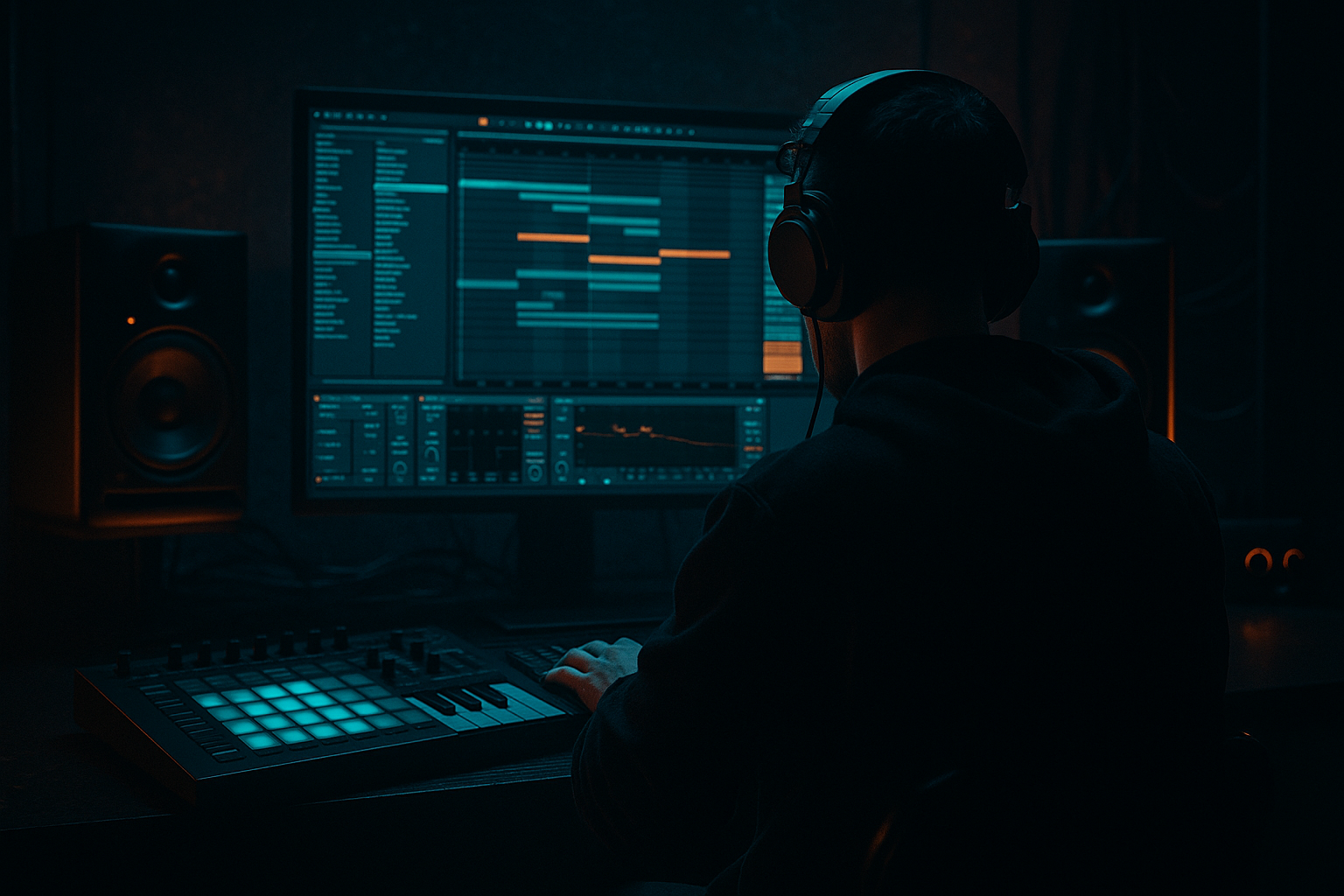
This lesson is about taking a classic Funky Drummer-style break and turning it into a transition edit that feels like authentic oldskool jungle / DnB movement without blowing up your headroom. In Ableton Live 12, that means building a break transformation that can carry you from one phrase to the next: a clean pre-drop lift, a halftime-to-double-time flip, a chopped fill, or a switch into a darker roller section.
Why this matters in DnB: drum & bass arrangement lives and dies by energy control. A good transition edit doesn’t just sound cool — it protects the low end, keeps the kick/snare relationship stable, and makes the drop feel bigger because the mix never got slammed before it arrived. If you overstack the break, transient chain, and FX all at once, the section gets loud but smaller. If you shape it carefully, you get that crisp, punchy, nostalgic jungle pressure with room for the sub and bassline to hit properly.
We’re focusing on an edits workflow: slicing, rearranging, resampling, and automating a Funky Drummer break into a transition element you can reuse across tracks. This is a very DnB-native technique because jungle and early DnB were built on break manipulation, but here we’ll do it in a way that stays modern, mix-safe, and headroom-aware inside Ableton Live 12.
What You Will Build
By the end of this lesson, you’ll have a 4- to 8-bar transition edit based on Funky Drummer that does three things:
1. Starts as a recognizable break groove.
2. Evolves into a chopped, tension-building fill or lift.
3. Resolves into a clean drop or a new section without eating headroom.
Musically, the result should feel like:
- A tight break edit with ghost notes and snare flicks
- A rising sense of motion through filtering, reverse hits, and re-slicing
- A controlled transient peak that leaves space for sub and reese bass
- A transition that works in a jungle intro, oldskool halftime switch, or roller drop setup
- Pushing the break too loud before the drop
- Over-quantizing the groove
- Stacking too many fills at once
- Ignoring the sub when editing drums
- Using too much reverb or delay on the full loop
- Not managing transient peaks
- Keep the break dark, not blurry. Roll off some top end with EQ Eight if the funk sample becomes too bright once chopped. Darker DnB often benefits from restrained cymbal energy.
- Layer a short sub-hit under the drop point. A single mono sine or 808-style sub note, very short and controlled, can make the transition land harder without needing more drum volume.
- Use a reese answer after the edit. The break edit can end with a snare roll, then the reese enters with a simple 1- or 2-note response. That call-and-response structure is classic roller language.
- Try saturating the transition only, not the whole break. A little Saturator or Drum Buss on the fill section can add urgency while keeping the main groove cleaner.
- Automate a tiny width change for impact. Keep the drums narrow and mono-safe, then open a very subtle stereo texture or ambience only in the final half-bar. The drop will feel wider by comparison.
- Use reverse room tails for tension. A reversed snare room or reversed break fragment before the drop gives that oldskool jungle suck-in effect.
- Check the master at low volume. If the transition still reads when quiet, it’s probably balanced correctly. If it disappears, it was relying on loudness instead of shape.
You’ll also end up with a reusable Ableton rack / track structure for future edits, so you can build more transitions faster.
Step-by-Step Walkthrough
1. Load the break and set the project up for edit work
Start by importing a clean Funky Drummer sample onto an audio track. If you have a longer loop, trim it so you’re working from a clear one- or two-bar section with strong snare landmarks. In Ableton Live 12, switch the track to Warp mode and make sure the groove sits properly at your project tempo — for jungle/oldskool DnB, a range around 160–174 BPM is most typical, with 170 BPM being a strong working point.
Use Complex Pro only if you need time-stretching that preserves the break’s body; otherwise, try Beats with preserved transients if the sample is already close to tempo. Keep the clip gain conservative: aim for the break hitting around -12 to -9 dB peak before any processing. That gives you room to edit aggressively later.
Why this works in DnB: break-based genres rely on punchy transient contrast. If the raw break is already too hot, every edit and FX layer becomes a headroom problem, especially once the sub comes in.
2. Slice the break into playable pieces instead of treating it like a loop
Right-click the clip and choose Slice to New MIDI Track. Slice by transients so you can trigger kick, snare, ghost hits, hats, and tiny funk articulations independently. Use the default Simpler mapping or move to a Drum Rack if you want more control over chain processing.
Organize the slices into categories:
- Main kick
- Main snare
- Ghost snare / rim
- Hat ticks
- Tail noise / room hit
Now build a basic 2-bar performance in MIDI that keeps the feel of the original break but gives you editing control. A good intermediate move is to leave the main snare mostly intact while chopping the surrounding micro-hits. That preserves the identity of Funky Drummer while letting the transition evolve.
Use Groove Pool with a swing that feels authentic to the break. Try starting around 55–58% swing on 16ths, then adjust by ear. Don’t quantize everything hard; let some micro-timing breathe.
3. Design the first 2 bars as a “before the transition” groove
The first part of the edit should still feel like a drum groove, not a fill. Keep the main kick/snare pocket strong and use ghost notes to imply movement. In the MIDI editor, keep the snare on the expected backbeat, but add short hats and low-volume snares around it.
Good starting ranges:
- Ghost notes at velocity 20–50
- Main snare at velocity 90–115
- Hats around velocity 30–70, with some variation
- Leave 1–2 small gaps per bar so the edit breathes
Add subtle variation on bar 2: for example, mute one kick or replace one ghost note with a tiny reverse slice. That kind of edit is very oldskool DnB — it keeps the phrase alive and sets up the transition without needing a giant FX sweep.
If the track has a bassline already, check the edit against it in context. A strong DnB edit should feel like it’s making room for the sub, not fighting it. Keep the low-end-heavy break elements under control with clip gain and EQ, not just volume faders.
4. Convert the break into a transition with resampling and micro-edits
Duplicate your break track and create a second version that is purely for the transition. This is where you stop thinking “loop” and start thinking “edit.”
In the transition version:
- Chop the last beat of bar 2 into smaller slices
- Repeat a snare ghost 2 or 3 times for a roll
- Add a reverse break slice leading into the drop
- Remove one kick or main snare hit to create tension
A useful method in Ableton Live 12 is to resample the edited break to a new audio track once you like the pattern. Then you can rearrange the resampled audio like a performance clip. This often sounds more cohesive than stacking too many individual slices because the transient relationship is already printed.
For the transition bar, try a simple structure like:
- Beat 1–2: groove still present
- Beat 3: snare roll or chopped fill
- Beat 4: reverse hit / fill / final snare
- Drop start: clean impact with the bassline
Keep the edit musically intentional. Don’t just cram in extra hits. In DnB, the best transition edits feel like they’re pulling the listener forward, not showing off random chops.
5. Control headroom with layered gain staging and transient shaping
This is the crucial part. Your transition can be dense and still leave headroom if you control the envelope and level of each layer.
On the edited break track, use:
- EQ Eight to clean sub-rumble below 25–35 Hz
- A gentle dip around 200–400 Hz if the break gets boxy
- A small high-shelf cut if the hats become brittle
Then add Drum Buss lightly:
- Drive: around 5–15%
- Boom: low or off for this exercise
- Transients: +5 to +20 for extra snap
- Damp: adjust to keep the top from getting sharp
If you need more control, add Compressor or Glue Compressor on the break bus with modest settings:
- Ratio: 2:1 or 4:1
- Attack: 10–30 ms
- Release: Auto or 80–150 ms
- Aim for just 1–3 dB of gain reduction
The key is to tame peaks before they hit the master. A transition edit can look exciting on the waveform but still be mix-safe if the loudest transient is managed properly. That’s how you keep space for the bass drop.
6. Automate filters, delays, and space without washing out the groove
Now build the transition energy using automation instead of brute force loudness. Insert Auto Filter on the transition track and automate a slow rise:
- Start with a low-pass around 2–4 kHz
- Open it to full range over 1–2 bars
- Add a subtle resonance bump only if it helps the lift
For atmosphere, use Echo or Delay on a return track, not directly on the drum track. Send only selected hits — especially the last snare or reverse slice — into the delay for a dubby jungle tail. Keep the return level low enough that it decorates the transition rather than clouding the groove.
A practical arrangement move: automate the send up only on the final snare of the phrase, then bring it back down immediately after. That creates tension without leaving a constant wash over the entire break.
If you want a classic oldskool feel, automate a short reverb on the final chopped snare:
- Decay: 0.4–1.0 s
- Pre-delay: 10–25 ms
- High cut: fairly low, to keep it dark
This works because DnB transitions often feel strongest when the drums are still readable. Space should feel like a surge, not a smear.
7. Tie the edit to the bassline and arrangement
The edit only really works in context. In a jungle or oldskool DnB track, the transition often sits right before:
- A sub drop
- A reese call-and-response phrase
- A drum switch-up
- A DJ-friendly re-entry after an 8-bar intro
Build a simple arrangement example:
- Bars 1–8: stripped intro with break fragments
- Bars 9–12: full groove and bassline
- Bars 13–14: transition edit builds tension
- Bar 15: bass cuts, break rolls, final snare lift
- Bar 16: drop with full sub and reese
When the bass comes back in, make sure the transition hasn’t stolen all the low-end energy. If you’re using a sub, keep it mono and stable. Use Utility on the bass group to check mono and, if needed, reduce width to 0% for the sub layer. That way the edited break can be energetic in the mids and highs without fighting the foundation.
8. Print a final performance clip and clean the arrangement
Once the transition sounds right, resample or consolidate the result into a final audio clip. This is where edits become efficient: one clip, one lane, easy to move around the arrangement.
Trim silence, fade the clip edges cleanly, and leave yourself enough room for DJ-style phrasing. For example, if your track needs a mix-friendly intro, keep the transition element out of the first 8 or 16 bars and save it for a later phrase change.
Label your clips clearly:
- “FunkyDrummer_Edit_A”
- “FunkyDrummer_Roll_Transition”
- “FunkyDrummer_ReverseLift”
- “FunkyDrummer_DropIn”
This may seem basic, but in DnB workflow speed matters. A clean edit library lets you build new arrangements faster and keep your creative momentum.
Common Mistakes
Fix: Pull the break down and rebuild impact with arrangement and automation, not raw level.
Fix: Keep some human push-pull. Funky Drummer loses its feel if every slice is locked too hard.
Fix: Choose one main transition idea — roll, reverse, filter lift, or snare rush — and let it breathe.
Fix: Check the edited break against the bassline in context. If the low-mid region gets crowded, cut or shorten the break layers.
Fix: Send only selected hits to FX returns, especially the final snare or reverse hit.
Fix: Use Drum Buss, Clip Gain, or light compression before the master bus gets hit.
Pro Tips for Darker / Heavier DnB
Mini Practice Exercise
Spend 10–20 minutes building one transition edit from a Funky Drummer break.
1. Load a Funky Drummer loop at 170 BPM.
2. Slice it to a Drum Rack or Simpler setup.
3. Program 2 bars of groove with ghost notes and a stable snare.
4. Duplicate the clip and create a 1-bar transition version.
5. Add one of each: a snare roll, a reverse slice, and one removed kick.
6. Apply EQ Eight and Drum Buss lightly to control body and peaks.
7. Automate Auto Filter opening over the last bar.
8. Resample the result to audio and place it before a fake drop.
9. Test it with a sub note and a reese stab underneath.
10. Check the whole thing in mono and at low volume.
Goal: make it feel like a believable jungle/DnB transition that still leaves space for the bass to hit.
Recap
The core idea is simple: turn Funky Drummer into a controlled transition edit, not just a louder break. Use slicing, resampling, and automation to create movement. Keep your transient peaks in check, preserve groove, and leave enough headroom for the sub and bassline to do their job. In DnB, the strongest edits don’t just fill space — they shape the drop.

