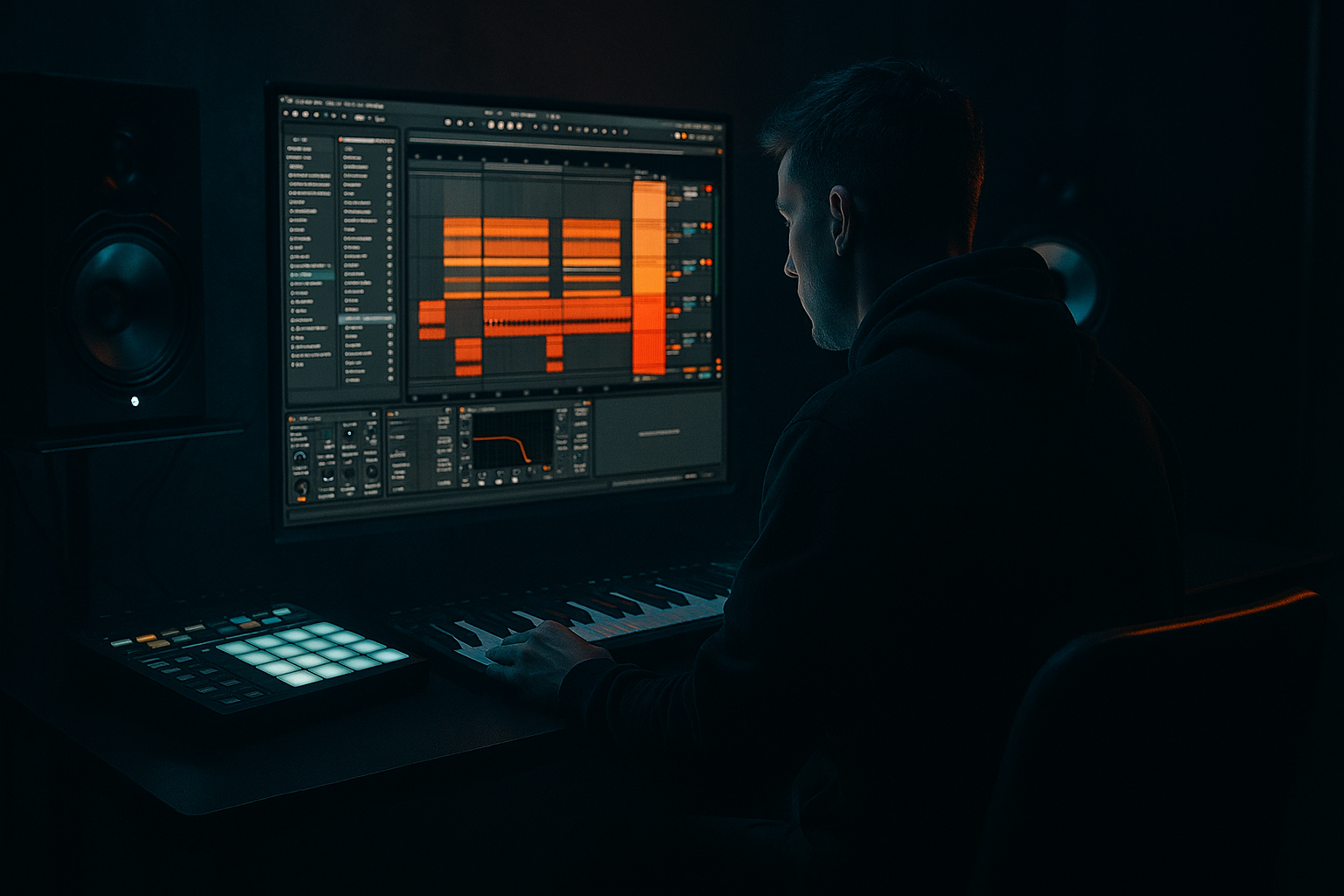
Main tutorial
Lesson Overview
This lesson is about building a darkside Future Jungle intro blueprint in Ableton Live 12 that feels like it came straight from a smoky warehouse: cold air, busted neon, oldskool jungle tension, and a modern DnB low-end undercurrent. The goal is not to write a full drop straight away, but to design a DJ-friendly intro section that sets mood, establishes identity, and tees up a heavy jungle/roller switch with real impact.
In DnB, the intro is doing a lot of work. It has to:
- establish the tonal world fast,
- hint at the bass personality without giving everything away,
- leave space for the mixdown to breathe,
- and create enough movement and grit that the listener feels the drop coming.
- sample-based drum design
- resampled atmospheres
- modulated reese textures
- controlled distortion
- arrangement automation
- and clean low-end management
- Bars 1–4: distant atmosphere, vinyl/tape haze, filtered percussion fragments, and a low sub hint
- Bars 5–8: an edited breakbeat enters with ghost hits, chopped hats, and tension risers
- Bars 9–12: a reese/bass texture starts pulsing in the midrange while the sub stays restrained
- Bars 13–16: a stronger rhythmic identity appears, setting up the drop with a final fill, reverse crash, and bass pickup
- minor-key tension,
- broken amen energy,
- oldskool jungle movement,
- and a modern dark DnB low-end bed underneath.
- Making the intro too full too early
- Letting the sub and kick fight
- Overprocessing the break so it loses its swing
- Too much stereo width in the low end
- Automation that sounds like random movement
- Harsh top end from overcranked distortion
- Parallel grime bus: send the reese and selected drum hits to a return with Saturator + Overdrive + EQ Eight, then blend in low. This adds underground density without destroying the main channel.
- Ghost bass movement: automate tiny filter nudges or note velocity changes on the reese so it “breathes” between drum hits.
- Resample your own tension: bounce 4–8 bars of the intro, then chop the audio into reverse swells, one-shot impacts, and degraded textures. This often sounds more authentic than endless MIDI tweaking.
- Control the top of the break: if the break gets brittle, use a gentle high shelf cut or dynamic restraint through clip gain/automation rather than flattening the whole thing.
- Use call-and-response phrasing: let the drums say something, then let the bass answer. That’s classic jungle logic, and it keeps dark intro arrangements feeling musical rather than mechanical.
- Keep the sub narrative simple: one strong low motif beats five weak ideas. The intro should imply the drop’s identity, not explain everything.
- 1 atmosphere track
- 1 break track
- 1 sub track
- 1 reese track
- 2 FX tracks
- Build the intro around mood, tension, and phrasing, not constant density.
- Use edited breaks, mono sub, and a restrained reese to create a dark Future Jungle identity.
- Automate in 2-, 4-, and 8-bar shapes so the arrangement feels intentional.
- Keep the low end disciplined and the top end gritty but controlled.
- Resampling, filtering, and selective distortion are your best tools for smoky warehouse character.
- The strongest dark DnB intros sound like they are holding back on purpose.
For a dark Future Jungle intro, the sound design matters because the genre lives on contrast: broken amen pressure, sub weight, eerie atmospheres, tape-style degradation, and stereo control. If the intro already sounds expensive and tense, the drop hits harder when the drums and bass finally open up.
This lesson focuses on an advanced Ableton workflow that combines:
By the end, you’ll have a blueprint you can reuse for smoky intros, cold breakdowns, and dark jungle preludes that still feel modern in an Ableton Live 12 session.
What You Will Build
You will build a 16-bar intro section that works like a DJ intro or first half of a tune:
Musically, this will feel like:
The result should sound like a warehouse intro for a track that could drop into jungle, rollers, or darkstep-adjacent territory without losing its oldskool character.
Step-by-Step Walkthrough
1. Set the arrangement framework before sound design
Start with a blank Live 12 project and set the tempo between 170 and 174 BPM. For this blueprint, 172 BPM is a strong middle ground: fast enough for jungle energy, but flexible for heavier DnB phrasing.
Create these groups:
- Drums
- Bass
- Atmospheres
- FX
- Returns
In the Arrangement View, mark out a 16-bar intro, a drop point, and a 32-bar development section. If you work like a DJ, think of bars 1–16 as the blend-in zone. This helps you make better decisions about how much energy to reveal early.
Add a reference track if you want, but keep it low in the mix and muted for comparison only. Oldskool jungle intros usually earn their power by leaving space for the DJ to mix in the next record, so don’t overfill the first 16 bars.
Why this works in DnB: the intro needs controlled narrative. A drum-and-bass listener expects fast phrasing, but not constant density. Space and restraint make the later drum switch or bass drop feel bigger.
2. Build the atmospheric bed with resampled texture
Create an audio track for atmosphere and start with a single field recording, noise loop, or sustained synth sample. If you don’t have external material, use Ableton stock tools to synthesize grit:
- Add Wavetable or Operator
- Use a noise source or a simple detuned saw with no obvious melodic motion
- Filter it heavily with Auto Filter
- Add Redux for digital roughness if needed
Suggested chain:
- Auto Filter: low-pass around 400–1.2 kHz, resonance low to moderate
- Hybrid Reverb: small dark room or convolution hall, decay around 1.8–3.5 s
- Echo: low feedback, darkened repeats, high cut around 3–6 kHz
- Utility: reduce width if the texture feels too wide in the low mids
Then automate the filter to slowly open over the first 8 bars. Keep the movement subtle: think 5–15% changes, not a dramatic sweep. Add a little frequency modulation or slow LFO-style motion using Shaper or LFO-style clip automation if you want the pad to wobble like fluorescent warehouse light.
Save-worthy trick: resample 4 bars of this atmosphere to a new audio track, then reverse sections and chop them into 1-bar and 2-bar phrases. This gives you the degraded, tape-worn intro feel that oldskool jungle often nails so well.
3. Design the drum identity from an amen-first perspective
Place a classic-style break, ideally an amen or amen-adjacent loop, but don’t just loop it raw. The key is to edit it like a producer, not a librarian.
Use the Slice to New MIDI Track workflow if your break is audio. Then:
- assign slices to a Drum Rack,
- shorten the open tail hits,
- accent the snare ghosts,
- and remove a few kicks to create space.
On the break channel or Drum Rack group, add:
- Drum Buss for weight and transient control
- EQ Eight to carve low mud
- Saturator for controlled bite
Starting settings:
- Drum Buss Drive: around 5–15%
- Boom: low, or off during the intro if the sub will carry separately
- Transient: slightly positive for snap, or neutral if the break is already sharp
- Saturator Drive: 2–6 dB, with soft clip on if needed
Edit the break so it doesn’t feel too looped:
- Bar 1: leave it sparse
- Bar 2: introduce a ghost snare or shuffled hat
- Bar 3: add a kick pickup
- Bar 4: a small fill or reverse fragment
Use clip envelopes for fast edits if you want the intro to feel alive without drawing every automation lane manually. A strong jungle intro often uses micro-variation every 2 bars, not full-on chaos.
4. Create a sub foundation that hints at the drop without giving it away
Make a dedicated Sub Bass instrument using Operator. Keep it simple: a sine or very soft triangle, mono, clean, and controlled. This is not the main bassline yet; it’s the pressure underneath the intro.
Suggested Operator setup:
- Oscillator A: Sine
- Filter: off or minimal
- Volume envelope: short attack, medium decay if you want stabs, or sustained for a long note
- Voices: mono
- Glide: very subtle if you want a slur between notes
Write a sparse 2-bar phrase:
- note 1 on the root
- a small movement to the fifth or flat seventh
- occasional pickup note before the bar line
Keep the sub mostly in the 40–60 Hz zone and avoid overlong notes that obscure the kick or break transient. If the intro is drum-led, let the sub appear in call-and-response with the break rather than constantly holding the floor.
Process it with:
- EQ Eight: high-pass around 25–30 Hz
- Saturator: very light drive for translation on smaller systems
- Utility: mono the bass completely
If you want extra tension, automate a low-pass filter on the sub so it feels like it’s emerging from below the floor rather than sitting fully exposed from bar 1.
5. Build a dark reese layer for midrange tension
Now create the signature darkside tension layer. Use Wavetable or Analog to build a reese with movement in the mids, but keep it restrained enough for an intro.
In Wavetable:
- Use two detuned saw-style oscillators or stacked unison
- Slight phase offset or oscillator detune
- Route through a low-pass filter with moderate resonance
- Add slow modulation to wavetable position or filter cutoff
Suggested settings:
- Detune: enough to thicken, but not so wide that it smears the groove
- Filter cutoff: around 150–600 Hz for the intro layer, depending on how much midrange you want
- Resonance: 10–25%
- LFO rate or automation sweep: very slow, over 2–8 bars
- Drive: moderate, enough to create harmonics
Then process with a chain like:
- Amp or Overdrive for edge
- Corpus very lightly if you want metallic resonant tension
- EQ Eight to remove mud below 120–180 Hz
- Auto Filter for opening movement
Split the bass into layers:
- Sub layer = mono, clean, low
- Reese layer = midrange movement, narrowed or controlled below stereo-critical zones
- Texture layer = optional noise or distorted top layer, high-passed aggressively
This is where the intro starts to feel like dark DnB rather than just jungle drums. The reese doesn’t need to play the full bassline yet; even rhythmic hints in bars 9–16 are enough.
6. Shape the intro with automation and filter choreography
Use automation to make the section breathe. In dark intro design, automation is not decoration; it’s arrangement.
Focus on these lanes:
- Atmosphere filter cutoff
- Breakbeat high-pass or low-pass
- Reese filter movement
- Reverb send amount
- Delay feedback on one-shot FX
- Utility width on background textures
Good automation ideas:
- Bars 1–4: atmosphere low-pass slowly opens from 300 Hz to 1.2 kHz
- Bars 5–8: breakbeat high-pass eases down slightly to reveal body
- Bars 9–12: reese cutoff rises in a 2-bar phrase, then snaps back
- Bar 15–16: reduce reverb send on the drums so the final hit feels drier and more imminent
Add one or two distinct “tells”:
- a reverse crash before bar 9,
- a ghost vocal hit,
- a pitch-dropped stab,
- or a tape-stop-style turnaround using Warp and clip envelope changes.
Keep automation purposeful. If every lane is moving constantly, the intro loses focus. In DnB, tension is often built through one strong motion at a time while the rest of the groove stays locked.
7. Program the fills and switch-ups like a proper jungle intro
A strong Future Jungle intro needs enough drum intelligence to feel alive. Use 2-bar phrasing with a switch-up every 4 bars.
Example arrangement:
- Bars 1–2: sparse break, atmosphere only
- Bars 3–4: add ghost snares and a chopped hat fill
- Bars 5–6: introduce a second break layer or a one-shot tom
- Bars 7–8: brief drop-out before the next phrase
- Bars 9–10: bass pulse enters
- Bars 11–12: add snare drag or amen chop
- Bars 13–16: full tension build with pickup into drop
Use Drum Rack or audio clips for fills. If you’re using a rack, add:
- a rimshot layer,
- a shaker or ride ghost,
- and one short tom for classic jungle punctuation.
On the drum bus, apply Glue Compressor lightly:
- ratio 2:1
- attack 10–30 ms
- release Auto or 0.1–0.3 s
- only 1–2 dB of gain reduction
This glues the break and fills without flattening their punch. If the break starts feeling too polite, increase transient shaping with Drum Buss rather than smashing the bus harder.
8. Design the transition into the drop with contrast in mind
The last 2 bars should prepare the drop by simplifying, not overcrowding. Pull elements out so the drop can arrive with authority.
A strong transition recipe:
- remove the atmosphere low end
- filter the reese down briefly
- let the sub hold one final note
- add a riser or noise swell
- trigger a reverse crash into the first drop hit
- stop the break for half a beat if you want maximum impact
Use Echo or Hybrid Reverb throws on select hits, but automate them to disappear right before the drop. That “last tail cut” gives the drop a clean edge.
For a classic warehouse feel, let the final bar do a tiny fake-out:
- a half-bar snare pickup,
- one beat of silence,
- then the full drum/bass drop.
That silence is powerful. In drum and bass, a tiny negative space before the drop can feel heavier than adding another layer. It frames the first hit like a spotlight.
Common Mistakes
Fix: strip it back to atmosphere + break + one bass hint until at least bar 5 or 9.
Fix: mono the sub, high-pass non-bass elements, and keep kick energy from masking the main low note.
Fix: use subtle Drum Buss and light saturation; preserve the natural shuffle and ghost note character.
Fix: keep sub mono, check Utility width, and avoid wide effects below roughly 120 Hz.
Fix: automate with phrasing. In DnB, movements should feel tied to 2-, 4-, or 8-bar logic.
Fix: tame with EQ Eight, use filtered distortion, and reduce high-frequency buildup before it becomes fatiguing.
Pro Tips for Darker / Heavier DnB
Mini Practice Exercise
Spend 15 minutes building a fresh 16-bar dark Future Jungle intro using only Ableton stock devices.
1. Set tempo to 172 BPM.
2. Create one atmospheric layer with Wavetable or a resampled noise texture.
3. Add one edited breakbeat and make at least three micro-edits across 8 bars.
4. Build a mono sub in Operator with a 2-bar phrase.
5. Add a reese texture with Wavetable, and automate the filter over 8 bars.
6. Use one reverse crash and one final-bar silence or drop-out before the transition.
7. Mix it so the bass stays clear in mono and the break still grooves.
Limit yourself to:
When finished, mute each track one by one and ask: does the intro still feel like a believable DnB build? If not, simplify until the vibe is undeniable.

