Main tutorial
Lesson Overview
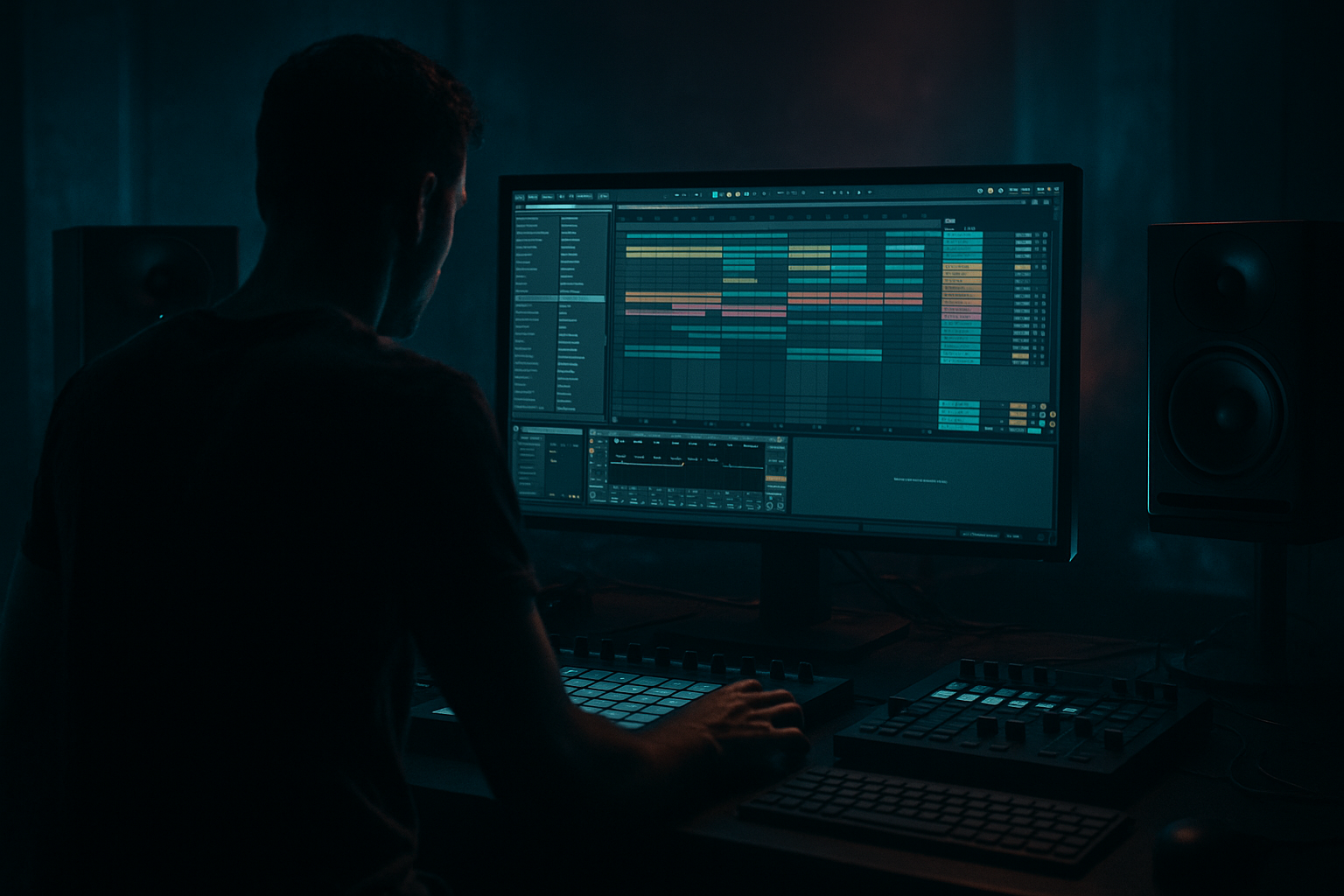
This lesson is about arranging a Future Jungle amen variation inside Ableton Live 12 so it feels like a real track section, not just a loop with extra drums. The goal is to take a chopped amen-led idea, give it clear A/B phrasing, bass interaction, and DJ-friendly structure, then evolve it into something that can survive a full drop without losing impact.
This lives in the heart of a DnB track: the main drop, second-drop switch-up, or an energy-peak midsection where you want break energy, jungle pressure, and modern low-end discipline at the same time. For Future Jungle specifically, that means the amen is not just a loop—it’s a lead rhythmic character that must work with subs, reese layers, atmospheres, and arrangement tension.
Why it matters musically: the amen provides motion, urgency, and identity. Why it matters technically: if you don’t arrange it with the bass and section changes in mind, the loop gets cluttered, the kick/snare hierarchy collapses, and the track stops reading on a dancefloor. Future Jungle needs the energy of classic break culture, but with tighter mix control and stronger section contrast than old-school chop-and-pray.
By the end, you should be able to hear a rolling, broken, bass-driven section that breathes in 8- and 16-bar phrases, keeps the sub stable, and evolves enough to stay exciting without losing the core groove.
What You Will Build
You will build a Future Jungle amen variation arrangement in Ableton Live 12 that feels like a finished drop section: chopped break edits up front, a bass call-and-response underneath, a controlled A/B variation across phrases, and enough automation and transition work to make it DJ-usable.
Sonic character: gritty but controlled, dusty break transients, tight sub foundation, reese or mid-bass movement, and small FX details that suggest motion without flooding the mix.
Rhythmic feel: urgent, syncopated, forward-driving, with ghost-note energy and break swing that locks to the kick/snare backbone instead of fighting it.
Role in the track: a core drop or second-drop evolution that can carry 16–32 bars before switching into a new answer phrase.
Polish level: mix-ready enough that the break, bass, and atmos can be judged together; rough edges are fine if they are intentional, but the low end and snare impact should already read clearly.
Success sounds like this: the amen variation feels alive and unpredictable, but the listener still knows exactly where the snare lands, where the sub hits, and when the section turns.
Step-by-Step Walkthrough
1. Start with an arrangement lane, not a loop lane
In Ableton Live 12, set up three core tracks before you start chopping endlessly: one for the amen, one for the sub/bass, and one for textures or fills. Put markers in the Arrangement View for 8-bar and 16-bar phrasing so you are arranging immediately, not just building a loop.
For the amen, load it into a Simpler or Audio track and trim the start so the first hit lands cleanly. If the break is long, consolidate a few useful chop points first: kick/snare hit, ghost note, ride/tom pickup, and a clean transient tail. This is a workflow move: you are deciding what the break is for in the arrangement, not just what it contains.
Why this works in DnB: future jungle lives or dies on forward motion. If you only hear the amen inside a 1-bar loop, it often sounds impressive but directionless. Putting it in arrangement context early forces you to shape phrases around drum impact and bass density.
What to listen for: the first two bars should already imply a destination. If it feels like “cool drums” but not “a drop,” you need clearer phrase markers and a stronger bass answer.
2. Build the amen as an A/B variation, not a repeating chop
Create two complementary patterns from the same break:
- A phrase: the most recognisable amen motif, with the strongest snare/kick identity
- B phrase: a variation with different ghost-note placement, a missing hit, or a tighter pickup into the next bar
A practical way to do this in Ableton is to duplicate the amen clip and use different split points in each copy. Keep the main snare landing consistent, but change the internal movement. For example:
- Bar 1–2: strong classic amen phrasing, minimal rearrangement
- Bar 3–4: remove one kick or shift a ghost note earlier to create lift
- Bar 5–8: introduce a tom/ride pickup or a reversed micro-chop before the snare
Keep the snare hierarchy intact. In Future Jungle, the snare is often the anchor that lets the chaos feel intentional.
A versus B decision point:
- Choose A = more classic and raw if you want the section to feel like it grew out of jungle heritage and hit with immediate recognisability.
- Choose B = more edited and modern if you want the break to feel hyper-arranged, tighter, and more like a contemporary club weapon.
What to listen for: does the B phrase feel like a response, not just a copied loop? If the groove feels identical after two bars, the arrangement is too static.
3. Shape the break with stock devices before adding more layers
Put the amen through a focused stock-device chain. A strong starting point:
Chain 1: EQ Eight → Drum Buss → Saturator
- EQ Eight: high-pass only if the break has rumble that conflicts with the sub. Try removing unnecessary low energy around 25–40 Hz. If the kick thump is muddy, narrow a small cut in the 180–300 Hz area.
- Drum Buss: set Drive modestly, roughly 5–20%, and use Transients to bring out the front edge if the break is too soft.
- Saturator: Soft Clip on, Drive around 1–4 dB if you need a little grain and density.
If the break already has enough crunch, stop before the Saturator and commit the chain more lightly. Too much top-end distortion will make the snare hashy and the hats brittle.
Why this works: amen chops need definition at club playback levels. Drum Buss and gentle saturation increase perceived density without requiring you to over-layer.
What to listen for: the kick/snare should feel closer, not smaller. If the transient gets fuzzy and the loop sounds flatter, back off the drive and re-check the gain staging.
4. Lock the sub first, then arrange the bass movement around the break
Build the bassline as a separate performance lane with a stable sub underneath. Use a simple arrangement rule: if the amen is doing a busy fill, the bass should often simplify; if the break is sparse, the bass can answer more aggressively.
A practical stock-device bass chain:
Operator → Saturator → EQ Eight
- In Operator, keep the sub clean and stable. A sine-based low end with short notes usually works best for this style.
- Use Saturator lightly, often around 1–3 dB Drive, to make the sub audible on smaller systems without overthickening it.
- EQ Eight can cut unnecessary low-mid mud around 120–250 Hz if the bass and break are crowding each other.
Then layer a separate mid-bass or reese track above it if needed, with movement but controlled stereo. In Ableton, keep the sub mono and let the movement live in the mids and highs. If your reese has width, high-pass its stereo layer so the low end stays centered and readable.
Why this works in DnB: the amen already has a lot of midrange detail. If the bass also fights for the same space, the mix turns into an undefined blur and the drop loses punch.
Fix-it moment: if the break feels exciting alone but collapses when the bass enters, solo the bass at lower volume and check the 200–500 Hz zone. That area is often where “energy” turns into “mud.”
5. Use bar-length call-and-response to create arrangement momentum
Map the section as a conversation. A strong Future Jungle structure often works like this:
- Bars 1–4: establish the amen identity
- Bars 5–8: bass answers with a stronger phrase, amen becomes slightly more skeletal
- Bars 9–12: break variation and fill leading into tension
- Bars 13–16: full-energy return or a new variation
You can exaggerate this by giving the amen a denser first half of the phrase and leaving more space in the second half for the bass to speak, then swapping that relationship in the next 8 bars.
Add one explicit arrangement event: for example, at bar 9, remove the main bass for half a bar and let a break fill or reverse texture pull the listener into the next phrase.
What to listen for: if the section feels flat after 8 bars, the problem is usually not sound design—it’s that both the break and bass are saying the same thing for too long.
6. Edit the amen around drum hierarchy, not around novelty
In Live 12, use clip duplication and small split edits to preserve the hierarchy: kick, snare, ghost notes, then hats/ride detail. Don’t shred the break randomly. Make each edit serve either:
- a stronger backbeat,
- a clearer pickup into the next bar,
- or a tension release before the drop re-enters.
Try this: in one bar, keep the main snare clean and move one ghost note earlier by a 16th to create push. In the next bar, remove a busy hat slice so the snare lands heavier.
If the amen is becoming too synthetic, use Simpler in Slice mode for tighter control, or stay with audio clips if you want more natural decay and transient feel. Both are valid. Simpler is better for precise performance-style chopping; audio clips are better when you want the original break’s glue and micro-timing to stay intact.
Why this works: jungle and future jungle are built on feel. The listener should hear intentional edits, not random fragmentation.
Stop here if the snare no longer feels like the anchor. Rebuild the phrase before adding extra fills. If the hierarchy breaks, the arrangement may become clever but less danceable.
7. Add movement with automation, but keep it purposeful
Use automation to evolve the section without overloading it. Good targets:
- Auto Filter on a break texture or reese layer, moving from roughly 200 Hz up to several kHz across a phrase for tension
- Reverb on a short send for fills only, not the full break
- Delay on one-shot hits or transitional chops, kept low so it reads as space rather than clutter
- Utility on the bass width layer if you want to tighten or widen the mid-bass by section
Keep automation focused on section change points: the end of 4, 8, or 16 bars. If everything moves constantly, nothing feels like a lift.
What to listen for: during automation moves, does the groove get bigger or just wetter? Bigger is the goal. If the drum attack disappears, reduce the effect amount or automate it only into the transition, not across the whole bar.
8. Check the arrangement in full context with drums and bass active
This is the point where you stop thinking like a loop designer and start thinking like a track builder. Play the amen variation with:
- kick and snare reference,
- sub/bass,
- and at least one supporting atmospheric layer or stab.
In the Arrangement View, mute and unmute the bass or the main break layer to check whether each part still makes sense alone and together. If the bass only works when the break is absent, it is probably too busy or too wide.
Add a simple supporting layer if needed, such as a filtered pad or noise texture, but keep it out of the low mids. That layer should create depth, not mask the break.
Mix-clarity note: do a mono check on the main low-end relationship. The sub and the core drum impact should survive in mono. If the groove weakens dramatically, the stereo information is too low or the bass layers are not disciplined enough.
9. Create a second-drop evolution, not a copy
Future Jungle needs progression. For the second half of the section, change at least one of these:
- the amen chop pattern
- the bass rhythm
- the top texture
- the fill density
- the low-mid saturation character
A strong second-drop evolution might be:
- more broken amen edits,
- a tighter sub rhythm,
- one extra percussion accent,
- and a shorter turnaround into the next 16 bars.
You could also choose a contrast direction:
- Option A: heavier and more stripped, with more space and bigger snare impact
- Option B: more frayed and chaotic, with additional ghost-note pressure and more aggressive chop density
Both can work, but only if the core low-end and snare placement remain readable.
Workflow efficiency tip: once the first drop section is working, consolidate the key amen phrase into audio. This makes later arrangement edits faster and prevents endless micro-tweaking of slice points while you should be deciding the song’s shape.
10. Print, compare, and make the final judgment
Export or resample your section and listen back as if it were part of a finished tune. Compare it against your reference in terms of:
- snare weight
- sub stability
- break clarity
- phrase tension
- how quickly the ear gets bored
If the loop sounded exciting in isolation but the 16-bar section feels repetitive, the fix is usually not “more layers.” It is one of these:
- shorten a repeating break phrase,
- create a stronger fill into bar 9 or 13,
- reduce busy content in one phrase,
- or change the bass answer so the phrase reads differently.
A successful result should feel like a controlled chase: the break is alive, the bass is weighty, the drop is functional, and every 8 bars something says, “pay attention, we’ve moved.”
Common Mistakes
1. Mistake: over-chopping the amen until it loses its identity
Why it hurts: the listener stops hearing a break-led groove and just hears random slices.
Fix: restore one clear snare anchor per phrase and rebuild the variation around that anchor.
2. Mistake: letting the bass and break occupy the same rhythmic lane
Why it hurts: the groove turns congested and the snare loses authority.
Fix: simplify the bass whenever the amen is busy, and push bass answers into the gaps rather than stacking them on top.
3. Mistake: widening the low end or the full break too much
Why it hurts: mono compatibility suffers and the drop loses club translation.
Fix: keep the sub centered with Utility or a mono-focused bass layer, and only widen mid/high texture layers.
4. Mistake: using too much saturation on the break
Why it hurts: the snare gets glassy, hats become hashy, and transient punch flattens out.
Fix: reduce Drive on Drum Buss or Saturator, then bring clarity back with small EQ moves instead of more distortion.
5. Mistake: arranging a loop instead of a phrase
Why it hurts: the section does not build toward anything, so the drop feels static.
Fix: map 8-bar and 16-bar markers, then assign a specific job to each phrase: establish, answer, tension, release.
6. Mistake: using too many fills at once
Why it hurts: every transition competes, and the drop stops feeling heavy.
Fix: keep one primary fill point per phrase and let the rest of the section breathe.
7. Mistake: ignoring the sub when editing the break
Why it hurts: the drums may sound exciting, but the actual floor energy disappears.
Fix: audition the amen edits with the bass on, not just soloed, and check the 40–90 Hz relationship before approving a change.
Pro Tips for Darker / Heavier DnB
- Let the sub “say less” when the amen is most active. Heavy Future Jungle often hits harder when the sub is shorter and more decisive, not constantly sustained. That leaves room for the break’s midrange grit to read.
- Use one ugly layer, not five competing ones. A single gritty resampled mid layer through Saturator or Drum Buss often sounds more convincing than multiple half-busy textures. Resample it once the character is right, then arrange with the printed audio.
- Trim the low mids before boosting highs. If the amen feels dull, don’t automatically add top end. Often the real issue is too much 180–400 Hz masking from the bass or atmos.
- Make your tension audio feel like a shadow, not a feature. Reverse hits, filtered noise, and little tonal pulls should support the drop structure. If they become the headline, the track stops sounding like jungle and starts sounding like trailer music.
- Use controlled asymmetry. Heavier DnB often feels more dangerous when one 4-bar phrase has a missing kick or a slightly delayed ghost note. That tiny imbalance creates tension without wrecking the pocket.
- Resample the best moment of the break with its processing included. Then edit that printed audio for the second drop. This gives you a more unified, harder-edged result and prevents endless device stacking.
- Keep snare contrast sacred. In darker material, the snare should cut through without becoming sharp enough to hurt. If the section gets too harsh, ease off high-frequency saturation before reducing snare level.
- Use only stock Ableton devices.
- Keep the sub mono.
- Use no more than two main amen variations.
- Add only one transition fill and one automation move.
- 4 bars of introduction,
- 4 bars of A phrase,
- 4 bars of B phrase,
- 4 bars of return or turnaround.
- Can you identify the snare anchor immediately?
- Does the bass feel like it answers the break rather than fighting it?
- In mono, does the low end stay solid?
- Does bar 9 or bar 13 create a noticeable shift without sounding crowded?
Mini Practice Exercise
Goal: Build a 16-bar Future Jungle amen variation that has one clear A phrase, one clear B phrase, and a bassline that supports both without clutter.
Time box: 15 minutes.
Constraints:
Deliverable: A 16-bar arrangement section with:
Quick self-check:
Recap
Future Jungle amen arrangement is about phrasing, contrast, and discipline. Keep the snare hierarchy clear, let the bass answer the break instead of competing with it, and arrange in 8-bar and 16-bar decisions, not endless loops. Use stock Ableton tools to shape the break, print useful moments, and keep the low end mono-safe. If the result feels alive, heavy, and readable on a dancefloor, you’ve done the job right.

