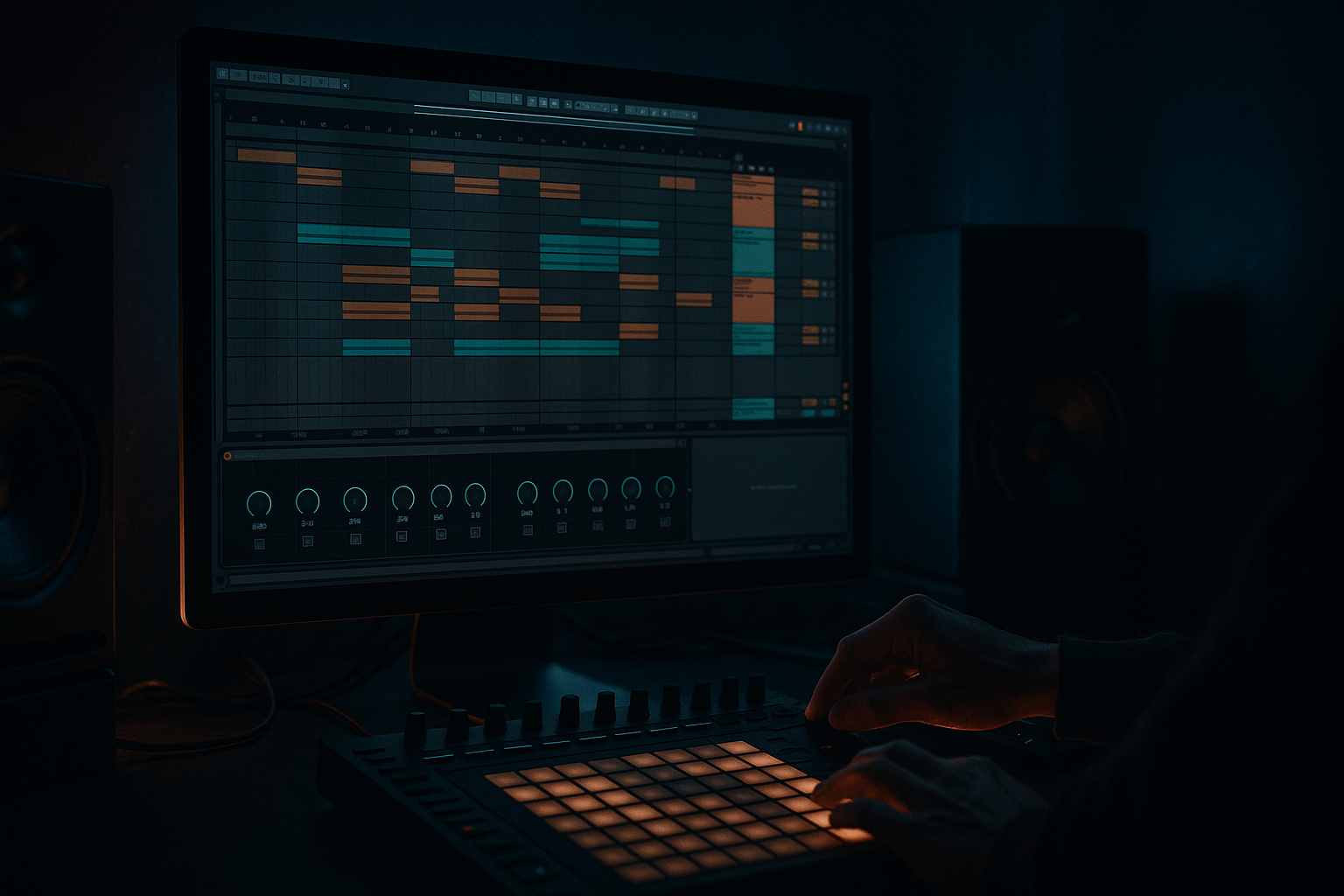
Main tutorial
Lesson Overview
Future Jungle lives in that sweet spot where classic amen energy meets modern DnB pressure: chopped break movement, off-grid swing, sub discipline, and a rough-edged bass attitude that feels urgent without sounding messy. In this lesson, you’ll build a Future Jungle chop carve method in Ableton Live 12 using jungle swing as the rhythmic backbone, then carve space so the loop hits hard like an intro-to-drop transition or a full 16-bar roller section.
The goal is not just to “chop a break.” It’s to make the break talk to the bassline. That means editing the drums so they leave pockets for the sub, carving the mids so the bass can breathe, and pushing the groove so it feels human, broken, and forward-driving at the same time. This technique sits perfectly in:
- 8–16 bar drop loops
- second-drop switch-ups
- DJ-friendly intro drums
- breakdown-to-drop tension builders
- dark rollers with jungle DNA
- A 2-bar Future Jungle break loop built from a sampled amen or similar classic break
- A carved drum pattern with ghost notes, selective chops, and controlled transients
- A jungle swing groove that gives the loop bounce without sounding lazy
- A bass pocket that sits under the drums with clearer sub separation
- A bus chain for glue, grit, and punch using Ableton stock devices
- A loop that can expand into a 16-bar arrangement idea with fills, switch-ups, and risers
- Over-swinging everything
- Too many chops
- Low-end clash between chopped kicks and sub
- Processing the drum bus too heavily
- Bassline ignoring the break
- Stereo width in the wrong place
- Layer a very quiet reese mid under the bass, but high-pass it so it doesn’t fight the sub.
- Use Saturator or Drum Buss on a parallel return for controlled grit instead of destroying the main drum track.
- Add a filtered room reverb to one or two snare ghosts for eerie space, then automate it off before the main drop hit.
- If the break needs more menace, use Auto Filter with a slow movement on the top loop only, not the entire drum bus.
- For darker rollers, reduce high-end shimmer and let the groove come from midrange chop detail and sub weight.
- If the tune needs more neuro tension, automate a bass formant/motion layer while keeping the sub simple and unwavering.
- Use short breaks in the arrangement where only drums and texture remain. Silence or near-silence before the drop makes the return feel brutal.
- Future Jungle works when break chops, jungle swing, and bass phrasing are designed together.
- Keep the main snare stable and swing the ghost notes and hats for motion.
- Use Ableton stock devices like Drum Rack, Simpler, EQ Eight, Drum Buss, Saturator, Glue Compressor, Utility, and Auto Filter to shape the groove.
- Carve space so the sub stays clean and the drums keep their punch.
- Arrange with contrast, fills, and switch-ups so the loop turns into a real DnB section.
- The best result feels broken, heavy, and alive — with enough space for the bass to hit properly.
Why it matters: in DnB, groove is everything. If the drums are too straight, the tune loses the shuffle and urgency that makes jungle-derived music feel alive. If the chop is too dense, the sub gets masked. The chop carve method solves both problems by combining tight break editing, frequency carving, and swing-aware placement so the drums and bass lock like one machine.
What You Will Build
By the end, you’ll have:
Musically, the result should feel like:
tight snare-led break energy + rolling sub + restless top-end movement + enough space for the drop to breathe.
Step-by-Step Walkthrough
1. Start with a break that already has character
Load a classic break or jungle-style drum loop onto an audio track. Amen, Think, or any dusty break with strong ghost hits will work. If the source is too clean, that’s fine — you’ll dirty it up later.
In Ableton Live 12:
- Warp the break carefully so the main hits stay tight.
- Use Beats warp mode for transient-heavy breaks.
- Try Preserve: Transients and keep transient envelopes around 60–90 depending on how punchy the source is.
- If the loop drifts, make a clean 2-bar segment first before chopping.
The key is to start with a break that has enough micro-movement to support jungle swing. A flat 4/4 drum loop will not give you the right result here.
2. Extract the swing from the break before you edit too much
The “jungle swing” feel comes from the relationship between kick, snare, ghost notes, and the spaces between them. In Live 12, you can use Groove Pool to help, but don’t overdo it. The best jungle grooves often feel like they were pushed and pulled by hand.
Try this:
- Open the Groove Pool and test a few MPC-style grooves or slightly shuffled swing templates.
- Keep Timing around 10–20% at first.
- Set Random very low, around 0–5%.
- Apply the groove to the break clip, then listen for whether the snare still feels anchored.
If the break already has a natural sway, just leave the groove subtle and use manual nudging instead.
Why this works in DnB: jungle and future jungle rely on microtiming contrast — the main snare stays confident while the ghost notes and hats lean just behind or ahead, creating the forward motion that makes the groove feel alive.
3. Slice the break into playable chunks
Right-click the break and choose Slice to New MIDI Track. For an intermediate workflow, use:
- Transient slicing for the fastest results
- Or 1/8 slicing if the break is already very consistent
Put the slices into Simpler in Slice mode, or let Ableton create a Drum Rack. Either is fine, but Drum Rack gives you faster control for carving and layering.
Now create a 2-bar MIDI pattern by selecting:
- The main kick
- The core snare
- 2–4 ghost hits
- 1–2 top-end accents like hats or rim fragments
Don’t fill every subdivision. Future Jungle often hits harder because it leaves gaps. A good rule: if your chop pattern looks busy, simplify it by 20%.
4. Build the chop-carve pattern with call-and-response
This is the heart of the lesson. The “chop carve method” means you place break hits so they carve space for each other and for the bassline. Think of it like a rhythm conversation.
In your MIDI clip:
- Put the snare on the strong backbeat as the anchor.
- Add chopped kick fragments before or after the snare to create push.
- Use ghost notes in the late 16ths to create shuffle.
- Leave at least one clear pocket before the bass phrase hits.
Try this patterning logic:
- Bars 1–2, beat 1: kick or low tom fragment
- Beat 2 / 4: snare anchor
- Late 2nd 16th before beat 3: ghost snare or hat tick
- After beat 4: a chopped fill that opens into the next bar
Use clip envelopes or note velocity to shape emphasis:
- Strong hits around 100–127 velocity
- Ghost hits around 35–75 velocity
The carve part is this: remove anything that competes with the bass on the low end. If a chop contains a low tom or kick tail that muddies the sub, shorten it or replace it with a higher-frequency fragment. The drums should sound aggressive but not bulky in the wrong place.
5. Shape the groove with timing nudges, not just swing
Jungle swing is not only about applying a preset groove. It’s also about nudging specific notes so the break breathes.
In the MIDI editor:
- Pull select ghost hits slightly behind the grid by a few milliseconds.
- Keep the main snare more locked in.
- Push one or two tiny hat chops slightly ahead of the beat for urgency.
Good starting ranges:
- Ghost notes: 5–15 ms late
- Fast hat fragments: 3–8 ms early
- Main snare: near-grid, or only slightly late if the whole loop needs more drag
This creates a layered groove: solid center, loose edges. That’s what gives future jungle its “broken but driving” identity. If everything is swung equally, the beat loses contrast. The contrast is what makes the rhythm speak.
6. Carve the frequency space using Ableton stock devices
Now build a drum processing chain. Keep it practical and focused.
On the break/drum rack group:
- EQ Eight: high-pass unnecessary rumble if the sample is too heavy. Use a gentle slope and avoid over-thinning the loop.
- Drum Buss: drive lightly for weight and smack. Start with Drive around 5–15%, Boom low or off if the kick tail conflicts with your sub, and Crunch subtle.
- Saturator: use Soft Clip and a modest drive amount to thicken midrange chop edges.
- Glue Compressor: light ratio, just enough to glue the edits together. Aim for 1–2 dB gain reduction on peaks.
- Utility: use Width control if the overheads or chopped tops get too wide.
Then carve around the bass:
- Make a gentle cut in the drum bus around the sub conflict zone if needed.
- If the break has a nasty snare ring, notch it with EQ Eight rather than flattening the whole drum bus.
- If the hats are stabbing too hard, a small dip around 7–10 kHz can calm the top without killing energy.
On the bass track:
- Use EQ Eight to high-pass any unwanted mids in the bass if the design allows.
- Keep the sub mono with Utility set to 0% Width on the lowest layer if needed.
- If using Operator or Wavetable, make sure the sub is stable and not too harmonically crowded.
Why this works in DnB: the drums and bass occupy the same emotional space, but not the same frequency space. Carving lets the rhythm feel bigger because each element has its own lane.
7. Design the bass response so the chops can breathe
Future Jungle rarely works if the bassline ignores the drums. You want bass phrases that answer the break, not fight it.
Build a simple bass pattern:
- Use Operator for a clean sub, or Wavetable for a reese layer plus sub.
- Keep the sub note lengths controlled and leave space after snare hits.
- Try call-and-response phrasing: bass speaks on bar 1, answers differently on bar 2.
Good practice:
- Sub layer mono, centered.
- Mid-bass layer slightly wider, but check mono.
- Use volume automation so bass hits harder after the main snare, not directly on top of the busiest chop.
A useful arrangement move: let the bass stay sparse for the first 2 bars of the drop, then increase the density on bar 3 or 4. That way the break feels like it’s building momentum instead of constantly maxing out. The drums get room to dance, and the drop lands harder when the bass opens up.
8. Add resampling and micro-fills for Future Jungle character
This is where the sound starts to feel less like a loop and more like a track. Create an audio track and resample the drum bus or selected chops. Then chop the resample into short hits.
Use the resampled material for:
- A reversed pickup into bar 4
- A stuttered snare fill
- A tiny atmospheric tail between phrases
- A filtered ghost loop tucked low in the mix
Process the resample with:
- Auto Filter for sweep transitions
- Redux very lightly if you want digital grit
- Echo for short dubby throws on only certain hits
- Reverb with short decay if you want a distant jungle space
Keep these effects selective. Future Jungle gets its identity from edited texture, not washed-out ambience. A couple of carefully placed fills is enough to make the loop feel arranged.
9. Automate tension and movement into a 16-bar structure
Take your 2-bar loop and map it into a basic drop arrangement:
- Bars 1–4: core groove, minimal variation
- Bars 5–8: add extra ghost chops and bass movement
- Bars 9–12: strip the bass for one bar, then bring it back with a fill
- Bars 13–16: switch-up with a different chop ending or a break stop
Automate:
- Filter cutoff on the break for build tension
- Dry/Wet on Echo for one-shot throws
- Bass filter or wavetable position for movement
- Send levels to reverb/delay only on transitions
A strong DnB arrangement trick: mute the kick for a tiny moment before the drop switch or fill. That negative space makes the return feel heavier than adding more sound ever could.
10. Check the mix like a DnB engineer, not just a loop maker
Before you call it done, do a quick reality check:
- Turn the whole mix down and ask if the groove still reads.
- Mono-check the low end with Utility.
- Make sure the sub is not disappearing under the chopped low drums.
- Check the snare transients: they should cut, not click painfully.
- Compare your loop to a reference roller or jungle tune for drum density and bass placement.
If the loop feels exciting at low volume, it’s probably working. If it only feels good loud, the balance is off.
Common Mistakes
- Fix: keep the main snare steady and swing mostly the ghost notes and hats.
- Fix: remove 20–30% of the notes. Future Jungle needs contrast, not constant fill.
- Fix: shorten the kick tails, use EQ Eight, and keep sub phrases out of the densest drum moments.
- Fix: use subtle Glue Compressor and light Drum Buss shaping; keep transients alive.
- Fix: rephrase the bass so it answers the drums, especially around snare accents.
- Fix: keep sub mono and let width live in hats, ambience, or higher bass harmonics.
Pro Tips for Darker / Heavier DnB
Mini Practice Exercise
Set a 15-minute timer and do this:
1. Find one 2-bar break loop and slice it into a Drum Rack.
2. Build a pattern with:
- 1 main snare
- 2 kick fragments
- 3 ghost hits
- 2 top-end ticks
3. Apply a subtle groove from the Groove Pool or manually nudge the ghost hits.
4. Add EQ Eight and Drum Buss to the drum group.
5. Create a simple sub in Operator with only two notes per bar.
6. Arrange 4 bars:
- Bars 1–2: sparse
- Bars 3–4: add one fill and one bass variation
7. Listen in mono and make one fix for low-end conflict.
Goal: finish with a loop that feels like it could be the core of a drop, not just a beat.

