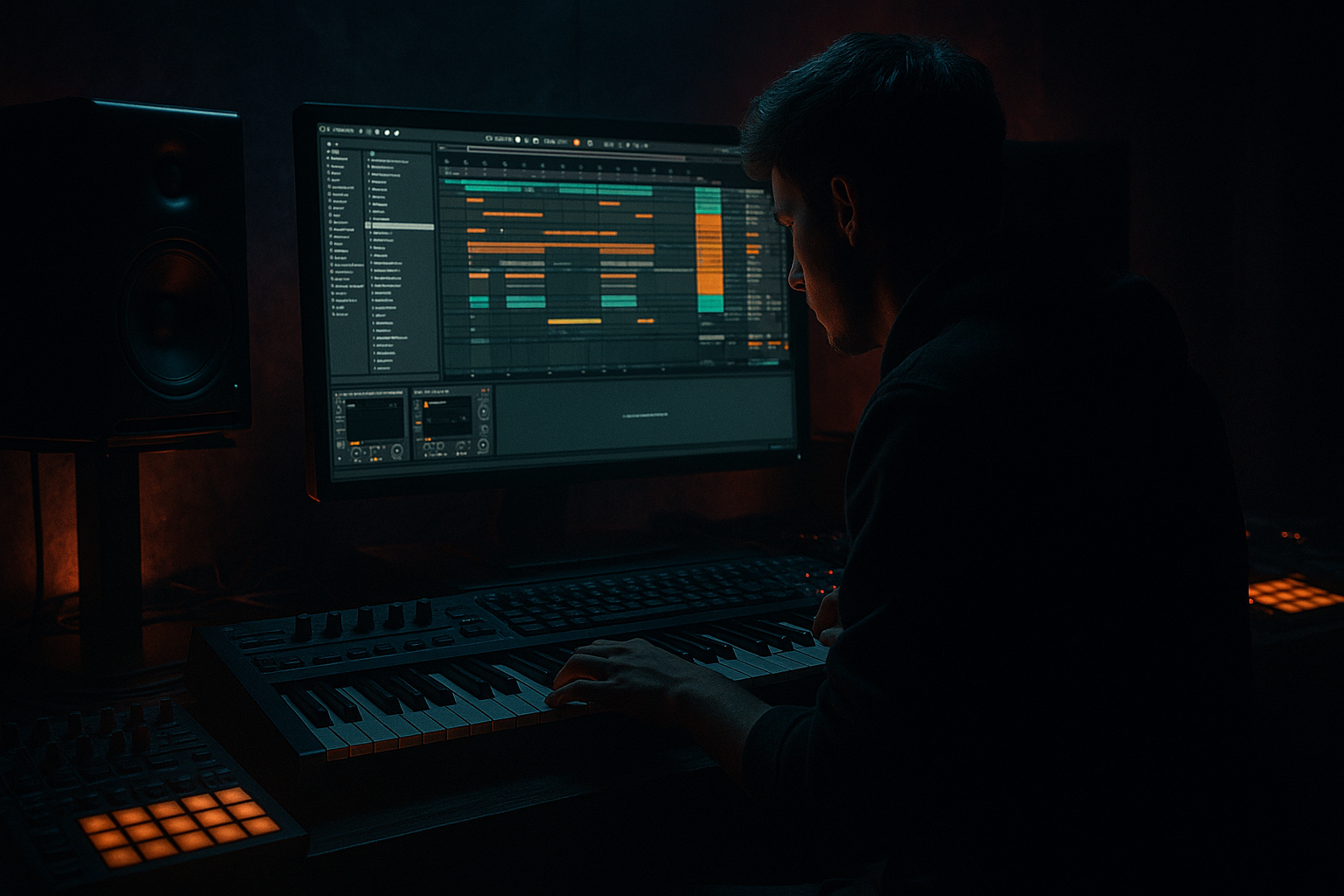
Main tutorial
```markdown
Future Jungle: Chop Design for Rewind‑Worthy Drops (Ableton Live 12) 🔥🥁
Skill level: Intermediate
Category: Mixing (with arrangement + sound design decisions that directly impact perceived mix)
---
1. Lesson overview
Future Jungle lives or dies by how your chops land: micro‑timing, tone, transient control, and the way the drop “speaks” against bass and subs. In this lesson you’ll design a drop built around modern jungle chops that feel classic but hit current: crisp, loud, and controlled.
We’ll focus on:
- Turning a break into drop‑ready chop groups
- Getting punch + glue without killing groove
- Making chops talk using envelopes, saturation, and tiny automation moves
- Mix‑first chop design so the drop is loud and clear without relying on heavy limiting
- A chopped break (Amen / Think / Hot Pants style) split into Kick / Snare / Hats / Ghosts
- A “call and response” chop pattern that creates rewind moments
- A clean low end: sub + reese / mid bass that doesn’t fight the break
- A punchy drum bus with controlled transients, harmonic density, and room placement
- Open the Drum Rack chains and identify the obvious Kick, Snare, Hat, and Ghost slices.
- For each slice, go to Simpler:
- EQ Eight
- Drum Buss
- EQ Eight
- Saturator
- Glue Compressor
- EQ Eight
- Auto Filter (optional movement)
- EQ Eight: HPF 250–600 Hz
- Utility: Width 120–160% (keep core drums more mono)
- Bars 1–4: establish the anchor (minimal edits)
- Bars 5–8: introduce a repeating chop “phrase”
- Bars 9–12: remove one expected snare or kick (space = impact)
- Bars 13–16: unleash the most complex chop + fill into the next section
- Duplicate the MIDI clip. One is your “tight version”, one is “looser.” A/B them against the bass. Choose the one that makes the bass feel bigger.
- Amp Envelope
- Filter
- Shorten Decay so hats don’t smear into bass hits.
- If hats are brittle, use Filter to tame top-end per slice rather than global EQ.
- On the Drum Rack (or at least `HATS`/`GHOSTS`): HPF aggressively.
- Keep some weight in `KICKS`, but don’t let the break carry sub.
- Put Compressor on your Sub track, sidechain from Kick Group (or a dedicated ghost kick).
- Make a Return track: `SHORT ROOM`
- Send snare more than hats.
- Keep kick/sub essentially dry.
- Over-warping the break: too tight = lifeless. Use Beats warp gently and avoid extreme transient reshaping.
- No grouping inside Drum Rack: mixing becomes a mess when everything shares the same processing.
- Too much high-end on hats: makes your limiter clamp early and shrinks the perceived low-end.
- Smearing transients with fast bus compression: if your Glue attack is too fast, your chops lose bite.
- Letting the break carry sub: classic “why does my drop feel weak?” problem when sub and break fight.
- Parallel dirt for snares:
- Mono discipline:
- Clip-to-win (controlled):
- Ghost note paranoia:
- Dark hat tone:
- With hats muted for half a bar
- With no dropout
- You built mixable chop groups inside a Drum Rack for precise control.
- You shaped transients and tone using Simpler envelopes, Drum Buss, Glue, and smart EQ.
- You created rewind-worthy contrast with planned dropouts and signature fills.
- You protected the low-end by ensuring the break isn’t the sub, and by sidechaining musically.
---
2. What you will build
By the end you’ll have a 16‑bar drop with:
---
3. Step-by-step walkthrough
Step 0 — Session setup (so the groove behaves) ⚙️
1. Tempo: 162–170 BPM (try 166 BPM as a sweet spot)
2. Warp mode:
- For breaks: start with Complex Pro OFF. Use Beats warp for tight transient control.
- In Clip View → Warp: Beats, Preserve: Transients, Envelope: 0–20 depending on how crunchy you want it.
3. Project headroom: keep your Master peaking around -6 dB while building. (You’ll get loud later.)
---
Step 1 — Choose and prep a break (the “raw material”) 🎛️
1. Drag your break into an Audio Track.
2. Right-click the clip → Slice to New MIDI Track…
- Slicing preset: Transient
- Create one slice per transient is usually perfect for jungle.
3. Ableton will create a Drum Rack with slices.
Immediate cleanup inside the Drum Rack:
- Turn Snap ON (keeps edits clean).
- Use Fade In/Out very small (0.5–3 ms) to prevent clicks.
---
Step 2 — Create “mixable” chop groups (Kick/Snare/Hats separation) 🎚️
This is the move that makes mixing future jungle easier.
1. In the Drum Rack, group slices by type:
- Select all kick-ish slices → right-click → Group (name it `KICKS`)
- Do same for `SNARES`, `HATS`, `GHOSTS/FX`
2. On each Group, add these stock devices (starting points):
#### `KICKS` Group chain
- HPF at 25–35 Hz (gentle 12 dB/oct)
- Small dip if boxy: 200–350 Hz (2–4 dB)
- Drive: 5–15%
- Boom: OFF (usually save Boom for dedicated kick design)
- Transients: +5 to +20 (until it bites)
#### `SNARES` Group chain
- HPF: 90–120 Hz
- Add crack: 2–5 kHz +1 to +3 dB (wide Q)
- Add air if needed: 9–12 kHz +1–2 dB
- Mode: Analog Clip
- Drive: 1–4 dB
- Soft Clip: ON
- Attack: 3 ms
- Release: Auto
- Ratio: 2:1
- Aim: 1–3 dB gain reduction on peaks
#### `HATS` Group chain
- HPF: 200–400 Hz (higher if break is muddy)
- If harsh: dip 7–10 kHz slightly
- HP 12 dB, Frequency around 5–9 kHz, slight envelope for “shh” motion
#### `GHOSTS/FX` Group chain
Why this matters: now you can push the snare without lifting hat hiss, and tighten hats without thinning the kick. That’s modern chop mixing.
---
Step 3 — Program the drop groove: “Anchor + chaos” 🧠
Future jungle that gets rewinds usually has a stable anchor (recognizable pattern) with intentional variation (surprise chops).
1. Create a 16-bar MIDI clip for your Drum Rack.
2. Start with an anchor pattern:
- Put a main snare on 2 and 4 (or jungle-style on 2 and the “late 4” depending on break).
- Reinforce kick placement so the drop feels “locked.”
3. Add signature jungle edits:
- 1/16 or 1/32 snare drags leading into bar changes
- Occasional kick stutters before the snare (not after)
4. Use velocity as mixing:
- Ghost hits: 20–60 velocity
- Primary snares: 95–127
- Hats: vary 55–95 for swing and realism
Arrangement idea (rewind recipe):
---
Step 4 — Micro-timing that still slaps (groove without flamming) ⏱️
1. Apply Groove Pool lightly:
- Try `MPC 16 Swing 57–59` (or similar)
- Commit at 10–25% intensity (don’t overdo it)
2. Manually nudge key slices:
- Hats can sit a few ms late for roll
- Kicks usually on grid for weight
- Ghost snares can be slightly early to pull energy forward
Pro workflow:
---
Step 5 — Make chops “speak” using envelopes (the secret sauce) 🗣️
Inside each Simpler (per slice), you can shape bite and length without new samples.
For snare slices:
- Attack: 0–1 ms
- Decay: shorten slightly if it’s washing out
- Release: 20–80 ms
- Turn on LP or BP if snare is too splashy
- Add a touch of Resonance (subtle!) to emphasize crack
For hat slices:
---
Step 6 — Drum bus chain for “future jungle loud” (without killing transients) 💪
On the Drum Rack (or a dedicated Drum Bus track), build this chain:
1. EQ Eight
- HPF 25–30 Hz (clean sub-rumble)
- Tiny dip 250–450 Hz if it’s cardboard
2. Drum Buss
- Drive: 5–20%
- Crunch: 0–20
- Transients: +5 to +25
- Damp: adjust to keep top under control
3. Glue Compressor
- Attack: 10 ms (let transients through)
- Release: Auto
- Ratio: 2:1
- GR target: 1–2 dB average
4. Limiter (temporary safety)
- Ceiling: -1 dB
- Only catching rogue peaks (not constant reduction)
Key concept: your chops should sound exciting before you slam them. If you need 6–8 dB of limiting to feel impact, go back to envelopes/transients.
---
Step 7 — Keep the low-end clean (break vs sub vs bass) 🧱
This is mixing, but it starts at chop design.
Break low-cut strategy:
Sidechain plan (stock devices):
- Ratio: 4:1
- Attack: 1–5 ms
- Release: 60–120 ms (tempo dependent)
- GR: 2–5 dB typical
Pro move:
Sidechain the mid bass slightly from the Snare Group too (1–3 dB GR). This makes snares feel bigger without turning them up.
---
Step 8 — “Rewind moment” drop trick: controlled silence + signature fill 🎯
To make the crowd react, you need contrast.
Try this at bar 8 or 16:
1. Mute the hats for 1/2 bar.
2. Leave only:
- One kick
- One snare
- A short vocal chop or FX hit
3. Then hit a signature fill:
- 1 bar of denser edits (snare rolls + kick syncopation)
4. Bring full hats back exactly on the downbeat.
Mix tip: automate Drum Buss Drive up by ~2–4% during the fill, then reset on the drop hit. Tiny automation = huge perception.
---
Step 9 — Space and depth (keep it rave, not washed out) 🌌
Breaks want space, but jungle hates muddy reverb.
- Hybrid Reverb
- Algorithmic
- Decay: 0.3–0.7 s
- Pre-delay: 10–25 ms
- HPF in reverb: 300–600 Hz
- EQ Eight after reverb to tame harshness (dip 7–10 kHz if needed)
---
4. Common mistakes 🚫
---
5. Pro tips for darker/heavier DnB 🌑
Create Return `SNARE GRIT` → Saturator (Drive 6–12 dB) → EQ Eight (band-pass 200 Hz–6 kHz) → blend lightly. Keeps punch but adds menace.
Use Utility on Drum Bus: Width 80–100%. Keep core drums centered; widen only hats/FX.
Add Saturator on Drum Bus, Soft Clip ON, Drive 1–3 dB. This often beats heavy limiting for jungle drums.
Too many ghosts = constant noise floor. Make ghosts rare and meaningful around snares and transitions.
Use Auto Filter LP around 10–14 kHz with slight resonance. Dark hats make snares feel brighter without EQ wars.
---
6. Mini practice exercise 🧪
Goal: Build 8 bars of chops with one rewind moment.
1. Slice a break to Drum Rack (Transient).
2. Create groups: Kicks/Snares/Hats/Ghosts.
3. Write an 8-bar pattern:
- Bars 1–4: stable anchor
- Bars 5–7: introduce one repeating fill motif
- Bar 8: half-bar hat dropout + one-bar fill into loop
4. Mix targets:
- Drum Bus peaks around -8 to -6 dB before master processing
- Glue GR on drum bus: ~1–2 dB
- Sub ducks 2–5 dB on kick hits
Export a loop and A/B:
Pick the one that feels like it demands a reload.
---
7. Recap ✅
If you want, tell me your BPM + which break you’re using (Amen/Think/etc.) and whether your bass is sub-only or sub+reese, and I’ll suggest an exact 16-bar chop arrangement and device settings tailored to it.
```

