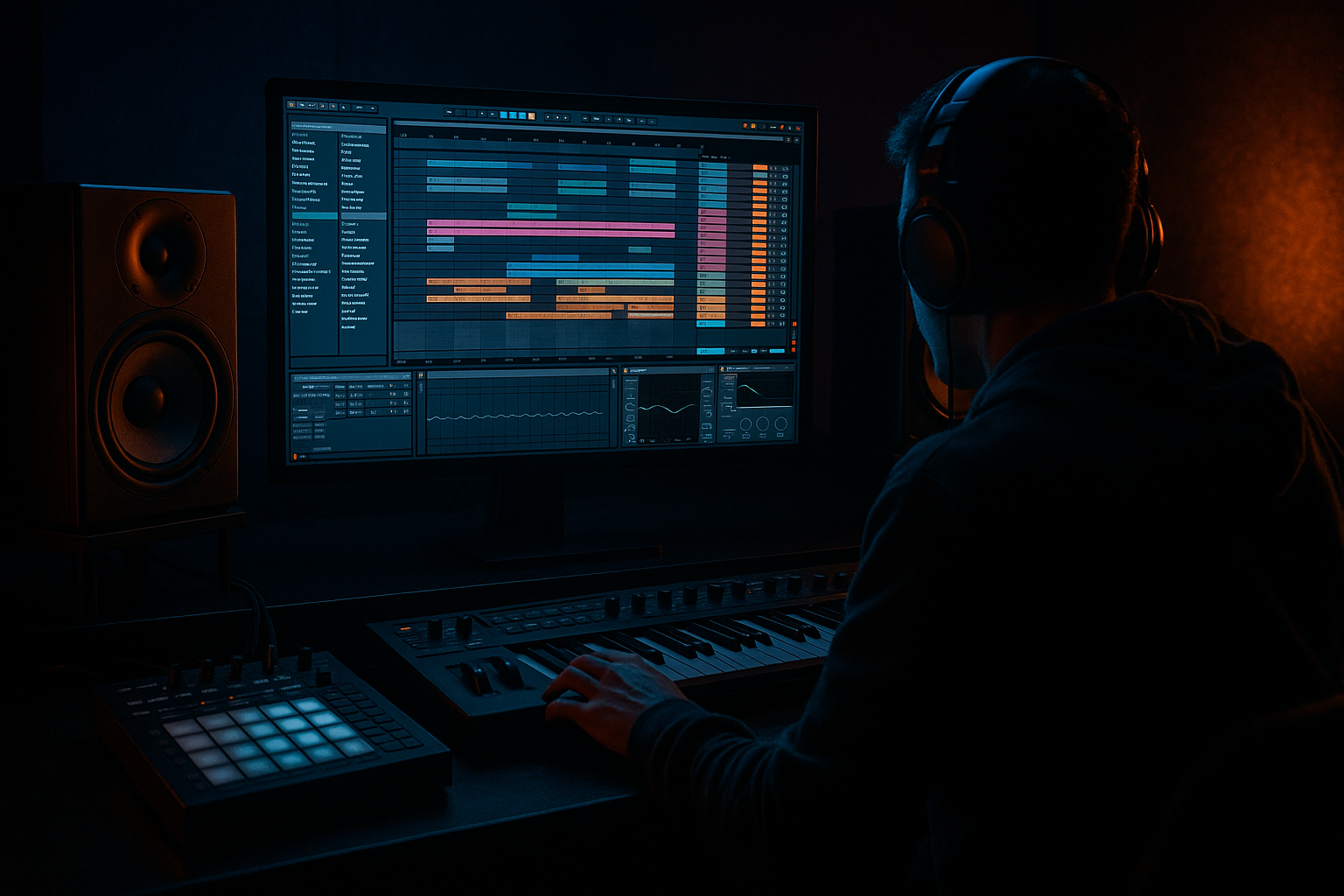
Main tutorial
Lesson Overview
A Future Jungle edit-distort breakdown is one of the most useful tension-building tools in modern Drum & Bass. It’s the part in the track where the groove gets sliced up, the drums wobble, the bass gets ugly in a good way, and the listener feels like something big is about to happen. In a proper DnB arrangement, this usually sits before a drop, after an 8- or 16-bar phrase, or as a switch-up in the second half of the track.
In this lesson, you’ll build a breakdown from scratch in Ableton Live 12 using sampling, editing, distortion, resampling, and automation. The goal is to take a clean break, chop it into a Future Jungle-style rhythmic idea, then push it into darker territory with grit and movement without losing the groove.
Why this technique matters:
- It creates contrast between clean sections and chaos
- It gives your track DJ-friendly tension
- It makes sampled drums feel alive, edited, and intentional
- It helps your track sound more like authentic jungle / rollers / dark DnB rather than a loop pasted on top of a beat
- A chopped drum break edit with swing and ghost hits
- A distorted “breakdown” version of the break using resampling and stock Ableton devices
- A sub-bass pulse or reese-like layer that ducks under the drums
- Automation for filtering, distortion amount, reverb size, and delay feedback
- A clean structure that can lead into a drop, such as:
- Too much distortion too early
- Break gets messy and loses the groove
- Sub bass fights the break
- Too much reverb makes the edit blurry
- No real arrangement movement
- Harsh top end after resampling
- Use call-and-response between break and bass
- Keep the low end disciplined
- Use tiny ghost notes for realism
- Try parallel dirt
- Automate a low-pass filter on the whole breakdown
- Add subtle pitch movement
- Use short echoes, not endless wash
- Start with a sampled break
- Chop it into a musical 2-bar edit
- Add a simple mono sub layer
- Build the “distort breakdown” with Saturator, Drum Buss, Auto Filter, Echo, and resampling
- Automate movement over 4 or 8 bars
- Keep the groove readable, the low end controlled, and the tension growing
We’ll keep it beginner-friendly, but still real enough to use in an actual track.
What You Will Build
By the end of this lesson, you’ll have a 4- to 8-bar Future Jungle breakdown that includes:
- bars 1–2: chopped break intro
- bars 3–4: distortion and filtering increase
- bars 5–8: tension peak and reset into the drop
Musically, think of this as the part in a Future Jungle tune where the drums feel like they’re collapsing into the next section, while the bass becomes more textured, unstable, and aggressive.
Step-by-Step Walkthrough
1. Set up a simple DnB session and choose your break
Start a new Live Set at 170–174 BPM. That’s a comfortable beginner range for Future Jungle and most darker DnB styles.
In the Browser, load a sampled break into an Audio Track. Good starting material:
- classic Amen-style break
- Think break
- any clean jungle break loop with obvious kick/snare content
If your break is too clean, that’s fine. We’re going to break it apart.
Useful setup:
- Turn Warp on
- Use Beats mode for drum breaks
- Keep the break looped over 4 bars so you can edit rhythmically
- Set the warp mode to preserve transients clearly
Why this works in DnB: jungle and Future Jungle rely on the feel of a sampled break being manipulated in rhythm, not just looped. The energy comes from edits, not perfection.
2. Slice the break into playable pieces
Right-click the break clip and choose Slice to New MIDI Track. For a beginner, this is one of the easiest ways to make a break sound more musical and less static.
In the slice menu:
- Choose Slice by: Transients
- Keep the slices on Drum Rack
- Use a sensible transient sensitivity so you get the main hits, not tiny noise fragments
Now you have the break chopped into pads. Play the pads on your controller or draw MIDI notes manually.
Starter rhythm idea:
- place a kick slice on beat 1
- snare on beat 2
- ghost kick or hat slice before beat 3
- snare on beat 4
- add a couple of offbeat chops between the main hits
Don’t try to make it perfect. Future Jungle often sounds exciting because the break feels a little unstable.
3. Build a 2-bar edit that feels like a real jungle phrase
In the MIDI clip, create a 2-bar loop first. Use a simple structure:
- bar 1: establish the break groove
- bar 2: answer the groove with extra chops or a fill
Good beginner approach:
- keep the main snare hits strong
- add 1–2 ghost notes before or after the snare
- add a tiny kick pickup before the downbeat
- leave a few gaps so the break can breathe
Try the following timing idea:
- main snare around beat 2 and 4
- a quieter ghost snare 1/16 before beat 2
- a kick or hat slice on the “and” of beat 3
- a short fill at the end of bar 2
Add swing if needed:
- use Groove Pool and try a light MPC-style groove
- keep groove strength around 10–25% so it feels human, not messy
If the break is too busy, simplify it. In DnB, clarity beats constant motion.
4. Add a sub layer under the break
Future Jungle breakdowns still need low-end weight. Create a second MIDI Track and load Operator or Wavetable with a simple sine-like sub.
Keep it basic:
- oscillator: sine or very simple low wave
- play short notes that follow the main kick pattern
- keep notes low, around C1 to G1 range depending on your track
Suggested settings:
- Amplitude envelope attack: 0–5 ms
- Decay: 150–300 ms if you want short punch
- Release: 40–120 ms to keep it tight
- keep the sub mono
Add Compressor on the sub sidechained to the break or main drum group if needed, or use EQ Eight to remove anything above the low band.
Simple rule:
- the sub should feel like it’s supporting the edit, not fighting it
5. Create the distortion breakdown with stock Ableton devices
Now make the breakdown feel like it’s melting. Put the break audio into an Audio Effect Rack or process the track directly with stock devices.
A good beginner chain:
- Saturator
- Drum Buss
- Auto Filter
- Echo or Delay
- optional Redux for digital grit
Suggested starting settings:
- Saturator
- Drive: 3–8 dB
- Soft Clip: On
- Drum Buss
- Drive: 5–20%
- Boom: low or off for now
- Transients: slightly up or slightly down depending on whether you want punch or crush
- Auto Filter
- Low-pass filter slowly closing from around 10–14 kHz down to 2–5 kHz
- Add a little resonance if you want a more dramatic sweep
- Redux
- Bit Reduction: light, around 8–12 bits
- Downsample: only a little, unless you want heavy digital destruction
- Echo
- Sync on
- Feedback: 15–35%
- Time: try 1/8 or 1/4 for rhythmic tails
Automate the distortion over 4 bars:
- start cleaner in bar 1
- increase saturation by bar 2
- introduce filtering and more delay in bar 3
- peak with the dirtiest, most compressed moment in bar 4
This is the “edit distort” part: the break is not just distorted, it is evolving into distortion.
6. Use resampling to print the character
This is where the breakdown starts sounding more like a finished DnB record. Create a new Audio Track and set its input to Resampling.
Arm the track and record 4 bars of your break processing. Now you have an audio version of the breakdown you can edit again.
Why resampling helps:
- it commits the sound
- it lets you cut the best moments into a tighter phrase
- it makes distortion, delays, and reverbs feel like part of the performance
After recording:
- trim the best 1- to 2-bar section
- reverse a tiny tail if it helps transition
- add a few clip fades to avoid clicks
- duplicate your favorite impact point at the end of the phrase
If the breakdown feels too flat, resampling usually fixes that because you can start chopping the “mistakes” into something rhythmic.
7. Add FX automation to shape tension and release
A Future Jungle breakdown needs movement, but it should still feel controlled. Use automation on the following:
- Auto Filter cutoff
- Echo feedback
- Reverb dry/wet
- Saturator drive
- Utility gain for level drops and rise backs
Simple automation ideas:
- lower the track volume by 2–4 dB at the start of the breakdown
- slowly increase Echo feedback into the last 1–2 bars
- push Reverb wetness from 10% to 25% for a wider, washed-out middle section
- automate filter cutoff downward to create a “closing tunnel” feel
- mute the sub for half a bar before the drop for extra impact
For reverb, use Hybrid Reverb or Reverb from Ableton if you want a more atmospheric wash. Keep it controlled:
- Pre-Delay: around 10–25 ms
- Decay: 1.2–2.5 s depending on how spacious you want it
- High cut the reverb so it doesn’t get fizzy
This creates that classic tension-release feel where the breakdown breathes before the drop returns.
8. Shape the drum bus so it hits like a real DnB edit
Group your break and any additional percussion into a Drum Bus. On the group, use gentle glue-style processing to make the edit feel cohesive.
Good stock chain:
- EQ Eight
- Glue Compressor
- Drum Buss or Saturator
Suggested starting points:
- EQ Eight
- high-pass anything unnecessary below 25–35 Hz
- cut a little mud around 200–400 Hz if the break gets boxy
- Glue Compressor
- Ratio: 2:1
- Attack: 10–30 ms
- Release: Auto or around 0.3 s
- Gain reduction: aim for 1–3 dB
- Drum Buss
- Drive: modest
- Crunch: light if you want extra bite
- Boom: only if the low end is under control
Keep the drum bus punchy. In darker DnB, the drums need to feel aggressive but not washed out.
9. Arrange the breakdown like part of a full track
Think in phrases, not just loops. A practical DnB arrangement example:
- Bars 1–8: intro with filtered drums and atmosphere
- Bars 9–16: first drop
- Bars 17–24: main groove
- Bars 25–32: Future Jungle breakdown with edit-distort processing
- Bars 33–40: drop return or switch-up
For the breakdown itself:
- use the first 2 bars to establish the chopped break
- use bars 3–4 to intensify the distortion
- use bars 5–6 for a more empty, echo-heavy tension section
- use the final bar as a pickup into the drop
Add a short impact, reverse cymbal, or downlifter at the end if needed. Keep transitions DJ-friendly by avoiding a total low-end collapse unless that’s the effect you want.
Common Mistakes
Fix: automate distortion gradually. Let the breakdown build instead of arriving at maximum grit instantly.
Fix: keep the main snare hits strong and remove extra chops until the phrase feels readable.
Fix: keep the sub mono, simpler, and quieter than you think. Let the drums own the midrange.
Fix: shorten decay, use less wet signal, or high-cut the reverb return.
Fix: change something every 2 or 4 bars: filter, fill, delay, or drum density.
Fix: use EQ Eight to soften 6–10 kHz, or reduce Redux/downsampling if the crunch is too sharp.
Pro Tips for Darker / Heavier DnB
Let the break answer a short bass stab, then leave space. That push-pull is huge in rollers and darker jungle-influenced DnB.
Put all sub-focused sounds in mono. Use Utility on the bass chain and keep Width at 0% if needed.
Quiet hits before the snare can make a loop feel like a real drummer, especially in break edits.
Duplicate the break or use an Audio Effect Rack with a dry chain and a dirty chain. Blend the dirty chain in low for extra weight without losing clarity.
This can make the section feel like it’s sinking into smoke before the drop returns.
A small pitch drop on a resampled hit or bass tail can create a grimy tension feel without needing a huge sound design move.
In darker DnB, rhythmic delay tails often sound more dangerous than huge reverb clouds.
Mini Practice Exercise
Spend 15 minutes making a 4-bar Future Jungle breakdown.
1. Load one sampled break and slice it to a Drum Rack.
2. Write a 2-bar MIDI break edit with:
- 2 main snares
- 2 kick hits
- 2 ghost notes
3. Add a sine sub in Operator that follows the kick pattern.
4. Put Saturator and Auto Filter on the break.
5. Automate:
- Saturator Drive from low to medium
- Auto Filter cutoff from open to closed
- Echo feedback rising in the last bar
6. Resample 4 bars onto a new audio track.
7. Trim the best 2 bars and loop them as your breakdown.
8. Listen once in mono using Utility and check whether the low end still makes sense.
Goal: by the end, you should have one breakdown idea that feels like it could sit before a drop in a real DnB track.
Recap
The key ideas are:
If it sounds a little dirty, unstable, and exciting, you’re on the right track. That’s the Future Jungle mindset: sampled drums, controlled chaos, and a drop that feels earned ⚡

