Main tutorial
Lesson Overview
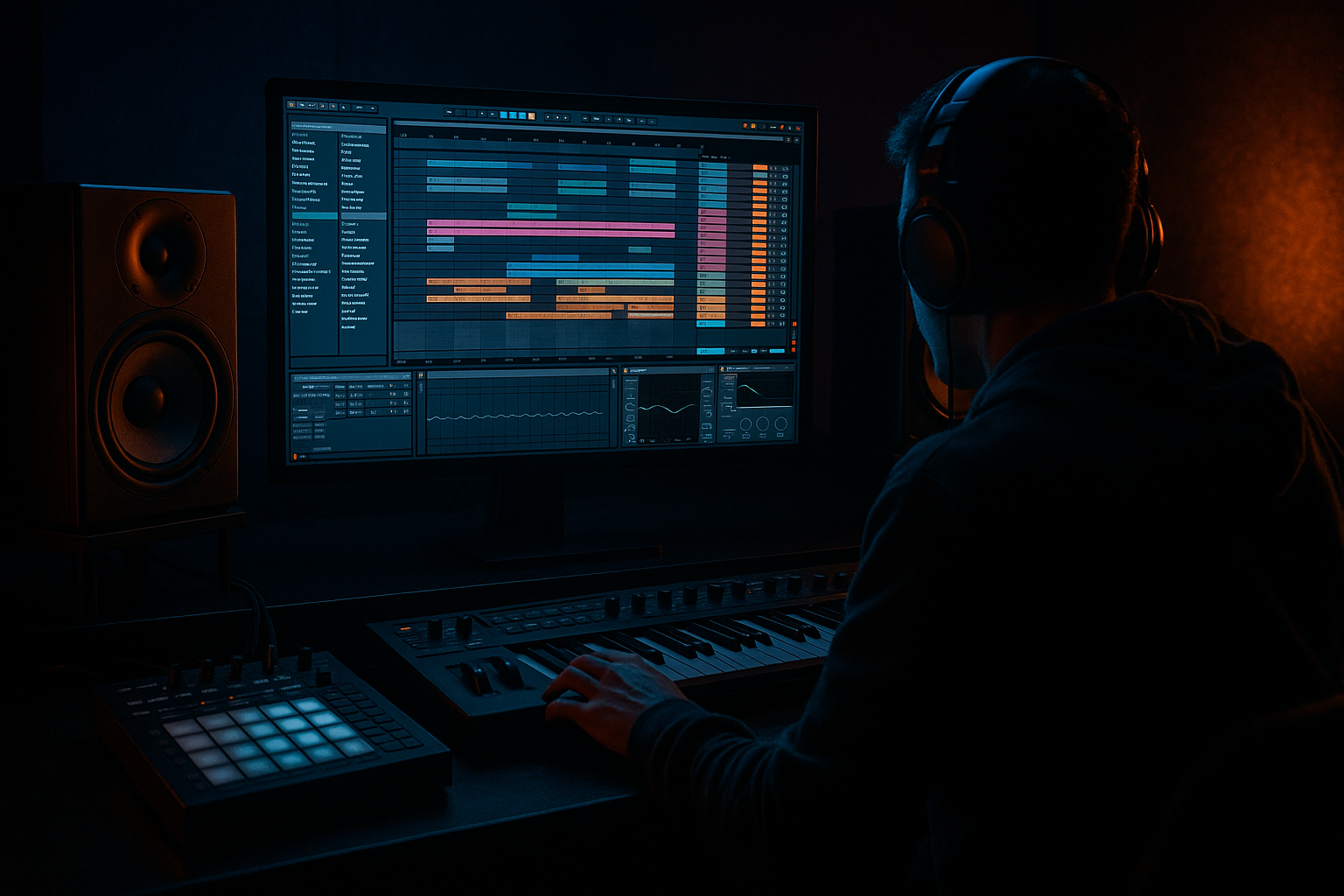
In future jungle and darker DnB, the kick is not just a drum hit — it’s part of the low-end engine. This lesson shows you how to take a jungle kick, give it more perceived weight, then flip and arrange it inside Ableton Live 12 so it hits hard without fighting your sub or breakbeat.
The goal is simple: turn a basic kick sample into a flexible, musical drum element that can lead the groove, answer the bassline, and help your drop feel bigger. In DnB, especially future jungle and rollers, kick placement matters just as much as sound design. A well-weighted kick can make the drop feel forward-moving, while a poorly placed one can blur the sub, weaken the break, or make the groove feel flat.
This technique fits especially well in:
- intro-to-drop build sections
- call-and-response drum patterns
- jungle edits and switch-ups
- half-time or roller drop variations
- darker breakdowns where the kick becomes a tension tool
- a weighted kick sample with tighter low-end control
- a layered kick group with a clean transient and a heavier body
- a flipped arrangement where the kick appears in different roles across 8 or 16 bars
- a simple automation pass that makes the kick feel alive in the drop
- a DJ-friendly structure that supports intro, drop, and switch-up sections
- jungle break energy
- deep roller low-end
- a modern future jungle drop with clear phrasing
- a darker bass music attitude without clutter
- Making the kick too long
- Boosting too much low end
- Forgetting the breakbeat
- Overusing saturation
- Not checking mono
- Repeating the same kick pattern for the whole section
- Use a slightly distorted kick layer only on selected hits
- Try Drum Buss on the kick group for controlled weight
- Automate tiny EQ changes before a drop
- Use reverb as a transition tool, not a constant effect
- Make space for the bass “answer”
- Resample your kick group if the sound feels good
- Keep the kick mostly mono
- In future jungle, the kick needs weight, control, and space.
- Use Simpler, EQ Eight, Saturator, and Drum Buss to shape the kick before arranging it.
- Flip the kick rhythmically so it supports the break and bass instead of repeating blindly.
- Keep low end clean, mono, and separated from the sub.
- Use arrangement and automation to make the kick feel like part of the drop’s energy, not just a sample on the grid.
We’ll use stock Ableton tools like Simpler, Drum Rack, EQ Eight, Saturator, Drum Buss, Utility, and Warp/Clip controls. You’ll also learn how to arrange the kick so it flips between roles: low-end anchor, chopped accent, and transition impact.
Why this matters in DnB: the genre is built on momentum. The kick must feel heavy, but it must also leave room for the bass and break. If the kick is too long or too loud, the low end collapses. If it’s too thin, the track loses power. The trick is weight with control.
What You Will Build
By the end of this lesson, you’ll have a future jungle kick setup in Ableton Live 12 that can do all of this:
Musically, you’ll build a loop that feels like a hybrid of:
Think: a kick that can punch through a chopped break at 174 BPM, then flip into a heavier accent before the bassline answers. 🔥
Step-by-Step Walkthrough
1. Start with a clean kick sample and place it in Simpler
Drag a kick sample into an empty MIDI track and it will open in Simpler automatically. If you’re working from a sample pack, choose a kick with a clear transient and a short tail. For future jungle, a kick with some analog thump or a slightly crunchy 90s texture works best.
In Simpler:
- Set Warp to Off if the sample already fits well as a one-shot.
- Use One-Shot mode.
- Set Trigger mode so the sample plays fully when hit.
- If the sample has too much tail, tighten the End marker slightly so the kick doesn’t eat into the next beat.
Beginner tip: don’t start with a huge kick that already dominates the mix. In DnB, a kick that is slightly restrained often sounds heavier once arranged with the bass and break.
2. Shape the kick into “weight + click” using stock devices
Add EQ Eight after Simpler. This is where you make the kick more useful in a DnB mix.
Try these starter moves:
- High-pass very gently only if needed, around 20–30 Hz, to clean sub-rumble.
- Boost the kick body around 45–70 Hz by 1–3 dB if the sample needs more weight.
- Cut a muddy area around 180–350 Hz by 2–4 dB if the kick sounds boxy.
- If the attack is soft, add a small lift around 2–5 kHz, but keep it subtle.
Then add Saturator:
- Drive: 2–6 dB
- Soft Clip: On
- Output: reduce to match volume
This gives the kick more density and helps it feel louder without needing huge peak gain.
Why this works in DnB: the ear perceives weight from both low-end energy and harmonic content. A little saturation makes the kick easier to hear on smaller speakers and helps it cut through dense break layers.
3. Split the kick into layers for control
For beginner-friendly layering, duplicate the Simpler track and create two versions:
- Layer A: the body layer
- Layer B: the click/attack layer
On Layer A, keep the low-end and body. Use EQ Eight to roll off some top end if needed.
On Layer B, use EQ Eight to high-pass around 120–180 Hz so it only contributes attack.
Optional stock-device processing:
- On Layer A, add Drum Buss:
- Drive: 5–15%
- Boom: low or off at first
- Crunch: 0–10%
- On Layer B, add a tiny bit of Saturator or EQ lift around 3–6 kHz
Group both tracks into a Drum Group. This makes later arrangement and automation easier.
Studio logic: layering lets you keep the kick punchy without making the low end too long. That’s crucial when a sub bass or reese is coming in behind it.
4. Make the kick tighter with clip and envelope edits
Open the sample in Simpler and use the amplitude envelope to shorten the tail if the kick feels too long.
Starting points:
- Attack: 0 ms
- Decay: short, if needed
- Sustain: 0
- Release: very short, near 0
If your kick has a natural tail that clashes with the bassline, shorten the clip instead of over-EQing it. In many DnB contexts, a shorter kick feels heavier because it leaves space for the sub to speak.
If needed, also use the Clip View:
- adjust the Start marker to remove silence
- trim the End marker to control tail length
- make sure transients stay clean
This is especially useful in jungle where the kick often needs to sit inside a break edit rather than dominate it.
5. Flip the kick with Groove and placement in the grid
Now we “flip” the kick by changing where it lands rhythmically. In future jungle, a kick doesn’t always sit on the obvious beat. It can answer the break, anticipate the snare, or push into the next bar.
Start with an 8-bar MIDI clip at 174 BPM. Place the kick in three roles:
- on the downbeat for anchor moments
- just before the snare for push
- as a syncopated response after a break chop
Example musical context:
- Bars 1–2: sparse intro with kick on beat 1 only
- Bars 3–4: kick starts answering the break with offbeat hits
- Bars 5–8: fuller drop with kick accents before the snare and on the “and” of 3
Add Groove from Ableton’s Groove Pool if you want a looser jungle feel. Try a light MPC-style or swing groove and keep the Amount modest:
- Groove Amount: 10–25%
- Timing: subtle, not extreme
This avoids making the kick feel robotic while keeping the track DJ-tight.
6. Build a break-and-kick relationship
Future jungle works best when the kick interacts with the break rather than replacing it. Bring in a chopped breakbeat on another track and use the kick to reinforce specific moments.
Workflow:
- Put a classic break or edited break on an audio track.
- Use Warp markers only where needed.
- Chop the break into a few useful slices.
- Let the kick hit in the gaps or reinforce the strongest break accents.
Useful stock tools:
- Beat Repeat for controlled stutter moments
- Auto Filter for breakdown filtering
- EQ Eight to carve space between kick and break low-mid content
Try this arrangement idea:
- Kick on bar 1 for grounding
- Break fills bars 1–2
- Kick returns with a stronger hit on bar 3
- Short break fill before bar 5
- Full drop section with kick and break locked together
Why this works in DnB: the genre thrives on rhythmic tension. The kick feels heavier when it’s not overcrowding every beat. Space creates impact.
7. Use bass-side discipline so the kick stays strong
Once the kick is working, make sure the bass doesn’t bury it. In DnB, kick and sub need a clear hierarchy.
Beginner-friendly routing:
- Keep kick on its own group or track
- Keep sub bass on a separate track
- Use Utility on the sub bass to keep low frequencies centered
- Check the kick in mono with Utility if needed
On the bass track, use EQ Eight to reduce low-mid overlap around the kick’s strongest body range. If the kick sits around 55 Hz, don’t let the bass constantly mask that area.
Two practical checks:
- Lower the bass until the kick clearly speaks without sounding thin
- Solo the kick and bass together, then mute each one to verify the relationship
In darker rollers, you want the kick to feel like it punches through the bass texture, not sits under it. Keep headroom so the master doesn’t feel crowded.
8. Arrange the kick for a proper DnB drop shape
Arrangement is where the flip becomes musical. Don’t loop the same kick pattern for too long.
A simple 16-bar future jungle arrangement:
- Bars 1–4: stripped intro, kick preview, filtered break
- Bars 5–8: first drop with basic kick pattern and light bass
- Bars 9–12: variation with extra kick fills or one-bar silence
- Bars 13–16: stronger switch-up with more aggressive kick placement
Good arrangement habits:
- remove one kick hit every few bars to create breathing room
- add a fill on the last half-beat before a new section
- use automation on a filter or reverb send for transition moments
- let the kick “answer” the bassline call-and-response style
For example: the bass hits on beat 1 and 3, then the kick answers on the “and” of 3 with a slightly more distorted layer. That kind of phrasing feels very natural in jungle-derived music.
9. Add movement with automation, not just volume
To make the kick feel more alive, automate tone and space rather than just turning it up.
Good automation ideas in Ableton:
- Saturator Drive: increase slightly for the last bar before a drop
- Auto Filter cutoff: filter the kick briefly in an intro, then open it up
- Reverb send: use a tiny send on one or two transition hits only
- Drum Buss Boom: automate lightly for a special impact, not every hit
Keep automation subtle:
- Drive moves of 1–3 dB are often enough
- Filter movements can be very small, especially in dense arrangements
- Reverb on kicks should be sparing in DnB; too much low-end wash blurs the groove
This makes the kick feel like part of the arrangement instead of a static sample.
10. Bounce, listen, and compare in context
Once the kick pattern is working, freeze or resample your drum group if needed so you can hear it as one unified element.
Check these things in context:
- Does the kick still hit when the break is playing?
- Is the low end clear around the kick?
- Does the pattern feel like it moves the tune forward?
- Does the kick work in mono?
If the answer is no, simplify before adding more processing. In beginner DnB production, clarity usually beats complexity.
A good rule: if the kick sounds great solo but weak in the full drop, the issue is usually arrangement or overlap, not just sound design.
Common Mistakes
- Fix: shorten the tail in Simpler or clip the sample tighter. In DnB, long tails often clash with the sub.
- Fix: use a small EQ lift, not a huge one. Too much 50–80 Hz can make the drop muddy.
- Fix: the kick should support the break, not fight it. Leave holes and let the break breathe.
- Fix: keep Saturator and Drum Buss controlled. If the kick becomes fuzzy and loses punch, pull back.
- Fix: use Utility on the drum group and bass track to verify the low end stays centered and stable.
- Fix: add one-bar changes, fills, or removed hits every 4 or 8 bars to keep tension alive.
Pro Tips for Darker / Heavier DnB
- This creates contrast. A clean kick on the downbeat and a dirtier one before a fill feels bigger.
- Start with low Drive and small Boom. Too much Boom can overwhelm the sub, so keep it conservative.
- A brief high-cut or low-pass on the kick before the drop can make the full-weight version feel much more powerful when it returns.
- A short send to a return track with Reverb can make the last kick hit before a drop feel cinematic. Keep decay short so it doesn’t smear the groove.
- In darker rollers, let the kick hit, then let the bass or reese response land after. That call-and-response tension is a core DnB move.
- Once you like the layered kick, resample or freeze it into audio. Editing audio can make arrangement faster and help you commit to a vibe.
- Heavy low-end elements in DnB should stay centered. If you want width, add it only to upper harmonics or atmosphere, not the fundamental kick body.
Mini Practice Exercise
Spend 10–20 minutes making a future jungle kick phrase at 174 BPM:
1. Load one kick sample into Simpler.
2. Shape it with EQ Eight and Saturator.
3. Duplicate it into two layers: body and click.
4. Program an 8-bar MIDI clip with at least three different kick placements.
5. Add a chopped break on another track and make the kick work around it.
6. Automate one parameter for the last bar before the drop, such as Saturator Drive or an Auto Filter.
7. Listen in context with a simple sub bass note or reese drone.
Goal: create one version that feels like an intro, one that feels like a drop, and one that feels like a switch-up. Save all three as clips so you can reuse them later.

