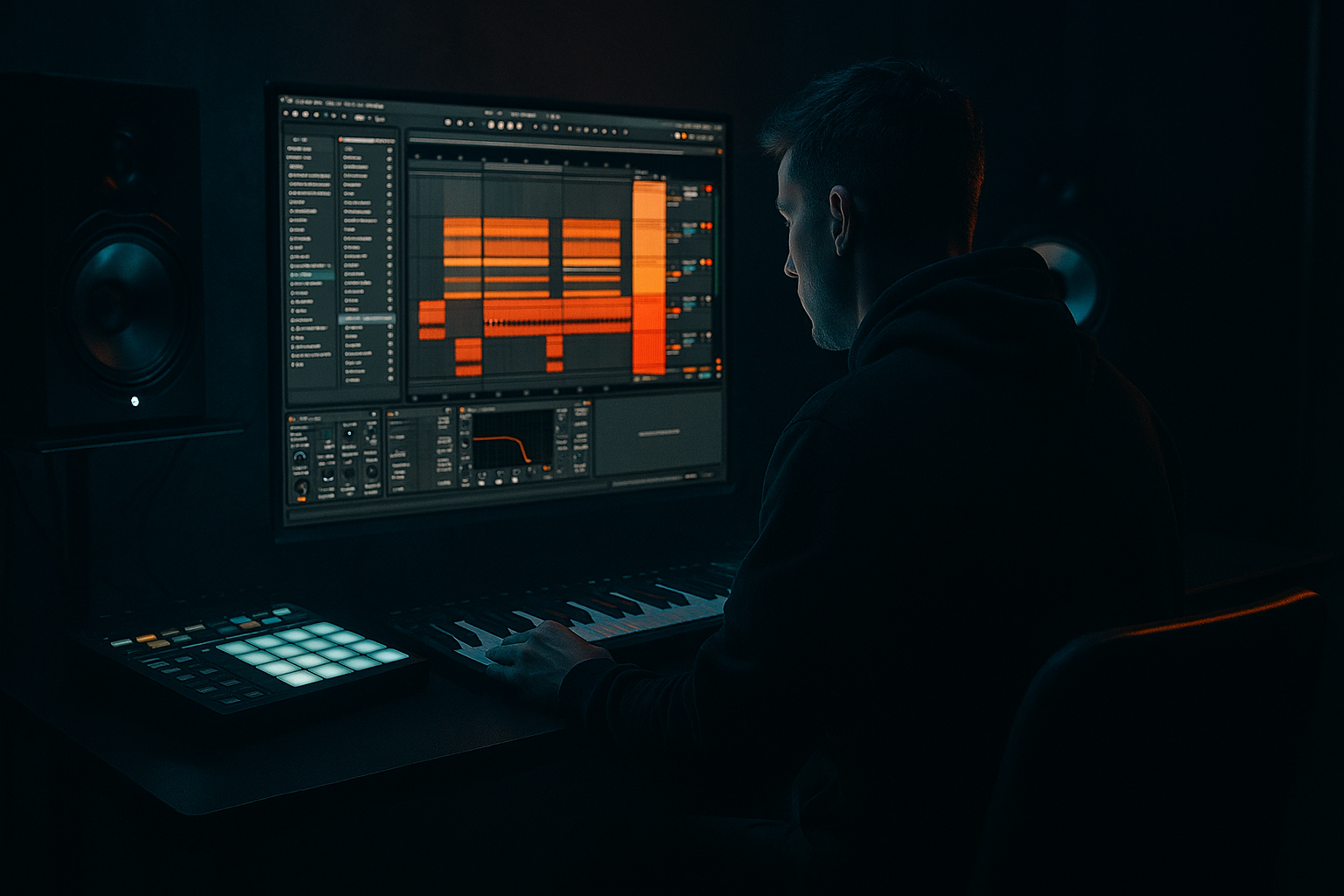
Main tutorial
```markdown
Future Jungle: Riser Swing for Floor‑Shaking Low End (Ableton Live 12) 🔥🥁
Skill level: Advanced
Category: Vocals (but engineered to drive the groove + low end)
---
1) Lesson overview
“Riser swing” in Future Jungle is that elastic, forward-leaning push that happens when your riser, vocal chops, and rhythmic FX are swung/offset in a way that makes the sub feel like it’s pulling the room forward. In Ableton Live 12, we’ll build a vocal-driven riser system that:
- Creates groove tension before the drop
- Locks to your break + bass pocket (instead of fighting it)
- Translates to floor-shaking low end because timing + space are managed like a mix engineer, not just a sound designer
- Vocal Riser Rack (Audio track or Simpler): sliced vocals, pitch ramp, formant-ish movement, rhythmic gating
- Swing Engine: Groove Pool + per-layer timing offsets (Track Delay + note start offsets)
- Low-End Protection: surgical filtering + sidechain timing so vocals enhance bass perception without masking it
- Arrangement: 8–16 bar build with increasing rhythmic density, ending in a tight “suck-out” moment before the drop
- Start simple: 8th notes on offbeats
- Then add 16th note fills at the end of the bar (classic jungle anticipation)
- Use call/response with breaks: leave space where the snare would “speak”
- Hits on: `1.2, 1.2.3, 1.3, 1.4, 1.4.3`
- Then a quick run: `1.4.2, 1.4.3, 1.4.4`
- Apply different groove amounts to different layers (vocal vs noise vs tonal riser) to create “riser swing depth.”
- Keep as your main Simpler.
- Track Delay (in mixer, show with “D”): set to -5 to -12 ms
- Controls → Transpose automate from `0` to `+7` or `+12` semitones across 8 bars
- Keep it musical: try `+5` or `+7` for jungle flavor, `+12` for hype.
- Add Auto Filter (if not already):
- Add a tiny resonance: `5–15%` for “edge” without whistle.
- Bars 1–4: mostly 8ths
- Bars 5–8: introduce 16ths
- Bars 9–12: add triplet flourish sparingly (jungle nod)
- Bars 13–16: drop out to create a “vacuum” right before drop (see Step 8)
- Duplicate the MIDI clip (safety copy)
- In Groove Pool: Commit (or consolidate timing by freezing/flattening audio if you resampled)
- Then do tiny manual edits for signature swing:
- Swinging everything equally: If all layers swing the same, it sounds flat. Offset layers in time.
- Leaving low end in vocal FX: Even “airy” vocals can have low-mid junk. High-pass aggressively.
- Over-randomizing timing: Jungle is loose, but Future Jungle is controlled chaos. Keep random low.
- Sidechain release too slow: You’ll smear the groove and weaken the drop.
- Too much reverb pre-drop without a cut: The drop won’t feel like a drop—just a continuation.
- Saturate the riser mids, not the lows:
- Create “shadow swing” with gated reverb:
- Use spectral shaping via Multiband Dynamics:
- Make the riser feel wider, but keep the drop centered:
- Resample and downsample:
- “Riser swing” is timing design—not just a rising sound.
- Use vocal chops as your transient anchor, then layer late air and neutral tonal motion.
- Control swing with Groove Pool, then sculpt feel with Track Delay in milliseconds.
- Protect the sub with high-pass + sidechain, and create a pre-drop vacuum for maximum impact.
- Commit and fine-edit: the best Future Jungle builds feel human, but engineered.
We’ll focus on vocal risers/chops as the “swing carrier,” then glue them to the bass using Groove Pool, track delays, sidechain, and smart filtering.
---
2) What you will build
A pre-drop “Future Jungle lift” made from vocals + noise + reese layer, with controlled swing that sets up the sub impact:
All stock Ableton devices (Live 12).
---
3) Step-by-step walkthrough
Step 0 — Session + groove context
1. Set tempo: `160–170 BPM` (try 165 for classic jungle energy).
2. Have a reference groove already running:
- A break (Amen-ish or tight 2-step)
- Your sub (simple sine/triangle) hitting in the drop pattern
> You need the drop groove present while designing the riser swing. Otherwise you’ll swing into the wrong pocket.
---
Step 1 — Prep a vocal to become your “swing carrier” 🎙️
1. Drag a vocal phrase into an Audio Track.
2. Right-click → Slice to New MIDI Track…
- Slicing preset: “Transient”
- Create one slice per: transient (adjust if it over-slices)
3. In the new Simpler (Slice Mode) track:
- Warp: On
- Mode: Complex Pro (if it’s tonal) or Complex (if it’s noisy/airy)
- Set Voices: `1–2` (tight chops)
- Filter: enable, set to HP 24 dB, start around `150–250 Hz` (we’ll automate later)
Why: you’re making the vocal rhythmic—like percussion—so swing becomes audible and groove-relevant.
---
Step 2 — Write a jungle-leaning riser rhythm (not just a whoosh)
Create a 1-bar MIDI clip driving the slices:
Example (1 bar, 1/16 grid):
> The goal: a rhythm that can swing like a shuffle, not a constant machine gun.
---
Step 3 — Apply groove properly (Groove Pool) 🌀
1. Open Groove Pool (hotkey: Ctrl/Cmd + Alt + G).
2. Drag in a groove:
- Start with MPC 16 Swing 57–63
- Or try SP 1200 grooves for gritty push
3. On the MIDI clip, enable Groove and pick your groove.
4. Groove settings (starting point):
- Timing: `60–85%`
- Velocity: `10–25%` (adds human lift without losing control)
- Random: `2–6%` (keep tight; we’re advanced, not sloppy)
5. Commit? Not yet. Keep it adjustable while arranging.
Critical advanced move:
---
Step 4 — Micro-time the layers (Track Delay + note offsets)
This is where “riser swing” turns into low-end enhancement.
Create three layers:
#### A) Vocal Chop Layer (front of groove)
- Makes vocal feel like it pulls the bar forward.
#### B) Noise/Air Layer (late + wide)
1. Duplicate track.
2. Replace Simpler with Operator:
- Osc A: Noise White
- Filter: Band-Pass around `2–6 kHz`
3. Add Auto Filter after Operator:
- HP/ BP sweep automation (more in Step 5)
4. Track Delay: +8 to +18 ms
- Makes width and tail sit behind, creating perceived depth.
#### C) Tonal Riser Layer (optional reese shimmer)
1. Add Wavetable:
- Two saws or a reese-like wavetable
- Unison: low (2–4), keep mono lows
2. Track Delay: 0 to +6 ms (neutral)
3. EQ: HP at `120–200 Hz` (do not fight the sub)
Why this works: your ear locks onto early transients (vocal), while later layers fill space without masking the bass attack.
---
Step 5 — Make it rise with movement (pitch, filter, density)
#### Pitch ramp (vocal “lift”)
On the Vocal Chop Simpler:
#### Filter ramp (low-end protection + excitement)
On each riser layer:
- Start HP around `150–300 Hz`
- End HP around `800 Hz–2 kHz` (depends on how bright your drop is)
#### Density ramp (arrangement energy)
---
Step 6 — Turn vocals into rhythmic pumping (sidechain that respects sub) 🔧
We want the riser to pump with the groove, but not smear the low end.
1. On the Vocal Riser Group, add Compressor (stock).
2. Enable Sidechain and choose your Kick or Ghost Kick track:
- If your drop is break-driven, create a Ghost Kick that triggers on the sub-impact moments (often 1 and the pickup).
3. Starting Compressor settings:
- Ratio: `3:1–5:1`
- Attack: `1–5 ms` (fast enough to carve space)
- Release: `60–140 ms` (tempo-dependent; set to groove)
- Threshold: dial for `2–6 dB` gain reduction
Advanced: sidechain pre-drop slightly more than the drop so the drop feels bigger when the riser stops.
---
Step 7 — Glue swing to the bass pocket (the “low end feels bigger” trick)
Even though the riser is mostly high-passed, it can still mess with perceived weight by cluttering timing.
Do this:
1. On the Sub Bass track, add Utility:
- Bass Mono: On (if available in your version), or keep Width at `0%` below ~120 Hz using a rack/EQ approach
2. On the Vocal Riser Group, add EQ Eight:
- High-pass: `24 or 48 dB/oct`
- Aim for no meaningful energy below 150–250 Hz
3. Now “lock” the swing relationship:
- If the vocal feels late vs the sub, move Vocal track delay earlier by `-2 to -5 ms`
- If it steals the snare space, move it later by `+3 to +8 ms` and reduce 2–4 kHz
Key idea: micro-timing changes the perceived bass hit because your brain interprets leading transients as “impact.”
---
Step 8 — The pre-drop “suck-out” (classic jungle tension) 😈
In the final 1/2 bar to 1 bar before the drop:
1. Automate Vocal Riser Group:
- Reverb (Hybrid Reverb or Reverb): increase Decay + Wet
- Then hard-cut the reverb return right on the drop (mute or automate wet to 0)
2. Add a Utility after effects:
- Automate Gain down `-3 to -inf` in the last 1/8 note (micro-dropout)
3. Optional: Auto Filter low-pass sweep down quickly at the very end (reverse energy)
This creates a vacuum so the sub feels like it inflates the room when it hits.
---
Step 9 — Commit the groove (when you’re happy)
Once it feels right:
- Nudge 1–2 key hits by `5–15 ms`
- Adjust velocities to emphasize the offbeat lift
---
4) Common mistakes
---
5) Pro tips for darker/heavier DnB 🖤
Use Roar or Saturator on the Vocal Riser Group, but keep a HP filter before it.
Put Gate after Hybrid Reverb, sidechain the Gate to your ghost kick—reverb breathes rhythmically.
Lightly control harsh highs (8–12k) so you can push volume without brittleness.
Put Utility on the riser: Width `130–170%` (only if it doesn’t phase), and hard-mono your sub.
Resample the riser into audio, then use Redux lightly (bit reduction small) for crunchy jungle texture.
---
6) Mini practice exercise (15–25 minutes) ⏱️
1. Take a 1-bar vocal slice groove and apply MPC 16 Swing 60.
2. Duplicate it into three layers and set Track Delays:
- Vocal: `-8 ms`
- Noise: `+12 ms`
- Tonal: `+2 ms`
3. Arrange an 8-bar build:
- Bars 1–4: 8th pattern
- Bars 5–7: add 16ths
- Bar 8: reverb swell + suck-out
4. Bounce/resample the riser and A/B:
- With swing at `50%` vs `80%`
- With Track Delays on vs off
5. Write one sentence: “Where does the groove feel like it leans?” Adjust delays by ±3 ms until it’s undeniable.
---
7) Recap
If you want, tell me your BPM and whether your drop is more Amen roller or 2-step steppers, and I’ll give you a specific 16-bar riser pattern + groove settings that match it.
```

