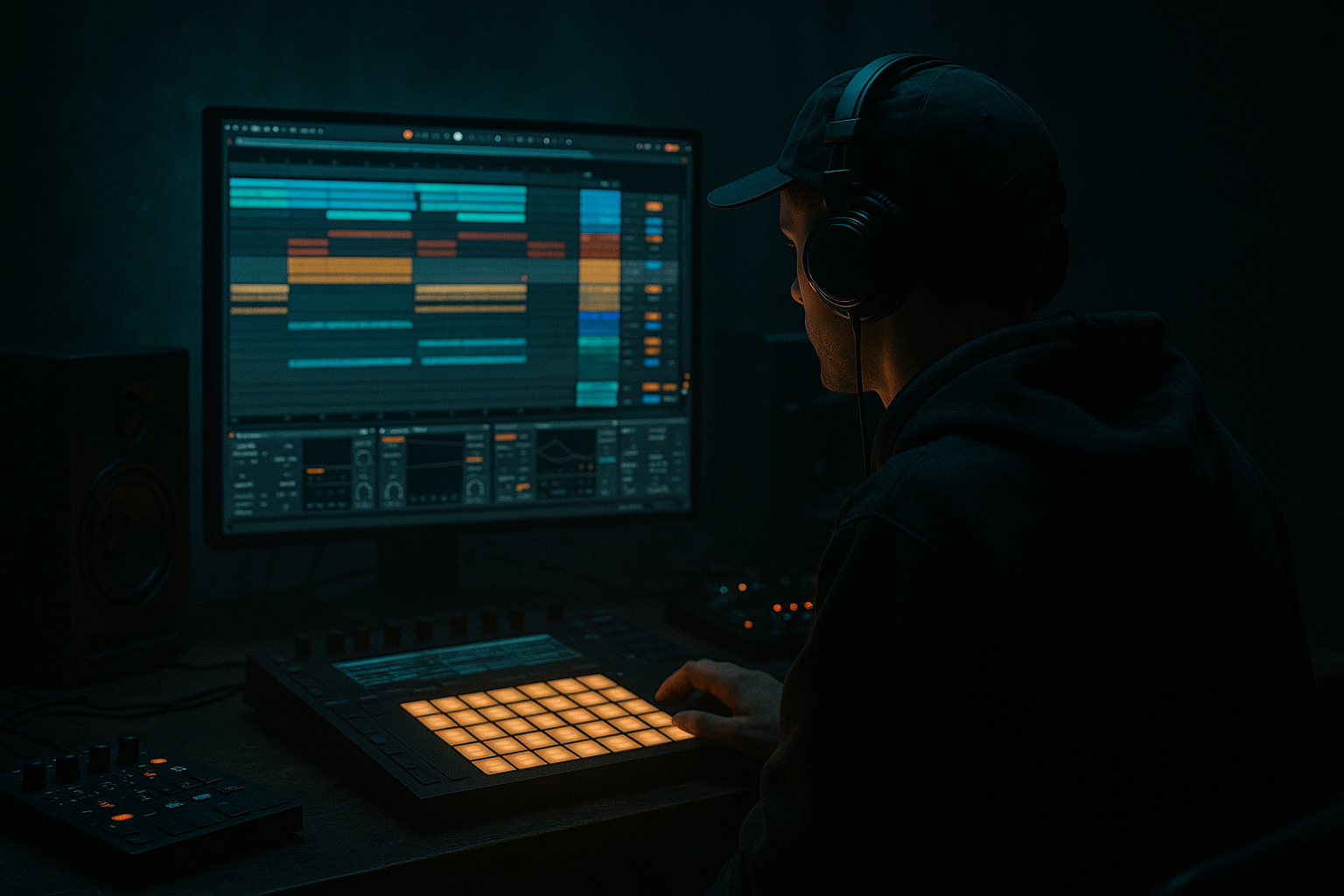
Main tutorial
FX Chains for DnB Breakdowns (from scratch) — Arrangement View (Ableton Live) 🎛️🥁
1. Lesson overview
In drum & bass, the breakdown isn’t just “the quiet part”—it’s where you reset energy, create tension, and set up the drop. In this lesson you’ll build repeatable FX chains using Ableton stock devices and automate them in Arrangement View so your breakdowns feel intentional, cinatic, and DnB-ready.
You’ll learn:
- How to turn a busy drop into a controlled breakdown using automation
- Practical FX chains: wash-out reverb, tape-stop, riser, downlifter, drum “ghosting”
- Clean routing + gain staging so it stays punchy when the drop returns
- A “Breakdown Wash” Return track (big reverb + filtering + width)
- A “Tension Bus” Audio track for resampling + one-shot FX
- Automated chains on key groups:
- Arrangement moves that sound like real DnB/jungle: drum ghosting, 16-bar ramp, last-2-bars kill + impact
- Mode: start with Hall
- Decay: 6–10 s
- Predelay: 20–40 ms (keeps transients readable)
- Dry/Wet: 100% (because it’s a Return)
- High-pass: 150–300 Hz (12 or 24 dB/oct)
- Type: Low-pass
- Frequency: automate later (start around 8–12 kHz)
- Resonance: 0.7–1.2 (a little bite is nice for tension)
- Width: 120–150% (careful: too wide can get smeary)
- Gain: -2 to -6 dB if it’s overpowering
- Type: High-pass (for breakdown)
- Starting freq (drop): ~30 Hz
- Ending freq (breakdown): 200–500 Hz depending on how empty you want it
- Resonance: 0.8–1.3 (adds “whistle” tension when automated)
- Drive: 5–15%
- Crunch: 0–10%
- Boom: Off (or very low; breakdowns don’t need extra sub)
- Trim so level doesn’t jump
- Gain automation later if needed (small moves: -1 to -3 dB)
- Bars 1–8 of breakdown: keep hats/shakers lightly present
- Bars 9–16: reduce drums to snare ghosts + reverb throws
- Last 2 bars: hard cut most drums, leave a tail + impact
- Add Gate after Hybrid Reverb on the Return (or before EQ) if tails get too long.
- High-pass automation target: move from 20–30 Hz (drop) up to 80–150 Hz (breakdown)
- Optional: small dip at 200–400 Hz if it boxes up when filtered
- Use Low-pass to “close the bass tone”
- Frequency: automate from 18 kHz down to 400 Hz–2 kHz depending on sound
- Add a touch of resonance for that “closing door” vibe
- Width: 0% on the BASS group if it contains sub
- If you want airy stereo in breakdown: split your bass into SUB (mono) + MID (stereo) tracks (best practice), and only widen MID.
- In the breakdown, let the bass become a midrange drone (filtered) while the sub is mostly gone. Then slam the sub back in at the drop locator.
- High-pass: automate from 100 Hz → 1–2 kHz across 8–16 bars
- Time: 1/4 or 3/16 (DnB-friendly)
- Feedback: 25–45%
- Mod: small (adds movement)
- Dry/Wet: 15–30%
- Decay: 2–4 s
- Dry/Wet: 10–25%
- Automate Gain up slightly into the final bars (+1 to +3 dB), then cut right before drop.
- Use a crash or a low boom (short, not long), and high-pass the reverb tail so it doesn’t cloud the drop.
- Too much low-end in reverb: always high-pass your returns (150–300 Hz is a great starting point).
- Over-widening everything: width is exciting in breakdowns, but if you widen drums + bass + music all at once, the drop feels smaller.
- Automation ramps that aren’t timed to bars: DnB tension is arrangement-driven—make ramps land exactly at 8/16 bar landmarks.
- No level control: big FX can jump 6–10 dB easily. Use Utility gain or Return fader to keep headroom.
- Filtering the kick but leaving sub-bass: you’ll feel “mud” even if it sounds filtered. Treat bass + kick together.
- Use resonant high-pass sweeps on drums: set Auto Filter Resonance around 1.1–1.4 for that sharp, tense edge.
- Distorted reverb return (dark techy vibe):
- Make space with “sub absence”: removing sub in the breakdown makes the drop feel twice as heavy.
- Short, controlled tails > endless wash: for neuro/tech DnB, keep tails tighter and automate throws more precisely.
- Noise beds + atmos movement: use Auto Pan (slow rate 0.05–0.15 Hz) on a pad/field recording for uneasy motion.
- Breakdown FX in DnB are mostly about controlled filtering, selective reverb throws, and bar-accurate automation.
- Build a reliable foundation:
- Commit special moments by resampling and placing them like fills.
- Keep low end clean and mono—your drop will thank you.
---
2. What you will build
A complete breakdown FX setup for a rolling DnB tune:
- Drum bus: filter-out + short ambience tail
- Bass bus: controlled low-end mute + stereo “air” (without wrecking mono)
- Music/atmos: widening + movement + reverb throws
---
3. Step-by-step walkthrough
Step 0 — Quick session prep (2 minutes)
1. In Arrangement View, make these Groups (or at least keep tracks organized):
- DRUMS (kick, snare, breaks, hats)
- BASS
- MUSIC / ATMOS (pads, stabs, vocals, FX)
2. Set locators:
- `Drop Start`
- `Breakdown Start`
- `Build Start` (typically 8 or 16 bars before the drop)
3. Keep headroom: aim for Master peak around -6 dB during the drop. Your breakdown FX will add level fast.
---
Step 1 — Create a “Breakdown Wash” Return track 🌊
Return tracks are perfect for breakdowns because you can throw selected sounds into big FX without permanently destroying them.
1. Create Return Track A and name it: `A - WASH`
2. Add these stock devices in this order:
#### Device chain: `Hybrid Reverb → EQ Eight → Auto Filter → Utility`
Hybrid Reverb
EQ Eight (after the reverb)
This stops reverb mud from eating your breakdown.
Auto Filter
Utility
✅ Now you have a safe, mix-friendly mega-reverb you can throw drums/vocals/stabs into during the breakdown.
---
Step 2 — Add “Tension Bus” for resampling (optional but powerful) 🔥
This is where you print crazy FX for fills and uplifters.
1. Create a new Audio Track named: `TENSION RESAMPLE`
2. Set Audio From: `Resampling` (or choose the group you want to print)
3. Arm it when you want to capture a bar or two.
Why this matters: DnB breakdown FX often sound “produced” because they’re committed audio, edited tightly, and placed like drum fills.
---
Step 3 — Drum breakdown chain (classic DnB “fade to ghost”)
On your DRUMS group, add a simple but effective chain:
#### Device chain on DRUMS group: `Auto Filter → Drum Buss (light) → Utility`
Auto Filter
Drum Buss (subtle)
Utility
#### Automate it in Arrangement View
1. Hit `A` to show automation lanes.
2. On the DRUMS group:
- Automate Auto Filter Frequency to rise gradually across 8–16 bars.
- Optional: automate Resonance slightly up in the last 2 bars for tension.
DnB arrangement tip:
---
Step 4 — Snare reverb throw (the “big room hit”) 🏟️
This is a signature move in rolling and jungle.
1. On your snare track, raise the send to `A - WASH` only on key hits.
2. In Arrangement View automation:
- Send level normally: -inf to -20 dB
- On the throw hit: push to -6 to 0 dB briefly (even just one snare)
Extra control trick:
- Threshold: adjust until it closes after ~1–2 seconds
- This keeps the breakdown clean while still sounding huge.
---
Step 5 — Bass breakdown control (don’t let reverb wreck your low end)
For DnB, the rule is: sub stays clean and mono. In breakdowns, you often remove the sub to create space, then bring it back for impact.
On your BASS group:
#### Device chain: `EQ Eight → Auto Filter → Utility`
EQ Eight
Auto Filter
Utility
Arrangement move:
---
Step 6 — Create a simple riser with stock devices (no samples needed) 🚀
Make a riser track that fits DnB tension.
1. Create a MIDI Track named `Riser`
2. Add Operator:
- Oscillator A: Sine or Saw
- Play a sustained note (e.g., F or G root)
3. Add this chain after Operator:
#### Device chain: `Auto Filter → Echo → Reverb → Utility`
Auto Filter
Echo
Reverb (or Hybrid Reverb smaller than the Wash)
Utility
Bonus: Add Redux lightly (Bit Reduction 10–12, Dry/Wet 5–15%) for gritty jungle tension.
---
Step 7 — The “last 2 bars” breakdown trick: tape-stop + silence + impact 🎚️💥
This is huge in heavier DnB.
Option A (Stock-friendly): frequency + volume kill
1. On the Master (or DRUMS + MUSIC bus), automate:
- Auto Filter Low-pass from 18 kHz → 300–800 Hz over the final 1 bar
- Utility Gain: dip -3 to -8 dB right before the drop
2. At the exact drop, reset everything instantly.
Option B (Resample for tape-stop feel)
1. Resample a 1-bar drum loop into audio.
2. Use Warp:
- Warp Mode: Beats (or Texture for smear)
3. Automate Transposition down (clip envelope) or stretch the end for a slow-down feel.
4. Add a huge reverb tail to the last hit (send to `WASH`).
Finish with an impact:
---
4. Common mistakes
---
5. Pro tips for darker/heavier DnB 🖤
- On `A - WASH`, insert Saturator before EQ Eight
- Drive: 2–6 dB, Soft Clip On
- Then EQ out harshness around 3–6 kHz if it bites
---
6. Mini practice exercise (15 minutes) ⏱️
Goal: Build a clean 16-bar breakdown that sets up a drop.
1. Pick an 8-bar loop from your drop (drums + bass + one musical element).
2. Duplicate it to create 16 bars of breakdown before your drop.
3. Add `A - WASH` return as described.
4. Automate:
- DRUMS Auto Filter HP: 30 Hz → 350 Hz over 16 bars
- BASS EQ Eight HP: 30 Hz → 120 Hz by bar 12, then keep it there
- Snare send throw to WASH on bar 8 and bar 16
5. Add a riser using Operator and automate the high-pass up.
6. Last 2 bars:
- Low-pass the MUSIC group down to 600 Hz
- Cut everything for 1/8 or 1/4 bar of silence before the drop
7. Play from breakdown into drop and adjust Return level so the drop hits harder, not softer.
---
7. Recap ✅
- `WASH` Return: Hybrid Reverb → EQ → Filter → Utility
- DRUMS + BASS: automate high-pass / low-pass to create space and tension
If you tell me what subgenre you’re aiming for (liquid, roller, jungle, neuro, jump-up), I can suggest a matching breakdown template and exact automation shapes.

