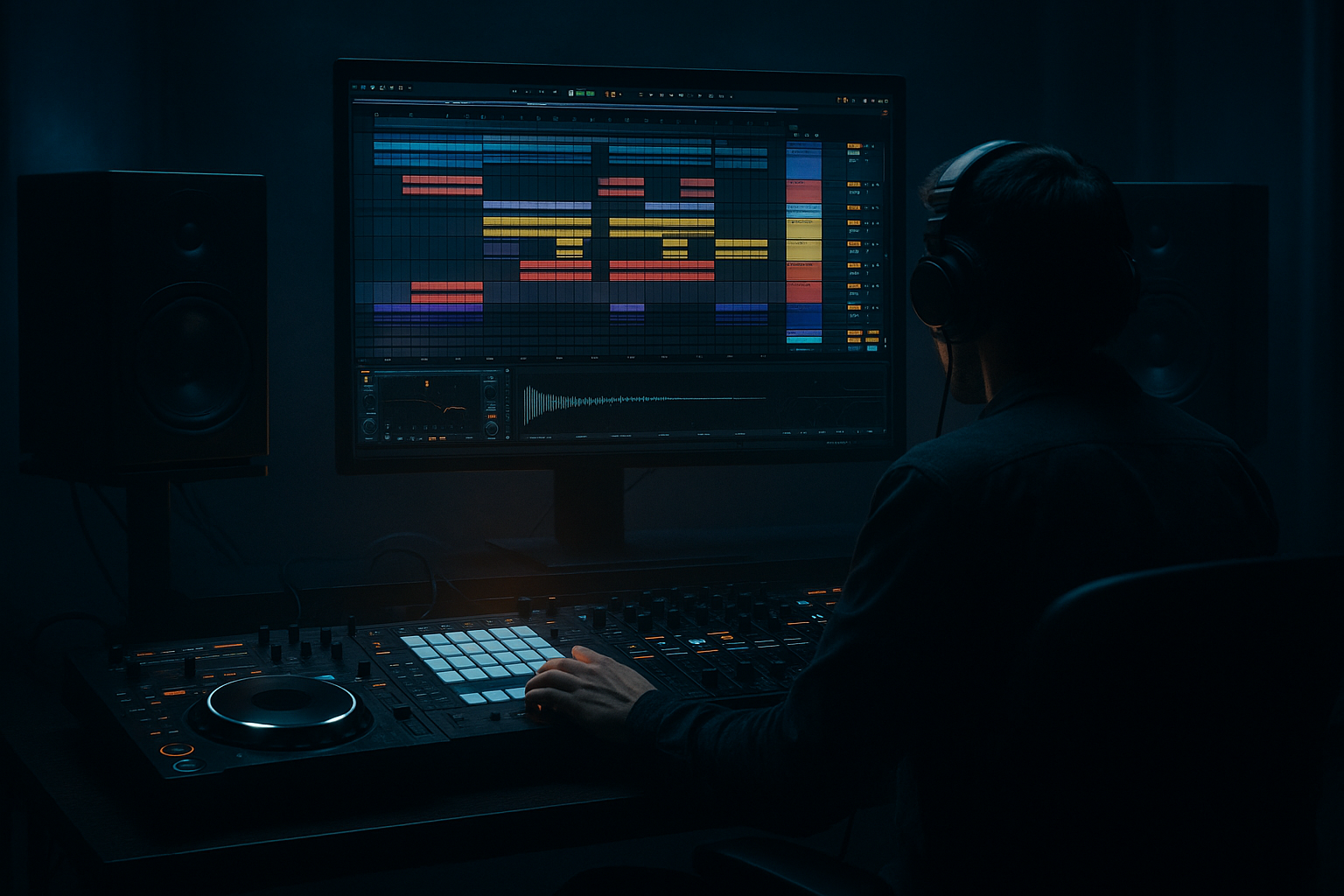
Main tutorial
```markdown
FX Sweeps from Reversed Dub Chords (DnB in Ableton Live) 🔁🌊
1. Lesson overview
In drum & bass, big transitions often feel empty if you rely only on noise risers. A super musical alternative is making FX sweeps from reversed dub chords—that classic “pulling you into the drop” sound you hear in rolling, jungle-influenced, and darker DnB.
You’ll create a chord stab, print it to audio, reverse it, then shape it into a controlled sweep using filtering, reverb, modulation, and resampling.
Skill focus (Intermediate):
- Resampling + audio workflow
- FX chains using stock Ableton devices
- Arrangement and tension building in DnB
- Starts thin/distant and grows into a wide, noisy harmonic lift
- Lands perfectly on a bar line (e.g., right before the drop)
- Can be tuned to match your key and vibe
- Works as: pre-drop pull, 8/16 bar transition, mid-drop impact setup, or jungle-style turnaround
- Clean + airy
- Dark + gritty
- Aggressive + distorted
- Simpler (for sampled stabs) or
- Wavetable (for synth stabs) or
- Any dub-chord rack you already use
- Osc 1: Saw, Unison 2–4, Detune 10–20%
- Osc 2: Sine or Square low blend (optional)
- Filter: Lowpass 24, Drive 3–8, Cutoff around 500–2kHz
- Amp Env: Attack 0–5 ms, Decay 250–600 ms, Sustain 0, Release 80–200 ms
- Add Chorus-Ensemble (Classic mode) for width:
- Add Echo (dub timing):
- Typical DnB: minor tonality, simple voicings.
- Try one stab on the “and” of 2 or right before beat 4 (classic tension).
- Chord: Am9 vibe (A–C–E–G–B) but you can omit notes to keep it tight.
- Freeze + Flatten the MIDI track or
- Resample:
- Select the stab + tail region
- Press Cmd/Ctrl + J to Consolidate
- In Clip View, click Reverse
- Turn Warp ON
- Set Warp mode:
- Decide sweep length:
- Stretch so the end of the reverse hits lands exactly on the drop downbeat.
- Put Auto Filter on the reversed audio track.
- Mode: Highpass 12 or 24
- Start cutoff low-ish then automate up:
- Add resonance: 10–25% (careful—can whistle)
- Cutoff rises steadily, but do a tiny dip right before the drop (last 1/8 bar), then snap open again—creates a “gulp” effect.
- Ratio 2:1
- Attack 3 ms
- Release Auto
- Aim for 1–3 dB gain reduction to keep the sweep stable.
- Algorithm: Hall or Plate
- Decay: 3–8 s
- Pre-Delay: 10–25 ms (keeps definition)
- EQ inside reverb:
- Mix: 20–45% (or 100% if doing a pure wet FX layer)
- Phaser-Flanger (slow):
- Frequency Shifter (for metallic tension):
- Add Utility at the end:
- If it gets too wide/phasey, reduce width or use:
- Record the output to a new audio track (Resampling).
- Consolidate again so you have a clean single clip.
- Pitch it (Clip Transpose -12 for darker)
- Reverse it again (for weird inhale/exhale combos)
- Chop it into 1/2-bar FX hits
- HP-filtered + wide + reverby
- Use Operator (Noise oscillator) or a noise sample
- Auto Filter HP rising
- Light reverb
- Mix quietly for “air lift”
- Automate Reverb Dry/Wet to 0% right on the downbeat
- Automate a Utility mute (gain to -inf) just at the drop, while your kick/snare takes over.
- Leave a tiny 20–80 ms tail so it “hits” and disappears.
- Not consolidating before reversing → timing becomes messy and you lose the sweep shape.
- Too much low end → your sweep fights the sub and muddies the pre-drop. Highpass earlier.
- Over-widening → phasey mono collapse in clubs. Check with Utility (Width 0–100%) or a mono check.
- Reverb too bright → sounds like trance riser, not DnB. Lowpass the reverb.
- No final transient control → the end can click/pop or be too loud. Fade or compress lightly.
- Pitch it down: Clip Transpose -5 to -12 for weight and menace.
- Saturate after filtering:
- Add distortion only on the mids:
- Use Frequency Shifter subtly for “industrial dread”:
- Gate the reverb rhythmically (jungle vibe):
- Build a dub chord stab, print to audio, reverse it, and warp to fit your DnB grid.
- Shape the sweep with Auto Filter automation, then add size using Hybrid Reverb, movement FX, and careful stereo control.
- Resample to commit, then create variations (pitch, saturation, mid-only distortion).
- Finish with a clean drop transition (reverb cut / mute / micro-tail) so the drums and bass hit hard.
---
2. What you will build
A tight, tempo-locked sweep that:
You’ll end with 2–3 variations:
---
3. Step-by-step walkthrough
A) Make a dub chord source (MIDI → Audio)
1) Create a MIDI track and load an instrument:
Quick Wavetable dub chord recipe (stock):
- Amount 25–45%, Rate 0.2–0.6 Hz
- Time: 1/8 or 1/4 dotted, Feedback 25–45%
- Filter in Echo: HP around 200–400 Hz, LP around 4–8 kHz
2) Write a chord hit
Example (in A minor):
3) Print to audio
- Create a new audio track
- Set its input to Resampling
- Arm + record your stab + tail for 1–2 bars
Goal: a clean audio file with reverb/delay tail (or you can add FX later).
---
B) Reverse it into a sweep 🔥
4) Consolidate the audio
This makes it easy to reverse and warp cleanly.
5) Reverse
Now you’ve got the “sucking in” shape: quiet tail → loud transient.
6) Warp & timing
- Complex Pro if it’s rich/washed
- Complex works fine too
- For DnB transitions, common lengths: 1 bar, 2 bars, 4 bars, 8 bars
Arrangement tip:
Place the reversed chord so its final transient hits exactly on bar 17 (drop start), then mute it right at the drop or let it smack into a reverb cut.
---
C) Shape it like a proper riser (filter + envelope)
7) Add an Auto Filter
- Start: 80–200 Hz
- End: 1.5–6 kHz depending on brightness
Automation move (very DnB):
8) Add a Glue Compressor (optional control)
---
D) Make it huge: reverb + width + movement 🌌
9) Reverb (Hybrid Reverb is perfect)
Use Hybrid Reverb after the filter:
- Low cut: 200–400 Hz
- High cut: 6–10 kHz (darker vibe)
10) Add subtle movement
Options:
- Rate 0.05–0.2 Hz, Amount 20–40%
- Shift +10 to +80 Hz (automate rising)
- Dry/Wet 5–20%
11) Stereo control
- Width 120–160%
- Bass Mono: turn on if needed (or just HP filter earlier)
- Utility Width 90–110% and rely on reverb for space.
---
E) Resample into a “finished” FX and build variations
12) Resample the processed sweep
Now you can:
13) Layer it like a DnB producer
Create two layers:
Layer 1: Harmonic sweep (your reversed chord)
Layer 2: Noise air layer (optional)
This keeps the musical identity while ensuring it still “reads” as a riser.
---
F) Drop impact: stop the tail cleanly 🧨
Classic DnB trick: hard reverb cut at the drop.
or
If you want it to slam into the drop:
---
4. Common mistakes
---
5. Pro tips for darker/heavier DnB 🖤
Use Saturator (Analog Clip):
- Drive 2–8 dB
- Soft Clip ON
- Then re-check levels (it adds loudness fast).
- Audio Effect Rack:
- Chain A: clean/wide (HP at 200 Hz)
- Chain B: distorted mid band (EQ Eight band-pass ~400 Hz–4 kHz → Overdrive)
- Shift automation rising into the drop (tiny amounts)
- Put Gate after reverb
- Sidechain from a ghost break or hats (if you’re comfortable routing)
- Creates pulsing pre-drop energy without extra drums.
---
6. Mini practice exercise (15–20 min) 🧪
1. Make a 2-bar reversed dub chord sweep that lands on your drop.
2. Create three versions:
- Version A (Clean): Auto Filter + Hybrid Reverb only
- Version B (Dark): Add Saturator + lowpassed reverb
- Version C (Aggro): Add Frequency Shifter + Overdrive (mid-band only)
3. Arrange them across a 16-bar buildup:
- Bars 9–12: Version A (subtle)
- Bars 13–15: Version B (heavier)
- Bar 16: Version C (most intense), then hard cut on the drop
4. Bounce/resample each to audio and label them in your project as your own FX pack.
---
7. Recap
If you want, tell me your track BPM + key (e.g., 174 BPM in F minor) and whether you’re going for liquid, rollers, or neuro-ish, and I’ll suggest specific chord voicings + an automation curve template.
```

