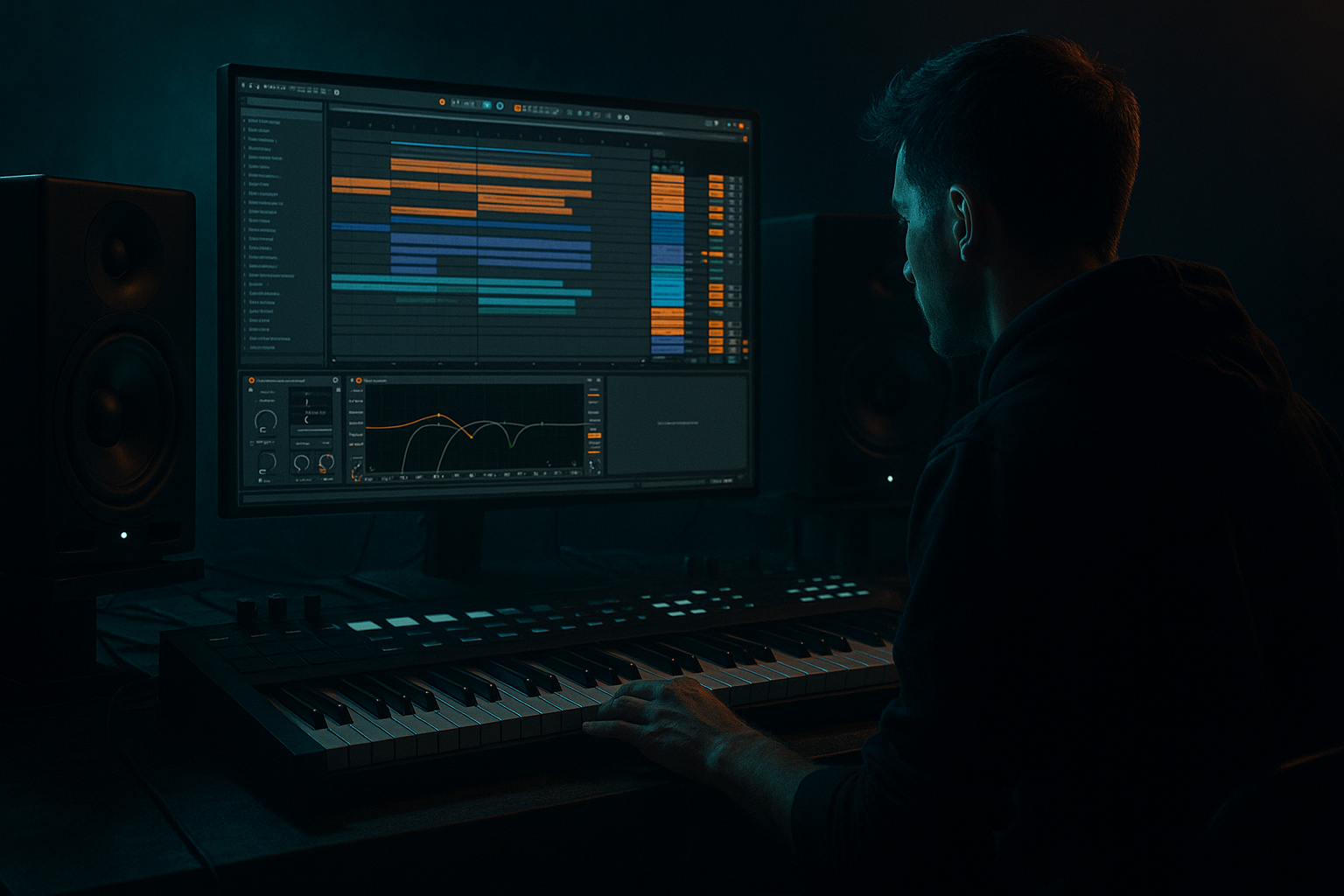
Main tutorial
FX Tails Without Clutter (Smoky Late‑Night DnB) 🌙💨
Ableton Live | Mixing | Beginner-friendly
---
1) Lesson overview
DnB lives on space: cavernous snares, misty atmospheres, dubby delays… but the downside is mud, masking, and clutter—especially in fast 170–174 BPM grooves where tails pile up quickly.
In this lesson you’ll learn a clean, repeatable workflow to get lush reverb/delay tails that feel smoky and late-night while keeping your kick, snare, bass, and hats sharp and upfront. ✅
---
2) What you will build
A practical Ableton Live FX setup using return tracks and sidechained / filtered FX:
- Return A: “NightVerb” (dark reverb with controlled low end)
- Return B: “DubDelay” (tempo delay that doesn’t smear the groove)
- Return C: “WashTail” (long tail for transitions, automated)
- A bus workflow for drums + bass so FX sit behind the mix
- A few arrangement tricks to use tails musically (without fogging the drop)
- Snare: -12 to -6 dB send (more if minimal kit)
- Hats/Tops: -18 to -12 dB (just a halo)
- Vocal chops/FX: as needed
- Kick/Sub: usually off (or extremely low with aggressive filtering)
- Send snare ghost hits or percs to DubDelay for subtle movement.
- For jungle-ish vibes, try sending rimshots or shaker loops lightly.
- The last snare of an 8-bar phrase
- A vocal chop at the end of a call/response
- A crash/impact before a drop
- Most clutter happens below 200–400 Hz.
- Your sub and kick live there—don’t let reverb compete.
- Bright tails scream “EDM hall.”
- Dark tails whisper “late-night warehouse.”
- 6–10 kHz on reverb returns
- 4–8 kHz on delays
- Put a Compressor on each return
- Sidechain from Snare (most common)
- Or from Drum Bus if you want the entire groove to “push” the space back
- Ratio: 4:1
- Attack: 5 ms
- Release: 160 ms
- GR: aim 3–6 dB on main hits
- Every 8 bars: last snare gets a bit more NightVerb send
- Every 16 bars: a vocal chop gets DubDelay with higher send
- Between sections: one big WashTail hit that “hangs” into the next part
- Drop clarity trick: reduce sends by ~2–4 dB in the first 8 bars of the drop, then gradually bring them back
- Pre-delay is your friend: 15–30 ms keeps snares punchy while still huge.
- Saturate returns quietly: A touch of Saturator lets you run FX lower but still feel them.
- Delay into reverb (on the return):
- Automate filters for mood:
- Keep sub mono and dry:
- Use return tracks for consistent, controllable FX tails.
- Always high-pass and often low-pass your FX returns for dark DnB space.
- Sidechain duck returns from snare/drum bus to prevent masking.
- Keep long tails (WashTail) for arrangement moments, not constant use.
- Automate sends/filters so FX become musical punctuation, not fog.
All with stock Ableton devices.
---
3) Step-by-step walkthrough
Step 0 — Prep your session (DnB-friendly routing)
1. Group your drums (Kick, Snare, Hats/Top loops, Perc) into a Drum Bus group.
2. Put your bass (sub + reese/growl layers) into a Bass Bus group.
3. Keep FX sends on individual tracks (snare, tops, vocals, atmos), but try to avoid sending the kick and sub to long reverbs.
Why: DnB needs a stable low-end. FX tails are mainly a mid/high story.
---
Step 1 — Build Return A: “NightVerb” (dark, controlled reverb) 🌫️
Create Return Track A and add this chain:
#### Device chain (in this order)
1. EQ Eight
- High-pass: 150–250 Hz (12 or 24 dB/oct)
- Optional: small dip around 300–500 Hz if it gets boxy
2. Reverb (Ableton stock)
- Decay Time: 1.2–2.4 s (start at 1.8 s)
- Pre-Delay: 15–30 ms (start at 20 ms)
This preserves snare punch before the verb blooms.
- Size: 60–90
- Diffusion: 70–100 (smooth tail)
- Low Cut (inside Reverb): 200–400 Hz
- High Cut (inside Reverb): 6–10 kHz (start at 8 kHz)
Instant “late-night” darker vibe.
- Dry/Wet: 100% (because it’s a return)
3. Compressor (for sidechain ducking)
- Enable Sidechain
- Audio From: your Snare track (or Drum Bus if you want the whole kit to duck it)
- Ratio: 4:1
- Attack: 2–10 ms (start 5 ms)
- Release: 120–250 ms (start 180 ms)
- Lower Threshold until you see ~3–6 dB gain reduction on snare hits
4. (Optional but great) Saturator
- Drive: 1–3 dB
- Soft Clip: On
Adds thickness so you can run the reverb quieter but still feel it.
✅ Send choices (typical DnB):
---
Step 2 — Build Return B: “DubDelay” (tempo echo that stays out the way) 🕳️
Create Return Track B and add:
#### Device chain
1. Echo (or Delay)
- Sync: On
- Time: 1/8 or 1/4 (start with 1/8 for rolling DnB)
- Feedback: 20–35%
- Stereo: 80–120% (keep mono compatibility in mind)
- Modulation: very subtle (Amount ~5–10%) for smokiness
- Filter in Echo:
- Low Cut: 200–400 Hz
- High Cut: 4–8 kHz (darker = lower)
2. EQ Eight (extra cleanup after Echo)
- High-pass: 200–300 Hz
- Gentle low-pass: 6–10 kHz if needed
3. Compressor (sidechain from snare OR drum bus)
- Similar settings to NightVerb, but often a slightly faster release: 100–180 ms
Usage idea:
---
Step 3 — Build Return C: “WashTail” (long tail for transitions) 🌌
This return is not for constant use. It’s for fills, one-shots, and end-of-phrase moments.
Create Return Track C:
#### Device chain
1. EQ Eight
- High-pass: 250–500 Hz
- Optional notch: 2–4 kHz if harsh
2. Hybrid Reverb (amazing stock device)
- Choose Reverb or Convolution (either works)
- Decay: 4–8 s (start 6 s)
- Pre-Delay: 25–45 ms (start 35 ms)
- High Cut: 5–8 kHz
- Dry/Wet: 100%
3. Auto Filter
- Mode: Low-pass
- Frequency: start 8–12 kHz, automate down for “closing curtain” vibes
- Gentle resonance: 5–15%
4. Utility
- Width: 120–160% (keep it wide)
- Consider Bass Mono (if your Live version has it) or just keep lows filtered earlier
Key technique:
Use automation on the send to this return only at:
That gives you big mood without constant blur.
---
Step 4 — Keep tails clean with “frequency containment” (the secret weapon) 🎛️
Even dark reverbs can build mud. Here’s the beginner-proof method:
#### A) High-pass the return (always)
#### B) Add a gentle low-pass for “smoke”
Try low-pass around:
---
Step 5 — Sidechain ducking on returns (space without masking) 🧠
This is how you get tails that feel long but don’t step on transients.
DnB starting point:
If the tail feels like it “breathes” musically, you nailed it.
---
Step 6 — Arrangement ideas: use tails like punctuation ✍️
For rolling DnB, use reverb/delay as phrase markers:
This keeps the drop tight while still sounding cinematic.
---
4) Common mistakes
1. Sending kick/sub to long reverbs
Creates low-end smear and headroom loss. Keep lows dry and solid.
2. No filtering on returns
Full-range reverb = instant mud. High-pass is mandatory.
3. Too much stereo in low mids
Wide 200–500 Hz reverb makes mixes feel unfocused. Filter it out.
4. Reverb decay too long for constant use
In 174 BPM, 4–8s reverb on everything becomes fog. Save it for moments.
5. No ducking
Without sidechain, tails mask transients—your drums will feel “far away.”
---
5) Pro tips for darker/heavier DnB 🖤
On DubDelay, try placing a small reverb after Echo (very short decay, like 0.6–1.2s) for a cohesive haze.
Low-pass the WashTail return down during breakdowns for that “airless” smoky pressure.
Heavy DnB = stable sub. Space happens above it.
---
6) Mini practice exercise (15 minutes) ⏱️
1. Load a simple loop: kick + snare + hats + a reese + sub at 174 BPM.
2. Create the 3 returns: NightVerb, DubDelay, WashTail (use the settings above).
3. Do this automation:
- On the snare track, automate NightVerb send:
- Bars 1–7: around -10 dB
- Bar 8 (last snare): push to -5 dB
- On a vocal stab/FX hit, automate WashTail send only on bar 16.
4. Add sidechain compressors to each return and dial until the drums feel forward but the space still lingers.
Goal: When you mute the returns, the mix feels dry and small. When you unmute, it feels deep and late-night—but still clean.
---
7) Recap ✅
If you tell me your sub/bass style (liquid roller, neuro, jungle/amen, minimal 2-step), I can suggest exact send ranges and tail times that match that subgenre.

