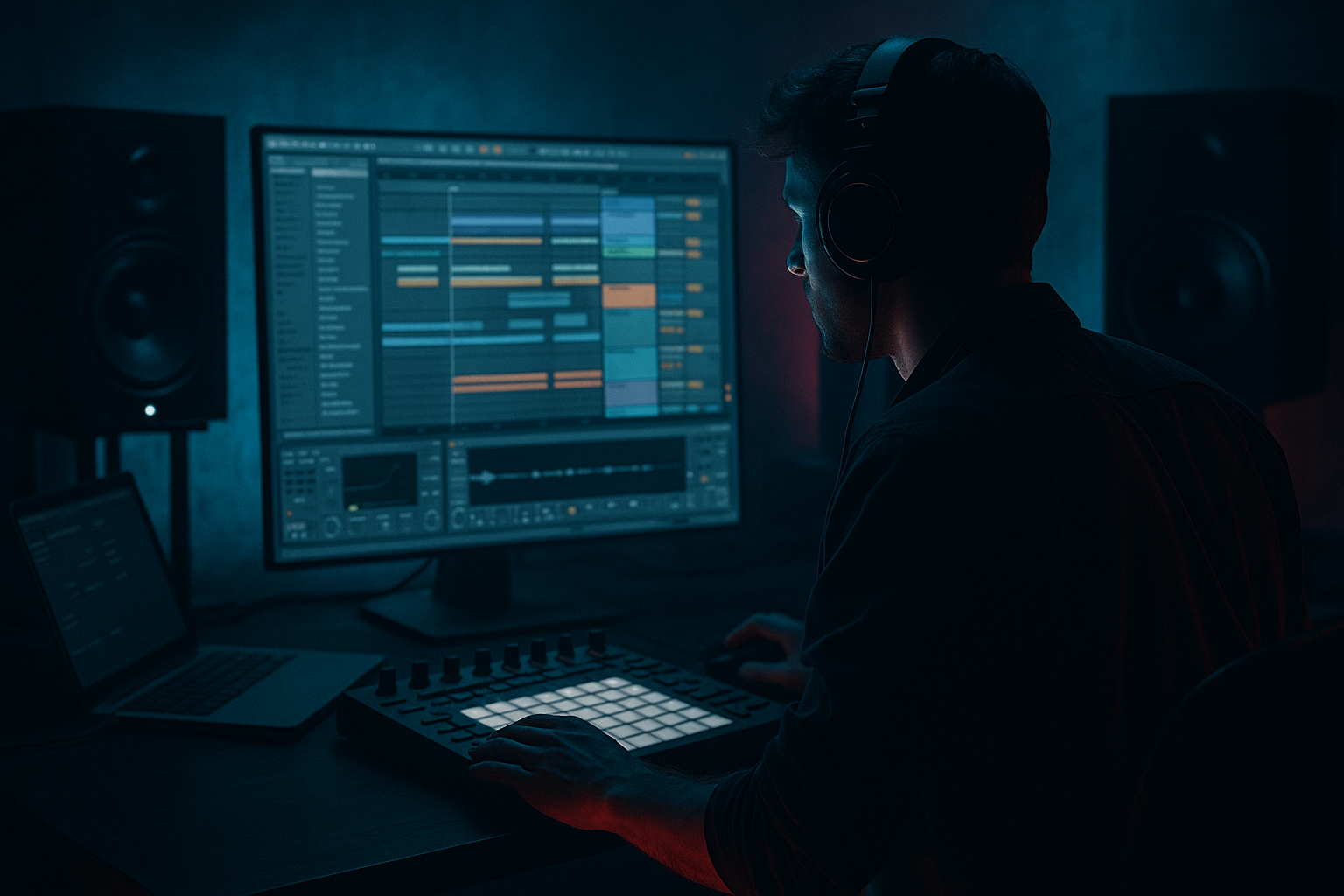
Main tutorial
Lesson Overview
In this lesson, you’ll learn how to glue an Amen-style bass wobble using Groove Pool tricks in Ableton Live 12 so it feels like part of the same jungle-leaning rhythm as the drums, not a separate synth line sitting on top.
This is a very useful composition skill in Drum & Bass because a lot of great basslines are not just about sound design — they’re about rhythmic lock. In rollers, jungle, darker halftime-influenced DnB, and even neuro-inspired bass music, the bass often needs to breathe with the break, leave space for the snare, and create that “one machine” feel where drums and bass move together.
The Groove Pool in Ableton Live is perfect for this because it lets you borrow the swing and timing feel from an Amen break, then apply that same movement to your bassline. Instead of programming a rigid wobble, you’ll build a bass phrase that feels like it’s cut from the same cloth as the drums.
Why this matters in DnB:
- The kick and snare need room to hit hard.
- The bass must feel rhythmic, not random.
- A little groove makes repeating patterns feel alive.
- In darker DnB, tight drum/bass interaction creates tension and momentum without needing too many notes.
- Uses a wobbling low-mid bass note pattern
- Follows a breakbeat-derived groove
- Has sub weight underneath
- Feels like it’s glued to the drums
- Works in a roller, jungle, or dark DnB drop
- Bar 1: a simple bass hit that answers the kick and leaves space for the snare
- Bar 2: a slightly shifted wobble or syncopated note that creates call-and-response
- The bass motion is not overly busy, but it has enough swing to feel alive
- The groove feels connected to an Amen-style break rather than a straight 1/16 grid
- Using too much groove
- Letting bass overlap the snare too much
- Making the wobble too fast or too dramatic
- Too much low-end in both layers
- Forgetting the break is the reference
- No variation across the phrase
- Use a muted mid-bass layer
- Try subtle pitch movement
- Keep the bass mono below the crossover
- Use a touch of Saturator before EQ
- Experiment with ghost notes
- Shape tension with silence
- Pair groove with automation
- groove amount
- note position
- note length
- filter movement
- The Groove Pool can help your bass inherit the feel of the Amen break.
- In DnB, the bass should lock with the drums, not fight them.
- Keep the phrase simple: few notes, strong rhythm, clear space.
- Use Wavetable, Operator, Auto Filter, EQ Eight, Saturator, and Glue Compressor to support the groove.
- Sub and mid layers should be separated clearly for weight and clarity.
- Small timing shifts, note lengths, and automation moves are what make the bass feel glued and musical.
By the end, you’ll have a practical method for making your bass wobble feel more human, locked-in, and jungle-authentic using stock Ableton tools.
What You Will Build
You’ll build a 2-bar Amen-style bass phrase that:
Musically, the result is something like:
Think of it as a bassline that could sit under a stripped-back break, a sub-heavy drop, or a dark halftime section and still feel right.
Step-by-Step Walkthrough
1. Set up a simple drum+bass foundation
Start with a basic DnB session at 174 BPM. That’s the most common starting point for jungle, rollers, and many darker DnB styles.
In one MIDI track, drop in an Amen break or an Amen-inspired break edit. If you’re using a sample, keep it simple: one loop, no heavy processing yet.
On a second MIDI track, create a bass instrument using stock Ableton devices:
- Wavetable for a clean, flexible bass tone
- or Operator if you want a more straightforward sub-reese hybrid
For beginners, keep the sound plain at first:
- Oscillator: saw or basic waveform
- Filter: low-pass around 120–250 Hz depending on brightness
- Add a little Saturator after the instrument for extra density
- Keep the bass mostly mono
Why start simple? Because the groove is the main focus here. If the sound design is too wild too early, it becomes harder to hear whether the bass actually locks to the break.
2. Build a short bass phrase around the break
Program a 2-bar MIDI clip with only a few notes. Don’t make it too busy.
A good beginner pattern is:
- A long bass note on beat 1
- A shorter reply around beat 2.3 or 2.4
- Another note leading into the second bar
- Leave space for the snare
Try a pattern like this conceptually:
- Bar 1: hit on 1, short answer near the “and” of 2
- Bar 2: hit on 1, small syncopated wobble before 3
- Keep note lengths varied so it breathes
For DnB, this works because the snare usually owns beat 2 and beat 4 in a break-driven context. If the bass constantly fills those spaces, the groove becomes muddy and loses impact.
Keep note velocities controlled:
- Main notes: around 90–110
- Ghost or smaller supporting notes: around 50–80
If you’re using a sub layer, keep it following the same MIDI. You want the low end to feel unified.
3. Create the wobble with simple modulation, not chaos
For the wobble movement, use one of these stock Ableton approaches:
Option A: Wavetable
- Assign an LFO or automation to the filter cutoff
- Set the movement slow enough to feel musical, not EDM-style
- Good starting range: cutoff moving between 150 Hz and 800 Hz
- Keep resonance low to moderate: about 10–25%
Option B: Auto Filter
- Use Auto Filter on the bass track
- Choose Low-Pass 12 or 24 dB
- Automate cutoff in a gentle wobble shape
- Add a touch of filter drive if needed
Beginner rule: make the wobble obvious enough to hear, but not so extreme that it turns into a dubstep patch. In DnB, the wobble usually works best as a rhythmic texture, not the whole personality of the sound.
A useful starting tempo feel:
- Wobble rate around 1/8 or 1/16
- Slow sections can feel more menacing
- Faster movement can work in a neuro-influenced section
4. Open the Groove Pool and choose an Amen-style feel
Now the key move: use the Groove Pool in Ableton Live 12 to add the rhythmic feel of the Amen break to your bass clip.
Here’s the workflow:
- Find your Amen break clip
- In the Clip View, extract or apply its groove feel to the Groove Pool
- Drag that groove onto your bass MIDI clip
- Start with a subtle amount of groove, then increase if needed
Focus on these Groove Pool controls:
- Timing: shifts note placement
- Random: adds slight human variation
- Velocity: shapes note dynamics
- Base: controls how much the groove is applied relative to the grid
Beginner-friendly starting suggestions:
- Timing: 20–40%
- Velocity: 10–25%
- Random: 0–8%
- Base: try 1/16 if your clip is more active, or keep it light if the break already has strong swing
This is the heart of the lesson. Instead of hand-placing every note to imitate the break, you’re letting the bass inherit the same rhythmic DNA as the Amen.
5. Adjust note lengths so the groove can breathe
Groove alone is not enough. The note lengths must also support the drum phrasing.
In the MIDI clip:
- Shorten notes that clash with the snare
- Lengthen notes that should feel weighty and sustained
- Leave tiny gaps before strong drum hits if the bass feels crowded
For example:
- If the snare lands on beat 2, pull the bass note back so it doesn’t ring too far into that hit
- If you want a more rolling feel, let a note overlap slightly into the next beat, but keep it controlled
Why this works in DnB: the bass and break need shared motion but not constant overlap. The groove makes the bass swing, while note length keeps the mix clean and punchy.
A nice beginner trick:
- Make the first bass note slightly longer
- Make the second bass response shorter and tighter
- This creates a simple call-and-response shape without needing extra notes
6. Layer sub and mid bass for proper weight
A proper DnB bass usually needs a sub layer and a mid layer.
On your bass track, you can:
- Duplicate the track, or
- Use an Audio Effect Rack to split duties
Simple beginner approach:
- Sub layer: Operator, sine wave, very clean, mono, no wobble or very little wobble
- Mid layer: Wavetable or simpler synth patch with the wobble and character
Suggested ranges:
- Sub: keep mostly below 90 Hz
- Mid bass: emphasize 120–500 Hz, depending on style
- Use EQ Eight to carve space:
- High-pass the mid layer if needed around 80–100 Hz
- Keep the sub uncluttered
This matters because the Groove Pool trick is about feel, but the bass still needs real low-end authority. In dark DnB, the sub should hit like a controlled weapon 🔊
7. Lock the bass to the drums with small timing checks
Once the groove is applied, loop your 2-bar section and listen to how the bass interacts with:
- Kick
- Snare
- Ghost snares
- Hi-hat swing
Make micro adjustments:
- If the bass feels late, reduce groove amount a little
- If it feels too stiff, increase Timing slightly
- If the bass is fighting the snare, move note starts away from the snare hit
- If the bass feels disconnected, copy more of the break’s rhythmic shape into the MIDI
In DnB composition, this is where the track starts to feel professional. The goal is not perfect quantization. The goal is a bassline that feels like it was written with the break, not over it.
Use Ableton’s MIDI note nudge and clip looping to compare:
- Groove on
- Groove off
- Lower groove amount
- Higher groove amount
Very often, the best result is somewhere in the middle.
8. Add automation for drop energy and arrangement movement
Once the groove feels right, give the phrase some arrangement life.
Useful automation ideas:
- Filter cutoff rises slightly into the second bar
- Resonance nudges up for tension on a lead-in note
- Saturator Drive increases before the drop hit
- Auto Filter opens briefly at the end of a 4-bar phrase
In a typical DnB drop, a good arrangement might be:
- Bars 1–4: simple bass groove, establishing the pocket
- Bars 5–8: add a variation, one extra note, or a higher octave hit
- Bars 9–12: remove one bass hit to create tension
- Bars 13–16: reintroduce the original phrase with stronger filter movement
This is especially useful in rollers and jungle-inspired tracks where repetition is part of the hypnosis, but subtle changes stop it from getting stale.
9. Resample if you want more glue
If the bass and break feel good together, consider resampling them into audio for tighter control.
In Ableton:
- Route the drum+bass section to a new audio track
- Record a few bars
- Chop the audio if needed
- Add Warp only if necessary
Then process lightly:
- Glue Compressor on the drum bus if needed, with gentle gain reduction
- Saturator on the bass print for harmonics
- EQ Eight to clean any low-mid buildup around 200–400 Hz
Resampling can make the bass wobble feel more “printed into the track,” which is often the vibe in older jungle-informed production and modern dark rollers.
Common Mistakes
- Fix: reduce Groove Pool Timing to around 20–30% and test again. Too much swing makes the bass feel drunk instead of tight.
- Fix: shorten note lengths or move notes slightly earlier/later so the snare hits cleanly.
- Fix: slow the modulation down and treat it like rhythmic movement, not a lead sound.
- Fix: keep the sub clean and use EQ to separate the sub from the mid bass.
- Fix: always compare the bass rhythm to the Amen pattern. If the bass ignores the drum swing, it won’t feel glued.
- Fix: create at least one small change every 4 or 8 bars, even if it’s just one note or a filter move.
Pro Tips for Darker / Heavier DnB
- A slightly filtered, saturated mid layer under the sub gives the phrase more menace without making it too bright.
- Automate very small pitch bends or use a touch of glide in Wavetable/Operator for a more liquid, sinister feel.
- In darker DnB, solid mono low end keeps the mix punchy and club-ready.
- This can add harmonics that help the bass translate on smaller systems without pushing the sub too hard.
- Very low-velocity MIDI notes can imitate break ghosting and make the bass feel more conversational with the drums.
- One empty 16th note can feel heavier than three extra notes. Space is part of the aggression.
- Groove gives the pocket; automation gives the story. Together they create a bassline that feels alive and intentional.
Mini Practice Exercise
Spend 10–20 minutes making one 2-bar loop.
1. Load an Amen break or Amen-style break into a drum track.
2. Create a bass track with Wavetable or Operator.
3. Program only 3–5 bass notes over 2 bars.
4. Apply Groove Pool timing from the Amen clip to the bass MIDI.
5. Set Timing around 25–35% and Velocity around 10–20%.
6. Adjust note lengths so the snare has space.
7. Add a clean sub layer if you have time.
8. Automate the filter cutoff so bar 2 feels like a reply to bar 1.
9. Loop it and ask: does the bass feel like it belongs to the break?
If it doesn’t, change only one thing at a time:
That’s the fastest way to learn.

